What is an excitable tissue?
Name two examples of excitable tissue.
What is a stimulus?
List the types of stimuli known.
What are the qualities of a good stimulus?
What are the physical methods of killing or anaesthetizing animals for experiments?
What is the chemical method of killing or anaesthetizing animals for experiments?
What is the normal saline concentration for amphibian tissues?
What is the normal saline concentration for mammalian tissues?
Why are Amphibians (Toads/Frogs) preferred for excitable tissue experiments than mammals (e.g. Rat)?
What is nerve muscle preparation?
List the materials used in nerve muscle preparation.
What is necessary for the survival of tissue in nerve muscle preparation?
What is the process of anaesthetizing in nerve muscle preparation?
What instruments are used in the isolation or dissection phase of nerve muscle preparation?
What is used in the mounting phase of nerve muscle preparation?
How is stimulation performed in nerve muscle preparation?
What is minimal or threshold stimulus?
What are the five types of threshold?
What is maximum stimulus?
What components are used in a simple nerve-muscle preparation? 
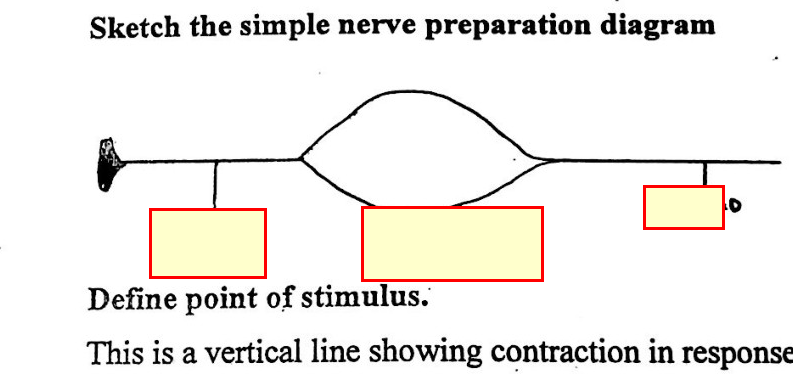
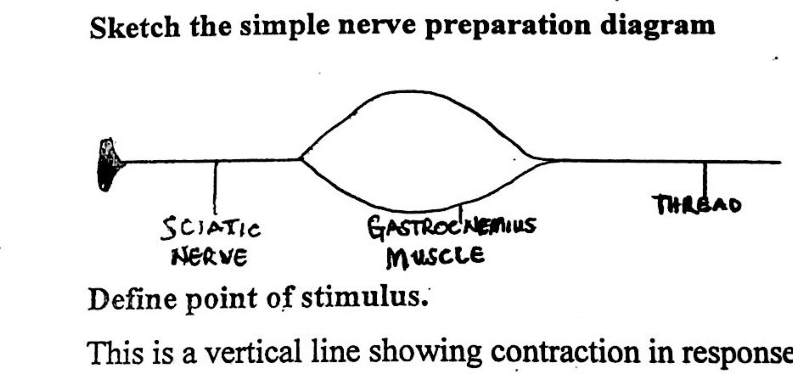
What is the point of stimulus in a muscle twitch tracing?
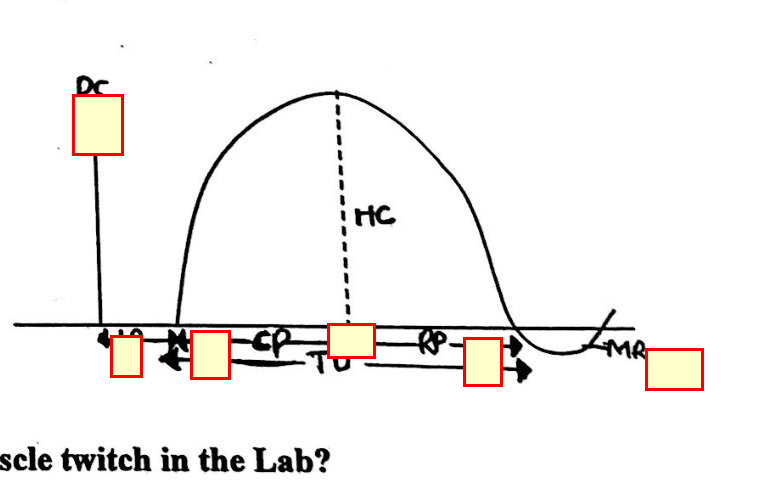
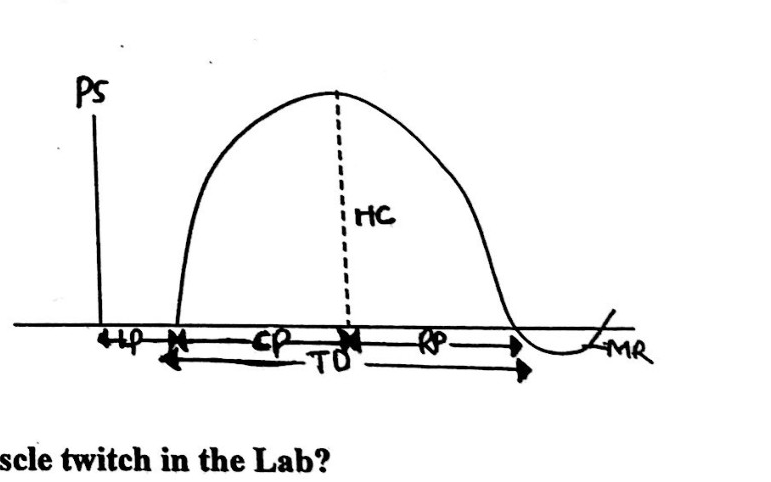
How is the point of stimulus determined?
In a muscle twitch tracing, what does PS represent? 
In a muscle twitch tracing, what does LP represent?
In a muscle twitch tracing, what does CP represent?
In a muscle twitch tracing, what does HC represent?
In a muscle twitch tracing, what does MR represent?
In a muscle twitch tracing, what does TD represent?
In a muscle twitch tracing, what does RP represent?
What are the first two steps to determine a simple muscle twitch in the lab?
What is the setting for the speed of the kymograph when determining a simple muscle twitch?
How do you establish the point of stimulus on the kymograph?
How do you provide the stimulus during the simple muscle twitch experiment?
What is the contact arm set to on the kymograph?
What is the speed on the kymograph when the contact arm is at \(180^{\circ}\)?
What is another name for isotonic contraction?
What happens to the tension or tone of a muscle during isotonic contraction?
What happens to the physical structure of a muscle during isotonic contraction?
What is the primary responsibility of isotonic contraction?
What is another name for isometric contraction?
What happens to the muscle length during isometric contraction?
What is the role of isometric contraction?
Define an invivo experiment.
Define an invitro experiment.
What is the definition of Latent Period?
What are the two methods of determining Latent Period?
List the factors affecting Latent Period.
What is the All-or-None-Law?
What is the appropriate factor for eliciting the All-or-None-Law?
What is beneficial effect?
How is beneficial effect obtained in the lab?
At what angle is the beneficial effect obtained?
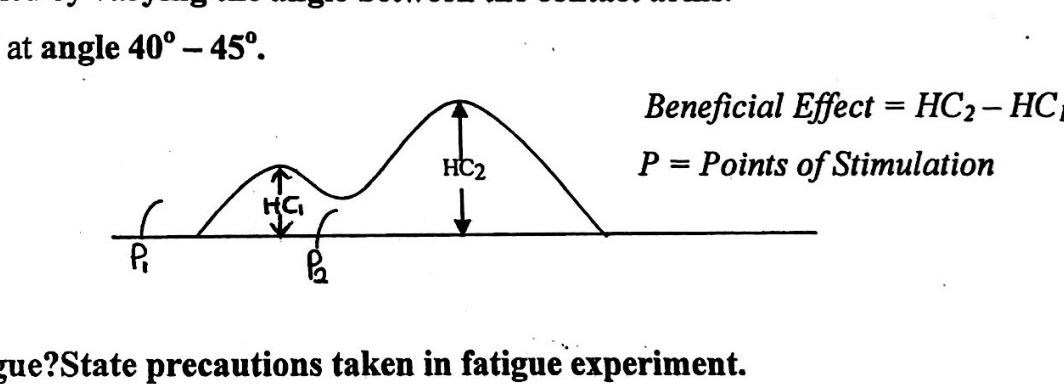
What is the formula used to calculate beneficial effect?
What is fatigue in a physiological context?
What is the first precaution taken in a fatigue experiment?
What is the second precaution taken in a fatigue experiment?
What is the third precaution taken in a fatigue experiment?
What happens to the muscle in the recovery phase for fatigue compared to Tetanus?
How does fibre recruitment differ between fatigue and Tetanus?
What substance is depleted in fatigue and what substance is depleted in Tetanus?
What is the substance formed in fatigue?
What is Tetanus?
When is tetanus produced with lower frequency?
How is Tetanus defined physiologically?
What is Tetany and what causes it?
What is the distinction between physiological and pathological tetanus?
What is another name for partial tetanus?
What is another name for sustained tetanus?
What are four factors that influence fatigue?
Besides the primary list, what other factors influence fatigue?
How do you isolate tissue to determine fatigue in the lab?
How is the nerve electrode setup for determining fatigue?
What are the required settings for the circuit contact arm when determining fatigue?
How do you determine the point of stimulus when fatigue testing in the lab?
What is the procedure for stimulating the nerve until the muscle becomes fatigued?
When does wave summation occur?
What is the result of wave summation?
At what angle does summation occur?
What do summation and beneficial effects indicate?
What occurs during spatial summation?
What is the result of increasing the strength of a stimulus in spatial summation?
Why is spatial summation considered a less efficient process?
What occurs during temporal summation?
What is the primary method of increasing activity in temporal summation?
What is the role of spatial and temporal summation in physiology?
Define the refractory period.
What are the two types of refractory period?
How does the muscle respond during an absolute refractory period?
How does the muscle respond during a relative refractory period?
What is the formula for calculating the Refractory Period?
In the formula for the Refractory Period, what do the variables RP, ES, CP, and NC represent?
List the stages of genesis of tetanus as shown in the tracing diagram.
Why is the cardiac muscle immune to Tetanus and Fatigue?
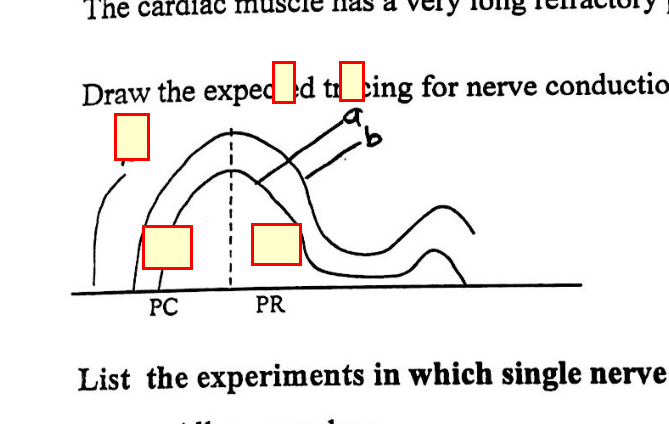
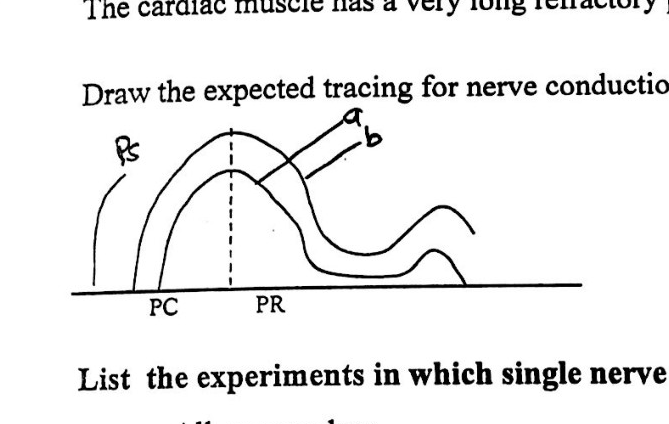
In the context of nerve conduction velocity, what does point \(a\) represent?
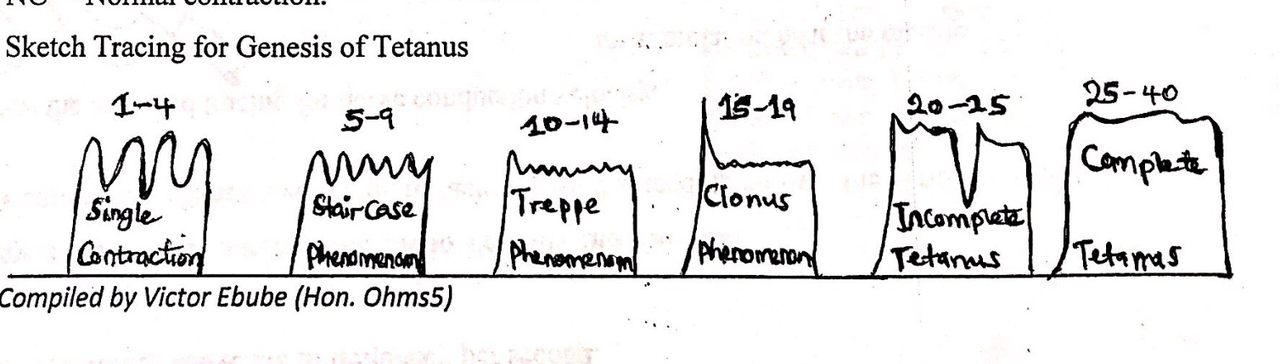
In the context of nerve conduction velocity, what does point \(b\) represent?
What is represented by the label \(PS\) in nerve conduction tracing?
What is represented by the label \(PC\) in nerve conduction tracing?
What is represented by the label \(PR\) in nerve conduction tracing?
Which experiments can a single nerve electrode be used for?
Which experiment requires the use of a double nerve electrode?
What are the characteristics of a single nerve electrode?
What are the characteristics of a double nerve electrode?
What is the importance of Frog Ringer solution?
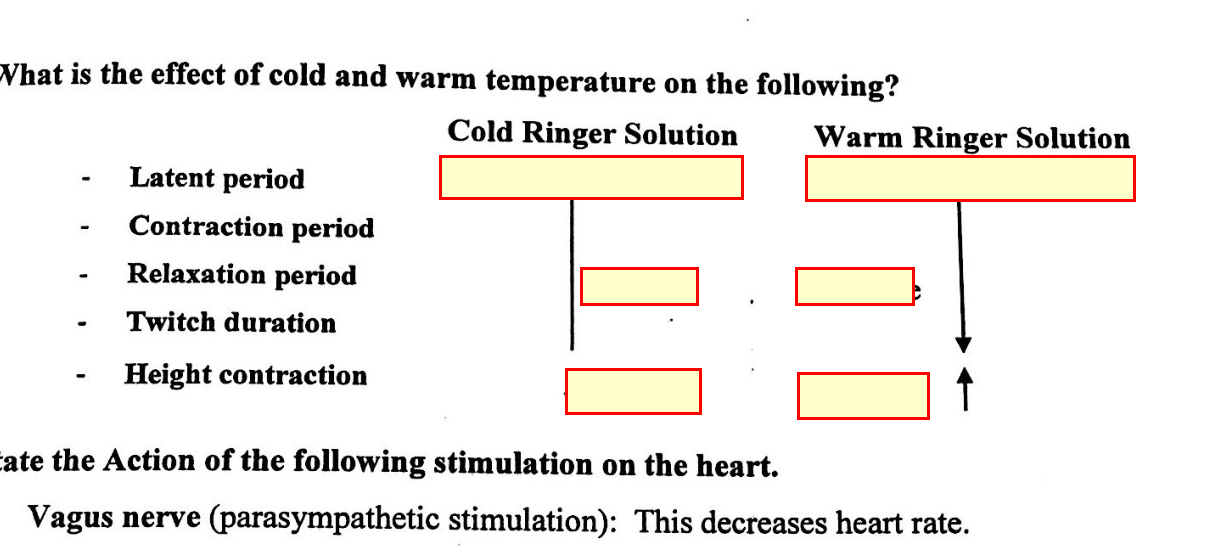
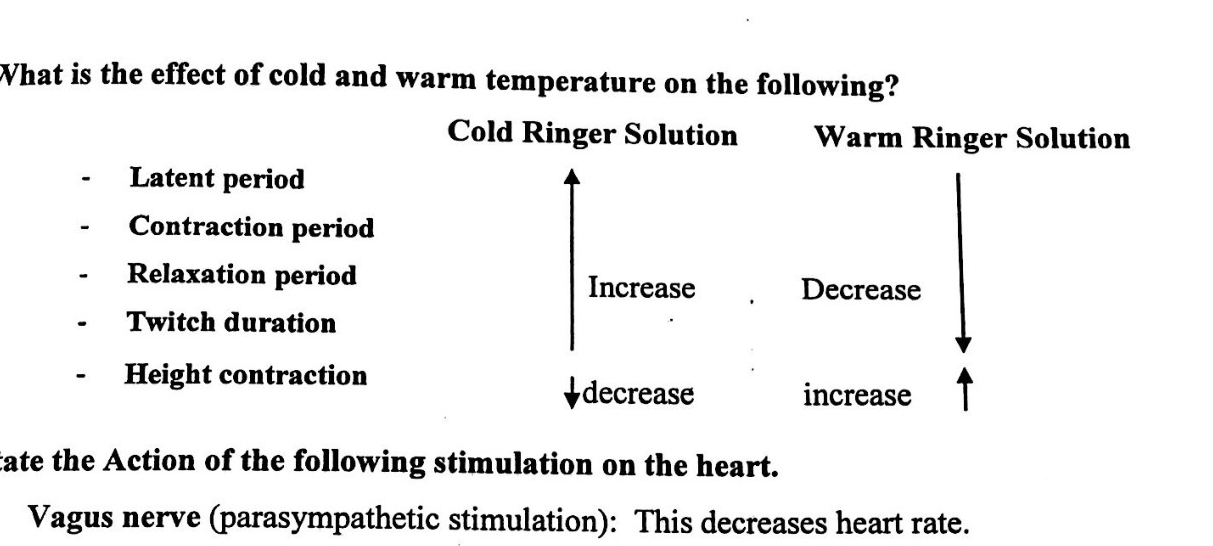
What is the effect of cold Ringer solution on the latent period, contraction period, relaxation period, and twitch duration?
What is the effect of warm Ringer solution on the latent period, contraction period, relaxation period, and twitch duration?
What is the effect of cold Ringer solution on the height of contraction?
What is the effect of warm Ringer solution on the height of contraction?
What is the effect of vagus nerve (parasympathetic) stimulation on the heart?
What is the effect of sympathetic stimulation on the heart?
What are the effects of adrenaline/norepinephrine on the heart?
What is the effect of acetylcholine on the heart?
What is the function of the calcium ion in the heart?
What happens in the event of excess calcium in the heart?
What is the function of the potassium ion in the heart?
What happens in the event of excess potassium in the heart?
What is the effect of atropine on the heart?
What is the effect of adrenaline on smooth muscle?
What is the effect of acetylcholine on smooth muscle?
What is the effect of atropine on smooth muscle?
Карточек в этом наборе (126)
-
1
What is an excitable tissue?
This is a tissue that responds to irritation or stimulation.
-
2
Name two examples of excitable tissue.
- Nerve cells
- Muscles (cardiac/skeletal)
-
3
What is a stimulus?
This is an agent which cause the response in an excitable tissue.
-
4
List the types of stimuli known.
- Mechanical stimulus (pinching)
- Electrical stimulus e.g. electric shock
- Thermal stimulus (e.g. applying heated glass rod or ice)
- Chemical stimulus (applying chemical substances e.g. acids)
- Osmotic stimulus.
-
5
What are the qualities of a good stimulus?
i) Intensity or strength. ii) Duration.
-
6
What are the physical methods of killing or anaesthetizing animals for experiments?
- Stunning
- Decerebration/compression
- Decapitation
- Pithing
-
7
What is the chemical method of killing or anaesthetizing animals for experiments?
e.g. use of chemicals such as Chloroform and ether.
-
8
What is the normal saline concentration for amphibian tissues?
Amphibian tissues has normal saline of 0.65% NaCl.
-
9
What is the normal saline concentration for mammalian tissues?
Mammalian tissues has normal saline of 0.85% NaCl.
-
10
Why are Amphibians (Toads/Frogs) preferred for excitable tissue experiments than mammals (e.g. Rat)?
- Frog tissue function at room temperature without blood supply.
- Its \(O_2\) requirement is satisfied by diffusion from atmospheric air.
- Has twitch fibre similar to mammalian twitch fibre.
- Has a slow postural muscle which is not found in mammalian.
-
11
What is nerve muscle preparation?
This is the isolation of sciatic nerve and Gastrocnemius muscle.
-
12
List the materials used in nerve muscle preparation.
- Blunt forceps
- Scissors
- Thread
- Dissecting board
- Pithing needle
- Frog ringer solution
-
13
What is necessary for the survival of tissue in nerve muscle preparation?
Continuous moistening of tissue is necessary for its survival.
-
14
What is the process of anaesthetizing in nerve muscle preparation?
Anaesthetizing (Instrument used = Pither and seeker)
-
15
What instruments are used in the isolation or dissection phase of nerve muscle preparation?
Scissors, forceps and scalpel
-
16
What is used in the mounting phase of nerve muscle preparation?
Muscle bath, office pin, thread
-
17
How is stimulation performed in nerve muscle preparation?
Stimulation (with a set of kymograph, single or double nerve electrode).
-
18
What is minimal or threshold stimulus?
This is the minimal or weakest stimulus that can excite the muscular fibres to contraction.
-
19
What are the five types of threshold?
- Subthreshold (subminimal)
- Threshold (minimal)
- Submaximal threshold
- Maximal threshold
- Supra maximal threshold.
-
20
What is maximum stimulus?
A stimulus that can excite muscle fibres to contract maximally and no amount of further increase in strength of stimulus can increase height of contraction.
-
21
What components are used in a simple nerve-muscle preparation?
Sciatic nerve, gastrocnemius muscle, and thread.
-
22
What is the point of stimulus in a muscle twitch tracing?
This is a vertical line showing contraction in response to initial stimulus applied to the nerve.
-
23
How is the point of stimulus determined?
Press the key button and manually rotate the Kymograph.
-
24
In a muscle twitch tracing, what does PS represent?
Point of stimulus.
-
25
In a muscle twitch tracing, what does LP represent?
Latent period.
-
26
In a muscle twitch tracing, what does CP represent?
Contraction period.
-
27
In a muscle twitch tracing, what does HC represent?
Height of contraction.
-
28
In a muscle twitch tracing, what does MR represent?
Mechanical rebound (of the lever).
-
29
In a muscle twitch tracing, what does TD represent?
Twitch duration (total max contraction).
-
30
In a muscle twitch tracing, what does RP represent?
Relaxation period.
-
31
What are the first two steps to determine a simple muscle twitch in the lab?
Isolate tissue and mount on single nerve electrode.
-
32
What is the setting for the speed of the kymograph when determining a simple muscle twitch?
\(625 \text{ min/sec}\).
-
33
How do you establish the point of stimulus on the kymograph?
By rotating down manually until the upper electrode contact striker touches the lower contact striker, continuing until a vertical line is produced.
-
34
How do you provide the stimulus during the simple muscle twitch experiment?
By pressing the primary key.
-
35
-
36
-
37
What is the contact arm set to on the kymograph?
The contact arm is set at \(180^{\circ}\).
-
38
What is the speed on the kymograph when the contact arm is at \(180^{\circ}\)?
Speed = \(625\text{mm/sec}\) \(\Rightarrow\) Speed 5 on kymograph.
-
39
What is another name for isotonic contraction?
Also called dynamic contraction.
-
40
What happens to the tension or tone of a muscle during isotonic contraction?
Here tension or tone of muscle remains constant. This is because the muscle is performing work by changing its length while maintaining a consistent tension.
-
41
What happens to the physical structure of a muscle during isotonic contraction?
Muscle become shorter and thicker.
-
42
What is the primary responsibility of isotonic contraction?
Responsible for lifting limbs.
-
43
What is another name for isometric contraction?
Also called static contraction.
-
44
What happens to the muscle length during isometric contraction?
Length of muscle remains constant.
-
45
What is the role of isometric contraction?
Involved in maintenance of pasture.
-
46
Define an invivo experiment.
Tissues are studied by experiment in the body without being removed. Also called Intact tissue preparation. Done within the living organism.
-
47
Define an invitro experiment.
Tissues are removed and studied outside the body of the animal. Also called Isolation tissue preparation. Done outside the living organism.
-
48
What is the definition of Latent Period?
This is the hidden period between the point of stimulus and point of contraction.
-
49
What are the two methods of determining Latent Period?
- Mechanical
- Electrical method.
-
50
List the factors affecting Latent Period.
- Temperature
- Drugs
- Fatigue
- Conduction of impulses
- Inertia of the lever
- Disease
-
51
What is the All-or-None-Law?
When a stimulus is applied, whatever the strength, the tissue gives a maximum response or does not give any response at all. This occurs because the stimulus must meet a minimum threshold to trigger any physiological reaction.
-
52
What is the appropriate factor for eliciting the All-or-None-Law?
Threshold stimulus. This stimulus represents the minimum intensity required to elicit a response from the tissue.
-
53
What is beneficial effect?
This is the addition contraction of a muscle due to a second stimulus which is applied during the relaxation phase of a previous contraction. This happens because the second stimulus interacts with the still-contracting muscle fibers to increase overall force.
-
54
How is beneficial effect obtained in the lab?
B.E. is obtained by varying the angle between the contact arms. This adjustment changes how the stimuli are applied to the muscle tissue.
-
55
At what angle is the beneficial effect obtained?
It is obtained at angle \(40^{\circ} - 45^{\circ}\). This specific range of motion optimizes the interaction between successive stimuli.
-
56
What is the formula used to calculate beneficial effect?
Beneficial Effect \(= HC_2 - HC_1\). This calculation measures the difference in contraction height generated by a second stimulus compared to the first.

-
57
What is fatigue in a physiological context?
Fatigue refers to a complete tiredness and weakness of tissues as a result of exhaustion and depletion of oxygen and nutrient during heavy and prolonged muscular activity. This state is caused by the metabolic insufficiency within the muscle tissue.
-
58
What is the first precaution taken in a fatigue experiment?
Avoiding stretching or contamination of tissue during preparation. These measures prevent unnecessary physical damage that could alter baseline muscle performance.
-
59
What is the second precaution taken in a fatigue experiment?
The point of stimulus and the base line should be kept the same. Consistent stimulation placement ensures reproducibility of the experimental results.
-
60
What is the third precaution taken in a fatigue experiment?
Avoid moistening of the nerve muscle with ringer solution during the experiment as it may help the muscle to recover thereby impeding fatigue. Preventing recovery allows the observer to accurately measure the onset and progression of fatigue.
-
61
What happens to the muscle in the recovery phase for fatigue compared to Tetanus?
There is recovery of muscle in fatigue, whereas muscle does not recover in Tetanus.
-
62
How does fibre recruitment differ between fatigue and Tetanus?
Not all fibres are recruited in fatigue, but all fibres are recruited in Tetanus.
-
63
What substance is depleted in fatigue and what substance is depleted in Tetanus?
ATP/muscle glycogen is depleted in fatigue, whereas \(\text{Ca}^{2+}\) is depleted in Tetanus.
-
64
What is the substance formed in fatigue?
Lactic acid. Lactic acid is formed due to the metabolic activity during muscle fatigue.
-
65
What is Tetanus?
It is an apparent sustained contraction of muscle due to repetitive stimulation at high frequency.
-
66
When is tetanus produced with lower frequency?
At lower temperature. A fall in temperature increases the duration of active state and decreases the velocity of contraction.
-
67
How is Tetanus defined physiologically?
Tetanus physiologically is a state of continuous muscular contraction induced artificially by rapidly repeated stimuli of high frequency.
-
68
What is Tetany and what causes it?
Tetany is a condition that is usually due to low calcium (hypocalcemia) and is characterized by involuntary muscle spasms. Tetany can also be caused by magnesium deficiency or too little potassium.
-
69
What is the distinction between physiological and pathological tetanus?
Pathological tetanus refers to the spastic contraction of different muscle group in pathological conditions caused by bacillus Clostridium tetani, while physiological tetanus refers to continuous muscular contraction induced by repeated stimuli.
-
70
What is another name for partial tetanus?
Partial tetanus is also called unfused or incomplete tetanus. Partial relaxation of fibres occurs between twitches.
-
71
What is another name for sustained tetanus?
Sustained tetanus is also called fused or complete Tetanus. There is no relaxation of muscle fibres between twitches.
-
72
What are four factors that influence fatigue?
- Exhaustion of ach of motor end plate.
- Accumulation of metabolites such as lactic acid.
- Depletion in muscle glycogen – ATP.
- Depletion in \(O_2\) with subsequent buildup of \(CO_2\).
-
73
Besides the primary list, what other factors influence fatigue?
Drugs, diseases, strength of stimulus, the freeness or none loading of the preparations.
-
74
How do you isolate tissue to determine fatigue in the lab?
Isolate tissue.
-
75
How is the nerve electrode setup for determining fatigue?
Mount on a single nerve electrode.
-
76
What are the required settings for the circuit contact arm when determining fatigue?
Set up circuit contact arm at \(180^{\circ}\) and speed at \(625mm/Sec\).
-
77
How do you determine the point of stimulus when fatigue testing in the lab?
Determine point of stimulus by switching on the kymograph and pressing the key button.
-
78
What is the procedure for stimulating the nerve until the muscle becomes fatigued?
By pulling the thread a little far away from drum, stimulate nerve at various intervals until muscle becomes fatigued (tired).
-
79
When does wave summation occur?
When the second stimulus is applied during the contraction period, or during second half of latent period.
-
80
What is the result of wave summation?
The 2 contraction are summed up to give a single curve. This occurs because the second stimulus is applied before the first muscle contraction is complete.

-
81
At what angle does summation occur?
Summation occurs around angle \(25^{\circ} - 15^{\circ}\).
-
82
What do summation and beneficial effects indicate?
Both summation and beneficial effect indicate abnormal situations.
-
83
What occurs during spatial summation?
Many presynaptic terminal are stimulated simultaneously. Summation involves stimulation of several spatially separated neurons at the same time.
-
84
What is the result of increasing the strength of a stimulus in spatial summation?
Increasing strength of stimulus.
-
85
Why is spatial summation considered a less efficient process?
It is a less efficient process as it takes time to generate an action potential.
-
86
What occurs during temporal summation?
One presynaptic terminal is stimulated repeatedly. Summation involves the addition of a single stimuli over a short period of time.
-
87
What is the primary method of increasing activity in temporal summation?
Increasing frequency of activity.
-
88
What is the role of spatial and temporal summation in physiology?
Both spatial and temporal summation play an important role in facilitation of response.
-
89
Define the refractory period.
A period at which the muscle does not show any response to a stimulus. This is because one action potential is already in progress in the muscle.
-
90
What are the two types of refractory period?
- Absolute refractory period
- Relative refractory period
-
91
How does the muscle respond during an absolute refractory period?
Muscle does not show any response at all, whatever may be the strength of the stimulus. This occurs because the membrane is temporarily unexcitable during the depolarization and early repolarization phases.
-
92
How does the muscle respond during a relative refractory period?
Muscle shows some response if the strength of stimulus is increased to maximum. This occurs because the threshold for excitation is higher than normal during this period.
-
93
What is the formula for calculating the Refractory Period?
\(RP = 2NC - (CP + ES)\)
-
94
In the formula for the Refractory Period, what do the variables RP, ES, CP, and NC represent?
- \(RP = \text{refractory period}\)
- \(ES = \text{Extrasystole}\)
- \(CP = \text{compensatory pause}\)
- \(NC = \text{Normal contraction}\)
-
95
List the stages of genesis of tetanus as shown in the tracing diagram.
 - Single Contraction
- Staircase Phenomenon
- Treppe Phenomenon
- Clonus Phenomenon
- Incomplete Tetanus
- Complete Tetanus
-
96
Why is the cardiac muscle immune to Tetanus and Fatigue?
The cardiac muscle has a very long refractory period spreading all over the period of contraction. This immunity is caused by the refractory period lasting for the entire duration of the contraction cycle.
-
97
In the context of nerve conduction velocity, what does point \(a\) represent?
\(a\) = stimulation near the muscle. This point represents the site of stimulation relative to the muscle tissue.
-
98
In the context of nerve conduction velocity, what does point \(b\) represent?
\(b\) = stimulation near Sacral vertebral. This point represents the secondary stimulation site relative to the vertebral anatomy.
-
99
What is represented by the label \(PS\) in nerve conduction tracing?
\(PS\) = point of stimulation. This indicates the precise moment when the stimulus is applied to the nerve.
-
100
What is represented by the label \(PC\) in nerve conduction tracing?
\(PC\) = point of contraction. This signifies the specific timing of the muscle contraction initiated by the nerve impulse.
-
101
What is represented by the label \(PR\) in nerve conduction tracing?
\(PR\) = point of relaxation. This marks the moment when the muscle tension releases following contraction.
-
102
Which experiments can a single nerve electrode be used for?
- All or none law
- Genesis of Tetanus
- Simple muscle twitch
- Fatigue Single electrodes are used for general properties of skeletal muscle contraction.
-
103
Which experiment requires the use of a double nerve electrode?
Nerve conduction velocity. This specific setup is required to measure the speed of signals between two distinct stimulation points.
-
104
What are the characteristics of a single nerve electrode?
- All other properties (i.e. all or none law, Simple muscle twitch etc.) of skeletal muscle.
- Has one point of stimulation. A single electrode is utilized for general muscle properties rather than measuring conduction speed.
-
105
What are the characteristics of a double nerve electrode?
- Nerve conduction velocity property only.
- Has 2 points of stimulation. The two points of stimulation allow for the calculation of impulse speed over a defined nerve segment.
-
106
What is the importance of Frog Ringer solution?
This helps keep the tissue in a life like manner. It provides the necessary isotonic environment to maintain the physiological function of the isolated tissue.
-
107
What is the effect of cold Ringer solution on the latent period, contraction period, relaxation period, and twitch duration?
Increase. Cold temperatures slow metabolic and biochemical processes, leading to prolonged phases of the muscle twitch.
-
108
What is the effect of warm Ringer solution on the latent period, contraction period, relaxation period, and twitch duration?
Decrease. Warm temperatures accelerate metabolic processes, resulting in shorter durations for the contraction and relaxation phases.
-
109
What is the effect of cold Ringer solution on the height of contraction?
Decrease. Cold reduces the efficiency of the contractile machinery in the muscle cells.
-
110
What is the effect of warm Ringer solution on the height of contraction?
Increase. Higher temperatures improve the force-generating capacity of muscle contraction.
-
111
What is the effect of vagus nerve (parasympathetic) stimulation on the heart?
This decreases heart rate.
-
112
What is the effect of sympathetic stimulation on the heart?
This increases heart rate.
-
113
What are the effects of adrenaline/norepinephrine on the heart?
Increase heart rate and force of contraction and BP.
-
114
What is the effect of acetylcholine on the heart?
decreases heart rate, force of contraction and blood pressure.
-
115
What is the function of the calcium ion in the heart?
responsible for contraction of cardiac muscle.
-
116
What happens in the event of excess calcium in the heart?
Excess calcium stops the heart at systole.
-
117
What is the function of the potassium ion in the heart?
responsible for relaxation of cardiac muscle.
-
118
What happens in the event of excess potassium in the heart?
Excess K+ stops the heat at diastole.
-
119
What is the effect of atropine on the heart?
Slightly increase heart rate and force of contraction.
-
120
What is the effect of adrenaline on smooth muscle?
decreases smooth muscle contraction.
-
121
What is the effect of acetylcholine on smooth muscle?
increases smooth muscle contraction.
-
122
What is the effect of atropine on smooth muscle?
slightly decrease smooth muscle contraction.
-
123
-
124
-
125
-
126