Сохрани колоду, пока она не исчезла
Эти карточки ещё не сохранены — они исчезнут, как только ты уйдёшь. Заведи бесплатный аккаунт, чтобы сохранить их и получить доступ ко всем функциям ниже.
- Save this deck to your account
- Study with spaced repetition
- Export to Anki (.apkg) or PDF
- Process documents up to 100 pages
- Images extracted from your PDFs
- Sharper text extraction & a more advanced AI model
What is the primary purpose of chromatography in organic labs?
What is the first step when applying a sample in chromatography?
How is 'adsorption' defined in the context of chromatography?
Give two common materials used as the stationary phase in chromatography.
What happens to a sample after adsorption when exposed to the mobile phase?
How do intermolecular interactions with the stationary phase affect compound travel speed?
How does mobile-phase polarity influence separation?
Where can an illustrative image of 'Lecture 7 Chromatography – General Separation Principles' be found?
What is the primary analytical use of Thin-Layer Chromatography (TLC)?
Why is TLC useful for monitoring reactions?
How is an aliquot taken from a reaction mixture for TLC spotting?
What is the required practice for applying samples and standards on a TLC plate?
What mobile phase (eluent) is specified for the example TLC run?
Describe the step to finish the TLC development after the solvent rises near the top.
How does the solvent travel up the TLC plate during development?
Where can an illustrative image of the TLC handwritten notes and diagrams be found?
What is the primary purpose of chromatography?
What is the stationary phase in chromatography?
Define adsorption in the context of chromatography.
What is the mobile phase in chromatography?
How does polarity affect compound movement in chromatography?
What is the typical use of Thin-Layer Chromatography (TLC) in organic labs?
List the basic TLC workflow steps mentioned for monitoring a reaction.
Give an example mobile-phase composition used in the provided TLC procedure.
How should the solvent front be recorded after developing a TLC plate?
Where can a visual illustration of the TLC spotting and development steps be found?
On the TLC plate shown, what is indicated by a 'new spot' appearing in addition to the starting spot?
If a TLC shows 'Some BA still in rxn mixture' alongside a new product spot, what does that imply about the reaction?
What does the annotation 'NO BA; rxn Complete!' on a TLC plate indicate?
What feature is noted as marked on the TLC plate before developing the plate?
According to the diagram transcript, what action might be taken if the TLC shows product forming but starting material still present?
Flashcards in this deck (31)
-
What is the primary purpose of chromatography in organic labs?
- To separate the components of a complex mixture
- Used as an analytical technique or a purification technique
chromatography purification -
What is the first step when applying a sample in chromatography?
- The sample is applied to a stationary material that adsorbs it
stationary adsorption -
How is 'adsorption' defined in the context of chromatography?
- Molecules or ions adhering to a surface; strength depends on intermolecular forces with the stationary phase
adsorption definition -
Give two common materials used as the stationary phase in chromatography.
- Silica gel (SiO2 x H₂O)
- Alumina (Al₂O₃ x H₂O)
stationary materials -
What happens to a sample after adsorption when exposed to the mobile phase?
- The sample can exist in equilibrium between stationary and mobile phases, enabling separation based on differing interactions
equilibrium separation -
How do intermolecular interactions with the stationary phase affect compound travel speed?
- Weaker interactions (typically nonpolar) → travel faster
- Stronger interactions (typically polar, H-bond acceptors/donors) → travel slower
polarity movement -
How does mobile-phase polarity influence separation?
- Changing mobile-phase polarity alters rates compounds travel; example: vary % EtOAc in hexanes to change separation
mobile polarity -
Where can an illustrative image of 'Lecture 7 Chromatography – General Separation Principles' be found?
- Illustration:
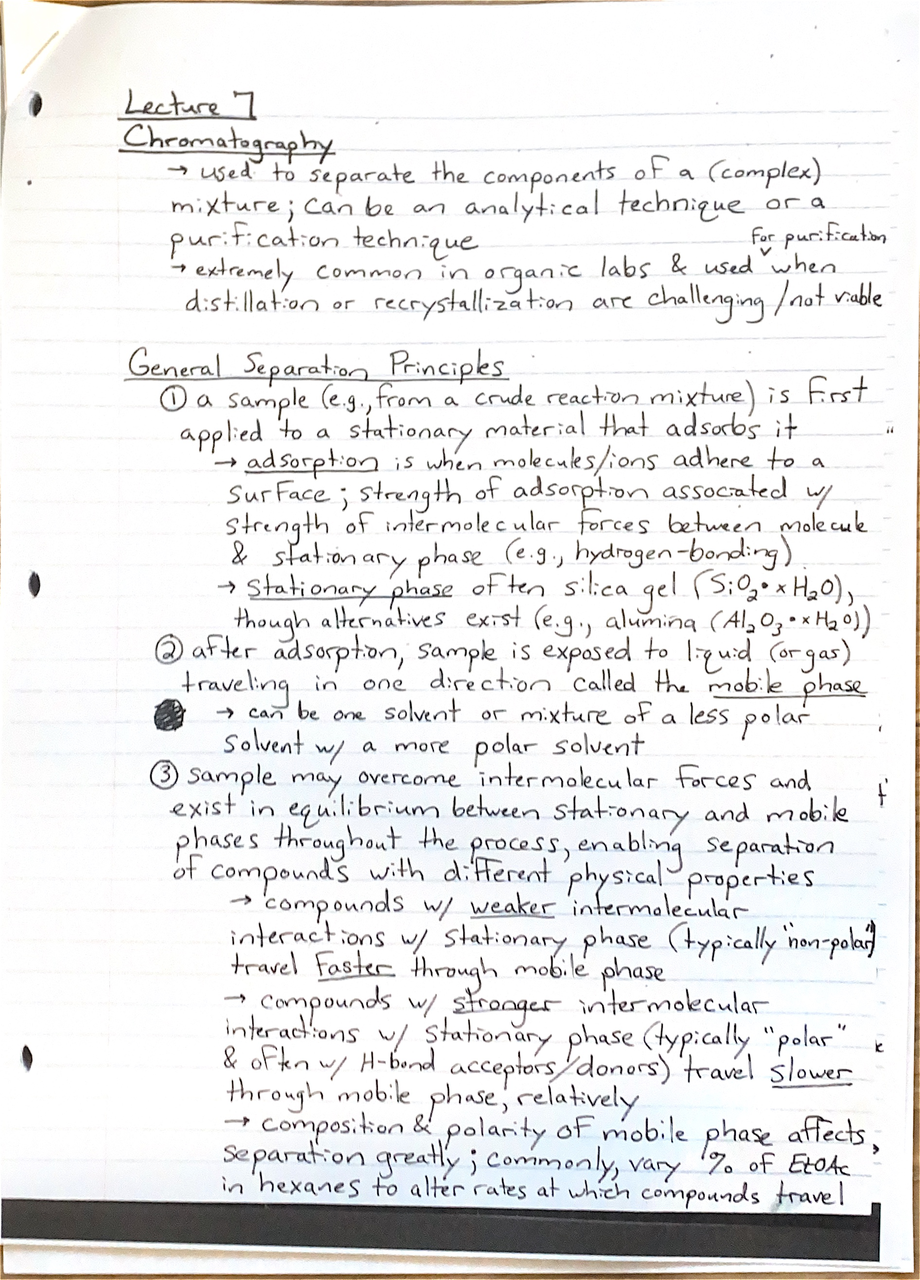
- Use as supplementary visual of the principles
image illustration - Illustration:
-
What is the primary analytical use of Thin-Layer Chromatography (TLC)?
To quickly assess the purity of a sample via separation of components (takes <5 min.).
chromatography tlc -
Why is TLC useful for monitoring reactions?
It allows efficient monitoring of reaction progress without stopping the reaction or using a large amount of sample.
tlc analysis -
How is an aliquot taken from a reaction mixture for TLC spotting?
Use a capillary tube to take an 'aliquot' (a tiny sample) from the reaction mixture.
technique sampling -
What is the required practice for applying samples and standards on a TLC plate?
Every sample must be co-spotted; spot the reaction under 'Rxn' and make a 'Co', and spot a standard under 'BA' using a clean capillary to co-spot it.
tlc spotting -
What mobile phase (eluent) is specified for the example TLC run?
4:1 hexanes:EtoAc.
mobilephase solvent -
Describe the step to finish the TLC development after the solvent rises near the top.
Remove the TLC plate with tweezers, quickly mark the solvent line with a pencil, then let the plate dry.
tlc development -
How does the solvent travel up the TLC plate during development?
The solvent runs up by capillary action.
tlc capillary -
Where can an illustrative image of the TLC handwritten notes and diagrams be found?
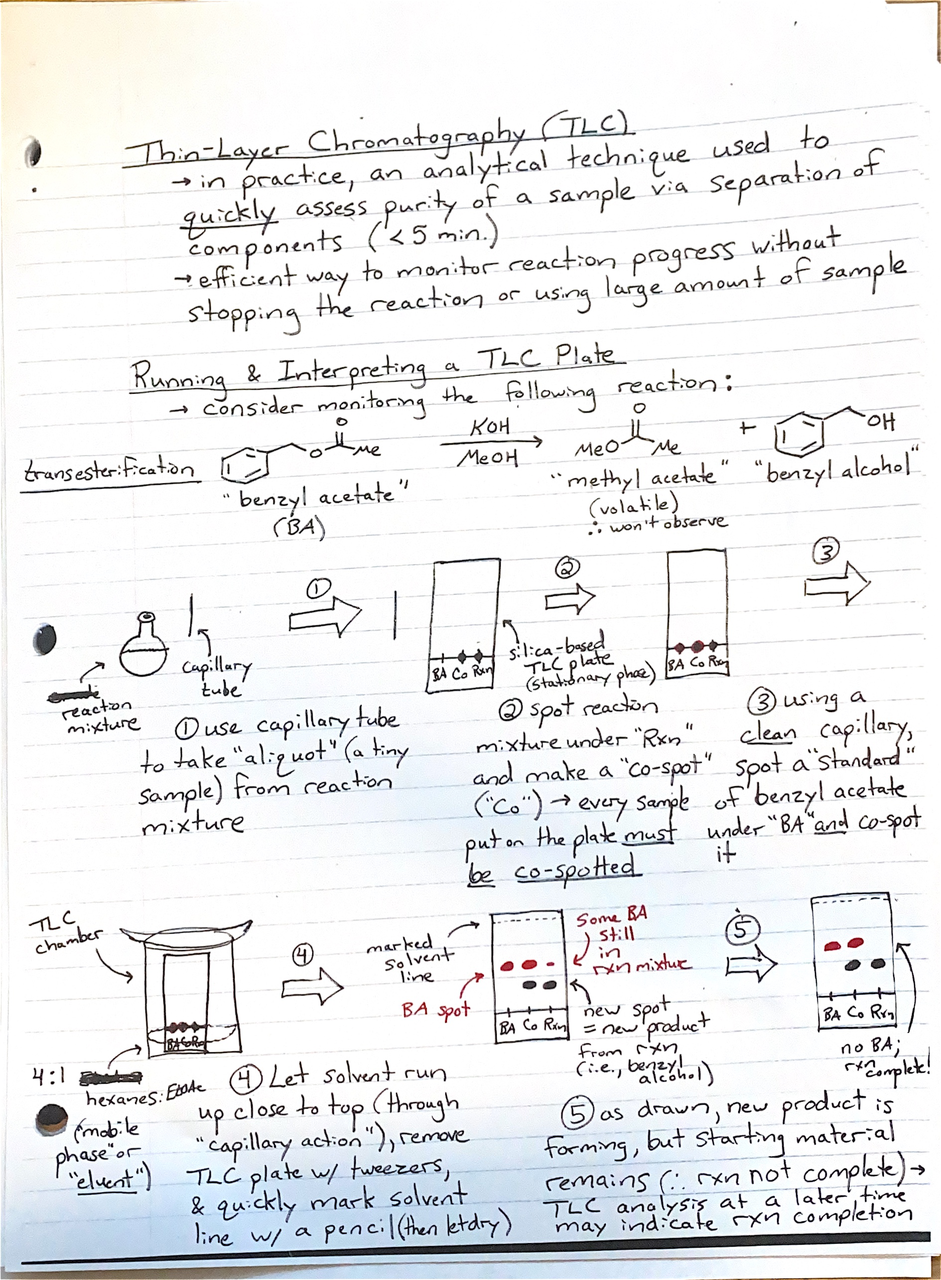 media tlc
 -
What is the primary purpose of chromatography?
To separate the components of a complex mixture for analysis or purification.
chromatography definition -
What is the stationary phase in chromatography?
A material that adsorbs the sample (commonly silica gel, SiO₂·xH₂O, or alumina).
stationary silica adsorption -
Define adsorption in the context of chromatography.
When molecules or ions adhere to a surface; strength depends on intermolecular forces between analyte and stationary phase.
adsorption concept -
What is the mobile phase in chromatography?
A liquid or gas that travels over the stationary phase and carries sample components (can be a solvent or solvent mixture).
mobile eluent -
How does polarity affect compound movement in chromatography?
Compounds with weaker interactions with the stationary phase (typically nonpolar) travel faster; compounds with stronger interactions (typically polar) travel slower.
polarity separation -
What is the typical use of Thin-Layer Chromatography (TLC) in organic labs?
An analytical technique to quickly assess sample purity and monitor reaction progress in under 5 minutes.
tlc analytical -
List the basic TLC workflow steps mentioned for monitoring a reaction.
- Use a capillary to take an aliquot
- Spot reaction and co-spot samples
- Spot a standard (e.g., benzyl acetate)
- Develop with mobile phase and mark the solvent line
tlc workflow -
Give an example mobile-phase composition used in the provided TLC procedure.
A 4:1 mixture of hexanes:EtOAc was used as the mobile phase (eluent).
mobile solvent -
How should the solvent front be recorded after developing a TLC plate?
Remove the plate, quickly mark the solvent line with a pencil, then let the plate dry.
tlc procedure -
Where can a visual illustration of the TLC spotting and development steps be found?
See the TLC diagram:
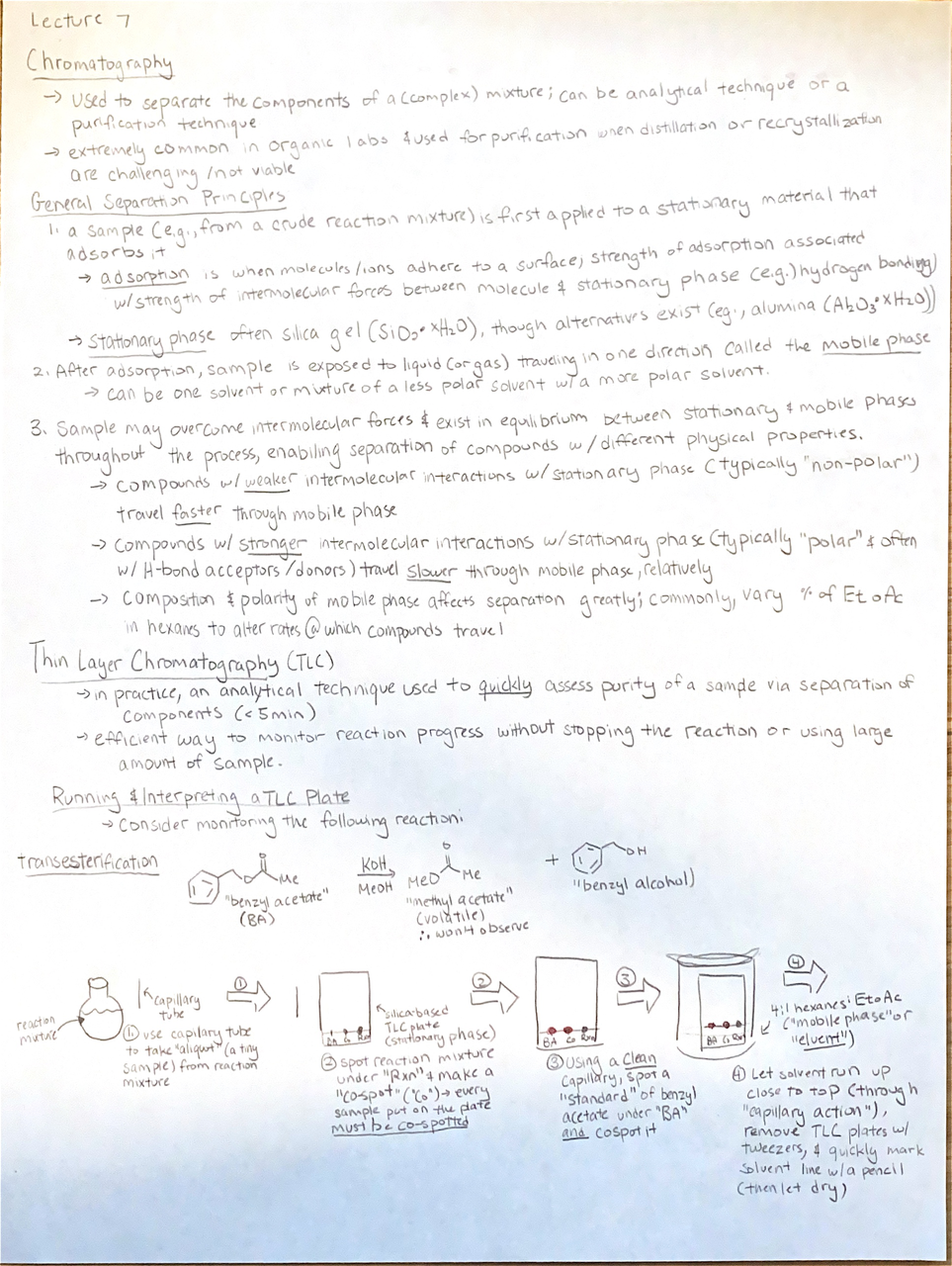 tlc image
 -
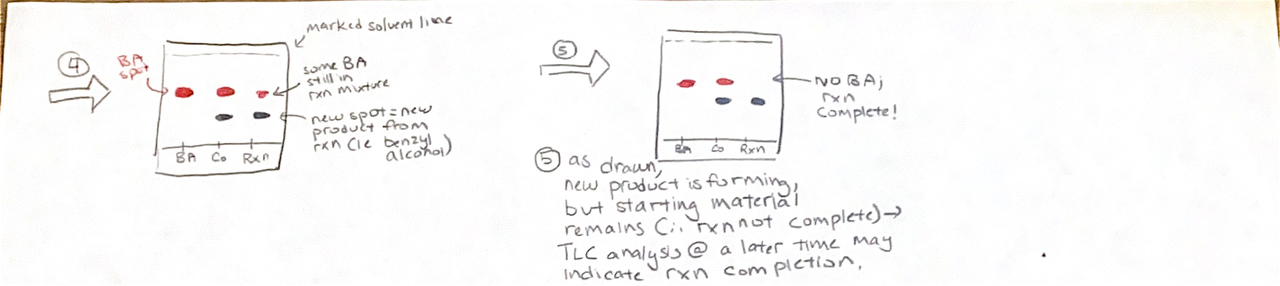
On the TLC plate shown, what is indicated by a 'new spot' appearing in addition to the starting spot?
- A new product from the reaction (e.g., benzyl alcohol)
tlc products -
If a TLC shows 'Some BA still in rxn mixture' alongside a new product spot, what does that imply about the reaction?
- The reaction is not complete (starting material remains)
tlc reaction-monitoring -
What does the annotation 'NO BA; rxn Complete!' on a TLC plate indicate?
- Starting material (BA) is absent and the reaction is complete
tlc completion -
What feature is noted as marked on the TLC plate before developing the plate?
- Marked solvent line
tlc procedure -
According to the diagram transcript, what action might be taken if the TLC shows product forming but starting material still present?
- Perform TLC analysis at a later time to check for reaction completion
tlc timing
Chromatography — Lecture 7
Purpose
- Chromatography separates components of a complex mixture for analysis or purification.
- Common in organic labs when distillation or recrystallization are unsuitable.
General separation principles
- Stationary phase: solid surface that adsorbs sample (commonly silica gel, SiO2·xH2O; sometimes alumina).
- Adsorption: molecules stick to the stationary surface via intermolecular forces (H-bonding, dipole, van der Waals); stronger adsorption → slower movement.
- Mobile phase: solvent or solvent mixture that moves through the stationary phase carrying analytes.
- Separation arises from an equilibrium between stationary and mobile phases; different compounds partition differently.
- Polarity rule of thumb: nonpolar compounds interact less with polar silica and travel faster; polar compounds interact more and travel slower.
- Changing mobile-phase polarity (e.g., percent EtOAc in hexanes) controls separation.
Thin-Layer Chromatography (TLC)
- TLC is a quick analytical method to check purity or monitor reaction progress (usually <5 min).
Running a TLC plate (typical workflow)
- Use a capillary to take a tiny aliquot from the reaction mixture.
- Spot the reaction sample on the baseline and make a co-spot (mix of sample + standard) for comparison.
- Spot a standard (known starting material or product) on the plate to identify spots later.
- Place the plate in a closed chamber with a shallow layer of mobile phase; a common eluent is hexanes:EtOAc in a \(4{:}1\) ratio.
- Allow solvent to rise by capillary action until near the top, then remove the plate and immediately mark the solvent front with a pencil.
- Visualize spots (UV lamp, stain, or other visualization method) and record positions.
Interpreting a TLC plate
- Calculate the retention factor:
\(\(R_f = \dfrac{\text{distance travelled by spot}}{\text{distance travelled by solvent front}}\)\)
- Use co-spots and standards to assign which spot is starting material or product.
- If starting-material spot remains while a new spot appears, the reaction is still proceeding.
- When only the product spot is present (no starting-material spot), the reaction is likely complete.
Practical tips and common issues
- Keep spots small and concentrated; large or overloaded spots give streaking/tailing.
- If spots run too far (Rf too high), use a less polar mobile phase; if too low, use a more polar mobile phase.
- If two compounds have very similar Rf, change solvent composition or use a different stationary phase.
- Always mark the solvent front quickly; accurate Rf requires correct solvent-front measurement.
- Use co-spots to avoid misidentifying coincident spots.
Key takeaways
- Chromatography separates components by differing affinities for stationary vs mobile phase.
- Silica is polar: nonpolar analytes run faster, polar analytes run slower.
- TLC is rapid for monitoring reactions; interpret with Rf and co-spots.
- Adjust mobile-phase polarity to optimize separation; watch for spotting technique and visualization.