What does a pen dropping onto a table illustrate in physics?
In the impulse scenario, what energy is not lost on impact?
What does the gradient of the velocity graph represent?
How is the force during the impact represented?
What mathematical relationship relates force, mass, and acceleration?
What tool can we derive for analyzing impacts more effectively?
What are the core concepts explored in this text?
What does the impulse-momentum equation relate?
Define impulse in the context of force.
What is the abbreviation for translational momentum?
What happens if impulse is zero?
How is impulse analyzed in systems where energy conservation does not apply?
List some scenarios where impulse is significant.
Why is translational momentum a vector property?
Define angular momentum for a rotating body.
Express the relationship between angular impulse and angular momentum.
What happens when the net torque (\(\sum M\)) is zero?
In terms of angular momentum, describe the 'mvd' term.
Provide an example involving angular momentum.
What does the impulse-momentum equation describe in rotation?
What is the effective angular momentum before impact?
What happens to angular momentum after impact?
Is there any net impulse when the ball and arm interact?
What can be neglected in an impulse analysis?
Why is \(H + G\) not meaningful?
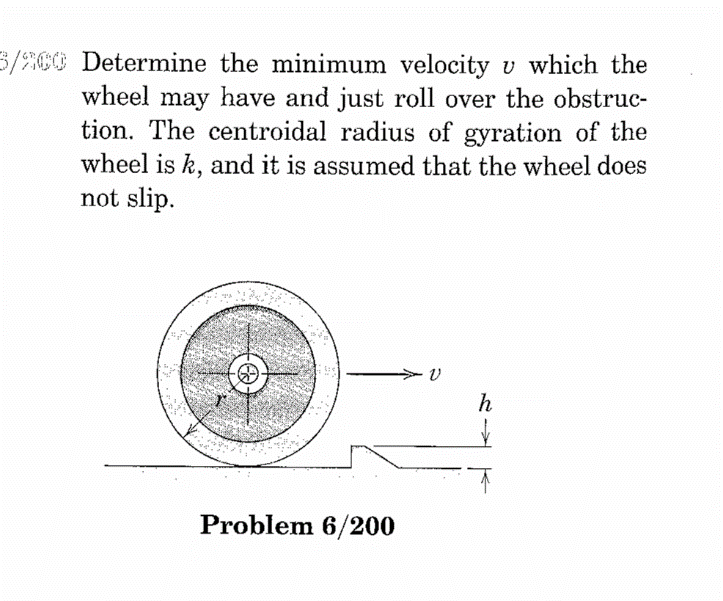
What is being determined in the example problem?
What is the assumed condition for the wheel in the example?
What graphical information is provided in the example?
Карточек в этом наборе (28)
-
1
What does a pen dropping onto a table illustrate in physics?
An impact scenario involving rapid deceleration and impulse.
-
2
In the impulse scenario, what energy is not lost on impact?
No sound energy is lost.
-
3
What does the gradient of the velocity graph represent?
The acceleration of the object.
-
4
How is the force during the impact represented?
It looks the same as the acceleration plot at the point of impact.
-
5
What mathematical relationship relates force, mass, and acceleration?
F = ma.
-
6
What tool can we derive for analyzing impacts more effectively?
The integral of forces over the course of the impact.
-
7
What are the core concepts explored in this text?
- Impulse and momentum basics
- Impulse-Momentum equation (translation)
- Impulse-Momentum in rotation
- Examples of impulse scenarios
-
8
What does the impulse-momentum equation relate?
Impulse relates to the change in linear momentum. \(\int\sum F dt = mv(t_2) - mv(t_1)\)
-
9
Define impulse in the context of force.
Impulse is the time integral of force, representing momentum change.
-
10
What is the abbreviation for translational momentum?
G = MVG, where G represents translational momentum.
-
11
What happens if impulse is zero?
If \(\int\sum F dt = 0\), then momentum is conserved: \(G_2 = G_1\).
-
12
How is impulse analyzed in systems where energy conservation does not apply?
Impulse-momentum analysis is used to quantify momentum changes over time.
-
13
List some scenarios where impulse is significant.
- Sound
- Heat
- Light
-
14
Why is translational momentum a vector property?
Because it has both magnitude and direction, unlike scalar energy.
-
15
Define angular momentum for a rotating body.
- \(H_G = I_G \omega\) (about mass centre G)
- \(H_o = I \omega\) (about axis O)
- \(H_p = I \& + mvd\) (about point P)
-
16
Express the relationship between angular impulse and angular momentum.
\(\int \sum M dt = H(t_2) - H(t_1)\)
-
17
What happens when the net torque (\(\sum M\)) is zero?
Angular momentum is conserved: \(H(t_2) = H(t_1)\)
-
18
In terms of angular momentum, describe the 'mvd' term.
'mvd' is useful for describing angular momentum about a point, especially during transitions between linear and angular momentum.
-
19
Provide an example involving angular momentum.
A ball falling onto a rotating arm: analyzes the transition between linear and angular momentum.
-
20
What does the impulse-momentum equation describe in rotation?
It relates the impulse applied to a rotating body with the change in its angular momentum.
-
21
What is the effective angular momentum before impact?
\(H_p = mvd\)
-
22
What happens to angular momentum after impact?
\(H_p = (I_{arm}(p) + md^2)\)
-
23
Is there any net impulse when the ball and arm interact?
No net impulse; what's gained by the arm is lost by the ball.
-
24
What can be neglected in an impulse analysis?
Small impulses, unless from a large force or 'Ft' occurs over a long time.
-
25
Why is \(H + G\) not meaningful?
Just as \(F + M\) isn't meaningful.
-
26
What is being determined in the example problem?
The minimum velocity \(u\) for a wheel to roll over an obstruction.
-
27
What is the assumed condition for the wheel in the example?
The wheel does not slip.
-
28
What graphical information is provided in the example?
Diagram showing the wheel's radius \(r\), the obstruction’s height \(h\), and velocity \(v\).
Impulse and Momentum
2.13 Impulse and Momentum
An object in impact experiences rapid deceleration. For example, a pen dropping on a table demonstrates this.
Key Graphs:
Velocity vs. Time
Shows an increase followed by a sharp decrease in velocity.
Acceleration vs. Time
Displays initial positive acceleration and subsequent large negative acceleration.
From the force-mass-acceleration relation \(F = ma\), the force during impact is represented by the acceleration profile. To analyze the maximum negative acceleration and the force profile during the impulse, we focus on integrating the forces during impact.
Impulse – Momentum Equation (Translation)
Impulse – Momentum Equation
By integrating \(F = ma\), we obtain:
\(\(\int \sum F dt = m \int dv/dt dt = mv(t_2) - mv(t_1)\)\)
The left side represents impulse, and thus the equation indicates that:
- Total impulse = increase in linear momentum
It's crucial to note that impulse can quantify momentum changes over time, even in non-sudden events like sound, heat, or light production. If the impulse is zero (\(\int \sum F dt = 0\)), momentum is conserved: \(G_2 = G_1\), emphasizing that momentum remains a vector property.
Impulse – Momentum Equation (Rotation)
Impulse – Momentum Equation (Rotation)
Angular momentum can similarly be defined as:
\(\(HG = IG\)\) (about mass center, \(G\))
or
\(\(Ho = I\omega\)\) (about a fixed axis, \(O\))
Angular impulse equals the change in angular momentum:
\(\(\int \sum M dt = H(t_2) - H(t_1)\)\)
If \(\sum M = 0\), angular momentum is conserved.
In dynamic scenarios, such as a ball impacting a rotating arm:
Before impact, the ball possesses translational momentum, while both the ball and the arm rotate post-impact, showing a conservation of angular momentum.
Impact Examples
2.14 Examples
To solve for the minimum velocity \(v\) of a wheel rolling over an obstruction:
- The wheel has radius \(r\) and the height of the obstruction is \(h\) with centroidal radius of gyration \(k\).
This analysis ensures that the wheel does not slip while navigating the height.