Lưu bộ thẻ trước khi nó biến mất
Các flashcard này chưa được lưu — chúng sẽ biến mất khi bạn rời đi. Tạo tài khoản miễn phí để giữ lại và mở khóa mọi thứ bên dưới.
- Save this deck to your account
- Study with spaced repetition
- Export to Anki (.apkg) or PDF
- Process documents up to 100 pages
- Images extracted from your PDFs
- Sharper text extraction & a more advanced AI model
Flashcards in this deck (13)
-
What is the social-cognitive approach?
Processing, remembering, and learning information in social contexts to explain and predict the behaviour of others.
psychology social-cognitive -
How does operant conditioning explain learning in the behaviorist view?
Learns through actively receiving rewards and punishments.
behaviorism learning -
How does observational learning explain learning in the social-cognitive view?
Learns through observing others being rewarded and punished.
social-cognitive learning -
What is observational learning?
- Observational learning occurs when one observes a model's actions and their consequences to guide future actions.
learning observational -
How does observational learning relate to other people?
- People learn from those around them by watching others' actions and outcomes.
social learning -
How is observational learning described compared to classical conditioning?
- Observational learning is an active type of learning in comparison to classical conditioning.
comparison conditioning -
Why is observational learning considered efficient compared to operant conditioning?
- It is efficient because there is no need to wait for an actual consequence to learn from a model.
efficiency operant -
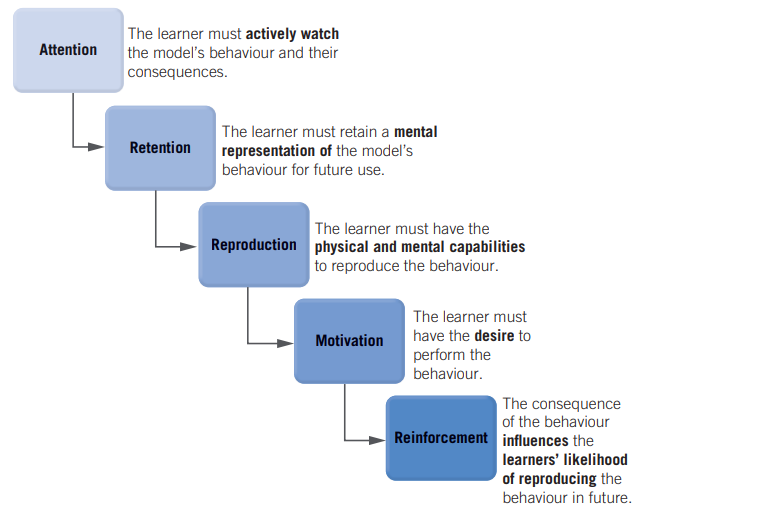
What does the mnemonic A.R.R.M.R stand for in observational learning?
- Attention
- Retention
- Reproduction
- Motivation
- Reinforcement
learning mnemonic -
What is the role of Attention in observational learning?
The learner must actively watch the model's behaviour and its consequences.
attention observational -
What does Retention require in observational learning?
The learner must retain a mental representation of the model's behaviour for future use.
retention memory -
What capability is required by Reproduction in observational learning?
The learner must have the physical and mental capabilities to reproduce the behaviour.
reproduction capability -
What does Motivation mean in the A.R.R.M.R model?
The learner must have the desire to perform the behaviour.
motivation drive -
How does Reinforcement affect future behaviour in observational learning?
The consequence of the behaviour influences the learner's likelihood of reproducing it in the future.
reinforcement consequences
Social-cognitive approach
- Definition: Learning, remembering and thinking about information in social contexts to explain and predict other people’s behaviour.
- Emphasises learning from models (other people) rather than only from direct rewards or punishments.
- Contrasts with behaviourism:
- Operant conditioning: learning by receiving direct rewards and punishments.
- Social-cognitive (observational) learning: learning by watching others receive rewards/punishments.
Observational learning
- Core idea: People learn when they observe a model's actions and the consequences of those actions, then use that information to guide their own behaviour.
- Characteristics:
- Active process (attention and mental representation required), unlike passive classical conditioning.
- Efficient compared with operant conditioning because learners can adopt behaviours without personally experiencing consequences.
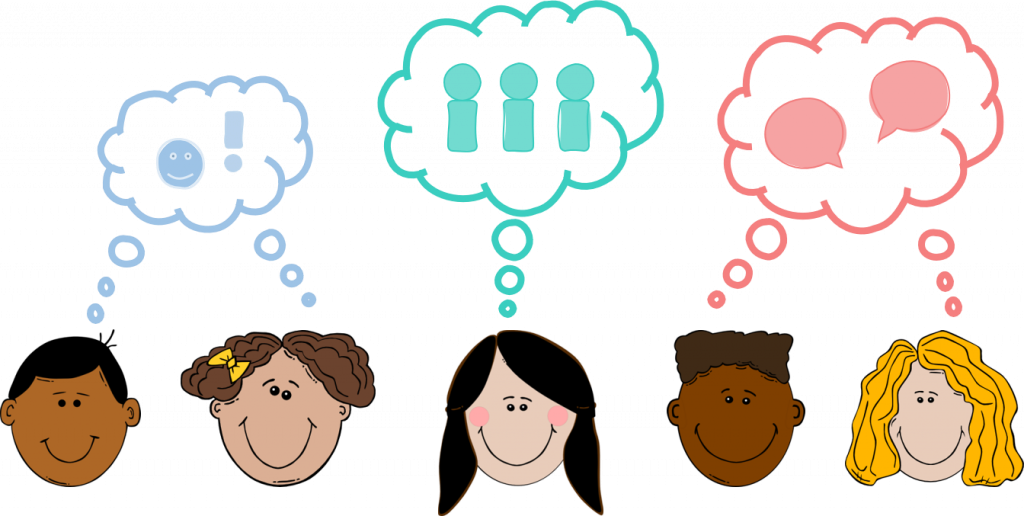
Remember A.R.R.M.R (key steps for observational learning)
- Attention: The learner must actively notice the model and the situation.
- Retention: The learner must form and store a mental representation of the observed behaviour.
- Reproduction: The learner needs the physical and cognitive ability to reproduce the behaviour.
- Motivation: The learner must want or have a reason to perform the behaviour.
- Reinforcement: Observed or experienced consequences influence the likelihood of repeating the behaviour.
Key terms & short definitions
- Model: Any person whose behaviour is observed and imitated.
- Vicarious reinforcement: When seeing a model rewarded increases the observer's likelihood of copying the behaviour.
- Vicarious punishment: When seeing a model punished decreases imitation.
Examples and applications
- Children imitate behaviours of parents, teachers, or media figures after watching consequences.
- Training and coaching: demonstrate skills, provide clear outcomes, and encourage mental rehearsal.
- Behaviour change programs use modelling and vicarious reinforcement to teach social skills.
Practical study tips (apply ARRMR)
- Attention: Reduce distractions and highlight key steps when observing a demonstration.
- Retention: Take notes, make mental images, and verbally summarise what you observed.
- Reproduction: Practice the behaviour soon after observing; break it into steps.
- Motivation: Link the behaviour to rewards or personal goals to increase effort.
- Reinforcement: Seek feedback and notice consequences to strengthen correct performance.
Quick summary (what to remember)
- Observational learning explains learning from models and consequences without direct experience.
- The ARRMR sequence (Attention, Retention, Reproduction, Motivation, Reinforcement) determines whether observation becomes learning.
- Use modelling, rehearsal, and feedback to teach or learn skills efficiently.