What rights do equity holders have in a company?
How are equity providers liable for company obligations?
What are the main features of debt financing?
What is the lender's position in case of insolvency?
What important caveat is noted about lender reimbursement in practice?
Why does debt financing provide a tax advantage?
What control option can owners exercise over company management?
Which two distinctions are shown in the 'Forms of financing' image?
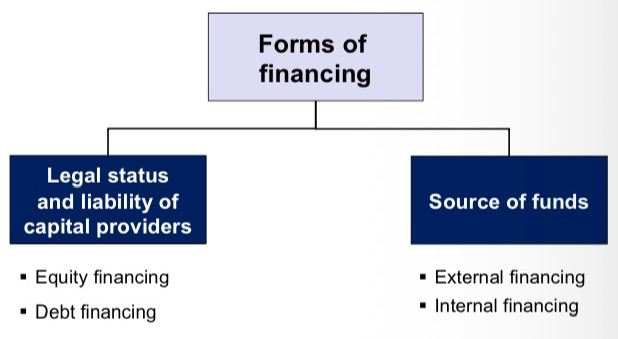
What is meant by 'External Financing'?
Give two examples of equity external financing mentioned.
Give examples of debt external financing listed in the notes.
What are 'hybrid' or 'mezzanine' financing forms as described?
What is 'Internal Financing' as defined in the notes?
How do retained earnings function as self-financing?
What is the effect of depreciation on cash and profit as described?
How do provisions affect profit, tax, and liquidity according to the notes?
Which additional internal and special forms of financing appear in the flowchart illustration?
What does 'self-financing from asset disposal' mean?
What happens to profit when an asset is sold above book value?
What is a common practical outcome when a company still needs an asset after selling it?
Which items are listed as components of self-financing?
Give two examples of other internal financing methods mentioned.
State the pecking order of financing preferences.
Why might a company have a high equity ratio according to the text?
Use the provided diagram to illustrate sources of funds for internal financing.
What does the free cash flow theory warn about when cash flows exceed required cash?
According to POT, what are large internal funds used for?
What controlling issue does the free cash flow theory highlight?
What is recommended to mitigate the risks of free cash flow misuse?
Flashcard trong bộ này (29)
-
1
What rights do equity holders have in a company?
- Ownership of the company
- Dividends
- Residual claim
- Co-determination and control rights
-
2
How are equity providers liable for company obligations?
- Liable with their contributed capital
-
3
What are the main features of debt financing?
- Lenders provide capital
- No ownership/control rights
- Company pays interest and must repay capital
-
4
What is the lender's position in case of insolvency?
- Lenders are first to get reimbursed
-
5
What important caveat is noted about lender reimbursement in practice?
- Lenders do not always get their entire money back
-
6
Why does debt financing provide a tax advantage?
- Interest payments are accounted as costs and can be paid from income before tax
-
7
What control option can owners exercise over company management?
- Owners can take over management (often delegated to managers)
-
8
Which two distinctions are shown in the 'Forms of financing' image?
- Legal status and liability of capital providers
- Source of funds (External and Internal financing)
-
9
What is meant by 'External Financing'?
- External Financing: Financing from outside the firm such as equity, debt, or hybrid instruments.
-
10
Give two examples of equity external financing mentioned.
- Capital increase by previous shareholders
- Admission of new shareholders (capital increase)
-
11
Give examples of debt external financing listed in the notes.
- Bank loans
- Issuance of corporate bonds
- Supplier credit & customer credit
-
12
What are 'hybrid' or 'mezzanine' financing forms as described?
- Hybrid / mezzanine financing: Instruments that have characteristics of both equity and debt.
-
13
What is 'Internal Financing' as defined in the notes?
- Internal Financing: Financing from internally generated sources such as retained earnings, depreciation, and provisions.
-
14
How do retained earnings function as self-financing?
- Retained earnings: Profits kept in the firm that must be accrued as liquidity for internal financing.
-
15
What is the effect of depreciation on cash and profit as described?
- Depreciation: Imputed asset cost; cash outflow occurs on acquisition, depreciation lowers profit and gives tax advantage.
-
16
How do provisions affect profit, tax, and liquidity according to the notes?
- Provisions: Creating provisions reduces profit and tax now; the actual liquidity effect occurs later and they act like borrowed capital.
-
17
Which additional internal and special forms of financing appear in the flowchart illustration?
- Other internal financing: Sale of assets, Factoring
- Special forms: Leasing

-
18
What does 'self-financing from asset disposal' mean?
The company receives liquidity through the sale of fixed assets.
-
19
What happens to profit when an asset is sold above book value?
Profit increases due to the release of hidden reserves.
-
20
What is a common practical outcome when a company still needs an asset after selling it?
The asset is often leased back to the company (sale-lease-back).
-
21
Which items are listed as components of self-financing?
- Retained Earnings
- Depreciation
- Provisions
-
22
Give two examples of other internal financing methods mentioned.
- Asset disposal
- Factoring
-
23
State the pecking order of financing preferences.
Companies prefer internal financing first, then debt financing, and equity financing last.
-
24
Why might a company have a high equity ratio according to the text?
- Highly profitable and finances itself internally
- Unable to attract more debt holders and therefore issues new equity
-
25
Use the provided diagram to illustrate sources of funds for internal financing.
Diagram:
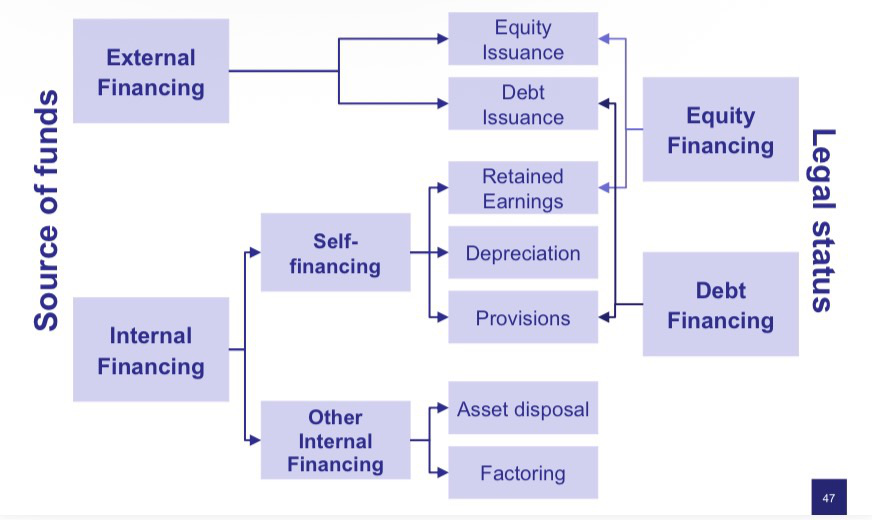
-
26
What does the free cash flow theory warn about when cash flows exceed required cash?
- Problems may arise due to excess cash flows over required cash
-
27
According to POT, what are large internal funds used for?
- For investment projects
-
28
What controlling issue does the free cash flow theory highlight?
- Poor control can lead management to use free cash flow for personal rather than company interests
-
29
What is recommended to mitigate the risks of free cash flow misuse?
- Good control is necessary
Forms of financing — concise guide
Alt text: Forms of financing, equity vs debt and source of funds
Overview
- Financing supplies the funds a company needs and determines who bears risk, control and liability.
- Main dimensions: legal status/liability (equity vs debt) and source of funds (external vs internal).
- Key trade-offs: control, repayment obligation, tax treatment, and insolvency priority.
Equity financing
- Equity holders own the company and have residual claim on profits and assets after creditors.
- Equity confers voting/co‑determination and the right to appoint or replace managers.
- Equity providers are liable only up to their contributed capital (no personal liability).
- Returns to equity: dividends and capital gains; dividends are not tax‑deductible for the firm.
- Use when owners want to share risk or cannot obtain more debt without diluting control.
Debt financing
- Debt holders (lenders) provide capital in return for contractual interest and principal repayments.
- Lenders have no ownership or routine control, but can impose covenants that restrict owners' actions.
- Interest payments are typically periodic; principal must be repaid according to schedule.
- In insolvency, lenders have priority over equity holders but may still face losses (credit risk).
- Tax advantage: interest is an expense for accounting/tax purposes and reduces taxable income.
Hybrid / Mezzanine instruments
- Instruments that mix features of equity and debt (e.g., convertible bonds, subordinated debt).
- Used to tailor risk, control and tax characteristics between pure equity and pure debt.
Sources of funds
External financing (raised from third parties)
- Equity issuance: capital increases by existing or new shareholders.
- Debt issuance: bank loans, corporate bonds, supplier credit, customer credit.
- Hybrid instruments combine external debt and equity characteristics.
Alt text: Flowchart of external and internal sources of funds
Internal financing (generated within the firm)
- Retained earnings: profits kept in the firm to finance investment; principal source of internal funds.
- Depreciation (imputed): non‑cash accounting charge that builds internal liquidity over time and reduces taxable profit.
- Provisions: recorded liabilities that lower current profit and taxes; cash outflow happens later when provision is used.
- Important: internal funds are real liquidity only when cash is actually available or released.
Other internal financing
- Sale of assets (self-financing from asset disposal): frees cash but may remove productive capacity; often followed by sale‑and‑lease‑back to retain use.
- Factoring: selling receivables to get immediate cash, effectively transforming trade credit into cash.
Alt text: Internal and external financing types and examples
Pecking Order Theory (POT)
- Firms prefer financing in this order: internal funds → debt → equity.
- Preference arises from information asymmetry and costs of issuing securities.
- High internal funds often signal profitability and reduce need for external capital.
- When firms cannot borrow more (or borrowing is costly), they issue new equity.
Free Cash Flow (FCF) problem
- Large internal cash flows can create agency problems: managers may invest in projects that benefit themselves rather than shareholders.
- Good governance and monitoring are needed to prevent value‑destroying investments.
- Debt can discipline managers by committing to repayments and reducing free cash available for wasteful spending.
Practical notes & implications for managers
- Choose financing by balancing: cost (interest vs dividends), tax effects, control dilution, and insolvency risk.
- Debt increases financial risk but provides tax shields; equity preserves flexibility and limits downside for owners.
- Use retained earnings first when available; resort to debt for predictable cash flows and equity when raising large sums or preserving cash flow agility.
- Consider leasebacks, factoring or hybrids when conventional debt or equity are unattractive.
Quick reference — key relationships
- Priority in insolvency: creditors > equity holders.
- Pecking order: internal > debt > equity.
- Tax effect: interest expense reduces taxable profit (tax shield).
- Agency trade-off: more free cash flow → higher agency risk; debt can mitigate this.
Typical exam/flashcard prompts
- Define equity vs debt and list three differences (control, liability, tax treatment).
- Explain pecking order theory and give a financing sequence example.
- Describe how depreciation and provisions create internal financing.
- Explain why lenders may not recover full amounts in insolvency.
Summary tips for studying
- Memorize the pecking order and main pros/cons of equity vs debt.
- Be able to classify financing items as external/internal and as equity/debt/hybrid.
- Understand practical examples: sale‑and‑lease‑back, factoring, convertibles, and how tax shields work.