Karteikarten in diesem Deck (215)
-
1
What is tissue?
Groups of cells similar in structure and function.
-
2
What is histology?
The study of tissues.
-
3
What are the types of tissues?
- Epithelial tissue
- Connective tissue
- Muscle tissue
- Nerve tissue
-
4
What is epithelial tissue responsible for?
- Protection
- Absorption
- Secretion
-
5
What is the function of connective tissue?
- Support
- Binding
- Storage
-
6
What does muscle tissue do?
- Movement
- Contraction
-
7
What is the role of nerve tissue?
- Transmission of impulses
- Coordination
-
8
What is the primary function of nervous tissue?
Internal communication
-
9
What types of muscle tissue exist?
- Skeletal
- Cardiac
- Smooth
-
10
What are the functions of epithelial tissue?
- Forms boundaries
- Protects
- Secretes
- Absorbs
- Filters
-
11
What does connective tissue do?
- Supports
- Protects
- Binds other tissues
-
12
What are examples of connective tissue?
- Bones
- Tendons
- Fat
-
13
Where is epithelial tissue found?
- Skin surface
- Lining of GI tract
-
14
What system includes the brain and spinal cord?
Nervous system
-
15
What are the two main types of epithelial tissue?
- Covering and lining epithelia
- Glandular epithelia
-
16
What types of surfaces cover covering and lining epithelia?
- External surfaces
- Internal surfaces
-
17
What is the function of glandular epithelia?
They act as secretory tissue in glands.
-
18
What characteristic do epithelial cells have from their polarity?
- Apical (upper, free) surface
- Basal (lower, attached) surface
-
19
What structures may the apical surfaces of epithelial cells bear?
- Microvilli (e.g., intestinal lining)
- Cilia (e.g., trachea lining)
-
20
What lies adjacent to the basal surface of epithelial tissues?
A noncellular basal lamina made of glycoprotein and collagen.
-
21
What are the two surfaces of epithelial tissue?
- Apical surface: free surface exposed to exterior or cavity
- Basal surface: lower surface attached to the body
-
22
What is the role of the basal lamina in epithelial tissue?
Acts as a filter for molecules diffusing into the epithelium from the connective tissue below.
-
23
What does the apical surface of epithelial tissue refer to?
The free surface exposed to the body exterior or cavity of an internal organ.
-
24
What is the basal surface in epithelial tissue?
The lower surface that is attached to the body.
-
25
What are the specialized contacts of epithelial cells?
Epithelial cells fit close together by tight junctions and desmosomes to form sheets.
-
26
What is depicted in the illustration of epithelial tissue?
The diagram shows cell junctions, basal lamina, and connective tissue.
-
27
What supports epithelial tissue?
It is supported by connective tissue beneath the basal lamina.
-
28
What composes the basement membrane of epithelium?
- Basal lamina
- Reticular lamina (collagen fibers)
-
29
What are the characteristics of epithelial tissue?
- Closely packed cells
- Continuous sheets held by tight junctions and desmosomes
- Supported by connective tissue reticular lamina
- Avascular but innervated
- High rate of regeneration
-
30
What is simple epithelium?
1 layer of cells
-
31
What is stratified epithelium?
1 layer of cells
-
32
Name the types of epithelial cells.
- Squamous
- Cuboidal
- Columnar
-
33
How are stratified epithelial cells named?
According to apical layer of cells
-
34
What are the two classifications of epithelial tissue based on cell layers?
- Simple
- Stratified
-
35
What is the apical surface in epithelial tissue?
The surface that faces the body cavity or exterior.
-
36
What are the shapes of epithelial cells?
- Squamous
- Cuboidal
- Columnar
-
37
What is the main function of simple epithelia?
- Absorption
- Secretion
- Filtration
-
38
How many cell layers do simple epithelia consist of?
One cell layer
-
39
Are simple epithelia protective?
No, they are not protective.
-
40
What is the description of simple squamous epithelium?
- Single layer of flattened cells
- Disc-shaped central nuclei
- Sparse cytoplasm
- Simplest of the epithelia
-
41
What is the function of simple squamous epithelium?
- Allows passage of material by diffusion and filtration
- Secretes lubricating substances in serosa
-
42
Where is simple squamous epithelium located?
- Kidney glomeruli
- Air sacs of the lung
- Lining of the heart
- Blood vessels
- Lymphatic vessels
- Ventral body cavity (serosa)
-
43
What is the description of simple cuboidal epithelium?
- Single layer of cubelike cells
- Large, spherical central nuclei
-
44
What are the functions of simple cuboidal epithelium?
- Secretion
- Absorption
-
45
Where is simple cuboidal epithelium located?
- Kidney tubules
- Ducts and secretory portions of small glands
- Ovary surface
-
46
What is the function of simple columnar epithelium?
- Absorption
- Secretion of mucus, enzymes, and other substances
- Ciliated type propels mucus or reproductive cells by ciliary action
-
47
Where is the location of simple columnar epithelium?
- Non-ciliated type: digestive tract, gallbladder, excretory ducts
- Ciliated type: small bronchi, uterine tubes, regions of the uterus
-
48
What is the function of pseudostratified columnar epithelium?
- Secretion of mucus
- Propulsion of mucus by ciliary action
-
49
Where is pseudostratified columnar epithelium located?
- Non-ciliated type: male's sperm-carrying ducts, ducts of large glands
- Ciliated variety: lines trachea and upper respiratory tract
-
50
What defines stratified epithelia?
- 2 or more cell layers
- Regenerate at the basement membrane
- Migrate upward
-
51
What is the main function of stratified epithelia?
- Protection
-
52
What is the function of epithelial tissue?
Protects underlying tissues in areas subjected to abrasion.
-
53
Describe the stratified squamous epithelium.
- Thick membrane with several layers
- Basal cells are cuboidal or columnar
- Surface cells are flattened and keratinized in the outer layers.
-
54
Where is non-keratinized stratified squamous epithelium located?
- Moist linings of the esophagus
- Mouth
- Vagina
-
55
Where is keratinized stratified squamous epithelium found?
Forms the epidermis of the skin.
-
56
What does transitional epithelium resemble?
- Stratified squamous
- Stratified cuboidal
-
57
What is the function of transitional epithelium?
Stretches readily and permits distension of urinary organ by contained urine.
-
58
Where is transitional epithelium located?
- Ureters
- Urinary bladder
- Part of the urethra
-
59
What do the surface cells of transitional epithelium look like?
- Dome-shaped
- Squamous-like (depending on degree of organ stretch)
-
60
What are the basal cells of transitional epithelium like?
- Cuboidal
- Columnar
-
61
What is stratified cuboidal epithelium?
- Typically 2 layers of cuboidal cells
- Found in sweat glands and mammary glands
-
62
Where is stratified columnar epithelium found?
- Pharynx
- Male urethra
- Glandular ducts
- Transitional areas
-
63
What is a gland?
A gland consists of one or more cells that make and secrete a product called a secretion.
-
64
How are glands classified?
- By where they release their product: endocrine or exocrine
- By cell number: unicellular or multicellular
-
65
What are endocrine glands?
- Ductless glands
- Produce hormones
- Secrete by exocytosis into bloodstream
- Transport hormones to target organ
-
66
What are exocrine glands?
- Glands with ducts
- Secrete products onto body surfaces or into cavities
-
67
What are the only important unicellular exocrine glands?
- Mucous cells
- Goblet cells
-
68
Where are unicellular glands found?
- Intestinal tract
- Respiratory tract
-
69
What do unicellular glands produce?
- Mucin
- Dissolves in water to form mucus
-
70
What is the function of mucus?
- Protective coating
- Lubricating coating
-
71
What are the key structures in a Goblet Cell?
- Microvilli
- Secretory vesicles containing mucin
- Golgi apparatus
- Rough ER
- Nucleus
-
72
What are the two parts of multicellular exocrine glands?
- Epithelial derived duct
- Secretory unit (acinus)
-
73
What supports the secretory unit of exocrine glands?
- Connective tissue
- Blood vessels
- Nerve fibers
-
74
What are the two types of glandular structures?
- Simple glands (unbranched duct)
- Compound glands (branched duct)
-
75
What are the cell types in glands?
- Tubular
- Alveolar
- Tubuloalveolar
-
76
What is a unicellular gland?
- Goblet cells in intestines
- Respiratory passages
-
77
What are examples of simple tubular glands?
- Straight tubular (stomach, colon)
- Coiled tubular (lower stomach, small intestine)
-
78
What is a simple acinar gland?
- Example: Sebaceous glands of skin
-
79
What types of compound glands are there?
- Tubular
- Acinar
- Tubuloacinar
-
80
What is Merocrine secretion?
Secretes products by exocytosis as produced.
-
81
What is Holocrine secretion?
Accumulated products within the cell then rupture.
-
82
What is Apocrine secretion?
Accumulated products within but only apex ruptures; controversy if it exists in humans.
-
83
What is the most abundant tissue in the body?
Connective Tissue
-
84
What are the functions of connective tissue?
- Binds together and supports
- Protects and insulates organs
- Stores fuel
- Compartmentalizes structures
-
85
Name the four main classes of connective tissue.
- Connective tissue proper
- Cartilage
- Bone
- Blood
-
86
What are the three components of connective tissue?
- Ground substance
- Fibers
- Cells
-
87
What is a common characteristic of connective tissue?
- Common origin
- Degrees of vascularity
- Cells separated by extracellular matrix
-
88
What are the components of extracellular matrix in connective tissue?
- Ground substance
- Fibers
-
89
What is mesenchyme?
A type of tissue with loosely associated cells lacking polarity and surrounded by a large extracellular matrix.
-
90
What can mesenchymal cells develop into?
- Tissues of the lymphatic system
- Tissues of the circulatory system
- Connective tissues (e.g., bone, cartilage)
-
91
What characterizes mesenchymal cells?
They are elongated, lack polarity, and are visible in large extracellular matrix.
-
92
What is the vascularity of cartilage?
Avascular
-
93
How is the vascularization of dense connective tissue described?
Poorly vascularized
-
94
What type of connective tissue has a rich supply of blood vessels?
Bone
-
95
What is the medium for solute diffusion in connective tissue?
Ground substance
-
96
What are the components of ground substance?
- Interstitial fluid
- Adhesion proteins
- Proteoglycans
-
97
What major substances make up proteoglycans?
- Protein core
- Chondroitin sulfate
- Hyaluronic acid
-
98
What does ground substance do to water?
Traps water, affecting its viscosity
-
99
What are collagen fibers known for?
- Strongest
- Most abundant type
- Provides high tensile strength
-
100
What characterizes elastic fibers?
- Networks of long, thin elastin fibers
- Allow for stretch
-
101
What are reticular fibers?
- Short, fine
- Highly branched collagenous fibers
-
102
What are the immature, mitotically active cells in connective tissue called?
Blasts
-
103
What do blasts become after secreting the matrix?
Cytes
-
104
What type of mature cell is a fibroblast?
Connective tissue proper
-
105
Name a type of cyte in cartilage.
Chondrocyte
-
106
What is the function of osteoblasts?
To form bone
-
107
What types of cells are found in bone marrow?
- Hematopoietic stem cells
- Fat cells
- White blood cells
- Mast cells
- Macrophages
-
108
What are the types of cells in connective tissue?
- Macrophages
- Fibroblasts
- Lymphocytes
- Fat Cells
- Mast Cells
- Neutrophils
-
109
What composes the extracellular matrix?
- Ground Substance
- Fibers:
- Collagen Fiber
- Elastic Fiber
- Reticular Fiber
-
110
What are elastic fibers composed of?
- Core region enriched in elastin proteins
- Microfibrillar sheath as a tough coating
-
111
What molecule is involved in the cross-linking of elastin?
Lysyl oxidase
-
112
How do elastic fibers behave in a relaxed vs stretched state?
- Relaxed state: coiled structure
- Stretched state: extended structure
-
113
What type of collagen primarily composes reticular fibers?
Mostly Type III Collagen
-
114
Where are reticular fibers predominantly located?
- Liver
- Lymph Nodes
- Spleen
- Hemopoietic Organs
-
115
What is the structural characteristic of reticular fibers?
Thin net-like framework
-
116
What do reticular fibers support?
- Capillaries
- Nerves
- Muscle cells
-
117
What are the two main types of connective tissue?
- Proper
- Specialized
-
118
What are the types of proper connective tissue?
- Loose
- Areolar
- Reticular
- Adipose
- Dense
- Regular
- Elastic
- Irregular
-
119
What types are included in specialized connective tissue?
- Bone
- Spongy
- Compact
- Blood
- Cartilage
- Elastic
- Hyaline
- Fibrocartilage
-
120
What are the two subclasses of Connective Tissue Proper?
- Loose connective tissues
- Dense connective tissues
-
121
Name three types of loose connective tissues.
- Areolar
- Adipose
- Reticular
-
122
Name four types of dense connective tissues.
- Dense regular
- Dense irregular
- Elastic
-
123
What cells produce fibrous tissue in Connective Tissue Proper?
- Fibroblasts
-
124
What are the fixed cells in Connective Tissue Proper?
- Fibrocytes
- Adipocytes
- Mesenchymal cells
-
125
What is the function of Areolar Connective Tissue?
- Wraps and cushions organs
- Phagocytizes bacteria
- Plays a role in inflammation
- Holds and conveys tissue fluid
-
126
Where is Areolar Connective Tissue located?
- Under epithelia of body
- Forms lamina propria of mucous membranes
- Packages organs
- Surrounds capillaries
-
127
What is the description of Adipose Connective Tissue?
Matrix similar to areolar; sparse; closely packed adipocytes with nuclei pushed to side by fat droplets.
-
128
What are the functions of Adipose Tissue?
- Provides reserve food fuel
- Insulates against heat loss
- Supports and protects organs
-
129
Where is Adipose Tissue located?
- Under skin in subcutaneous tissue
- Around kidneys and eyeballs
- Within abdomen
- In breasts
-
130
What is the function of Reticular Connective Tissue?
Forms a soft internal skeleton (stroma) that supports cells like white blood cells and macrophages.
-
131
Where is Reticular Connective Tissue located?
Lymphoid organs: lymph nodes, bone marrow, and spleen.
-
132
What is the main characteristic of dense connective tissue?
Contains closely packed bundles of collagen fibers running in the same direction, parallel to the pull.
-
133
Which cell type is found in dense regular connective tissue?
Fibroblasts
-
134
What are the three types of dense connective tissue?
- Dense regular
- Dense irregular
- Elastic
-
135
What is the vascularization level of dense regular connective tissue?
Poorly vascularized with few cells.
-
136
What gives dense connective tissue its great tensile strength?
Arrangement of many collagen fibers.
-
137
What are the primary characteristics of Dense Regular Connective Tissue?
- Primarily parallel fibers
- A few elastic fibers
- Major cell type: fibroblast
-
138
What is the function of Dense Regular Connective Tissue?
- Attaches muscles to bones
- Attaches bones to bones
- Withstands great tensile stress in one direction
-
139
Where is Dense Regular Connective Tissue located?
- Tendons
- Most ligaments
- Aponeuroses
-
140
What are the main features of dense irregular connective tissue?
- Primarily irregularly arranged collagen fibers
- Some elastic fibers
- Major cell type: fibroblast
-
141
What is the function of dense irregular connective tissue?
- Withstands tension in many directions
- Provides structural strength
-
142
Where is dense irregular connective tissue located?
- Fibrous capsules of organs
- Joints
- Dermis of skin
- Submucosa of digestive tract
-
143
What is the description of Elastic C.T.?
Dense regular connective tissue containing a high proportion of elastic fibers.
-
144
What is the function of Elastic C.T.?
- Allows tissue to recoil after stretching
- Maintains pulsatile flow of blood through arteries
- Aids passive recoil of lungs following inspiration
-
145
Where is Elastic C.T. typically located?
- Walls of large arteries
- Ligaments associated with the vertebral column
- Walls of the bronchial tubes
-
146
What does Elastic C.T. consist of?
A high proportion of elastic fibers.
-
147
What are the three types of cartilage?
- Hyaline cartilage
- Elastic cartilage
- Fibrocartilage
-
148
What are the characteristics of cartilage?
Tough, flexible; stands up to tension and compression; lacks nerve fibers; avascular; receives nutrients by diffusion from the perichondrium.
-
149
What are the cell types in cartilage?
- Chondroblasts: produce new matrix
- Chondrocytes: maintain matrix, found in lacunae
-
150
What is the description of hyaline cartilage?
- Amorphous but firm matrix
- Imperceptible collagen fiber network
- Chondroblasts produce matrix
- Chondrocytes lie in lacunae
-
151
What is the function of hyaline cartilage?
- Supports and reinforces
- Serves as resilient cushion
- Resists compressive stress
-
152
Where is hyaline cartilage located?
- Embryonic skeleton
- Ends of long bones
- Costal cartilages of ribs
- Cartilages of nose, trachea, larynx
-
153
What is the function of elastic cartilage?
Maintains the shape of a structure while allowing great flexibility.
-
154
Where is elastic cartilage located?
- Supports the external ear (pinna)
- Epiglottis
-
155
What are the characteristics of fibrocartilage?
- Matrix similar to hyaline cartilage but less firm
- Thick collagen fibers predominate
-
156
What is the function of fibrocartilage?
Tensile strength allows it to absorb compressive shock
-
157
Where is fibrocartilage located?
- Intervertebral discs
- Pubic symphysis
- Discs of the knee joint
-
158
What are the two types of bone?
- Compact Bone
- Spongy Bone
-
159
What is osseous tissue made of?
- Collagen fibers
- Calcium salts
-
160
What do osteoblasts do?
- Produce the matrix
- Reside in lacunae
-
161
What do osteocytes maintain?
- The matrix
- Reside in lacunae
-
162
What is the function of compact bone tissue?
- Supports and protects
- Provides levers for muscle action
- Stores calcium, minerals, and fat
- Site for blood cell formation (hematopoiesis)
-
163
Where is compact bone tissue located?
Bones
-
164
What is spongy bone?
A light, porous bone with a honeycombed appearance, organized into trabeculae.
-
165
What fills the spaces in spongy bone?
- Marrow
- Blood vessels
-
166
What structure provides support and flexibility in spongy bone?
The three-dimensional latticework of trabeculae.
-
167
What type of connective tissue is blood?
Blood is a fluid matrix containing red and white blood cells and platelets.
-
168
What is the main function of blood?
To transport respiratory gases, nutrients, and wastes.
-
169
Where is blood located in the body?
Blood is contained within blood vessels.
-
170
What are the three types of muscle tissue?
- Skeletal
- Cardiac
- Smooth
-
171
What are myofilaments made of?
- Actin
- Myosin
-
172
What is the function of muscle tissue?
Responsible for most types of body movements.
-
173
What is the function of skeletal muscle?
- Voluntary movement
- Locomotion
- Manipulation of the environment
- Facial expression
- Voluntary control
-
174
Where is skeletal muscle located?
In skeletal muscles attached to bones or occasionally skin.
-
175
What are the characteristics of cardiac muscle?
- Branching
- Striated
- Generally uni-nucleated
- Intercalated discs
-
176
What is the function of cardiac muscle?
Propels blood into the circulation; involuntary control.
-
177
Where is cardiac muscle located?
The walls of the heart.
-
178
What are the characteristics of smooth muscle cells?
- Spindle-shaped
- Central nuclei
- No striations
- Arranged in sheets
-
179
What is the primary function of smooth muscle?
- Propels substances such as:
- Foodstuffs
- Urine
- A baby
- Involuntary control
-
180
Where is smooth muscle primarily located?
- Mostly in the walls of hollow organs
-
181
What are the components of nervous tissue?
- Neurons
- Supporting Cells
-
182
What is the function of neurons?
Transmit electrical signals from sensory receptors to effectors (muscles and glands)
-
183
Where is nervous tissue located?
- Brain
- Spinal Cord
- Nerves
-
184
What are the three types of covering and lining membranes?
- Cutaneous Membranes
- Mucous Membranes
- Serous Membranes
-
185
What do membranes consist of?
At least two primary tissue types: an epithelium and an underlying layer of connective tissue proper.
-
186
What is the cutaneous membrane commonly known as?
Skin
-
187
What is the role of the cutaneous membrane?
- Dry membrane
- Outermost protective boundary
-
188
What is the significance of skin as an organ?
Largest, most visible organ
-
189
What are mucous membranes?
- Line cavities that open to the outside
- Secrete mucus
- Contain epithelium with Goblet cells
- Have basement membrane, lamina propria, and sometimes smooth muscle
- Found in respiratory, digestive, urinary, and reproductive systems
-
190
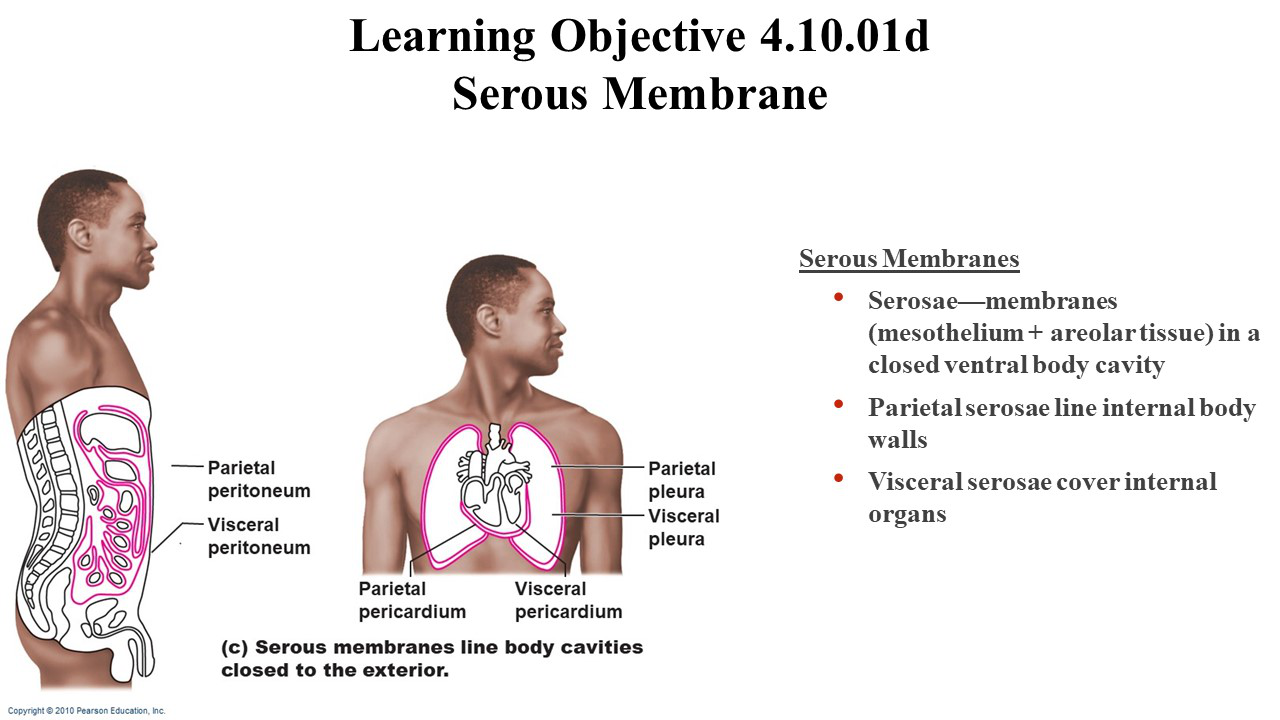
What are serous membranes?
Membranes (mesothelium + areolar tissue) in a closed ventral body cavity.
-
191
What do parietal serosae do?
They line internal body walls.
-
192
What do visceral serosae do?
They cover internal organs.
-
193
What do serous membranes line?
Body cavities closed to the exterior.
-
194
What is shown in the serous membranes diagram?
Parietal peritoneum, Visceral peritoneum, Parietal pericardium, Visceral pericardium, Parietal pleura, Visceral pleura.
-
195
From which germ layer does nerve tissue arise?
Ectoderm
-
196
From which germ layer do muscle and connective tissues arise?
Mesoderm
-
197
Which germ layers give rise to epithelial tissues?
- Ectoderm
- Mesoderm
- Endoderm
-
198
When are the primary germ layers formed?
Early in embryonic development
-
199
What do the primary germ layers specialize to form?
The four primary tissues
-
200
What are the three primary germ layers formed shortly after conception?
- Ectoderm
- Mesoderm
- Endoderm
-
201
What tissue does the ectoderm differentiate into?
- Nervous tissue
-
202
What tissue does the mesoderm differentiate into?
- Muscle tissue
- Connective tissue
-
203
What does the endoderm develop into?
- Inner lining of digestive system
-
204
Which germ layers contribute to epithelium?
- All three germ layers
-
205
What initiates tissue repair?
Growth factors (wound hormones) released by injured cells.
-
206
What are the two major ways tissue repair occurs?
- Regeneration: Replaces tissue with the same kind.
- Fibrosis: Forms scar tissue with fibrous connective tissue.
-
207
What are the steps involved in inflammation during tissue repair?
- Release of inflammatory chemicals
- Dilation of blood vessels
- Increase in vessel permeability
- Clotting occurs
-
208
What happens during the inflammation stage of tissue repair?
- Severed blood vessels bleed
- Inflammatory chemicals are released
- Blood vessels become more permeable
- White blood cells, fluid, and clotting proteins seep into the area
-
209
What forms on the surface during the clotting process?
- A clot forms
- Surface dries and a scab is created
-
210
What replaces the clot in tissue repair?
Granulation tissue, which restores vascular supply.
-
211
What do fibroblasts produce during tissue repair?
Collagen fibers that bridge the gap.
-
212
What is the role of macrophages in tissue repair?
Phagocytize cell debris.
-
213
What happens to surface epithelial cells during tissue repair?
They multiply and migrate over the granulation tissue.
-
214
What is the effect of regeneration and fibrosis in tissue repair?
- Matures and contracts fibrosed area
- Thickens epithelium
- Results in scar tissue with regenerated epithelium
-
215
What do we observe in a fully regenerated epithelium?
An underlying area of scar tissue is present.
Tissues
Definition
- Tissue: Groups of cells similar in structure and function.
Histology
- The study of tissues.
Types of Tissues
- Epithelial Tissue
- Connective Tissue
- Muscle Tissue
- Nerve Tissue

Epithelial Tissue Characteristics
- Polarity: Cells have an apical (upper) and basal (lower) surface.
- Specialized Contacts: Cells fit close by tight junctions.
- Supported by Connective Tissue: Consists of basal and reticular lamina.
Classification of Epithelial Tissue
Layers
- Simple (1 layer)
- Stratified (>1 layer)
Cell Types
- Squamous (flat)
- Cuboidal (cube-like)
- Columnar (tall)

Connective Tissue
- Functions: Binds, supports, protects, and insulates organs.
- Four Main Classes: Connective tissue proper, cartilage, bone, blood.
Types of Connective Tissue
| Type | Components | Characteristics |
|---|---|---|
| Connective Proper | Loose/Dense | Varying degrees of vascularity |
| Cartilage | Chondrocytes/Matrix | Tough but flexible, avascular |
| Bone | Osteocytes/Matrix | Hard, supports and protects |
| Blood | Red/white cells in plasma | Transport of gases and nutrients |
Muscle Tissue Types
- Skeletal Muscle: Voluntary, striated, multinucleate.
- Cardiac Muscle: Involuntary, striated, branched.
- Smooth Muscle: Involuntary, non-striated.

Nervous Tissue
- Components: Neurons (signal transmission) and supporting cells (neuroglia).

Body Membranes
Types of Membranes
- Cutaneous Membrane: Skin, protects body.
- Mucous Membranes: Line cavities open to the exterior and secrete mucus.
- Serous Membranes: Line closed body cavities.
Tissue Development
- Primary Germ Layers: Ectoderm, mesoderm, endoderm; give rise to the four main tissue types.

Tissue Repair
Steps in Repair
- Inflammation: Chemical release, blood vessel dilation.
- Organization: Granulation tissue replaces clot, restores blood supply.
- Regeneration/Fibrosis: Epithelium thickens, potential scar formation.
