Guarda tu mazo antes de que desaparezca
Estas tarjetas aún no se han guardado — desaparecerán cuando salgas. Crea una cuenta gratuita para conservarlas y desbloquear todo lo de abajo.
- Save this deck to your account
- Study with spaced repetition
- Export to Anki (.apkg) or PDF
- Process documents up to 100 pages
- Images extracted from your PDFs
- Sharper text extraction & a more advanced AI model
What are the basal nuclei?
Which structures are included in the basal nuclei?
Hippocampus, amygdala, thalamus, hypothalamus
Cerebellar cortex, dentate nucleus, fastigial nucleus, interposed nuclei
Caudate, putamen, globus pallidus, subthalamic nucleus (STN), substantia nigra (SN)
Primary motor cortex, premotor cortex, supplementary motor area, somatosensory cortex
Name the five parallel functional loops of the basal nuclei.
What is the functional difference between the direct and indirect basal nuclei pathways?
Direct pathway increases inhibition; indirect pathway causes excitation of thalamocortical output
Direct pathway uses glutamate exclusively; indirect pathway uses GABA exclusively
Direct pathway produces disinhibition of thalamocortical output; indirect pathway increases inhibition of thalamocortical output
Direct pathway only affects emotion; indirect pathway only affects movement
Which main neurotransmitters are involved in basal nuclei circuits?
Which clinical disorders are associated with basal nuclei dysfunction?
Myasthenia gravis, Guillain–Barré syndrome, peripheral neuropathy
Parkinson disease, Huntington disease, hemiballism, chorea
Meningitis, encephalitis, brain abscess
Alzheimer disease, multiple sclerosis, amyotrophic lateral sclerosis
How are pyramidal and extrapyramidal pathways distinguished in relation to basal nuclei?
Where do the basal nuclei project their main output?
Basal nuclei can also be considered a what?
How many basal nuclei loops are listed in the objectives?
What mechanisms in the motor loop should be explained?
What should be described about basal nuclei disorders?
Which two major motor pathway systems should be differentiated?
What can certain pharmaceuticals lead to regarding motor systems?
What are the basal nuclei?
What alternative term is often used for basal nuclei?
Why is the term 'ganglia' sometimes considered imprecise for basal ganglia?
What type of tremor is associated with cerebellar dysfunction?
What type of tremor is associated with basal nuclei dysfunction and Parkinson's disease?
What two nuclei compose the 'corpus striatum'?
Which structures make up the lentiform nucleus?
Which basal nucleus is described as having a head, body, and tail?
Which basal nucleus is labeled as a 'major input' structure?
Which basal nucleus is described as the 'major output'?
Name the two segments of the globus pallidus mentioned.
Referencing the diagram, name three basal nuclei shown in the flow of information: 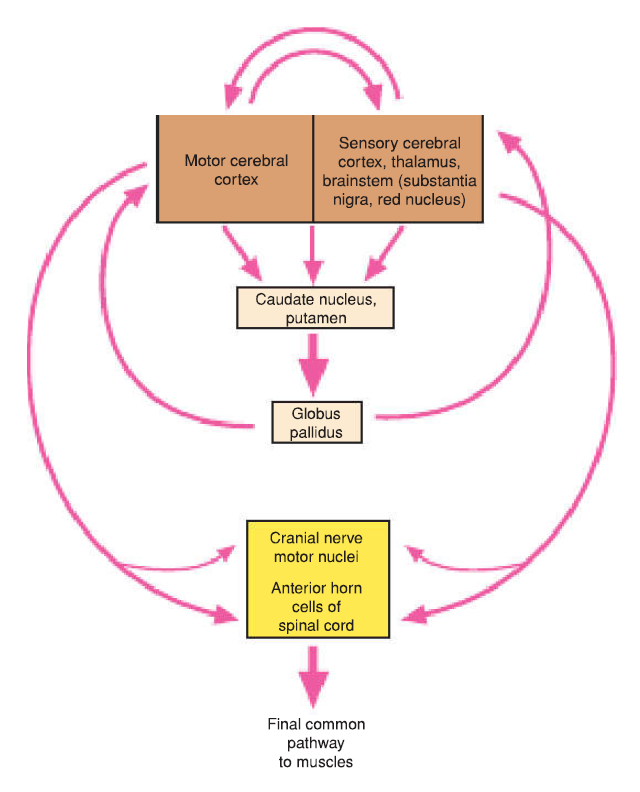
What two structures compose the corpus striatum?
Which two parts make up the lentiform nucleus?
Which region in the diagram is labeled as receiving input?
Where does the output go according to the diagram?
Where are the basal nuclei located in the cerebral hemisphere?
Name the structures labeled in the sagittal illustration of the right cerebral hemisphere.
Which cerebral structure in the illustration is described with 'head, body, tail'?
Which labeled structure lies adjacent to the lateral ventricle and is part of basal ganglia region on the image?
Provide the image URL showing the sagittal view location of these structures.
What is the primary role of the basal nuclei in brain function?
Name the main anatomical components of the basal nuclei listed in the summary.
How do the direct and indirect basal ganglia pathways differ in their net effect on thalamocortical output?
Which neurotransmitters are explicitly listed as involved in basal nuclei circuits?
List the five parallel functional loops of the basal nuclei.
Name clinical movement disorders associated with basal nuclei dysfunction mentioned in the notes.
What distinction between motor systems is highlighted in the core concepts?
Which deep cerebral structures are shown in the provided horizontal cross-section image (answer includes an illustrative image)?
What are the main nuclei included in the basal nuclei (basal ganglia) anatomy?
Name other brain structures related to the basal ganglia.
Which of the following is NOT listed as one of the five parallel loops of the basal nuclei?
Motor
Auditory
Oculomotor
Limbic
What is the functional difference between the direct and indirect basal ganglia pathways?
Which neurotransmitters are explicitly associated with basal nuclei function?
Which clinical disorder is associated with loss of dopaminergic neurons in the substantia nigra?
Hemiballism
Parkinson
Huntington
Chorea
Name three clinical movement disorders linked to basal nuclei dysfunction.
How do basal nuclei regulate movement, cognition, and emotion according to the summary?
What distinction is noted between pyramidal and extrapyramidal pathways?
Where can a schematic diagram of basal ganglia interconnected pathways be found (used as an illustrative media)?
How are the basal nuclei organized with respect to information flow?
How many parallel circuits operate within the basal nuclei?
What is the primary function of the motor loop of the basal nuclei?
What is the primary function of the oculomotor loop of the basal nuclei?
What is the role of the dorsolateral prefrontal loop in the basal nuclei?
What does the lateral orbitofrontal loop of the basal nuclei mediate?
What functions are associated with the limbic loop of the basal nuclei?
What does 'Dishinihibition' mean?
How do direct and indirect pathways generally affect information flow through the thalamus?
What is the primary functional mode of the basal nuclei?
What effect does the direct pathway of the motor loop have on thalamic output and cortical excitation?
What effect does the indirect pathway of the motor loop have on thalamic output and cortical excitation?
What effect does the Globus Pallidus have on extensors?
What term is used in the notes for release from inhibition?
According to the notes, what happens to flexors when the Globus Pallidus is inhibitory?
What is GABA?
What initiates the motor loop circuit?
Through which structure is motor loop output channeled to influence cortical motor output?
What motor functions does the motor loop deal with?
With which structure is dopamine associated in the motor system?
Which structures are shown in the motor loop diagram as involved in motor control? (illustration on answer side)
What is chorea?
What brain structure degenerates in Huntington's chorea?
Define hemiballism.
What are common Parkinson disease motor symptoms listed?
Which structure's degeneration is cited as causing Parkinson disease?
What is athetosis and which structure degenerates?
What does a hyperkinetic basal nuclei disorder produce?
Give three examples of hyperkinetic movement disorders listed.
What does a hypokinetic basal nuclei disorder produce?
Which disease is noted to have both hyperkinetic and hypokinetic features?
What are the pyramidal pathways responsible for?
What is the corticospinal pathway?
What is the corticonuclear (corticobulbar) pathway?
What are extrapyramidal pathways described as?
Where does the rubrospinal pathway originate?
Which cranial nerve and location are associated with the vestibulospinal pathway in the notes?
What structures give rise to the tectospinal pathway?
What is tardive dyskinesia?
Which body parts are affected by the involuntary movements in tardive dyskinesia?
What common class of drugs often causes tardive dyskinesia after long-term use?
What can happen to abnormal movement patterns of tardive dyskinesia after stopping the offending medication?
Name the main anatomical components of the basal nuclei.
List the five parallel functional loops of the basal nuclei.
What is the difference between the direct and indirect basal nucleus pathways?
Which neurotransmitters are associated with basal nucleus circuits?
Name clinical movement disorders linked to basal nuclei dysfunction.
How do basal nuclei influence thalamocortical output?
What is the distinction between pyramidal and extrapyramidal pathways?
Flashcards in this deck (102)
-
What are the basal nuclei?
Deep cerebral circuits that regulate movement, cognition, and emotion via inhibitory direct and indirect loops modulating thalamocortical output.
basalnuclei definition -
Which structures are included in the basal nuclei?
Hippocampus, amygdala, thalamus, hypothalamus
Cerebellar cortex, dentate nucleus, fastigial nucleus, interposed nuclei
Caudate, putamen, globus pallidus, subthalamic nucleus (STN), substantia nigra (SN)
Primary motor cortex, premotor cortex, supplementary motor area, somatosensory cortex
anatomy basalnuclei -
Name the five parallel functional loops of the basal nuclei.
- Motor
- Oculomotor
- Cognitive
- Orbitofrontal
- Limbic
functionalloops basalnuclei -
What is the functional difference between the direct and indirect basal nuclei pathways?
Direct pathway increases inhibition; indirect pathway causes excitation of thalamocortical output
Direct pathway uses glutamate exclusively; indirect pathway uses GABA exclusively
Direct pathway produces disinhibition of thalamocortical output; indirect pathway increases inhibition of thalamocortical output
Direct pathway only affects emotion; indirect pathway only affects movement
pathways physiology -
Which main neurotransmitters are involved in basal nuclei circuits?
- GABA
- Glutamate
- Dopamine (from SNc)
neurotransmitters basalnuclei -
Which clinical disorders are associated with basal nuclei dysfunction?
Myasthenia gravis, Guillain–Barré syndrome, peripheral neuropathy
Parkinson disease, Huntington disease, hemiballism, chorea
Meningitis, encephalitis, brain abscess
Alzheimer disease, multiple sclerosis, amyotrophic lateral sclerosis
clinical disorders -
How are pyramidal and extrapyramidal pathways distinguished in relation to basal nuclei?
Pyramidal pathways are direct corticospinal motor tracts; extrapyramidal pathways include basal nuclei circuits that modulate movement indirectly.
pathways comparison -
Where do the basal nuclei project their main output?
To the thalamus
basalnuclei thalamus neuroanatomy -
Basal nuclei can also be considered a what?
A ganglion
basalnuclei terminology -
How many basal nuclei loops are listed in the objectives?
Five
basalnuclei loops -
What mechanisms in the motor loop should be explained?
Direct and indirect pathway mechanisms of inhibition and disinhibition
motor pathways inhibition -
What should be described about basal nuclei disorders?
The signs and symptoms of basal nuclei disorders
clinical disorders -
Which two major motor pathway systems should be differentiated?
The pyramidal and extrapyramidal pathways
motor pathways -
What can certain pharmaceuticals lead to regarding motor systems?
They can lead to extrapyramidals (extra pyramidals)
pharmacology sideeffects -
What are the basal nuclei?
- Deep nuclei within the cerebrum that play a major role in voluntary motor modulation.
neuroanatomy basal-nuclei -
What alternative term is often used for basal nuclei?
- 'Basal ganglia' (used interchangeably with basal nuclei).
terminology basal-nuclei -
Why is the term 'ganglia' sometimes considered imprecise for basal ganglia?
- 'Ganglia' is generally reserved for cell bodies in the peripheral nervous system.
terminology pns -
What type of tremor is associated with cerebellar dysfunction?
- Intention tremor: occurs when trying to perform a deliberate movement (eg, reaching or pointing).
clinical cerebellum -
What type of tremor is associated with basal nuclei dysfunction and Parkinson's disease?
- Resting tremor, as seen in Parkinson's disease.
clinical parkinson -
What two nuclei compose the 'corpus striatum'?
- Caudate nucleus
- Lentiform nucleus
anatomy basal_nuclei -
Which structures make up the lentiform nucleus?
- Putamen
- Globus pallidus
anatomy basal_nuclei -
Which basal nucleus is described as having a head, body, and tail?
- Caudate nucleus
anatomy caudate -
Which basal nucleus is labeled as a 'major input' structure?
- Putamen
physiology input -
Which basal nucleus is described as the 'major output'?
- Globus pallidus
physiology output -
Name the two segments of the globus pallidus mentioned.
- Internal
- External
anatomy globus_pallidus -
Referencing the diagram, name three basal nuclei shown in the flow of information:
- Caudate nucleus
- Putamen
- Globus pallidus
anatomy diagram -
What two structures compose the corpus striatum?
- Caudate
- Lentiform
basalnuclei anatomy -
Which two parts make up the lentiform nucleus?
- Putamen
- Globus Pallidus
basalnuclei anatomy -
Which region in the diagram is labeled as receiving input?
- Corpus striatum (labelled 'Input')
basalnuclei connections -
Where does the output go according to the diagram?
- Output to motor
basalnuclei connections -
Where are the basal nuclei located in the cerebral hemisphere?
Deep within the cerebral hemisphere (subcortical/deep structures).
anatomy basalnuclei -
Name the structures labeled in the sagittal illustration of the right cerebral hemisphere.
- Thalamus
- Caudate nucleus (head, body, tail)
- Lentiform nucleus
- Hippocampus
anatomy structures -
Which cerebral structure in the illustration is described with 'head, body, tail'?
Caudate nucleus (head, body, tail).
anatomy caudate -
Which labeled structure lies adjacent to the lateral ventricle and is part of basal ganglia region on the image?
Caudate nucleus (positioned adjacent to the lateral ventricle).
anatomy ventricle -
Provide the image URL showing the sagittal view location of these structures.
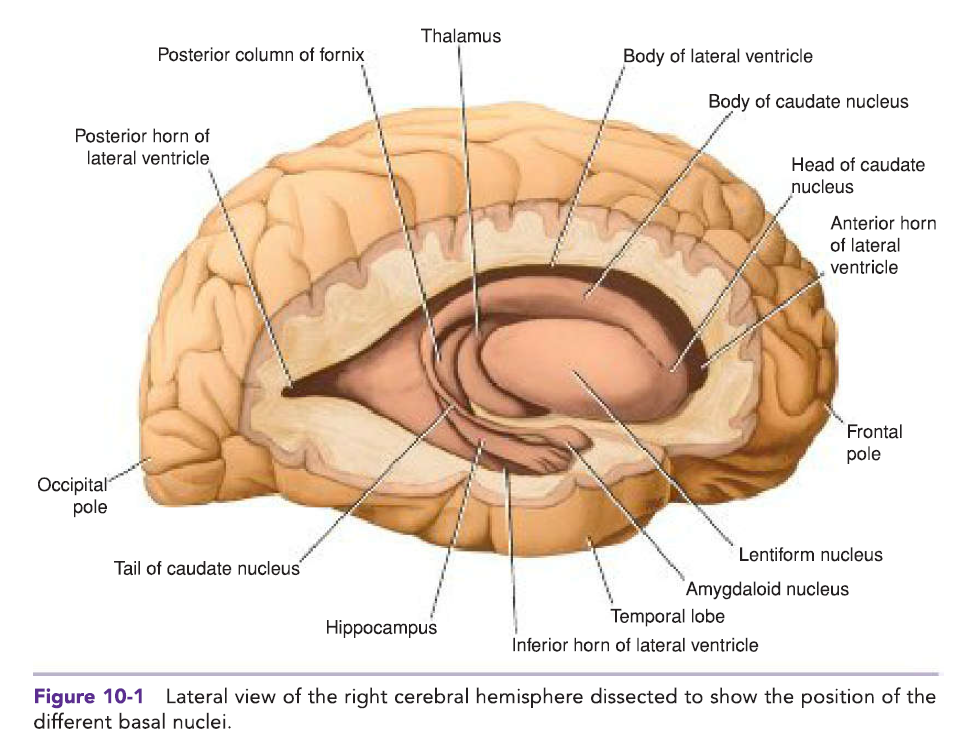 - Labels: thalamus, caudate nucleus, lentiform nucleus, hippocampusimage anatomy
 -
What is the primary role of the basal nuclei in brain function?
Regulate movement, cognition, and emotion via inhibitory direct and indirect loops that modulate thalamocortical output.
basalnuclei function -
Name the main anatomical components of the basal nuclei listed in the summary.
- Caudate nucleus
- Putamen
- Globus pallidus
- Subthalamic nucleus (STN)
- Substantia nigra (SN)
anatomy basalnuclei -
How do the direct and indirect basal ganglia pathways differ in their net effect on thalamocortical output?
- Direct pathway: disinhibition (net facilitation)
- Indirect pathway: inhibition (net suppression)
pathways basalganglia -
Which neurotransmitters are explicitly listed as involved in basal nuclei circuits?
- GABA
- Glutamate
- Dopamine (from SNc)
neurotransmitters basalnuclei -
List the five parallel functional loops of the basal nuclei.
- Motor
- Oculomotor
- Cognitive
- Orbitofrontal
- Limbic
circuits basalnuclei -
Name clinical movement disorders associated with basal nuclei dysfunction mentioned in the notes.
- Parkinson disease
- Huntington disease
- Hemiballism
- Chorea
clinical movement -
What distinction between motor systems is highlighted in the core concepts?
The distinction between pyramidal and extrapyramidal pathways.
motor pathways -
Which deep cerebral structures are shown in the provided horizontal cross-section image (answer includes an illustrative image)?
- Caudate nucleus, lentiform nucleus, thalamus, internal capsule, ventricles, corpus callosum
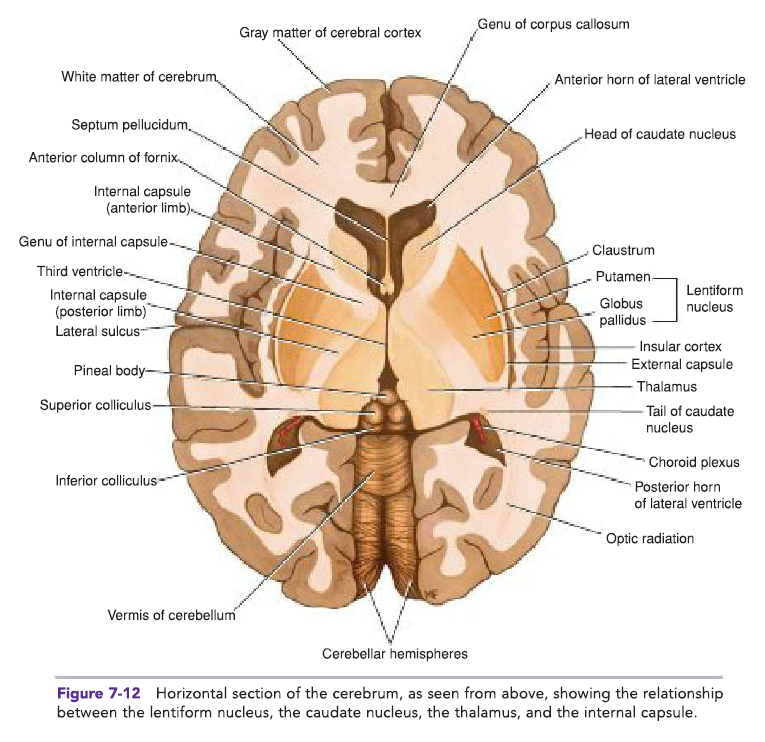 image anatomy
 -
What are the main nuclei included in the basal nuclei (basal ganglia) anatomy?
- Caudate nucleus
- Putamen
- Globus pallidus
- Subthalamic nucleus (STN)
- Substantia nigra (SN)
anatomy basalganglia -
Name other brain structures related to the basal ganglia.
- Amygdala
- Subthalamus
- Substantia nigra
- Thalamus
anatomy related -
Which of the following is NOT listed as one of the five parallel loops of the basal nuclei?
Motor
Auditory
Oculomotor
Limbic
functional loops -
What is the functional difference between the direct and indirect basal ganglia pathways?
- Direct pathway: disinhibition of thalamocortical output
- Indirect pathway: inhibition of thalamocortical output
pathways physiology -
Which neurotransmitters are explicitly associated with basal nuclei function?
- GABA
- Glutamate
- Dopamine (from SNc)
neurotransmitters basalganglia -
Which clinical disorder is associated with loss of dopaminergic neurons in the substantia nigra?
Hemiballism
Parkinson
Huntington
Chorea
clinical parkinson -
Name three clinical movement disorders linked to basal nuclei dysfunction.
- Parkinson
- Huntington
- Hemiballism / Chorea
clinical disorders -
How do basal nuclei regulate movement, cognition, and emotion according to the summary?
By deep cerebral circuits using inhibitory direct and indirect loops that modulate thalamocortical output
function summary -
What distinction is noted between pyramidal and extrapyramidal pathways?
A functional distinction exists between pyramidal and extrapyramidal pathways
pathways distinction -
Where can a schematic diagram of basal ganglia interconnected pathways be found (used as an illustrative media)?
Schematic diagram of basal ganglia pathways:
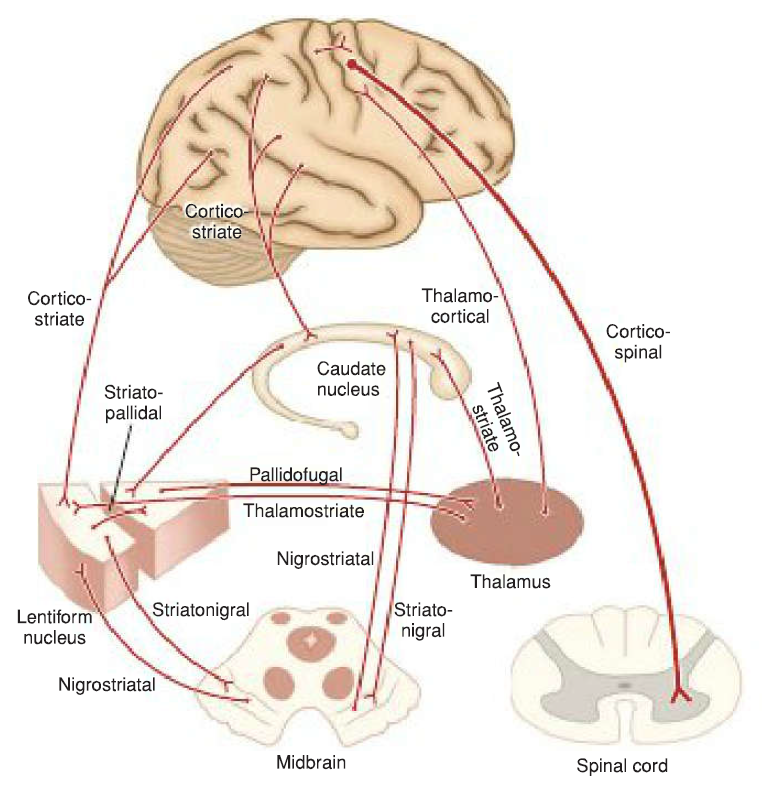 media diagram
 -
How are the basal nuclei organized with respect to information flow?
The basal nuclei are wired in circular loops performing various functions.
basal_nuclei organization -
How many parallel circuits operate within the basal nuclei?
Five parallel circuits operate within the basal nuclei.
basal_nuclei circuits -
What is the primary function of the motor loop of the basal nuclei?
Motor loop: somatic motor control.
motor basal_nuclei -
What is the primary function of the oculomotor loop of the basal nuclei?
Oculomotor loop: orientation and gaze.
oculomotor basal_nuclei -
What is the role of the dorsolateral prefrontal loop in the basal nuclei?
Dorsolateral prefrontal loop: cognitive processes.
cognitive prefrontal -
What does the lateral orbitofrontal loop of the basal nuclei mediate?
Lateral orbitofrontal loop: cognitive processes.
orbitofrontal cognitive -
What functions are associated with the limbic loop of the basal nuclei?
Limbic loop: emotions and visceral functions.
limbic emotion -
What does 'Dishinihibition' mean?
Release of inhibitions
basalganglia terminology -
How do direct and indirect pathways generally affect information flow through the thalamus?
- Direct pathways: facilitate thalamic information flow
- Indirect pathways: inhibit thalamic information flow
pathways thalamus -
What is the primary functional mode of the basal nuclei?
They function primarily through inhibition and disinhibition (release from inhibition).
basalganglia function -
What effect does the direct pathway of the motor loop have on thalamic output and cortical excitation?
Disinhibition of the thalamus increases its output, leading to increased cortical excitation.
motor direct -
What effect does the indirect pathway of the motor loop have on thalamic output and cortical excitation?
Increased inhibition of the thalamus decreases its output, leading to decreased cortical excitation.
motor indirect -
What effect does the Globus Pallidus have on extensors?
The Globus Pallidus is inhibitory to extensors
basalganglia extensors -
What term is used in the notes for release from inhibition?
Disinhibiton
physiology terminology -
According to the notes, what happens to flexors when the Globus Pallidus is inhibitory?
The notes state the flexor muscle contracting
basalganglia flexors -
What is GABA?
GABA is an inhibitory neurotransmitter.
neurotransmitter gaba -
What initiates the motor loop circuit?
- Motor information from the cortex
- Motor information from the thalamus
- Motor information from the brain stem
motor circuit -
Through which structure is motor loop output channeled to influence cortical motor output?
The globus pallidus channels motor loop output to influence motor output from the cerebral cortex.
globuspallidus motor -
What motor functions does the motor loop deal with?
Execution and preparation of movement, for example getting the body in proper alignment to perform a movement.
motor function -
With which structure is dopamine associated in the motor system?
Dopamine is associated with the substantia nigra.
dopamine substantianigra -
Which structures are shown in the motor loop diagram as involved in motor control? (illustration on answer side)
Illustrated structures include the cerebral cortex, corpus striatum, globus pallidus, thalamus, subthalamic nuclei, brainstem, and spinal cord.
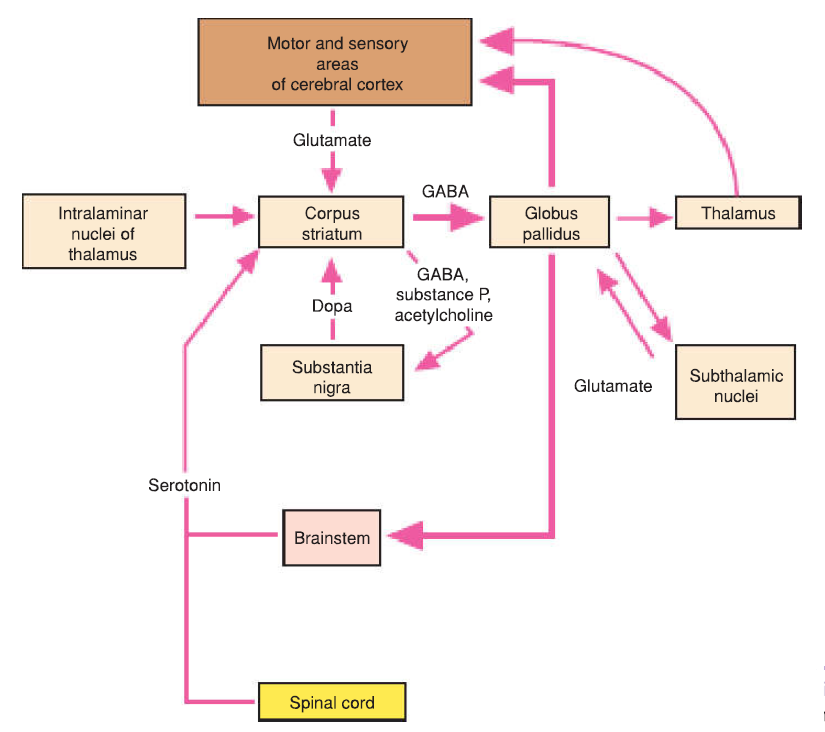 diagram motor
 -
What is chorea?
Involuntary, quick, nonrepetitive movements that can involve the face, head, and limbs.
movement chorea -
What brain structure degenerates in Huntington's chorea?
Degeneration of the caudate nucleus.
huntington caudate -
Define hemiballism.
Involuntary movement of one side of the body, usually involving proximal limb muscles; lesion often involves the subthalamus.
hemiballism subthalamus -
What are common Parkinson disease motor symptoms listed?
Bradykinesia, pill-rolling tremor at rest, masked facies, and cogwheel rigidity.
parkinson symptoms -
Which structure's degeneration is cited as causing Parkinson disease?
Degeneration of the substantia nigra.
parkinson substantianigra -
What is athetosis and which structure degenerates?
Slow, worm-like, writhing movements most commonly of the distal limbs; degeneration of the globus pallidus.
athetosis globuspallidus -
What does a hyperkinetic basal nuclei disorder produce?
Excessive or abnormal movements (e.g., chorea, hemiballism, athetosis).
basalnuclei movement -
Give three examples of hyperkinetic movement disorders listed.
- Chorea
- Hemiballism
- Athetosis
hyperkinetic examples -
What does a hypokinetic basal nuclei disorder produce?
Lack or slowness of movement.
basalnuclei movement -
Which disease is noted to have both hyperkinetic and hypokinetic features?
Parkinson disease
parkinson clinical -
What are the pyramidal pathways responsible for?
Main pathways for voluntary motor control to somatic muscles.
pyramidal motor -
What is the corticospinal pathway?
A pyramidal pathway conveying voluntary motor commands from cortex to spinal motor neurons.
corticospinal pyramidal -
What is the corticonuclear (corticobulbar) pathway?
A pyramidal pathway providing conscious motor control to cranial nerves.
corticonuclear pyramidal -
What are extrapyramidal pathways described as?
Alternate pathways for voluntary motor output and involuntary brainstem-origin reflex motor pathways.
extrapyramidal motor -
Where does the rubrospinal pathway originate?
Red nucleus in the midbrain.
rubrospinal extrapyramidal -
Which cranial nerve and location are associated with the vestibulospinal pathway in the notes?
Associated with CN VIII at the pons.
vestibulospinal extrapyramidal -
What structures give rise to the tectospinal pathway?
Superior and inferior colliculi in the posterior part of the midbrain.
tectospinal extrapyramidal -
What is tardive dyskinesia?
A movement disorder characterized by involuntary movements of the tongue, lips, face, trunk, and extremities.
movement-disorder extrapyramidal -
Which body parts are affected by the involuntary movements in tardive dyskinesia?
- Tongue
- Lips
- Face
- Trunk
- Extremities
symptoms extrapyramidal -
What common class of drugs often causes tardive dyskinesia after long-term use?
Dopaminergic antagonists such as antipsychotics (neuroleptics).
causes pharmacology -
What can happen to abnormal movement patterns of tardive dyskinesia after stopping the offending medication?
They may either resolve or continue after the medication is discontinued.
prognosis extrapyramidal -
Name the main anatomical components of the basal nuclei.
- Caudate
- Putamen
- Globus pallidus
- Subthalamic nucleus (STN)
- Substantia nigra (SN)
anatomy basal-nuclei -
List the five parallel functional loops of the basal nuclei.
- Motor
- Oculomotor
- Cognitive
- Orbitofrontal
- Limbic
functional-loops basal-nuclei -
What is the difference between the direct and indirect basal nucleus pathways?
- Direct: causes disinhibition of thalamocortical output.
- Indirect: causes inhibition of thalamocortical output.
pathways basal-nuclei -
Which neurotransmitters are associated with basal nucleus circuits?
- GABA, glutamate, and dopamine (from SNc).
neurotransmitters basal-nuclei -
Name clinical movement disorders linked to basal nuclei dysfunction.
- Parkinson disease
- Huntington disease
- Hemiballism
- Chorea
- Tardive dyskinesia
clinical movement-disorders -
How do basal nuclei influence thalamocortical output?
- They use inhibitory direct and indirect loops to modulate (increase or decrease) thalamocortical output.
function basal-nuclei -
What is the distinction between pyramidal and extrapyramidal pathways?
- Pyramidal: corticospinal motor pathway.
- Extrapyramidal: motor regulation via basal nuclei and related circuits.
pathways motor-systems
Overview
- Basal nuclei (basal ganglia) are deep cerebral nuclei that modulate voluntary movement, cognition, and emotion via inhibitory/disinhibitory loops.
- They act mainly by controlling thalamic output to cortex, using direct (facilitatory) and indirect (inhibitory) pathways.
Key components (anatomy)
- Corpus striatum = caudate nucleus + lentiform nucleus (putamen + globus pallidus).
- Caudate: head, body, tail — major input structure.
- Putamen: major input (motor-related).
- Globus pallidus: major output; has internal (GPi) and external (GPe) segments.
- Other related nuclei: subthalamic nucleus (STN), substantia nigra (pars compacta SNc and pars reticulata SNr), thalamus, amygdala.
Alt: Sagittal anatomy showing basal nuclei and thalamus.
Organization & major connections
- Inputs: cortex (sensorimotor, associative, limbic) → striatum (caudate/putamen).
- Outputs: GPi and SNr → thalamus → cortex; also projections to brainstem.
- Important pathways: cortico-striatal, striato-pallidal, pallidofugal, nigrostriatal, thalamo-cortical.
Alt: Schematic of cortico‑striatal and pallidal pathways.
The five parallel basal nuclei loops (functions)
- Motor loop — execution and preparation of movement.
- Oculomotor loop — gaze and eye-movement orientation.
- Dorsolateral prefrontal loop — executive/cognitive processes.
- Lateral orbitofrontal loop — decision-making, behavioral flexibility.
- Limbic loop — emotions and visceral responses.
Motor loop: direct vs indirect pathways (mechanisms)
-
Overall principle: basal nuclei modulate cortex by inhibition and disinhibition of thalamic output.
-
Direct pathway (facilitates movement)
- Cortex → striatum (GABA) inhibits GPi/SNr → less inhibition on thalamus → increased thalamic output to cortex → movement facilitated.
-
Function: select and promote intended motor programs (release from tonic inhibition).
-
Indirect pathway (suppresses competing movements)
- Cortex → striatum inhibits GPe → reduced inhibition of STN → STN excites GPi → GPi increases inhibition on thalamus → reduced thalamic output → movement suppressed.
-
Function: inhibit unwanted or competing motor programs.
-
Dopamine (from SNc): modulates both pathways — D1 receptors enhance the direct pathway (facilitation); D2 receptors inhibit the indirect pathway (also net facilitation). Loss of dopaminergic input shifts balance toward inhibition of movement.
Alt: Motor loop showing cortex, striatum, GP, STN, thalamus and GABA.
Neurotransmitters (quick)
- GABA — main inhibitory output from striatum and globus pallidus.
- Glutamate — excitatory (cortex → striatum; STN → GPi).
- Dopamine — modulatory from SNc (D1, D2 effects).
Functions (summary)
- Selects appropriate motor patterns and suppresses competing ones.
- Involved in motor learning, posture, and initiation of movement.
- Also contributes to cognition and emotion via parallel loops.
Clinical correlations: disorders & signs
- Chorea: sudden, brief, irregular movements (face, limbs).
- Huntington disease: hereditary degeneration of caudate → chorea, cognitive decline.
- Hemiballism: violent flinging movements of one side; classically from STN lesion.
- Athetosis: slow, writhing distal movements; associated with pallidal dysfunction.
-
Parkinson disease: degeneration of SNc → bradykinesia, resting (pill‑rolling) tremor, masked face, cogwheel rigidity; mixture of hypokinetic and some hyperkinetic features.
-
Classification: hyperkinetic (excess movements: chorea, athetosis, hemiballism) vs hypokinetic (reduced movements: Parkinsonism).
Drug-induced extrapyramidal symptoms (EPS)
- Long-term use of dopamine antagonists (typical antipsychotics/neuroleptics) can cause tardive dyskinesia — repetitive involuntary movements of tongue, face, trunk, limbs.
- EPS may persist or sometimes improve after stopping the drug.
Pyramidal vs extrapyramidal (quick comparison)
- Pyramidal pathways: corticospinal and corticobulbar tracts — direct conscious motor control to somatic muscles.
- Extrapyramidal pathways: indirect motor systems (rubrospinal, reticulospinal, vestibulospinal, tectospinal) and basal nuclei circuits — modulate posture, tone, involuntary/reflex components.
Clinical exam tips & lesion localization
- Resting tremor suggests basal nuclei (Parkinsonian) involvement; intention tremor suggests cerebellar lesion.
- Hemiballism localizes to contralateral STN lesion.
- Parkinsonian signs point to loss of SNc dopamine.
Useful videos (clinical examples)
- Chorea: https://youtu.be/QORlwMeWOeU?si=1VCqPXCpK4VqejOb
- Hemiballism: https://youtu.be/RAATfknm1F4?si=3jsautE1clnZ31vE
- Athetosis: https://youtu.be/E5N9SZ4wYhw?si=sPhPec-i3Y-_mAQs
- Tardive dyskinesia: https://www.youtube.com/watch?v=FUr8ltXh1Pc
Quick facts to remember
- Corpus striatum = caudate + putamen; lentiform = putamen + globus pallidus.
- GPi = main inhibitory output to thalamus; GPe = part of the indirect loop.
- Dopamine loss → reduced direct & overactive indirect pathway → hypokinesia.
- STN lesion → decreased excitation of GPi → hemiballism (hyperkinetic).