Sauvegarde ton deck avant qu'il ne disparaisse
Ces flashcards ne sont pas encore sauvegardées — elles seront perdues si tu quittes. Crée un compte gratuit pour les garder et débloquer tout ce qui suit.
- Save this deck to your account
- Study with spaced repetition
- Export to Anki (.apkg) or PDF
- Process documents up to 100 pages
- Images extracted from your PDFs
- Sharper text extraction & a more advanced AI model
How should design parameters for an aircraft be analyzed?
What is the unit for wing loading?
What is the unit for the thrust-to-weight ratio?
Upon what value are both wing loading and thrust-to-weight ratio parameters relative?
What primary analysis can be used to determine wing loading and thrust-to-weight ratio?
What two metrics must be combined with the aircraft weight to compute absolute wing size and thrust?
What are the two most important parameters affecting aircraft performance?
How can a short takeoff distance be achieved using a large wing design?
What design configuration allows for a short takeoff distance using a small wing?
How does the required lift-off speed relate to the wing size of an aircraft?
What is the primary role of a high thrust-to-weight ratio (\(T/W\)) in aircraft takeoff?
How do wing loading (\(W/S\)) and thrust-to-weight ratio (\(T/W\)) relate during performance calculations?
Which design approach is illustrated by aircraft with different wing sizes relative to weight?
What is the formula for the thrust-to-weight ratio used for aircraft design?
Under what conditions is the installed thrust-to-weight ratio for an aircraft typically computed?
What is the typical installed thrust-to-weight ratio for a jet trainer?
What is the typical installed thrust-to-weight ratio for a jet fighter (dogfighter)?
What is the typical installed thrust-to-weight ratio for a military cargo/bomber aircraft?
How does a higher thrust-to-weight ratio impact the performance of an aircraft?
What is the effect of high wing loading on an aircraft?
How is wing loading \((W/S)\) defined?
What is the formula for calculating wing loading \((W/S)\)?
What parameters does wing loading \((W/S)\) influence in aircraft design?
Why must W/S values be adjusted during mission calculations?
What is the typical range of wing loading in \(N/m^2\) for Ultra light aircraft?
What is the typical range of wing loading in \(N/m^2\) for Light single piston engine aircraft?
What is the typical range of wing loading in \(N/m^2\) for General aviation single turboprop aircraft?
What is the typical range of wing loading in \(N/m^2\) for General aviation twin piston engine aircraft?
What is the typical range of wing loading in \(N/m^2\) for Small turboprop commuter aircraft?
What is the typical range of wing loading in \(N/m^2\) for Large turboprop commuter aircraft?
What is the typical wing loading in \(N/m^2\) for Small executive jets?
What is the typical wing loading in \(N/m^2\) for Medium executive jets?
What is the typical wing loading in \(N/m^2\) for Large executive jets?
What is the typical range of wing loading in \(N/m^2\) for Military jet trainers?
What is the typical range of wing loading in \(N/m^2\) for Turbopropeller transports?
What is the typical range of wing loading in \(N/m^2\) for Naval strike/interceptor aircraft?
What is the typical range of wing loading in \(N/m^2\) for Land based strike/interceptor aircraft?
What is the typical wing loading in \(N/m^2\) for Supersonic long-range bomber and transport aircraft?
What is the typical range of wing loading in \(N/m^2\) for Subsonic long-range bomber aircraft?
What is the typical range of wing loading in \(N/m^2\) for Short/medium haul jet transport aircraft?
What is the typical range of wing loading in \(N/m^2\) for Long haul jet transport aircraft?
What is the physical significance of the ratio \(T/W_{TO}\) in aircraft design?
What does the parameter \(W/S_{TO}\) represent in aircraft design?
How do typical thrust-to-weight ratios (\(T/W_{TO}\)) compare between transport and combat aircraft?
How do typical wing loading (\(W/S_{TO}\)) values compare between transport and combat aircraft?
What is the general relationship between thrust-to-weight ratio and wing loading for high-performance combat aircraft?
Which aircraft category generally exhibits lower thrust-to-weight ratios but handles higher wing loading?
Which aircraft flight phases specifically require low-speed performance?
Which aircraft flight phase specifically requires high-speed performance?
What are the primary design constraints for civil aircraft?
Aside from standard flight requirements, what additional factors may drive the design of military aircraft?
Name common factors that act as drivers for determining the required thrust-to-weight ratio (T/W) and wing loading (W/S) for an aircraft.
How does the analysis of different flight states affect the determination of \(T/W\) and \(W/S\) values?
How can requirements for different flight states be synthesized when determining \(T/W\) and \(W/S\)?
What is a common performance requirement considered during the initial design phase of a new aircraft?
Which parameters influence the stall speed of an aircraft?
When designing for a specific stall speed, what parameter is determined as an output?
How does engine thrust typically affect the stall speed of standard transport aircraft?
In what aircraft configurations must the stall speed equation be modified to account for engine thrust?
What is the basic lift equation for cruise flight, assuming \(L=W\)?
Provide the formula for calculating stall speed \(v_s\) in relation to weight, wing area, and maximum lift coefficient.
How does wing loading (\(W/S\)) affect an aircraft's stall speed?
How does the maximum lift coefficient (\(C_{L,max}\)) affect stall speed?
What is the relationship between air density (\(\rho\)) and stall speed at lower altitudes?
What is the formula to calculate the required wing loading (\(W/S\)) for a specified stall speed?
In a \(T/W\) vs \(W/S\) diagram, what does the region to the left of the \(W/S_{required}\) line represent?
What two metrics determine the airfields from which an aircraft can be operated?
What physical factors determine an aircraft's required landing field length?
Why is a typical landing performance equation considered a mix of physical relation and statistical data?
What is the primary requirement for aircraft landing performance defined in the provided context?
What are the key influencing parameters for determining the required landing wing loading (\(W/S\))?
What is the specific output value derived from the landing performance calculation regarding wing loading?
To which velocity parameter is the landing field length (\(S_{LFL}\)) proportional?
What variables are used to calculate the stall speed (\(v_S\)) of an aircraft?
How does a higher wing loading affect the landing field length (\(S_{LFL}\))?
How does a high maximum lift coefficient (\(C_{L,max,L}\)) affect the landing field length (\(S_{LFL}\))?
At lower altitudes, where air density is higher, what is the effect on landing field length (\(S_{LFL}\))?
What is the recommended value for the proportionality factor \(k_L\) for jet transport aircraft?
Provide the formula for required wing loading (\(W_{ML}/S\)) at landing for a specified landing field length (\(S_{LFL}\)).
Why is a correction factor \(W_{ML}/W_{MTO}\) sometimes used when calculating aircraft wing loading?
What is the formula to calculate required wing loading when the maximum landing weight differs from the take-off weight?
In the context of aircraft design, what do the abbreviations \(W_{ML}\) and \(W_{TO}\) represent?
Based on the provided \(T/W - W/S\) diagram, what does the region to the right of the \(W/S_{required}\) line represent?
How can an engineer estimate the weight ratio \(W_{ML}/W_{MTO}\) for different classes of aircraft?
What is the relationship between the landing field length (LFL) requirement and \(W/S\) according to the diagram?
What are the two primary sources for take-off performance requirements for an aircraft?
How does the maximum take-off weight \(W_{MTO}\) affect take-off distance?
What is the primary role of the maximum engine thrust \(T\) during take-off?
Which two parameters together influence the velocity at which an aircraft can lift-off?
What are the three main phases of the total take-off distance illustrated in the flight performance diagram?
What primary factors determine the take-off performance of an aircraft?
What is the primary factor that determines the landing performance of an aircraft?
Why are performance equations for take-off field length often a mix of physical correlations and statistical factors?
What is the main requirement regarding take-off performance?
What are two key influencing parameters for take-off performance?
What is the expected output when determining the required take-off performance relative to wing loading?
What is the relationship between acceleration, thrust, and mass for an aircraft assuming no drag or friction?
How is velocity as a function of time expressed for an accelerating aircraft?
How is travelled distance as a function of time expressed for an accelerating aircraft?
What is the relationship between travelled distance and velocity for an accelerating aircraft?
Which formula defines take-off field length using weight, thrust, and velocity?
What is the basic lift equation formula for stall speed squared?
What is the combined formula for take-off field length incorporating the stall speed lift equation?
What is the purpose of the correction factor \(k_{TO}\) in aircraft take-off field distance calculations?
What is the value of the take-off correction factor \(k_{TO}\) for jet transport aircraft according to Roskam?
How is the air density ratio \(\sigma\) defined in the context of aircraft take-off field length?
To which variables is the take-off field length \(s_{TOFL}\) directly proportional and inversely proportional?
What is the formula for the required thrust-to-weight ratio (\(\frac{T}{W}\)) for a specified take-off field length?
In a \(\frac{T}{W}\) versus \(\frac{W}{S}\) diagram, which region represents configurations that do not fulfill the required take-off field length (TOFL)?
Why do aircraft certification specifications require a minimum climb rate?
Which aircraft performance parameter is directly impacted by minimum climb rate requirements?
What is the key parameter that influences the calculation of the required \(T/W\) for a given climb rate?
What is the result of the calculation performed to meet minimum climb rate requirements?
What is the primary balance equation of forces for an aircraft in an unaccelerated climb along the flight path?
How does the lift \(L\) relate to weight \(W\) during an unaccelerated climb?
What is the climb performance equation for an aircraft with all engines operating?
How is the climb angle \(\gamma\) expressed in terms of the climb gradient percentage?
What effect does a high lift-to-drag ratio (\(L/D\)) have on climb performance?
What does a position in the non-shaded region above the threshold line represent in a \(T/W\) vs \(W/S\) diagram for climb performance?
What is the minimum steady climb gradient required for a two-engined aeroplane during the take-off phase with landing gear retracted and the critical engine inoperative?
What is the minimum steady climb gradient required for a three-engined aeroplane during the take-off phase with landing gear retracted and the critical engine inoperative?
What is the minimum steady climb gradient required for a four-engined aeroplane during the take-off phase with landing gear retracted and the critical engine inoperative?
What is the minimum steady climb gradient required for a two-engined aeroplane during the approach phase with the critical engine inoperative?
What is the minimum steady climb gradient required for a three-engined aeroplane during the approach phase with the critical engine inoperative?
What is the minimum steady climb gradient required for a four-engined aeroplane during the approach phase with the critical engine inoperative?
What does certification require for an aircraft in the event of a single engine failure during take-off?
What is the formula for the required thrust-to-weight ratio when all engines are operating?
What is the formula for the required thrust-to-weight ratio when one engine is inoperative (OEI)?
In the thrust-to-weight ratio formula for OEI conditions, what does the variable \(N\) represent?
How is the climb angle variable \(\sin \gamma\) defined in terms of climb performance?
What is a common cause of unexpected engine failure during the take-off phase, as illustrated in the provided context?
What is the landing configuration of an aircraft during a missed approach with one engine inoperative?
Which weight variable is used for thrust-to-weight ratio calculations during a missed approach with one engine inoperative?
What is the formula for the required thrust-to-weight ratio for a climb with one engine inoperative?
How is the thrust-to-weight ratio corrected for the maximum take-off weight \(W_{MTO}\)?
What is the complete thrust-to-weight ratio formula for an aircraft during a missed approach with one engine inoperative?
What does \(N\) represent in the formula for the thrust-to-weight ratio of an aircraft with one engine inoperative? 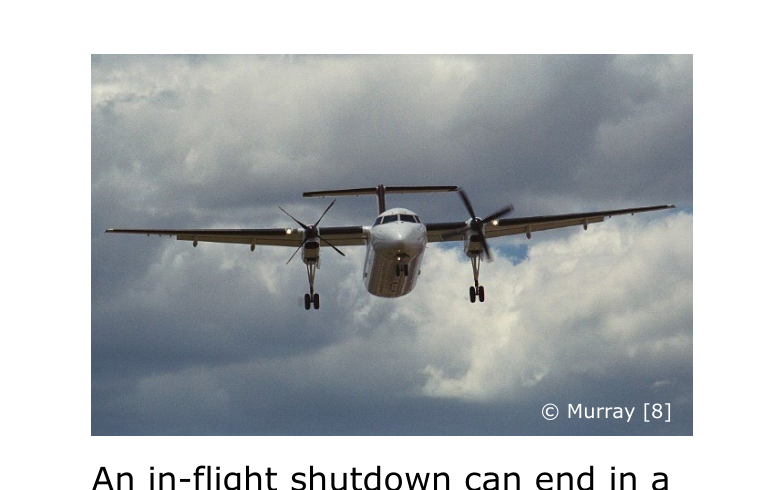
What is the primary reason for defining a specific cruise velocity \(v_{CR}\) or cruise Mach number \(Ma_{CR}\) for an aircraft?
From what aerodynamic consideration can the required thrust-to-weight ratio (\(T/W\)) be estimated?
From what aerodynamic consideration can the required wing loading (\(W/S\)) be estimated?
Name four parameters that influence the cruise performance requirements of an aircraft.
What is the key output sought when calculating aircraft performance based on cruise speed?
What is the target cruise lift coefficient (\(C_{L,cr}\)) for an aircraft to achieve optimal fuel efficiency?
Provide the equation to calculate the lift coefficient for the maximum lift-to-drag ratio (\(C_{L,(L/D)max}\)).
What is the fundamental equation for wing loading (\(W/S\)) during unaccelerated horizontal cruise flight?
How is cruise velocity (\(v_{cr}\)) related to the cruise Mach number (\(Ma_{cr}\))?
How is air density (\(\rho\)) expressed using the ideal gas law?
Provide the wing loading (\(W/S\)) equation for high-speed transport aircraft expressed in terms of the cruise Mach number and static pressure.
What is the relationship between weight (\(W\)) and lift (\(L\)) in steady horizontal flight?
In steady horizontal flight, what is the relationship between cruise thrust (\(T_{cr}\)) and drag (\(D\))?
What is the formula for the cruise thrust-to-weight ratio in terms of maximum lift-to-drag ratio?
What two factors influence the available thrust in cruise (\(T_{cr}\)) for a jet engine?
How is the takeoff thrust-to-weight ratio corrected to account for cruise conditions?
What is the full equation for the cruise thrust-to-weight ratio (\(\frac{T}{W}\)) using the reduction factor?
How are the required wing loading \(\frac{W}{S}\) and thrust-to-weight ratio \(\frac{T}{W}\) indirectly connected during cruise flight?
What is the formula for calculating ISA standard atmospheric pressure \(p\) at a given flight altitude \(h\)?
What is the standard sea-level atmospheric pressure value \(p_0\) used in aviation calculations?
What is the numerical value for the isentropic expansion factor \(\gamma\)?
What is the standard unit of measurement for flight altitude \(h\) in the provided pressure formula?
In a \(\frac{T}{W}\) vs \(\frac{W}{S}\) diagram, what does the region above the curve represent regarding cruise velocity?
What is the primary purpose of a 'Matching Diagram' in aircraft design?
In a Matching Diagram, what does the white area represent?
In a Matching Diagram, what does the shaded area represent?
To ensure comparability of aircraft performance values, what must be done to the \(T/W\) and \(W/S\) variables?
How should performance requirements like landing speed be plotted on a Matching Diagram?
What is the primary function of a Matching Diagram in the analysis of existing aircraft?
In a Matching Diagram, what do the performance lines for each requirement represent?
How do you interpret the position of an aircraft's \(\frac{T}{W}\) and \(\frac{W}{S}\) combination relative to performance requirement bounds in a Matching Diagram?
What is the primary objective when selecting the optimal combination of \(T/W\) and \(W/S\) for a new aircraft design?
What is the 'Design Point' in the context of aircraft performance matching diagrams?
Why is choosing a lower \(T/W\) ratio typically prioritized in aircraft design?
Why is choosing a higher \(W/S\) ratio typically prioritized in aircraft design?
What does the shaded 'Infeasible design space' region on a Matching Diagram represent?
Flashcards in this deck (173)
-
How should design parameters for an aircraft be analyzed?
They must be analyzed together as a system, rather than in isolation.
engineering aircraft -
What is the unit for wing loading?
\(N/m^2\)
engineering aeronautics -
What is the unit for the thrust-to-weight ratio?
\(N/N\)
engineering aeronautics -
Upon what value are both wing loading and thrust-to-weight ratio parameters relative?
The weight of the aircraft.
engineering aeronautics -
What primary analysis can be used to determine wing loading and thrust-to-weight ratio?
Flight performance analysis.
engineering performance -
What two metrics must be combined with the aircraft weight to compute absolute wing size and thrust?
- Wing loading (\(W/S\))
- Thrust-to-weight ratio (\(T/W\))
engineering calculations -
What are the two most important parameters affecting aircraft performance?
The thrust-to-weight ratio (\(T/W\)) and the wing loading (\(W/S\)).
aerodynamics performance -
How can a short takeoff distance be achieved using a large wing design?
By using a large wing (low \(W/S\)) paired with a relatively small engine (low \(T/W\)), which allows the aircraft to lift off at a lower speed.
aviation takeoff -
What design configuration allows for a short takeoff distance using a small wing?
A small wing (high \(W/S\)) paired with a large engine (high \(T/W\)) that provides the rapid acceleration required to reach the high lift-off speed.
aviation takeoff -
How does the required lift-off speed relate to the wing size of an aircraft?
Aircraft with a larger wing area (low \(W/S\)) can lift off at lower speeds, while aircraft with a smaller wing area (high \(W/S\)) must reach a higher speed to lift off.
aerodynamics aviation -
What is the primary role of a high thrust-to-weight ratio (\(T/W\)) in aircraft takeoff?
It provides the rapid acceleration necessary for an aircraft to reach the high speed required for lift-off when using a small wing.
aerodynamics aviation -
How do wing loading (\(W/S\)) and thrust-to-weight ratio (\(T/W\)) relate during performance calculations?
They are closely interconnected and must be considered together for most performance calculations.
aerodynamics engineering -
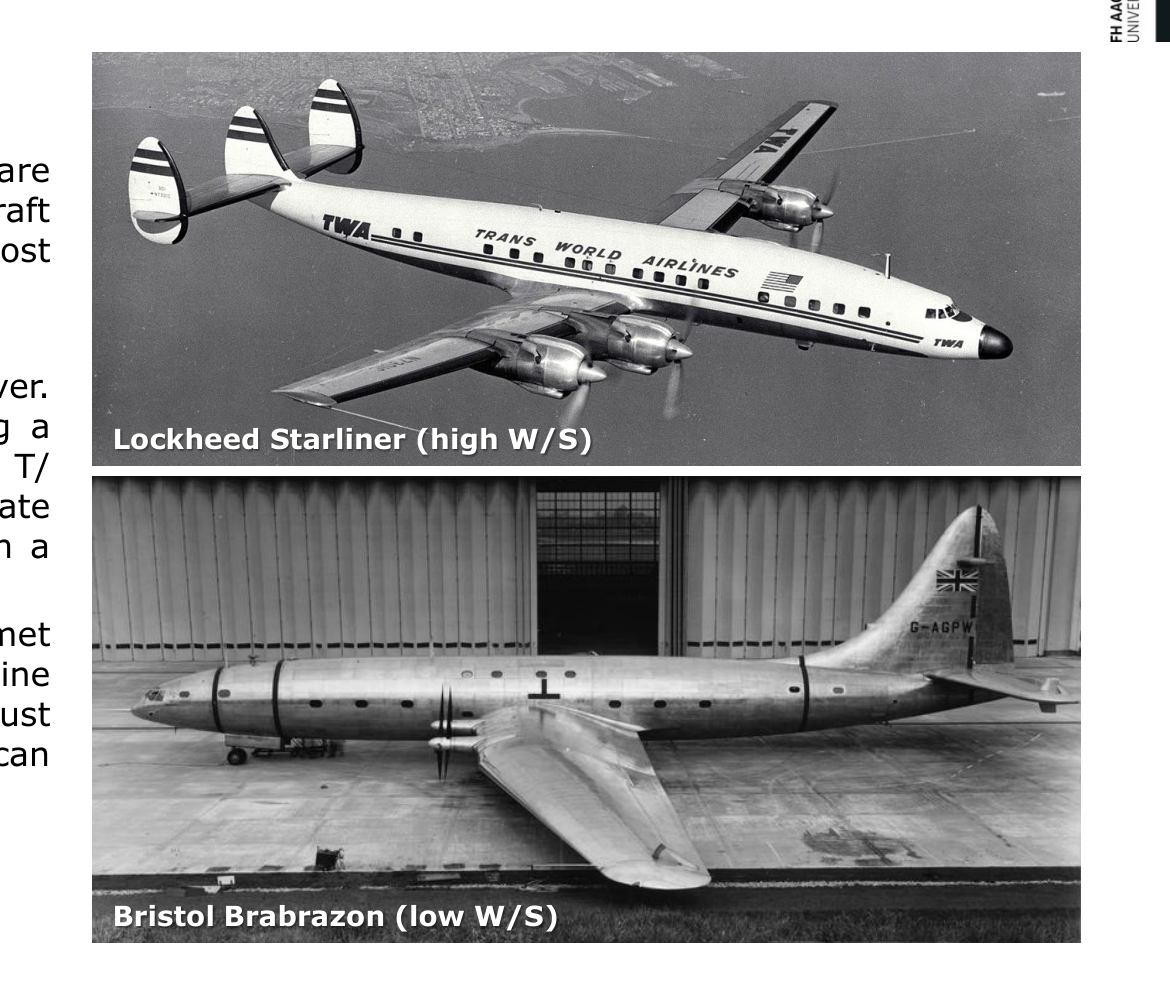
Which design approach is illustrated by aircraft with different wing sizes relative to weight?
Designing for takeoff performance involves balancing wing size (\(W/S\)) and engine power (\(T/W\)).
 aerodynamics aviation
 -
What is the formula for the thrust-to-weight ratio used for aircraft design?
\[\frac{T}{W} = \frac{T_{max,static,ISA,MSL}}{W_{max,take-off}}\]engineering aeronautics thrust -
Under what conditions is the installed thrust-to-weight ratio for an aircraft typically computed?
Sea-level static (zero-velocity), standard-day conditions at design takeoff weight and maximum throttle setting.
engineering aeronautics -
What is the typical installed thrust-to-weight ratio for a jet trainer?
0.4
engineering aeronautics -
What is the typical installed thrust-to-weight ratio for a jet fighter (dogfighter)?
0.9
engineering aeronautics -
What is the typical installed thrust-to-weight ratio for a military cargo/bomber aircraft?
0.25
engineering aeronautics -
How does a higher thrust-to-weight ratio impact the performance of an aircraft?
It allows the aircraft to accelerate more quickly, climb more rapidly, and reach a higher maximum speed.
engineering aeronautics -
What is the effect of high wing loading on an aircraft?
It leads to smaller wings and enables higher cruise speeds.
engineering aeronautics -
How is wing loading \((W/S)\) defined?
It is defined as the maximum gross weight of the aircraft divided by the area of the reference wing.
aerodynamics aircraft definition -
What is the formula for calculating wing loading \((W/S)\)?
\[\frac{W}{S} = \frac{W_{max.take-off}}{S_{ref}}\]aerodynamics formula aircraft -
What parameters does wing loading \((W/S)\) influence in aircraft design?
It determines the design lift coefficient and impacts drag through its effect on wetted area and wingspan/aspect ratio.
aerodynamics design aircraft -
Why must W/S values be adjusted during mission calculations?
Because fuel is burned off during flight, the aircraft weight decreases; calculations for W/S at various mission points must be converted back to takeoff weight.
aerodynamics mission calculations -
What is the typical range of wing loading in \(N/m^2\) for Ultra light aircraft?
200-400 \(N/m^2\)
aircraft data -
What is the typical range of wing loading in \(N/m^2\) for Light single piston engine aircraft?
500-800 \(N/m^2\)
aircraft data -
What is the typical range of wing loading in \(N/m^2\) for General aviation single turboprop aircraft?
1000-1800 \(N/m^2\)
aircraft data -
What is the typical range of wing loading in \(N/m^2\) for General aviation twin piston engine aircraft?
1000-2000 \(N/m^2\)
aircraft data -
What is the typical range of wing loading in \(N/m^2\) for Small turboprop commuter aircraft?
1500-2000 \(N/m^2\)
aircraft data -
What is the typical range of wing loading in \(N/m^2\) for Large turboprop commuter aircraft?
2000-3000 \(N/m^2\)
aircraft data -
What is the typical wing loading in \(N/m^2\) for Small executive jets?
2200 \(N/m^2\)
aircraft data -
What is the typical wing loading in \(N/m^2\) for Medium executive jets?
3000 \(N/m^2\)
aircraft data -
What is the typical wing loading in \(N/m^2\) for Large executive jets?
4000 \(N/m^2\)
aircraft data -
What is the typical range of wing loading in \(N/m^2\) for Military jet trainers?
2500-3000 \(N/m^2\)
aircraft data -
What is the typical range of wing loading in \(N/m^2\) for Turbopropeller transports?
3000-4000 \(N/m^2\)
aircraft data -
What is the typical range of wing loading in \(N/m^2\) for Naval strike/interceptor aircraft?
3500-4000 \(N/m^2\)
aircraft data -
What is the typical range of wing loading in \(N/m^2\) for Land based strike/interceptor aircraft?
4000-5000 \(N/m^2\)
aircraft data -
What is the typical wing loading in \(N/m^2\) for Supersonic long-range bomber and transport aircraft?
5000 \(N/m^2\)
aircraft data -
What is the typical range of wing loading in \(N/m^2\) for Subsonic long-range bomber aircraft?
5000-6000 \(N/m^2\)
aircraft data -
What is the typical range of wing loading in \(N/m^2\) for Short/medium haul jet transport aircraft?
5500-6500+ \(N/m^2\)
aircraft data -
What is the typical range of wing loading in \(N/m^2\) for Long haul jet transport aircraft?
6200-7000+ \(N/m^2\)
aircraft data -
What is the physical significance of the ratio \(T/W_{TO}\) in aircraft design?
It represents the thrust-to-weight ratio at take-off, which is a critical parameter for defining aircraft performance capabilities.
aerodynamics aircraft -
What does the parameter \(W/S_{TO}\) represent in aircraft design?
It represents the wing loading at take-off, defined as the ratio of take-off weight to wing surface area, measured in \(\text{lbf/ft}^2\).
aerodynamics aircraft -
How do typical thrust-to-weight ratios (\(T/W_{TO}\)) compare between transport and combat aircraft?
Combat aircraft generally maintain significantly higher \(T/W_{TO}\) values (ranging from approximately \(0.4\) to \(1.3\)) compared to transport aircraft, which typically operate in the \(0.15\) to \(0.45\) range.
performance aircraft -
How do typical wing loading (\(W/S_{TO}\)) values compare between transport and combat aircraft?
Transport aircraft typically operate at higher wing loading values (ranging from roughly \(50\) to \(250 \text{ lbf/ft}^2\)), while combat aircraft operate at lower wing loading values (typically between \(20\) and \(140 \text{ lbf/ft}^2\)).
performance aircraft -
What is the general relationship between thrust-to-weight ratio and wing loading for high-performance combat aircraft?
Combat aircraft prioritize high \(T/W_{TO}\) ratios to achieve superior maneuverability and acceleration, often requiring lower wing loading values to maintain flight efficiency and lift.
aerodynamics combat -
Which aircraft category generally exhibits lower thrust-to-weight ratios but handles higher wing loading?
Transport aircraft.
transport aircraft -
Which aircraft flight phases specifically require low-speed performance?
- Take-off
- Climb
- Landing
aircraft performance -
Which aircraft flight phase specifically requires high-speed performance?
Cruise
aircraft performance -
What are the primary design constraints for civil aircraft?
- Take-off field length
- Landing field length
- Climb requirements
- Cruise requirements
aircraft design -
Aside from standard flight requirements, what additional factors may drive the design of military aircraft?
- Maneuverability requirements (for fighters)
- Loiter requirements (for surveillance aircraft)
aircraft design -
Name common factors that act as drivers for determining the required thrust-to-weight ratio (T/W) and wing loading (W/S) for an aircraft.
- Cruise speed
- Climb rate
- Take-off field length
- Landing field length
- Stall speed
aircraft design -
How does the analysis of different flight states affect the determination of \(T/W\) and \(W/S\) values?
Each flight state results in a different value for these parameters.
aircraft performance analysis -
How can requirements for different flight states be synthesized when determining \(T/W\) and \(W/S\)?
The required \(T/W\) for each \(W/S\) across all flight states can be plotted in a diagram.
aircraft analysis -
What is a common performance requirement considered during the initial design phase of a new aircraft?
The stall speed \(v_s\).
aerodynamics design -
Which parameters influence the stall speed of an aircraft?
- The maximum lift coefficient \(C_{L,max}\)
- Air density \(\rho\)
aerodynamics parameters -
When designing for a specific stall speed, what parameter is determined as an output?
A maximum required value for the wing loading \(W/S\).
aerodynamics design -
How does engine thrust typically affect the stall speed of standard transport aircraft?
The influence of thrust on stall speed is small, so thrust effects are usually neglected in calculations.
aerodynamics transport -
In what aircraft configurations must the stall speed equation be modified to account for engine thrust?
In special configurations that rely on engine thrust to achieve very high lift coefficients.
aerodynamics thrust -
What is the basic lift equation for cruise flight, assuming \(L=W\)?
\(W = \frac{1}{2} \cdot \rho \cdot v^2 \cdot C_L \cdot S\)
aerodynamics aircraft -
Provide the formula for calculating stall speed \(v_s\) in relation to weight, wing area, and maximum lift coefficient.
\(v_s = \sqrt{\frac{2}{\rho \cdot C_{L,max}} \cdot \frac{W}{S}}\)
aerodynamics aircraft -
How does wing loading (\(W/S\)) affect an aircraft's stall speed?
A higher wing loading increases the stall speed.
aerodynamics aircraft -
How does the maximum lift coefficient (\(C_{L,max}\)) affect stall speed?
A higher \(C_{L,max}\) decreases the stall speed.
aerodynamics aircraft -
What is the relationship between air density (\(\rho\)) and stall speed at lower altitudes?
At lower altitudes, where air density is higher, the stall speed is lower.
aerodynamics aircraft -
What is the formula to calculate the required wing loading (\(W/S\)) for a specified stall speed?
\(\frac{W}{S} = \frac{\rho}{2} \cdot v_{S,req}^2 \cdot C_{L,max}\)
aerodynamics aircraft -
In a \(T/W\) vs \(W/S\) diagram, what does the region to the left of the \(W/S_{required}\) line represent?
This region represents wing loading values that fulfill the stall speed requirement.
aerodynamics diagram -
What two metrics determine the airfields from which an aircraft can be operated?
- Landing field length (LFL)
- Take-off field length (TOFL)
aviation design -
What physical factors determine an aircraft's required landing field length?
- Kinetic energy at touch-down
- Maximum landing weight (\(W_{ML}\))
- Square of the approach velocity (\(v_A^2\))
- Energy dissipation capability (e.g., wheel brakes or thrust reversion)
aviation landing -
Why is a typical landing performance equation considered a mix of physical relation and statistical data?
Because exact parameters—such as runway inclination, brake power, and friction coefficients—are difficult to determine precisely.
aviation engineering -
What is the primary requirement for aircraft landing performance defined in the provided context?
The aircraft must be able to land on runways of a specified length (\(s_{LFL}\)).
aviation requirements -
What are the key influencing parameters for determining the required landing wing loading (\(W/S\))?
- \(C_{L,max,Landing}\)
- Ratio of air densities \(\sigma = \rho/\rho_0\) (between airfield and mean sea level)
aviation engineering -
What is the specific output value derived from the landing performance calculation regarding wing loading?
A maximum value for \(W/S\).
aviation design -
To which velocity parameter is the landing field length (\(S_{LFL}\)) proportional?
The landing field length is proportional to the square of the approach velocity (\(v_A^2\)).
aerodynamics landing -
What variables are used to calculate the stall speed (\(v_S\)) of an aircraft?
- Maximum landing weight (\(W_{ML}\))
- Air density (\(\rho\))
- Maximum lift coefficient in landing configuration (\(C_{L,max,L}\))
- Wing area (\(S\))
aerodynamics physics -
How does a higher wing loading affect the landing field length (\(S_{LFL}\))?
It increases the landing field length.
aerodynamics performance -
How does a high maximum lift coefficient (\(C_{L,max,L}\)) affect the landing field length (\(S_{LFL}\))?
It decreases the landing field length.
aerodynamics performance -
At lower altitudes, where air density is higher, what is the effect on landing field length (\(S_{LFL}\))?
The landing field length is lower.
aerodynamics performance -
What is the recommended value for the proportionality factor \(k_L\) for jet transport aircraft?
\(0.107\)
aerodynamics aircraft-design -
Provide the formula for required wing loading (\(W_{ML}/S\)) at landing for a specified landing field length (\(S_{LFL}\)).
\[\frac{W_{ML}}{S} = k_L \cdot \sigma \cdot C_{L,max,L} \cdot S_{LFL} \cdot g\]aerodynamics equations -
Why is a correction factor \(W_{ML}/W_{MTO}\) sometimes used when calculating aircraft wing loading?
It accounts for instances where the maximum landing weight is lower than the maximum take-off weight, helping to reduce structural and landing gear loads during landing impact.
aerodynamics aircraft design -
What is the formula to calculate required wing loading when the maximum landing weight differs from the take-off weight?
\[\frac{W}{S} = \frac{1}{W_{ML}/W_{MTO}} \cdot k_L \cdot \sigma \cdot C_{L,max,L} \cdot S_{LFL} \cdot g\]math equations aeronautics -
In the context of aircraft design, what do the abbreviations \(W_{ML}\) and \(W_{TO}\) represent?
- \(W_{ML}\): Maximum landing weight
- \(W_{TO}\): Maximum take-off weight
definitions aircraft -
Based on the provided \(T/W - W/S\) diagram, what does the region to the right of the \(W/S_{required}\) line represent?
It represents wing loading values that do not fulfill the landing field length (LFL) requirements.
diagrams aircraft design -
How can an engineer estimate the weight ratio \(W_{ML}/W_{MTO}\) for different classes of aircraft?
By using the provided table, which organizes aircraft types (such as Business Jets and Transport Jets) and provides minimum, average, and maximum ratio estimates for each.
design aircraft -
What is the relationship between the landing field length (LFL) requirement and \(W/S\) according to the diagram?
Wing loading values less than or equal to \(W/S_{required}\) satisfy the landing field length requirement, while values greater than that limit do not.
aircraft design aerodynamics -
What are the two primary sources for take-off performance requirements for an aircraft?
- Customer requirements (size of airfields)
- Certifications specifications (safety considerations)
aircraft performance -
How does the maximum take-off weight \(W_{MTO}\) affect take-off distance?
It represents the weight that needs to be accelerated, which directly impacts the required take-off distance.
aircraft performance -
What is the primary role of the maximum engine thrust \(T\) during take-off?
It determines the rate of acceleration of the aircraft.
aircraft performance -
Which two parameters together influence the velocity at which an aircraft can lift-off?
- Wing area (\(S\))
- Maximum lift coefficient with high-lift devices deployed (\(C_{L,max,TO}\))
aircraft aerodynamics -
What are the three main phases of the total take-off distance illustrated in the flight performance diagram?
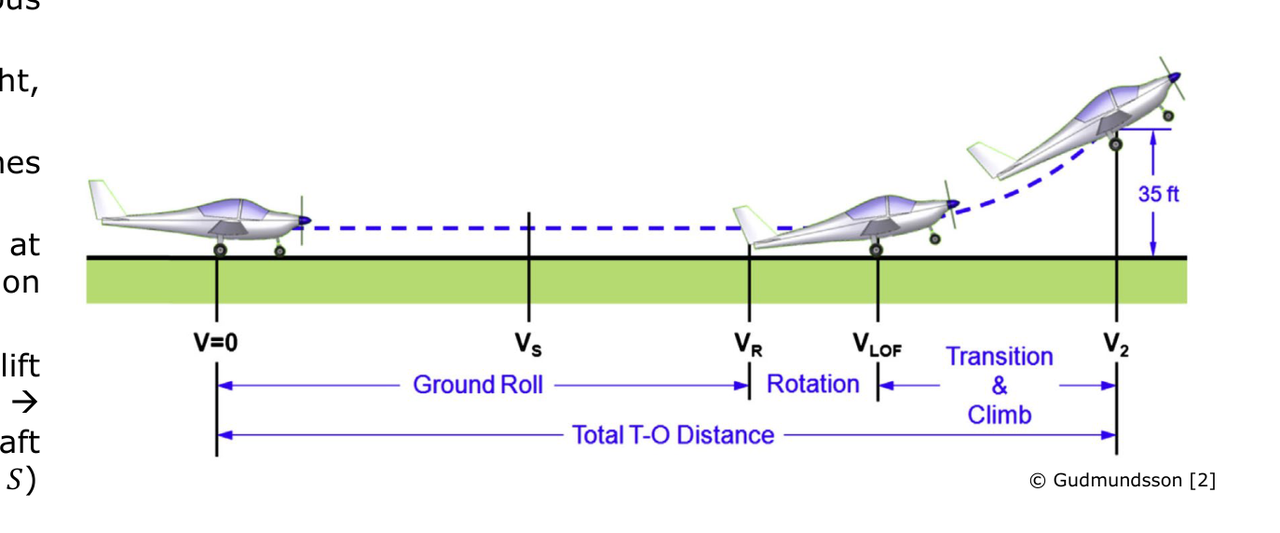 - Ground Roll
- Rotation
- Transition & Climbaircraft performance
- Ground Roll
- Rotation
- Transition & Climbaircraft performance -
What primary factors determine the take-off performance of an aircraft?
The thrust-to-weight ratio \(T/W\) and wing loading \(W/S\).
aerodynamics aircraft -
What is the primary factor that determines the landing performance of an aircraft?
The wing loading \(W/S\).
aerodynamics aircraft -
Why are performance equations for take-off field length often a mix of physical correlations and statistical factors?
Because take-off field length depends on many parameters that are very difficult to determine exactly.
aerodynamics aircraft -
What is the main requirement regarding take-off performance?
The aircraft must be able to take off from runways of a specified length \(s_{TOFL}\).
aerodynamics aircraft -
What are two key influencing parameters for take-off performance?
- The maximum lift coefficient during take-off \(C_{L,max,Take-Off}\)
- The ratio of air densities \(\sigma = \rho / \rho_{0}\)
aerodynamics aircraft -
What is the expected output when determining the required take-off performance relative to wing loading?
A minimum value for the thrust-to-weight ratio \(T/W\) as a function of wing loading \(W/S\).
aerodynamics aircraft -
What is the relationship between acceleration, thrust, and mass for an aircraft assuming no drag or friction?
\(a \sim \frac{T}{m_{MTO}}\)
aerodynamics aircraft physics -
How is velocity as a function of time expressed for an accelerating aircraft?
\(v(t) \sim \frac{T}{m_{MTO}} \cdot t\)
aerodynamics aircraft -
How is travelled distance as a function of time expressed for an accelerating aircraft?
\(s(t) \sim \frac{1}{2} \cdot \frac{T}{m_{MTO}} \cdot t^2\)
aerodynamics aircraft -
What is the relationship between travelled distance and velocity for an accelerating aircraft?
\(s(v) \sim \frac{1}{2} \cdot \frac{m_{MTO}}{T} \cdot v^2\)
aerodynamics aircraft -
Which formula defines take-off field length using weight, thrust, and velocity?
\(s_{TOFL} \sim \frac{1}{2} \cdot \frac{W_{MTO}}{T \cdot g} \cdot v_s^2\)
aerodynamics aircraft -
What is the basic lift equation formula for stall speed squared?
\(v_s^2 = \frac{2}{\rho \cdot C_{L,max,TO}} \cdot \frac{W_{MTO}}{S}\)
aerodynamics aircraft -
What is the combined formula for take-off field length incorporating the stall speed lift equation?
\(s_{TOFL} \sim \frac{1}{\rho \cdot C_{L,max,TO} \cdot g} \cdot \frac{W_{MTO}/S}{T/W_{MTO}}\)
aerodynamics aircraft -
What is the purpose of the correction factor \(k_{TO}\) in aircraft take-off field distance calculations?
It accounts for effects such as friction, drag, and velocity-dependent engine thrust that are otherwise neglected in simplified equations.
aerodynamics aircraft-design -
What is the value of the take-off correction factor \(k_{TO}\) for jet transport aircraft according to Roskam?
\(k_{TO} = 2.34 \, \frac{\text{m}^3}{\text{kg}}\)
aerodynamics aircraft-design -
How is the air density ratio \(\sigma\) defined in the context of aircraft take-off field length?
\(\sigma = \frac{\rho}{\rho_0}\) (the ratio of ambient air density to air density at mean sea level).
aerodynamics aircraft-design -
To which variables is the take-off field length \(s_{TOFL}\) directly proportional and inversely proportional?
It is proportional to the wing loading (\(\frac{W}{S}\)) and inversely proportional to the thrust-to-weight ratio (\(\frac{T}{W}\)) and the maximum lift coefficient (\(C_{L,max,TO}\)).
aerodynamics aircraft-design -
What is the formula for the required thrust-to-weight ratio (\(\frac{T}{W}\)) for a specified take-off field length?
\[\frac{T}{W} = k_{TO} \cdot \frac{1}{\sigma \cdot s_{TOFL} \cdot C_{L,max,TO} \cdot g} \cdot \frac{W}{S}\]aerodynamics aircraft-design -
In a \(\frac{T}{W}\) versus \(\frac{W}{S}\) diagram, which region represents configurations that do not fulfill the required take-off field length (TOFL)?
The shaded region below the boundary line.
aerodynamics diagram-interpretation -
Why do aircraft certification specifications require a minimum climb rate?
To ensure the safe operation of the aircraft even under failure conditions, such as having one engine inoperative.
aviation certification safety -
Which aircraft performance parameter is directly impacted by minimum climb rate requirements?
The required thrust-to-weight ratio, \(T/W\).
aviation performance -
What is the key parameter that influences the calculation of the required \(T/W\) for a given climb rate?
The lift-to-drag ratio (\(L/D\)) in the specific climb configuration, such as with a clean wing or high-lift devices deployed.
aerodynamics performance -
What is the result of the calculation performed to meet minimum climb rate requirements?
A minimum value for the thrust-to-weight ratio (\(T/W\)).
performance design -
What is the primary balance equation of forces for an aircraft in an unaccelerated climb along the flight path?
The thrust \(T\) must balance drag \(D\) plus the weight component acting along the flight path: \(\(T = D + W \sin(\gamma)\)\) where \(\gamma\) is the climb angle.
aerodynamics aircraft-performance -
How does the lift \(L\) relate to weight \(W\) during an unaccelerated climb?
The lift is equal to the weight component perpendicular to the flight path: \(\(L = W \cos(\gamma)\)\)
aerodynamics aircraft-performance -
What is the climb performance equation for an aircraft with all engines operating?
\[\frac{T}{W} = \frac{1}{L/D_{climb}} + \sin \gamma\]aerodynamics aircraft-performance -
How is the climb angle \(\gamma\) expressed in terms of the climb gradient percentage?
\[\sin \gamma \approx \frac{\text{climb gradient [\%]}}{100}\]aerodynamics climb-performance -
What effect does a high lift-to-drag ratio (\(L/D\)) have on climb performance?
A high \(L/D\) ratio improves climb performance.
aerodynamics aircraft-performance -
What does a position in the non-shaded region above the threshold line represent in a \(T/W\) vs \(W/S\) diagram for climb performance?
The aircraft's thrust-to-weight ratio (\(T/W\)) fulfills the required climb rate.
aerodynamics aircraft-performance -
What is the minimum steady climb gradient required for a two-engined aeroplane during the take-off phase with landing gear retracted and the critical engine inoperative?
2.4%
aviation regulations climb -
What is the minimum steady climb gradient required for a three-engined aeroplane during the take-off phase with landing gear retracted and the critical engine inoperative?
2.7%
aviation regulations climb -
What is the minimum steady climb gradient required for a four-engined aeroplane during the take-off phase with landing gear retracted and the critical engine inoperative?
3.0%
aviation regulations climb -
What is the minimum steady climb gradient required for a two-engined aeroplane during the approach phase with the critical engine inoperative?
2.1%
aviation regulations approach -
What is the minimum steady climb gradient required for a three-engined aeroplane during the approach phase with the critical engine inoperative?
2.4%
aviation regulations approach -
What is the minimum steady climb gradient required for a four-engined aeroplane during the approach phase with the critical engine inoperative?
2.7%
aviation regulations approach -
What does certification require for an aircraft in the event of a single engine failure during take-off?
A guaranteed minimum climb rate to ensure the aircraft can lift-off safely, reach a certain altitude, and return to the airport.
aerodynamics safety aircraft -
What is the formula for the required thrust-to-weight ratio when all engines are operating?
\[\frac{T}{W_{TO}} = \frac{1}{L/D_{TO}} + \sin \gamma\]aerodynamics thrust equations -
What is the formula for the required thrust-to-weight ratio when one engine is inoperative (OEI)?
\[\frac{T}{W_{TO}} = \frac{N}{N-1} \cdot \left[ \frac{1}{(L/D)_{TO}} + \sin \gamma \right]\]aerodynamics thrust equations -
In the thrust-to-weight ratio formula for OEI conditions, what does the variable \(N\) represent?
The total number of engines on the aircraft.
aerodynamics variables -
How is the climb angle variable \(\sin \gamma\) defined in terms of climb performance?
\[\sin \gamma = \frac{\text{climb rate } [\%] }{100}\]aerodynamics climb equations -
What is a common cause of unexpected engine failure during the take-off phase, as illustrated in the provided context?
Bird strikes.
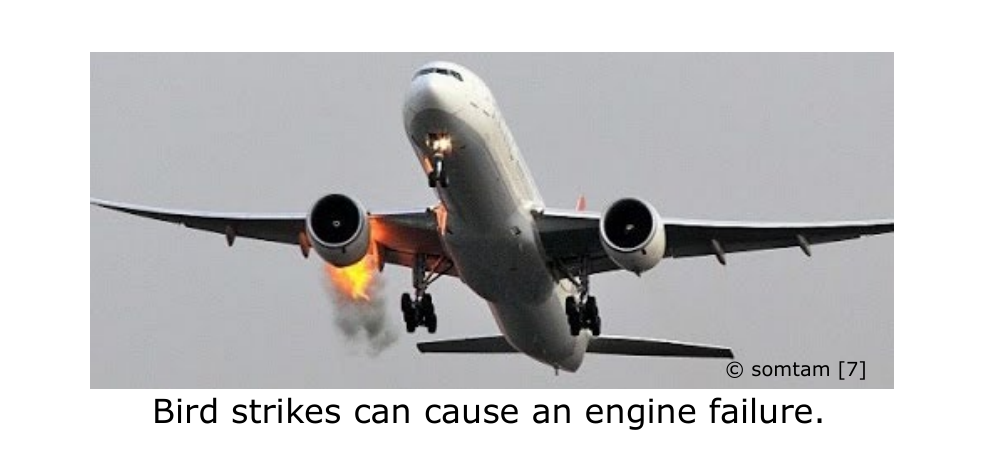 safety aviation
 -
What is the landing configuration of an aircraft during a missed approach with one engine inoperative?
The landing gear is extended and the high-lift surfaces are in their landing configuration.
aerodynamics aircraft -
Which weight variable is used for thrust-to-weight ratio calculations during a missed approach with one engine inoperative?
The maximum allowable landing weight, denoted as \(W_{ML}\).
aerodynamics aircraft -
What is the formula for the required thrust-to-weight ratio for a climb with one engine inoperative?
\[\frac{T}{W_{ML}} = \frac{N}{N - 1} \cdot \left[ \frac{1}{(L/D)_L} + \sin \gamma \right]\]aerodynamics aircraft -
How is the thrust-to-weight ratio corrected for the maximum take-off weight \(W_{MTO}\)?
\[\frac{T}{W_{MTO}} = \frac{T}{W_{ML}} \cdot \frac{W_{ML}}{W_{MTO}}\]aerodynamics aircraft -
What is the complete thrust-to-weight ratio formula for an aircraft during a missed approach with one engine inoperative?
\[\frac{T}{W} = \frac{W_{ML}}{W_{MTO}} \cdot \frac{N}{N - 1} \cdot \left[ \frac{1}{(L/D)_L} + \sin \gamma \right]\]aerodynamics aircraft -
What does \(N\) represent in the formula for the thrust-to-weight ratio of an aircraft with one engine inoperative?
The total number of engines on the aircraft.
aerodynamics aircraft -
What is the primary reason for defining a specific cruise velocity \(v_{CR}\) or cruise Mach number \(Ma_{CR}\) for an aircraft?
To ensure that a specific distance can be traveled within a specified time.
aeronautics flight performance -
From what aerodynamic consideration can the required thrust-to-weight ratio (\(T/W\)) be estimated?
Drag considerations.
aeronautics thrust drag -
From what aerodynamic consideration can the required wing loading (\(W/S\)) be estimated?
Lift considerations.
aeronautics lift wing -
Name four parameters that influence the cruise performance requirements of an aircraft.
- Maximum lift-to-drag ratio (\(L/D_{max}\))
- Zero-lift drag coefficient (\(C_{D,0}\)) and aspect ratio (\(AR\))
- Ratio of cruise thrust to take-off thrust (\(T_{CR}/T_{TO}\))
- Ambient pressure as a function of altitude
aeronautics aerodynamics parameters -
What is the key output sought when calculating aircraft performance based on cruise speed?
A minimum value for the thrust-to-weight ratio (\(T/W\)) as a function of wing loading (\(W/S\)).
aeronautics design performance -
What is the target cruise lift coefficient (\(C_{L,cr}\)) for an aircraft to achieve optimal fuel efficiency?
The cruise lift coefficient should be equal to the lift coefficient associated with the maximum lift-to-drag ratio: \(C_{L,cr} = C_{L,(L/D)max}\).
aerodynamics efficiency -
Provide the equation to calculate the lift coefficient for the maximum lift-to-drag ratio (\(C_{L,(L/D)max}\)).
\[C_{L,(L/D)max} = \sqrt{C_{D,0} \cdot \pi \cdot e \cdot AR}\]aerodynamics lift -
What is the fundamental equation for wing loading (\(W/S\)) during unaccelerated horizontal cruise flight?
\[\frac{W}{S} = \frac{1}{2} \cdot \rho \cdot v_{cr}^2 \cdot \sqrt{C_{D,0} \cdot \pi \cdot e \cdot AR}\]aerodynamics wing-loading -
How is cruise velocity (\(v_{cr}\)) related to the cruise Mach number (\(Ma_{cr}\))?
\[v_{cr} = Ma_{cr} \sqrt{\gamma RT}\]aerodynamics mach -
How is air density (\(\rho\)) expressed using the ideal gas law?
\[\rho = \frac{p}{RT}\]physics gas-law -
Provide the wing loading (\(W/S\)) equation for high-speed transport aircraft expressed in terms of the cruise Mach number and static pressure.
\[\frac{W}{S} = \frac{1}{2} \cdot p \cdot \gamma \cdot Ma_{cr}^2 \cdot \sqrt{C_{D,0} \cdot \pi \cdot e \cdot AR}\]aerodynamics wing-loading -
What is the relationship between weight (\(W\)) and lift (\(L\)) in steady horizontal flight?
\(W = L\)
aerodynamics flight -
In steady horizontal flight, what is the relationship between cruise thrust (\(T_{cr}\)) and drag (\(D\))?
\(T_{cr} = D\)
aerodynamics flight -
What is the formula for the cruise thrust-to-weight ratio in terms of maximum lift-to-drag ratio?
\(\frac{T_{cr}}{W} = \frac{1}{(L/D)_{max}}\)
aerodynamics flight -
What two factors influence the available thrust in cruise (\(T_{cr}\)) for a jet engine?
- Flight Mach number (\(M_{Cruise}\))
- Altitude (\(H\))
aerodynamics propulsion -
How is the takeoff thrust-to-weight ratio corrected to account for cruise conditions?
By multiplying the ratio by the reduction factor \(\frac{T_{cr}}{T_{TO}}\).
aerodynamics propulsion -
What is the full equation for the cruise thrust-to-weight ratio (\(\frac{T}{W}\)) using the reduction factor?
\(\frac{T}{W} = \frac{T_{TO}}{W} \cdot \frac{T_{cr}}{T_{TO}} = \frac{1}{(L/D)_{max}} \cdot \frac{T_{cr}}{T_{TO}}\)
aerodynamics propulsion -
How are the required wing loading \(\frac{W}{S}\) and thrust-to-weight ratio \(\frac{T}{W}\) indirectly connected during cruise flight?
They are connected via the flight altitude \(h\), as both parameters depend on it.
aerodynamics flight-mechanics -
What is the formula for calculating ISA standard atmospheric pressure \(p\) at a given flight altitude \(h\)?
\(p(h) = p_0 \times (1 - 0.02256 \times h)^{5.256}\)
atmosphere physics -
What is the standard sea-level atmospheric pressure value \(p_0\) used in aviation calculations?
\(101325\ Pa\)
atmosphere constants -
What is the numerical value for the isentropic expansion factor \(\gamma\)?
\(\gamma = 1.4\)
thermodynamics aerodynamics -
What is the standard unit of measurement for flight altitude \(h\) in the provided pressure formula?
Kilometers (km).
units atmosphere -
In a \(\frac{T}{W}\) vs \(\frac{W}{S}\) diagram, what does the region above the curve represent regarding cruise velocity?
It represents values that fulfill the cruise velocity requirement.
aerodynamics design -
What is the primary purpose of a 'Matching Diagram' in aircraft design?
It combines graphical representations of performance equations to evaluate whether a specific combination of \(T/W\) and \(W/S\) fulfills all flight performance requirements.
aerodynamics aircraft performance -
In a Matching Diagram, what does the white area represent?
The white area represents combinations of \(T/W\) and \(W/S\) where all flight requirements are fulfilled.
aerodynamics design -
In a Matching Diagram, what does the shaded area represent?
The shaded area represents combinations of \(T/W\) and \(W/S\) where at least one flight requirement is not fulfilled.
aerodynamics design -
To ensure comparability of aircraft performance values, what must be done to the \(T/W\) and \(W/S\) variables?
All values must be converted to the Maximum Take-off Weight \(W_{MTO}\) and based on take-off conditions.
aerodynamics design -
How should performance requirements like landing speed be plotted on a Matching Diagram?
Even if computed using landing weight, these requirements must be plotted at the Maximum Take-off Weight \(W_{MTO}\).
aerodynamics aircraft -
What is the primary function of a Matching Diagram in the analysis of existing aircraft?
It helps to assess whether an aircraft meets or fails to meet specific flight performance requirements.
aircraft performance -
In a Matching Diagram, what do the performance lines for each requirement represent?
They represent a minimum threshold where performance is exactly as specified.
aircraft performance -
How do you interpret the position of an aircraft's \(\frac{T}{W}\) and \(\frac{W}{S}\) combination relative to performance requirement bounds in a Matching Diagram?
- If the combination is below the bounds, the aircraft fails to meet all requirements.
- If the combination is above the bounds, the aircraft exceeds the requirements.
aircraft performance -
What is the primary objective when selecting the optimal combination of \(T/W\) and \(W/S\) for a new aircraft design?
To fulfill all flight performance requirements at the lowest possible cost.
aeronautics design -
What is the 'Design Point' in the context of aircraft performance matching diagrams?
It is the optimal combination of \(T/W\) and \(W/S\) that satisfies all requirements while minimizing aircraft cost.
aeronautics design -
Why is choosing a lower \(T/W\) ratio typically prioritized in aircraft design?
A lower \(T/W\) ratio leads to smaller engines, which reduces the overall cost of the aircraft.
aeronautics design -
Why is choosing a higher \(W/S\) ratio typically prioritized in aircraft design?
A higher \(W/S\) ratio leads to lower structural weight and less wetted area, which results in lower aerodynamic drag.
aeronautics design -
What does the shaded 'Infeasible design space' region on a Matching Diagram represent?
It represents combinations of \(T/W\) and \(W/S\) that do not meet one or more flight performance requirements.
aeronautics diagrams