Salva il tuo mazzo prima che scompaia
Queste flashcard non sono ancora salvate — spariranno se lasci la pagina. Crea un account gratuito per conservarle e sbloccare tutto quello qui sotto.
- Save this deck to your account
- Study with spaced repetition
- Export to Anki (.apkg) or PDF
- Process documents up to 100 pages
- Images extracted from your PDFs
- Sharper text extraction & a more advanced AI model
What is the primary difference between a paracentric and a pericentric inversion?
Why is it important to distinguish between chromosomal inversions and deletions or duplications?
Which is generally better tolerated by an organism: a deletion or a duplication of genetic material?
What defines an interstitial deletion?
Why are ring chromosomes often considered unstable?
What leads to the condition of mosaicism in individuals with ring chromosomes?
What can allow an acentric chromosome to survive during cell division?
Why do dicentric chromosomes typically result in cell death or failure?
How does the location of chromosomal involvement differ between a reciprocal translocation and an insertion?
What is the primary genetic result of the Philadelphia chromosome translocation?
What are position effects in the context of chromosomal rearrangements?
A _______ inversion occurs without involving the centromere, while a _______ inversion involves the centromere.
Ring chromosomes are formed when both _______ of a chromosome are lost and the remaining ends fuse together.
An _______ chromosome lacks a centromere, whereas a _______ chromosome possesses two centromeres.
What two primary factors determine the clinical consequences of a chromosomal rearrangement?
How does the body's tolerance for excess genetic material compare to its tolerance for a deficiency?
What is the viability limit of excess genetic material in the human genome?
What is the typical consequence of a chromosomal deletion representing less than 1% of the genome?
What are the common outcomes of a large unbalanced chromosomal translocation during pregnancy?
What clinical outcomes are often seen in children born with small, unbalanced chromosomal translocations?
What is a dosage-sensitive gene?
How can gene disruption in a balanced translocation lead to disease?
How does a balanced translocation result in the formation of an abnormal fusion gene?
What is an example of a fusion gene resulting from a balanced translocation that leads to cancer?
What is a position effect in chromosomal rearrangements?
What is the clinical implication of a position effect causing the inappropriate overexpression of an oncogene?
A balanced translocation can produce an abnormal fusion gene that promotes _______.
Under position effects, a gene may become _______ if separated from its original enhancer or _______ if relocated near a new one.
What genetic condition is associated with a translocation between chromosome 8 and 19 that disrupts the EXT1 gene?
When considering balanced maternal translocations, what is the estimated risk of having an affected child using the HC Forum model?
Why do maternal and paternal translocations differ in their predicted risk for an affected child?
What are the typical reproductive outcomes associated with large translocated segments?
What are the typical reproductive outcomes associated with small translocated segments?
The chromosomes considered acrocentric and capable of participating in Robertsonian translocations are _______, _______, _______, _______, and _______.
What two structural features characterize acrocentric chromosomes?
What are the primary chromosomal products formed by the breakage at the short arms or centromeres in a Robertsonian translocation?
How many chromosomes does an individual carrying a balanced Robertsonian translocation possess?
What is the evolutionary origin of the human chromosome 2?
Why are small, subtelomeric translocated segments more likely to be compatible with life than large translocated segments?
What outcomes are possible for zygotes resulting from the fertilization of gametes produced by a balanced translocation carrier?
Why does a balanced chromosomal rearrangement still carry reproductive risk?
What is the result of a Robertson translocation involving acrocentric chromosomes?
What is the only viable unbalanced outcome in a 14;21 translocation?
How does the recurrence risk of Down syndrome differ based on the carrier parent in a 14;21 translocation?
What are the common outcomes of crossing-over within an inverted chromosomal region?
What risk magnitude should be conveyed to carriers of balanced reciprocal or Robertsonian translocations?
How does the location of a breakpoint affect the risk for Eveleen Dupe 8 syndrome?
Why are some chromosome 9 inversions considered normal variants?
A _______ is defined as the presence of extra or missing genetic material that cannot be detected by _______.
What technique is required to detect cryptic genetic imbalances?
What is the approximate baseline reproductive risk in the general population?
What is the structure of an isochromosome 21?
What are the two clinical outcomes for an individual carrying an isochromosome 21?
What gamete types are produced by a balanced isochromosome 21 carrier?
Why are women with isochromosome Xq infertile?
Why is an \(Xp\) isochromosome incompatible with life?
What component must a marker chromosome contain to be maintained through cell division?
What clinical condition can arise from mitotically unstable marker chromosomes?
What genetic elements mediate Non-Allelic Homologous Recombination (NAHR)?
What are the typical size and sequence identity characteristics of Low-Copy Repeats (LCRs) involved in NAHR?
In which genomic regions do NAHR events frequently occur?
What sequence type mediates Non-Homologous End Joining (NHEJ)?
How does the requirement for sequence homology differ between NAHR and NHEJ?
What is the primary consequence of non-homologous end joining (NHEJ) due to its lack of sequence homology?
What enzymatic components are involved in the process of non-homologous end joining (NHEJ)?
The _______ (Fork Stalling and Template Switching) mechanism occurs during _______ when the replication fork stalls due to DNA damage, causing the machinery to switch to a nearby region containing _______.
What complex genomic rearrangements can result from the FoSTeS mechanism?
What are the opposite clinical phenotypes associated with the deletion and duplication of the \(7q11.23\) region?
What is the 'cocktail party syndrome' characteristic of individuals with Williams syndrome?
How do clinical phenotypes differ between deletion and duplication in the recurrent region of chromosome 16?
What rearrangements are associated with the PLP1 gene on the X chromosome?
Which clinical syndrome is associated with a corresponding duplication syndrome that is often asymptomatic or mild?
What gene-specific rearrangements are linked to HNPP and CMT1A?
_______ predispose chromosomes to future rearrangements by altering the genomic architecture in ways that facilitate _______ or _______.
What three laboratory conditions are required for studying chromosome rearrangements using classical cytogenetics?
Flashcards in this deck (75)
-
What is the primary difference between a paracentric and a pericentric inversion?
- Paracentric inversion: Does not involve the centromere.
- Pericentric inversion: Involves the centromere.
genetics chromosomes inversions -
Why is it important to distinguish between chromosomal inversions and deletions or duplications?
Inversions are typically balanced, whereas deletions and duplications result in an imbalance of genetic material, leading to different risks.
genetics chromosomes -
Which is generally better tolerated by an organism: a deletion or a duplication of genetic material?
An excess of genetic information (duplication) is better tolerated than a loss (deletion).
genetics chromosomes -
What defines an interstitial deletion?
The loss of an internal segment of a chromosome.
genetics chromosomes deletion -
Why are ring chromosomes often considered unstable?
They lack telomeres at the terminal ends where the chromosome has broken, which are essential for overall chromosomal stability.
genetics chromosomes -
What leads to the condition of mosaicism in individuals with ring chromosomes?
Ring chromosomes can be lost during mitosis or cell division throughout development, creating populations of cells with varying karyotypes.
genetics chromosomes -
What can allow an acentric chromosome to survive during cell division?
In some cases, an acentric chromosome can survive if it activates a neocentric, which partially restores its function.
genetics chromosomes -
Why do dicentric chromosomes typically result in cell death or failure?
They contain two centromeres, which the cell cannot manage properly during cell division.
genetics chromosomes -
How does the location of chromosomal involvement differ between a reciprocal translocation and an insertion?
Reciprocal translocations usually involve the exchange of terminal portions of chromosomes, while insertions involve the movement of an internal part of a chromosome.
genetics translocation insertion -
What is the primary genetic result of the Philadelphia chromosome translocation?
It fuses the BCR gene to the ABL tyrosine kinase gene, creating a fusion gene that encodes a hyperactive enzyme.
genetics cancer philadelphiachromosome -
What are position effects in the context of chromosomal rearrangements?
An effect where a gene's regulatory landscape is altered because it is moved closer to or further from enhancers, potentially leading to abnormal expression (hypo- or hyper-expression).
genetics expression -
A paracentric inversion occurs without involving the centromere, while a pericentric inversion involves the centromere.
genetics inversion -
Ring chromosomes are formed when both terminal segments of a chromosome are lost and the remaining ends fuse together.
genetics chromosomes -
An acentric chromosome lacks a centromere, whereas a dicentric chromosome possesses two centromeres.
genetics chromosomes -
What two primary factors determine the clinical consequences of a chromosomal rearrangement?
- The loss or acquisition of genetic material
- The location of the chromosomal breakpoints
genetics translocation -
How does the body's tolerance for excess genetic material compare to its tolerance for a deficiency?
The body tolerates an excess of genetic material better than a deficiency of the same amount.
genetics cytogenetics -
What is the viability limit of excess genetic material in the human genome?
Excess genetic material up to 4-5% of the genome can be viable.
genetics trisomy -
What is the typical consequence of a chromosomal deletion representing less than 1% of the genome?
Such a deletion is often lethal.
genetics deletion -
What are the common outcomes of a large unbalanced chromosomal translocation during pregnancy?
Premature abortion (miscarriage).
genetics pregnancy -
What clinical outcomes are often seen in children born with small, unbalanced chromosomal translocations?
- Developmental abnormalities
- Intellectual disability
- Congenital malformations
genetics developmental -
What is a dosage-sensitive gene?
A gene that requires two functional copies to maintain normal cellular function.
genetics biology -
How can gene disruption in a balanced translocation lead to disease?
It can reduce the dosage of a dosage-sensitive gene, potentially impairing important cellular functions even without a total gain or loss of material.
genetics translocation -
How does a balanced translocation result in the formation of an abnormal fusion gene?
The rearrangement joins two different genes together, creating a hybrid gene with novel or deregulated functions.
genetics fusion-gene -
What is an example of a fusion gene resulting from a balanced translocation that leads to cancer?
The BCR-ABL gene (Philadelphia chromosome), which acts as a hyperactive kinase promoting uncontrolled cell division.
genetics cancer oncology -
What is a position effect in chromosomal rearrangements?
A mechanism where a translocation separates a gene from its original enhancer or relocates it near a new one, leading to abnormal gene expression levels.
genetics enhancers -
What is the clinical implication of a position effect causing the inappropriate overexpression of an oncogene?
It can lead to B-cell malignancies, such as leukemias and lymphomas.
genetics oncology -
A balanced translocation can produce an abnormal fusion gene that promotes uncontrolled cell division.
genetics cancer -
Under position effects, a gene may become underexpressed if separated from its original enhancer or overexpressed if relocated near a new one.
genetics expression -
What genetic condition is associated with a translocation between chromosome 8 and 19 that disrupts the EXT1 gene?
Hereditary multiple exostoses.
genetics chromosomes -
When considering balanced maternal translocations, what is the estimated risk of having an affected child using the HC Forum model?
Approximately 24%.
genetics risk -
Why do maternal and paternal translocations differ in their predicted risk for an affected child?
Biological differences exist between maternal and paternal meiosis, causing paternal risk to be generally lower and less well understood.
genetics meiosis -
What are the typical reproductive outcomes associated with large translocated segments?
A high risk of spontaneous abortion and a low risk of having an affected liveborn child.
genetics reproduction -
What are the typical reproductive outcomes associated with small translocated segments?
A low risk of spontaneous abortion and a higher risk of having an affected liveborn child.
genetics reproduction -
The chromosomes considered acrocentric and capable of participating in Robertsonian translocations are 13, 14, 15, 21, and 22.
genetics chromosomes -
What two structural features characterize acrocentric chromosomes?
- A very small short arm containing satellite DNA and ribosomal RNA gene clusters
- A long arm containing nearly all functional genetic material
genetics chromosomes -
What are the primary chromosomal products formed by the breakage at the short arms or centromeres in a Robertsonian translocation?
One dicentric chromosome and one acentric chromosome (which is subsequently lost).
genetics chromosomes -
How many chromosomes does an individual carrying a balanced Robertsonian translocation possess?
45 chromosomes.
genetics chromosomes -
What is the evolutionary origin of the human chromosome 2?
It originated from the fusion of two ancestral acrocentric chromosomes.
genetics evolution -
Why are small, subtelomeric translocated segments more likely to be compatible with life than large translocated segments?
Small segments involve smaller imbalances of genetic material, which are less likely to result in early embryonic lethality than the large imbalances caused by large translocated segments.
genetics embryology -
What outcomes are possible for zygotes resulting from the fertilization of gametes produced by a balanced translocation carrier?
Zygotes may be normal, balanced carriers, or exhibit partial trisomy or monosomy, as shown here:
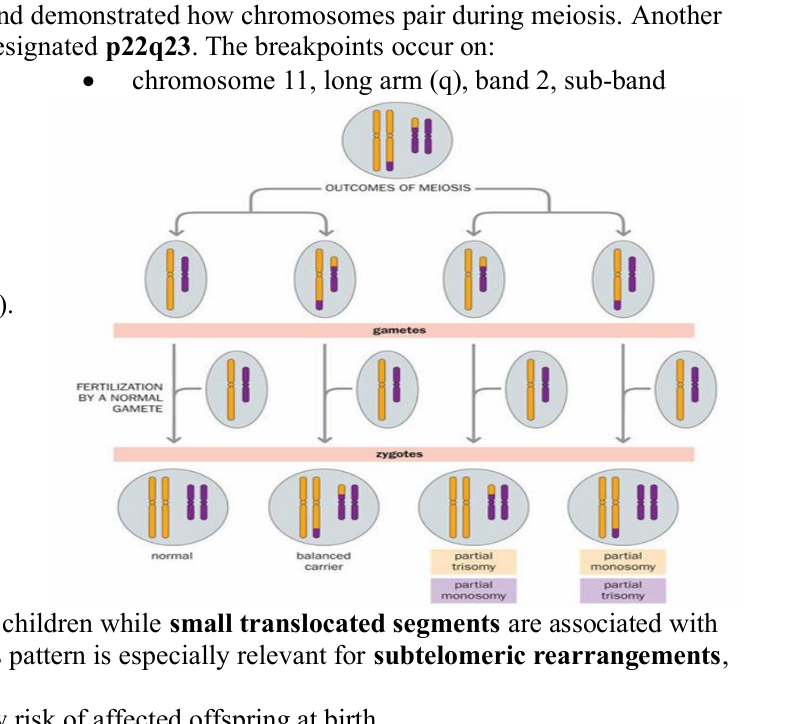 genetics meiosis
 -
Why does a balanced chromosomal rearrangement still carry reproductive risk?
Meiotic segregation can generate unbalanced gametes.
genetics reproduction -
What is the result of a Robertson translocation involving acrocentric chromosomes?
The two acrocentric chromosomes are fused into a single novel chromosome, while the short arms are lost.
genetics translocation -
What is the only viable unbalanced outcome in a 14;21 translocation?
Trisomy 21.
genetics downsyndrome -
How does the recurrence risk of Down syndrome differ based on the carrier parent in a 14;21 translocation?
The risk is 15% when the mother is the carrier and 1.4% when the father is the carrier.
genetics downsyndrome -
What are the common outcomes of crossing-over within an inverted chromosomal region?
- Duplications
- Deletions
- Dicentric chromosomes
- Acentric chromosomes
genetics inversion -
What risk magnitude should be conveyed to carriers of balanced reciprocal or Robertsonian translocations?
Moderate to high risk.
genetics counseling -
How does the location of a breakpoint affect the risk for Eveleen Dupe 8 syndrome?
Breakpoints near telomeres carry high risk of viable imbalance, while those near centromeres carry low risk.
genetics syndrome -
Why are some chromosome 9 inversions considered normal variants?
Crossing-over in these regions is extremely rare, so they do not produce clinically significant outcomes.
genetics inversion -
A cryptic imbalance is defined as the presence of extra or missing genetic material that cannot be detected by standard karyotyping.
genetics technology -
What technique is required to detect cryptic genetic imbalances?
Array comparative genomic hybridization (aCGH), also known as molecular karyotyping.
genetics technology -
What is the approximate baseline reproductive risk in the general population?
2-3% of all pregnancies result in a child with some form of health problem.
genetics epidemiology -
What is the structure of an isochromosome 21?
It is composed of two identical long arms (21q).
genetics isochromosome -
What are the two clinical outcomes for an individual carrying an isochromosome 21?
- Balanced: An individual with 45 chromosomes.
- Imbalanced: An individual with trisomy 21.
genetics trisomy -
What gamete types are produced by a balanced isochromosome 21 carrier?
- Gametes containing both chromosome 21q arms.
- Gametes lacking chromosome 21, resulting in lethal monosomy.
genetics reproduction -
Why are women with isochromosome Xq infertile?
The isochromosome contains two copies of the \(XIST\) gene, leading to complete skewed X-inactivation. This results in the loss of genes from the short arm (\(Xp\)), causing a phenotype similar to Turner syndrome.
genetics infertility -
Why is an \(Xp\) isochromosome incompatible with life?
It lacks the \(XIST\) gene, preventing the inactivation of the abnormal chromosome and resulting in functional trisomy for all \(Xp\) genes.
genetics x-chromosome -
What component must a marker chromosome contain to be maintained through cell division?
A centromere.
genetics chromosomes -
What clinical condition can arise from mitotically unstable marker chromosomes?
Somatic mosaicism.
genetics mosaicism -
What genetic elements mediate Non-Allelic Homologous Recombination (NAHR)?
Low-Copy Repeats (LCRs).
genetics recombination -
What are the typical size and sequence identity characteristics of Low-Copy Repeats (LCRs) involved in NAHR?
They are typically 10–500 kb in size with ~90% sequence identity.
genetics nahr -
In which genomic regions do NAHR events frequently occur?
Pericentromeric and telomeric regions.
genetics genomic-rearrangement -
What sequence type mediates Non-Homologous End Joining (NHEJ)?
Poly-AT Rich Regions (PATRR).
genetics nhej -
How does the requirement for sequence homology differ between NAHR and NHEJ?
NAHR is mediated by highly similar repeated sequences, while NHEJ repairs double-strand breaks without requiring sequence homology.
genetics recombination -
What is the primary consequence of non-homologous end joining (NHEJ) due to its lack of sequence homology?
It often introduces small insertions or deletions at the junction.
genetics nhej -
What enzymatic components are involved in the process of non-homologous end joining (NHEJ)?
- Ku binding proteins
- Nuclease
- Polymerase
- Ligase components
genetics nhej -
The FoSTeS (Fork Stalling and Template Switching) mechanism occurs during DNA replication when the replication fork stalls due to DNA damage, causing the machinery to switch to a nearby region containing micro-homology.
genetics fostes -
What complex genomic rearrangements can result from the FoSTeS mechanism?
Duplications and triplications.
genetics fostes -
What are the opposite clinical phenotypes associated with the deletion and duplication of the \(7q11.23\) region?
- Deletion: Williams syndrome
- Duplication: \(7q11.23\) duplication syndrome
genetics williams-syndrome -
What is the 'cocktail party syndrome' characteristic of individuals with Williams syndrome?
Patients are highly talkative but frequently produce disorganized or superficial speech.
genetics williams-syndrome -
How do clinical phenotypes differ between deletion and duplication in the recurrent region of chromosome 16?
- Deletion: Severe obesity
- Duplication: Extreme thinness
genetics phenotype -
What rearrangements are associated with the PLP1 gene on the X chromosome?
- Duplication: Most common
- Deletion: More severe cases
- Triplication: Severe forms
genetics plp1 -
Which clinical syndrome is associated with a corresponding duplication syndrome that is often asymptomatic or mild?
DiGeorge syndrome.
genetics digeorge -
What gene-specific rearrangements are linked to HNPP and CMT1A?
- HNPP (hereditary neuropathy with liability to pressure palsies): PMP22 deletion
- CMT1A (Charcot–Marie–Tooth disease type 1A): PMP22 duplication
genetics pmp22 -
Inversion polymorphisms predispose chromosomes to future rearrangements by altering the genomic architecture in ways that facilitate NAHR or FoSTeS.
genetics cytogenetics -
What three laboratory conditions are required for studying chromosome rearrangements using classical cytogenetics?
- Living cells
- Chromosomes arrested in metaphase
- Condensed chromatin suitable for staining
genetics cytogenetics