Salva il tuo mazzo prima che scompaia
Queste flashcard non sono ancora salvate — spariranno se lasci la pagina. Crea un account gratuito per conservarle e sbloccare tutto quello qui sotto.
- Save this deck to your account
- Study with spaced repetition
- Export to Anki (.apkg) or PDF
- Process documents up to 100 pages
- Images extracted from your PDFs
- Sharper text extraction & a more advanced AI model
What are the three main types of periodontitis?
What is the common term used for the group consisting of necrotising gingivitis, periodontitis, and stomatitis due to their clinical similarities?
What specific area of tissue is affected in cases of necrotising gingivitis?
Does necrotising gingivitis involve loss of gingival attachment?
What clinical features characterize the tissue damage seen in necrotising gingivitis?
What findings are used to diagnose necrotising periodontitis?
What defines the extent of a lesion in necrotising stomatitis?
What is considered the most severe form of a necrotising disease?
In which region is NOMA most commonly found?
Western Europe
North America
Sub-Saharan Africa
Australia
What are the primary risk factors associated with noma?
What is the typical progression of a noma infection?
What happens when patients with leukocyte adhesion deficiency develop periodontal disease?
What are the two key components of the current classification for common periodontitis?
Why was a new classification system for periodontitis introduced?
What is the primary function of neutrophils in the junctional epithelium during a healthy immune response?
To transport nutrients to the gum tissue
To build a wall against bacteria
To stimulate the production of new bone tissue
To prevent blood vessel constriction
What is the primary characteristic of periodontitis in terms of tissue status?
What are the clinical manifestations of periodontitis?
What is a primary diagnostic criterion for periodontitis involving interdental sites?
Interdental clinical attachment loss (CAL) at two or more non-adjacent teeth
Gingival bleeding at two or more non-adjacent teeth
Probing pocket depth > 3mm at any two teeth
Interdental clinical attachment loss (CAL) at any two teeth
In the absence of interdental attachment loss, what clinical criteria can suggest a periodontitis diagnosis?
List two examples of non-periodontitis related causes that may mimic clinical attachment loss.
Why is it important to exclude certain conditions when assessing clinical attachment loss for a periodontitis diagnosis?
What are common signs and symptoms of periodontitis?
Is periodontitis typically a painful condition?
What specific measurement indicates increased periodontal pocket depth?
What visual changes might patients report when experiencing gingival recession?
What is the final, most severe consequence of unchecked periodontitis?
Where does a probe typically stop when using 25 newton force on a healthy tooth without clinical attachment loss (CAL)?
What is the health status of a 3mm periodontal pocket if the Cemento-Enamel Junction (CEJ) is not detected?
Which anatomical components contribute to the combined 2.5-3mm measurement of a healthy sulcus?
What is the formula for Clinical Attachment Loss (CAL) when the Gingival Margin (GM) is at the same level as the Cemento-Enamel Junction (CEJ)?
What is the formula for Clinical Attachment Loss (CAL) when there is gingival recession (Gingival Margin apical to CEJ)?
What is the formula for Clinical Attachment Loss (CAL) in cases of gingival overgrowth?
What does Clinical Attachment Loss (CAL) use as the fixed reference point to measure loss?
What clinical signs are indicative of periodontitis?
Which types of radiographs are preferred for diagnosing periodontitis?
What are the two key elements in the 2017 classification of periodontitis?
How is staging defined in the context of periodontitis?
What specific factors are assessed to determine the complexity of managing a patient's periodontitis?
What is the range of interdental clinical attachment loss (CAL) for Stage I periodontitis?
1 to 2 mm
3 to 4 mm
5 mm or more
None
What is the expected radiographic bone loss for Stage II periodontitis?
Extending to middle or apical third of the root
No bone loss
Coronal third (<15%)
Coronal third (15% to 33%)
Which stage of periodontitis is associated with the loss of five or more teeth due to periodontitis?
Stage I
Stage IV
Stage II
Stage III
What complexity factors are specific to Stage III periodontitis?
What defines the extent of periodontitis as 'localized'?
When a patient has multiple stages of periodontitis in different areas, how is the final stage assigned?
What is the clinical attachment loss (CAL) threshold for Stage 1 periodontitis?
What is the clinical attachment loss (CAL) threshold for Stage 2 periodontitis?
What is the clinical attachment loss (CAL) threshold for Stage 3 or 4 periodontitis?
How is the extent of periodontitis described as 'localised'?
How is the extent of periodontitis described as 'generalised'?
What factors are examined when determining the grade of periodontitis?
If a patient has multiple complexity factors for periodontitis staging, how many are required to shift the diagnosis to a higher stage?
All
1
3
2
What are the three categories used to classify the rate of periodontal disease progression?
When grading a patient's periodontitis, what is the standard clinical starting point?
What is the direct evidence criteria for Grade A periodontitis regarding bone loss over 5 years?
What is the direct evidence criteria for Grade C periodontitis regarding bone loss over 5 years?
What is the indirect evidence threshold for the ratio of bone loss to age in Grade A periodontitis?
What is the indirect evidence threshold for the ratio of bone loss to age in Grade C periodontitis?
What HbA1c level is associated with Grade B periodontitis for a patient with diabetes?
What hsCRP level is classified as an indicator for high systemic risk in Grade C periodontitis?
What is the formula used in the indirect method to determine the periodontitis grade?
Based on the bone loss/age ratio, what is the criteria for Grade A periodontitis?
< 0.25
0.25 - 1.0
<blockquote>
1.0
</blockquote>
1.0 - 2.0
Which of the following conditions is mentioned as a risk factor that can act as a grade modifier for periodontitis?
Asthma
Hypertension
Smoking
Obesity
What is the threshold for HBA1c levels in a diabetic patient that could lead to a grade modification for periodontitis?
What is the clinical significance of c-reactive protein in the context of periodontitis?
How is a patient categorized by grade if their bone loss/age ratio is greater than 1.0?
Grade C
Grade A
Grade B
Grade D
What is the primary goal of staging a periodontitis patient?
What is the primary goal of grading a periodontitis patient?
When assessing a new patient for periodontitis via radiographs, what specific finding indicates a suspicion of periodontitis?
Good diagnostic quality
Presence of calculus
Normal interdental bone levels
Detectable marginal bone loss
In the absence of radiographs, what clinical finding during periodontal assessment suggests a possible periodontitis case?
Pocket depth of 2mm
Detectable interdental clinical attachment loss (CAL)
Gingival bleeding
Presence of plaque
What threshold of buccal or oral recession combined with pocket depth is used to screen for potential periodontitis?
Based on the decision-making algorithm, how is generalized gingivitis defined by bleeding on probing (BOP)?
What are the BOP index classifications when a patient has no buccal/oral or interdental CAL?
What local factors are assessed when determining the cause of attachment loss?
What criterion warrants a thorough periodontal charting in a patient with attachment loss?
If periodontal charting reveals no pocket depth of 4mm or more, how is the status interpreted based on the BOP value?
What is the clinical diagnosis if periodontal charting reveals pocket depths of 4mm or more?
What is the threshold for classifying periodontitis as 'generalised' based on the extent of teeth affected?
Which of the following factors are used to define the 'severity' of periodontitis when establishing a stage?
Bite collapse, drifting, and flaring
Pocket depth, furcation, and tooth hypermobility
Previous periodontal treatment and patient history
Clinical Attachment Loss (CAL), bone loss, and periodontal tooth loss
What clinical factors are evaluated to determine the 'complexity' of a periodontal case?
What documentation is required to establish the stage of a patient with suspected periodontitis?
Which patient history factors should be assessed during a periodontal examination?
Overall systemic health, medications, and allergies
Family history of heart disease, smoking status, and age
Daily oral hygiene routine, diet, and frequency of dental visits
Reason for previous tooth loss, reason for extractions, and previous periodontal treatment
What diagnostic findings are necessary to confirm a case of periodontitis according to the periodontal appraisal flowchart?
What Clinical Attachment Loss (CAL) or bone loss pattern necessitates an immediate diagnosis of periodontitis stage 3 or 4?
Which level of furcation involvement mandates a diagnosis of periodontitis stage 3 or 4?
If there is no furcation involvement, what pocket depth identifies periodontitis stage 3 or 4?
When pocket depth is between 3 mm and 5 mm and there is no furcation involvement, what specific clinical factor indicates periodontitis stage 3 or 4?
Which of the following clinical findings immediately indicates periodontitis stage 3 or 4?
Furcation degree of 1
Furcation degree of 2 or 3
Pocket depth of 2 mm
No tooth loss
If a patient has no furcation involvement and a pocket depth between 3 mm and 5 mm, what would confirm a diagnosis of periodontitis stage 3 or 4?
Bone loss in the coronal third of the root
A history of good oral hygiene
CAL of 1 mm
Any tooth loss caused by periodontitis
If a periodontitis patient has no tooth loss, what is the clinical stage?
What threshold of bone loss (CAL) characterizes Stage I periodontitis?
What threshold of bone loss (CAL) characterizes Stage II periodontitis?
What clinical factors determine if a case is classified as Stage IV periodontitis?
In the context of periodontal grading, what does the term 'previous existing records' refer to?
What are the criteria for Grade A periodontal progression over 5 years?
Which health conditions can lead to an upgrade in the grade of periodontitis for a patient?
What factors can lead to an upgrade in the grade of periodontitis?
What are the clinical criteria for a Currently Stable status in periodontitis?
What clinical parameters characterize the Currently in Remission status for periodontitis?
What defines a patient as Currently Unstable regarding periodontal disease?
What components should be included in a formal diagnostic statement for periodontitis?
Why do patients successfully treated for periodontitis remain classified as a patient with periodontitis for life?
Does being a non-smoker automatically change a grade B periodontitis diagnosis to a grade A?
Only if the patient is young
No
Yes
Only if there is no bone loss
What is the extent of the patient's periodontitis?
What is the clinical attachment loss (CAL) measurement for the patient's periodontitis?
What is the periodontal probing depth (PPD) noted for the patient's condition?
What is the current HbA1c value for the patient?
What is the current bleeding on probing (BOP) percentage for the patient?
What are the identified risk factors for this patient?
Flashcards in this deck (108)
-
What are the three main types of periodontitis?
- Necrotising periodontitis
- Periodontitis as a manifestation of a systemic disease
- Common periodontitis
periodontitis classification -
What is the common term used for the group consisting of necrotising gingivitis, periodontitis, and stomatitis due to their clinical similarities?
Necrotising periodontal disease (NPD)
periodontitis npd -
What specific area of tissue is affected in cases of necrotising gingivitis?
Only the gingival tissues.
gingivitis periodontology -
Does necrotising gingivitis involve loss of gingival attachment?
No, it is characterized by no loss of gingival attachment.
gingivitis periodontology -
What clinical features characterize the tissue damage seen in necrotising gingivitis?
- Central necrosis of the papilla
- Tissue destruction
- Formation of interproximal craters
gingivitis pathology -
What findings are used to diagnose necrotising periodontitis?
Diagnosis is based on the presence of attachment loss and radiographic evidence of bone loss.
dentistry periodontics -
What defines the extent of a lesion in necrotising stomatitis?
Ulcerations that extend more than 1 cm away from the gingival margin, including tissues beyond the mucosa gingival junction.
dentistry stomatitis -
What is considered the most severe form of a necrotising disease?
NOMA
dentistry pathology -
In which region is NOMA most commonly found?
Western Europe
North America
Sub-Saharan Africa
Australia
geography epidemiology -
What are the primary risk factors associated with noma?
Noma typically affects children aged 1-6 years who experience severe malnutrition, have a weakened immune system, and live in conditions of extreme poverty.
noma pediatrics pathology -
What is the typical progression of a noma infection?
- Begins as a soft tissue lesion (sore spot on the gums).
- Develops into acute necrotising gingivitis.
- Progresses rapidly to destroy soft tissues.
- Extends to involve hard tissues and facial skin.
noma pathology progression -
What happens when patients with leukocyte adhesion deficiency develop periodontal disease?
Neutrophils are unable to exit blood vessels to reach the junctional epithelium, preventing the formation of a protective wall against bacteria and leading to rapidly progressing gingivitis and periodontitis.
leukocyte immunology periodontitis -
What are the two key components of the current classification for common periodontitis?
- The stage of the disease.
- The grade of the disease involvement.
periodontitis classification dentistry -
Why was a new classification system for periodontitis introduced?
To provide a better structure for treatment planning and to improve the monitoring of a patient's response to therapy.
periodontitis therapy dentistry -
What is the primary function of neutrophils in the junctional epithelium during a healthy immune response?
To transport nutrients to the gum tissue
To build a wall against bacteria
To stimulate the production of new bone tissue
To prevent blood vessel constriction
immunology neutrophils dentistry -
What is the primary characteristic of periodontitis in terms of tissue status?
It is characterized by non-reversible progressive periodontal tissue destruction.
periodontitis pathology -
What are the clinical manifestations of periodontitis?
- Clinical attachment loss
- Radiographically assessed alveolar bone loss
- Presence of periodontal pocketing
- Gingival bleeding
periodontitis clinical -
What is a primary diagnostic criterion for periodontitis involving interdental sites?
Interdental clinical attachment loss (CAL) at two or more non-adjacent teeth
Gingival bleeding at two or more non-adjacent teeth
Probing pocket depth > 3mm at any two teeth
Interdental clinical attachment loss (CAL) at any two teeth
diagnosis periodontitis -
In the absence of interdental attachment loss, what clinical criteria can suggest a periodontitis diagnosis?
Buccal or oral clinical attachment loss \(\ge\) 3 mm with probing pocket depth > 3 mm at two or more teeth.
diagnosis periodontitis -
List two examples of non-periodontitis related causes that may mimic clinical attachment loss.
- Dental caries extending in the cervical area
- Vertical root fractures
- Gingival recession of traumatic or anatomic origin
- Endodontic lesions draining through the periodontium
diagnosis differential -
Why is it important to exclude certain conditions when assessing clinical attachment loss for a periodontitis diagnosis?
To ensure the observed attachment loss is not attributed to traumatic factors, non-periodontitis related aetiologies, or anatomic issues.
diagnosis periodontitis -
What are common signs and symptoms of periodontitis?
- Receding gums
- Gaps between teeth
- Increased food impaction
- Wobbly or loose teeth
- Altered speech
- Tooth loss
periodontitis symptoms -
Is periodontitis typically a painful condition?
No, it is usually painless, except in acute conditions like an abscess or necrotising periodontal disease where the nerve is involved.
periodontitis pain -
What specific measurement indicates increased periodontal pocket depth?
A depth of more than 3mm.
periodontitis signs measurement -
What visual changes might patients report when experiencing gingival recession?
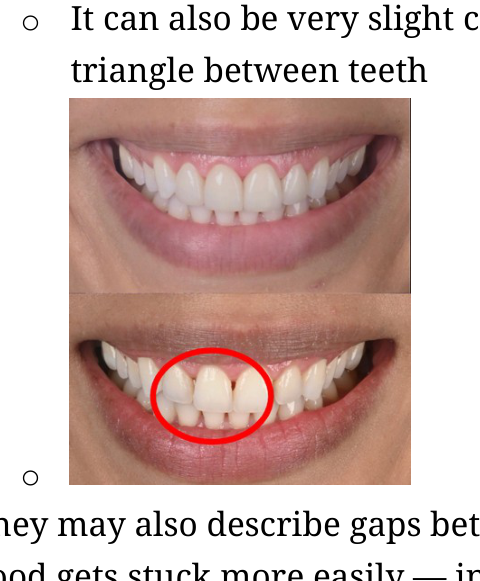 - Teeth appearing longer
- Formation of black triangles between teethgingival_recession symptoms
- Teeth appearing longer
- Formation of black triangles between teethgingival_recession symptoms -
What is the final, most severe consequence of unchecked periodontitis?
Tooth loss.
periodontitis consequences -
Where does a probe typically stop when using 25 newton force on a healthy tooth without clinical attachment loss (CAL)?
Somewhere within the junctional epithelium.
periodontal_probing anatomy -
What is the health status of a 3mm periodontal pocket if the Cemento-Enamel Junction (CEJ) is not detected?
It is considered healthy.
periodontics health -
Which anatomical components contribute to the combined 2.5-3mm measurement of a healthy sulcus?
- Gingival sulcus
- Junctional epithelium (JE)
- Connective tissue (CT) attachment
periodontics anatomy -
What is the formula for Clinical Attachment Loss (CAL) when the Gingival Margin (GM) is at the same level as the Cemento-Enamel Junction (CEJ)?
\(CAL = PPD\)
periodontics measurements -
What is the formula for Clinical Attachment Loss (CAL) when there is gingival recession (Gingival Margin apical to CEJ)?
\(CAL = PPD + Rec\)
periodontics measurements -
What is the formula for Clinical Attachment Loss (CAL) in cases of gingival overgrowth?
\(CAL = PPD - OG\)
periodontics measurements -
What does Clinical Attachment Loss (CAL) use as the fixed reference point to measure loss?
The Cemento-Enamel Junction (CEJ).
periodontics definitions -
What clinical signs are indicative of periodontitis?
- Radiographical bone loss
- Increased tooth mobility
- Tooth loss
periodontics symptoms -
Which types of radiographs are preferred for diagnosing periodontitis?
Vertical bitewings (BW) or orthopantomograms (OPGs).
periodontics diagnosis -
What are the two key elements in the 2017 classification of periodontitis?
- Staging
- Grading
periodontitis classification -
How is staging defined in the context of periodontitis?
Staging describes the severity of the periodontal breakdown and the extent of the disease based on the number and distribution pattern of teeth with detectable attachment loss.
periodontitis staging -
What specific factors are assessed to determine the complexity of managing a patient's periodontitis?
- Pocket depth
- Type of bone loss
- Furcations
- Lesions
- Tooth mobility
- Number of missing teeth
periodontitis complexity -
What is the range of interdental clinical attachment loss (CAL) for Stage I periodontitis?
1 to 2 mm
3 to 4 mm
5 mm or more
None
periodontitis staging -
What is the expected radiographic bone loss for Stage II periodontitis?
Extending to middle or apical third of the root
No bone loss
Coronal third (<15%)
Coronal third (15% to 33%)
periodontitis staging -
Which stage of periodontitis is associated with the loss of five or more teeth due to periodontitis?
Stage I
Stage IV
Stage II
Stage III
periodontitis staging -
What complexity factors are specific to Stage III periodontitis?
- Probing depth \(\geq 6\) mm
- Vertical bone loss \(\geq 3\) mm
- Furcation involvement Class II or III
- Moderate ridge defect
periodontitis complexity -
What defines the extent of periodontitis as 'localized'?
Less than 30% of teeth are involved.
periodontitis extent -
When a patient has multiple stages of periodontitis in different areas, how is the final stage assigned?
Patients are assigned to only one stage, which highlights the area with the most severe destruction and the most complex case management needs.
periodontitis staging -
What is the clinical attachment loss (CAL) threshold for Stage 1 periodontitis?
1-2 mm
dentistry periodontitis -
What is the clinical attachment loss (CAL) threshold for Stage 2 periodontitis?
3-4 mm
dentistry periodontitis -
What is the clinical attachment loss (CAL) threshold for Stage 3 or 4 periodontitis?
Greater than or equal to 5 mm
dentistry periodontitis -
How is the extent of periodontitis described as 'localised'?
If less than 30% of teeth are involved.
dentistry periodontitis -
How is the extent of periodontitis described as 'generalised'?
If more than 30% of teeth are involved.
dentistry periodontitis -
What factors are examined when determining the grade of periodontitis?
The rate of progression and the risk factors that need to be managed.
dentistry periodontitis -
If a patient has multiple complexity factors for periodontitis staging, how many are required to shift the diagnosis to a higher stage?
All
1
3
2
dentistry periodontitis -
What are the three categories used to classify the rate of periodontal disease progression?
- Grade A: Slow rate
- Grade B: Moderate rate
- Grade C: Rapid rate
periodontitis classification -
When grading a patient's periodontitis, what is the standard clinical starting point?
Clinicians should initially assume Grade B and subsequently look for evidence to justify moving to Grade A or Grade C.
periodontitis diagnosis -
What is the direct evidence criteria for Grade A periodontitis regarding bone loss over 5 years?
Evidence of no bone loss over 5 years.
periodontitis prognosis -
What is the direct evidence criteria for Grade C periodontitis regarding bone loss over 5 years?
Evidence of loss greater than or equal to \(2\text{mm}\) over 5 years.
periodontitis prognosis -
What is the indirect evidence threshold for the ratio of bone loss to age in Grade A periodontitis?
Less than \(0.25\).
periodontitis prognosis -
What is the indirect evidence threshold for the ratio of bone loss to age in Grade C periodontitis?
Greater than \(1.0\).
periodontitis prognosis -
What HbA1c level is associated with Grade B periodontitis for a patient with diabetes?
HbA1c \(< 7.0\%\).
diabetes periodontitis -
What hsCRP level is classified as an indicator for high systemic risk in Grade C periodontitis?
Greater than \(3\text{ mg/L}\).
biomarkers periodontitis -
What is the formula used in the indirect method to determine the periodontitis grade?
The ratio of the percentage of bone loss to the age.
periodontitis diagnosis -
Based on the bone loss/age ratio, what is the criteria for Grade A periodontitis?
< 0.25
0.25 - 1.0
<blockquote>
1.0
</blockquote>
1.0 - 2.0
periodontitis classification -
Which of the following conditions is mentioned as a risk factor that can act as a grade modifier for periodontitis?
Asthma
Hypertension
Smoking
Obesity
periodontitis risk-factors -
What is the threshold for HBA1c levels in a diabetic patient that could lead to a grade modification for periodontitis?
Greater than 7%.
periodontitis diabetes modifiers -
What is the clinical significance of c-reactive protein in the context of periodontitis?
It serves as a marker for the potential systemic impact of the inflammatory burden of periodontitis.
periodontitis biomarkers -
How is a patient categorized by grade if their bone loss/age ratio is greater than 1.0?
Grade C
Grade A
Grade B
Grade D
periodontitis classification -
What is the primary goal of staging a periodontitis patient?
To classify the severity and extent of tissue damage and assess the complexity of managing long-term function and esthetics.
periodontitis staging -
What is the primary goal of grading a periodontitis patient?
To estimate the future risk of disease progression, responsiveness to therapy, and the potential systemic health impact of periodontitis.
periodontitis grading -
When assessing a new patient for periodontitis via radiographs, what specific finding indicates a suspicion of periodontitis?
Good diagnostic quality
Presence of calculus
Normal interdental bone levels
Detectable marginal bone loss
periodontitis radiographs -
In the absence of radiographs, what clinical finding during periodontal assessment suggests a possible periodontitis case?
Pocket depth of 2mm
Detectable interdental clinical attachment loss (CAL)
Gingival bleeding
Presence of plaque
periodontitis clinical_assessment -
What threshold of buccal or oral recession combined with pocket depth is used to screen for potential periodontitis?
A pocket depth of more than \(3\text{mm}\).
periodontitis screening -
Based on the decision-making algorithm, how is generalized gingivitis defined by bleeding on probing (BOP)?
BOP \(> 30\%\).
gingivitis bop -
What are the BOP index classifications when a patient has no buccal/oral or interdental CAL?
- <10%: Periodontal health
- 10-30%: Localised gingivitis
-
<blockquote>
10%: Generalised gingivitis
</blockquote>
periodontology diagnosis -
What local factors are assessed when determining the cause of attachment loss?
- Infection of the pulpal region extending through the periodontium
- Vertical root fracture
- Subgingival caries/fillings
- Impacted wisdom teeth
periodontology diagnosis -
What criterion warrants a thorough periodontal charting in a patient with attachment loss?
Clinical Attachment Loss (CAL) of more than 1 on non-adjacent teeth.
periodontology diagnosis -
If periodontal charting reveals no pocket depth of 4mm or more, how is the status interpreted based on the BOP value?
- <10% BOP: Reduced but healthy periodontium
-
<blockquote>
10% BOP: Gingival inflammation in a periodontitis patient
</blockquote>
periodontology diagnosis -
What is the clinical diagnosis if periodontal charting reveals pocket depths of 4mm or more?
Periodontitis, which requires further assessment to determine the stage and grade.
periodontology diagnosis -
What is the threshold for classifying periodontitis as 'generalised' based on the extent of teeth affected?
More than 30% of all teeth affected.
periodontology diagnosis -
Which of the following factors are used to define the 'severity' of periodontitis when establishing a stage?
Bite collapse, drifting, and flaring
Pocket depth, furcation, and tooth hypermobility
Previous periodontal treatment and patient history
Clinical Attachment Loss (CAL), bone loss, and periodontal tooth loss
periodontology staging -
What clinical factors are evaluated to determine the 'complexity' of a periodontal case?
- Pocket depth
- Intrabony lesions
- Furcation involvement
- Tooth hypermobility
- Secondary occlusal trauma
- Bite collapse
- Drifting or flaring
- Fewer than 10 occluding pairs
periodontology complexity -
What documentation is required to establish the stage of a patient with suspected periodontitis?
- Full mouth x-rays
- Full periodontal chart
- Special periodontal history
periodontology assessment -
Which patient history factors should be assessed during a periodontal examination?
Overall systemic health, medications, and allergies
Family history of heart disease, smoking status, and age
Daily oral hygiene routine, diet, and frequency of dental visits
Reason for previous tooth loss, reason for extractions, and previous periodontal treatment
periodontology history -
What diagnostic findings are necessary to confirm a case of periodontitis according to the periodontal appraisal flowchart?
A periodontal probing depth (PPD) of 4 mm or more.
periodontology diagnosis -
What Clinical Attachment Loss (CAL) or bone loss pattern necessitates an immediate diagnosis of periodontitis stage 3 or 4?
CAL > 5 mm or bone loss reaching the middle or apical third of the root on two or more non-adjacent teeth.
periodontology diagnosis -
Which level of furcation involvement mandates a diagnosis of periodontitis stage 3 or 4?
A furcation degree of 2 or 3.
periodontology diagnosis -
If there is no furcation involvement, what pocket depth identifies periodontitis stage 3 or 4?
A pocket depth greater than 5 mm.
periodontology diagnosis -
When pocket depth is between 3 mm and 5 mm and there is no furcation involvement, what specific clinical factor indicates periodontitis stage 3 or 4?
Any tooth loss caused by periodontitis.
periodontology diagnosis -
Which of the following clinical findings immediately indicates periodontitis stage 3 or 4?
Furcation degree of 1
Furcation degree of 2 or 3
Pocket depth of 2 mm
No tooth loss
periodontology diagnosis -
If a patient has no furcation involvement and a pocket depth between 3 mm and 5 mm, what would confirm a diagnosis of periodontitis stage 3 or 4?
Bone loss in the coronal third of the root
A history of good oral hygiene
CAL of 1 mm
Any tooth loss caused by periodontitis
periodontology diagnosis -
If a periodontitis patient has no tooth loss, what is the clinical stage?
Stage 1 or 2.
periodontitis diagnosis -
What threshold of bone loss (CAL) characterizes Stage I periodontitis?
1-2 mm.
periodontitis staging -
What threshold of bone loss (CAL) characterizes Stage II periodontitis?
3-4 mm.
periodontitis staging -
What clinical factors determine if a case is classified as Stage IV periodontitis?
- 10 or fewer occluding pairs
- Bite collapse
- Drifting
- Flaring
periodontitis staging -
In the context of periodontal grading, what does the term 'previous existing records' refer to?
Old x-rays from the previous 5 years or periodontal charts.
periodontitis grading -
What are the criteria for Grade A periodontal progression over 5 years?
Less than 2 mm of bone loss.
periodontitis grading -
Which health conditions can lead to an upgrade in the grade of periodontitis for a patient?
- Smoking
- Diabetes
periodontitis grading -
What factors can lead to an upgrade in the grade of periodontitis?
- Smoking
- Diabetes
periodontics diagnosis grading -
What are the clinical criteria for a Currently Stable status in periodontitis?
- BoP < 10%
- No PPD \(\ge\) 6 mm
- No BoP at \(\ge\) 4 mm
periodontics diagnosis clinical-status -
What clinical parameters characterize the Currently in Remission status for periodontitis?
- BoP \(\ge\) 10%
- No PPD \(\ge\) 6 mm
- No BoP at \(\ge\) 4 mm
periodontics diagnosis clinical-status -
What defines a patient as Currently Unstable regarding periodontal disease?
- PPD \(\ge\) 6 mm OR
- PPD at \(\ge\) 4 mm & BoP
periodontics diagnosis clinical-status -
What components should be included in a formal diagnostic statement for periodontitis?
- Type of periodontitis
- Extent (localised or generalised, molar/incisor pattern)
- Stage
- Grade
- Basis of conclusion
- Current disease status
- Risk factor profile
periodontics diagnosis -
Why do patients successfully treated for periodontitis remain classified as a patient with periodontitis for life?
The disease may progress at any time if risk factors are not well controlled or if periodontal maintenance is insufficient.
periodontics prognosis maintenance -
Does being a non-smoker automatically change a grade B periodontitis diagnosis to a grade A?
Only if the patient is young
No
Yes
Only if there is no bone loss
periodontics grading -
What is the extent of the patient's periodontitis?
Generalized (all teeth)
periodontics diagnosis -
What is the clinical attachment loss (CAL) measurement for the patient's periodontitis?
11 mm
periodontics diagnosis -
What is the periodontal probing depth (PPD) noted for the patient's condition?
< 8 mm
periodontics diagnosis -
What is the current HbA1c value for the patient?
8.9%
diabetes diagnosis -
What is the current bleeding on probing (BOP) percentage for the patient?
45%
periodontics diagnosis -
What are the identified risk factors for this patient?
- Uncontrolled diabetes
- Smoking 20 cigarettes per day
riskfactors diabetes smoking