Save your deck before it's gone
These flashcards aren't stored yet — they'll disappear when you leave. Create a free account to keep them, and unlock everything below.
- Save this deck to your account
- Study with spaced repetition
- Export to Anki (.apkg) or PDF
- Process documents up to 100 pages
- Images extracted from your PDFs
- Sharper text extraction & a more advanced AI model
How is an sp² hybrid orbital formed in carbon?
Combination of the 2s orbital with two 2p orbitals to give three sp² hybrid orbitals.
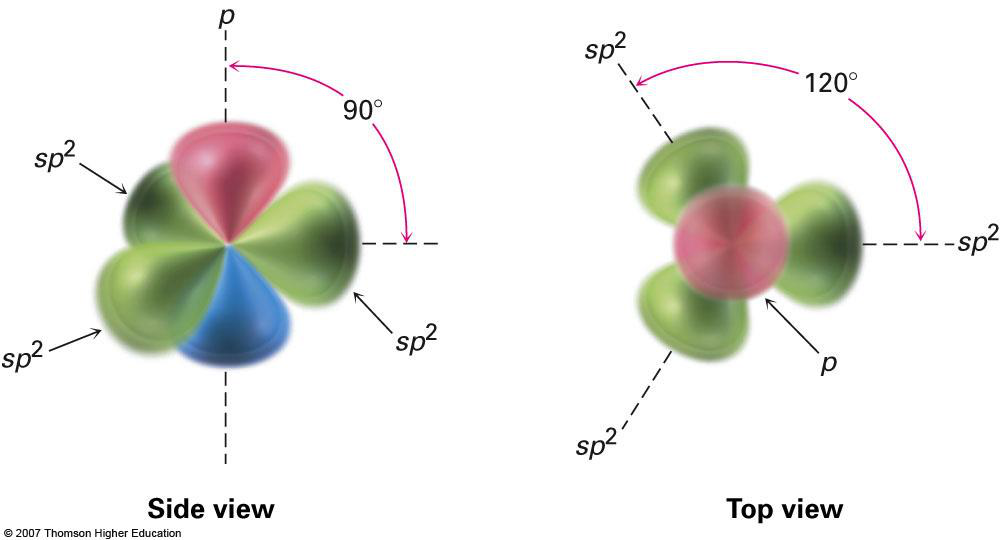
What is the molecular geometry of an sp²-hybridized carbon and its bond angles?
Trigonal planar geometry with bond angles of approximately \(120^\circ\).
Where is the remaining unhybridized p orbital located in an sp² carbon?
Perpendicular to the plane of the three sp² orbitals.
What two types of bonds make up a carbon-carbon double bond (C=C)?
One sigma bond from sp²–sp² overlap and one pi bond from side-by-side 2p–2p overlap.
How does the C=C bond length compare to a C–C single bond as noted in the study notes?
The C=C bond is shorter, about \(134\text{ pm}\).
What effect does the pi bond in a C=C double bond have on rotation about the bond?
The pi bond restricts rotation around the C=C bond.
Describe the spatial arrangement of sp² orbitals relative to each other.
Three sp² orbitals lie in one plane and are separated by approximately \(120^\circ\) from each other.
What type of bond forms when two sp²-hybridized orbitals overlap?
- A sigma (σ) bond
How is a pi (π) bond formed between carbon atoms in sp² systems?
- By side-to-side overlap of p orbitals (2p–2p overlap)
What bonds make up a carbon–carbon double bond in sp²-hybridized carbons?
- One sp²–sp² σ bond
- One 2p–2p π bond
Where are the electrons of a σ bond located relative to the nuclei?
- Centered between the two nuclei
Where do electrons in a π bond reside relative to the line between nuclei?
- In regions on either side of the line between the nuclei
Provide two geometric or bonding properties of sp²-hybridized carbon in a C=C double bond.
- Trigonal planar geometry, \(120^\circ\)
- C=C has one σ and one π bond (shorter bond length, restricts rotation)
Show an illustrative diagram of sp² orbital σ overlap and p-orbital π overlap for a C=C bond.
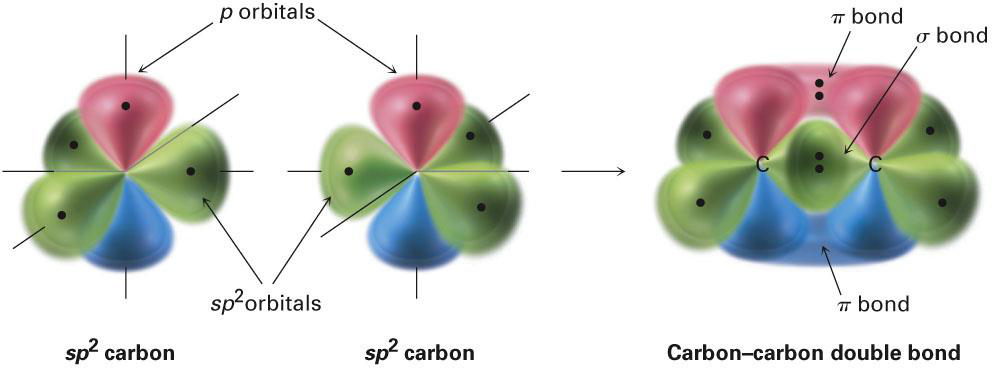 - Caption: sp² orbitals form the σ bond; p orbitals form the π bond
What orbitals form σ bonds to hydrogen in ethylene (C₂H₄)?
Hydrogen atoms form σ bonds with four sp² orbitals.
What are the approximate H–C–H and H–C–C bond angles in ethylene?
Both H–C–H and H–C–C bond angles are about 120°.
How does the C=C double bond in ethylene compare to a C–C single bond in ethane?
The C=C double bond in ethylene is shorter and stronger than the C–C single bond in ethane.
What is the bond length of the C=C double bond in ethylene and the C–C single bond value given?
- C=C (ethylene): 134 pm
- C–C (single): 154 pm
Where can a structural diagram of ethylene showing bond angles and bond lengths be found?
See molecular model and structural diagrams: 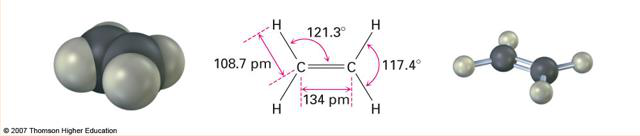
What molecule is titled in the section 'Structure of Ethylene'?
Ethylene (C₂H₄)
Write the Lewis structure shown for ethylene in the text.
H:C::C:H (each carbon bonded to two H and to the other C)
What is the molecular shape of a molecule with a carbon–carbon double bond as given?
Trigonal planar
Which atoms form the vertices of the triangle in the ethylene shape?
The hydrogens and carbons
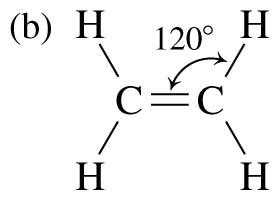
What are the bond angles in the ethylene molecule as stated?
120°
Flashcards in this deck (24)
-
How is an sp² hybrid orbital formed in carbon?
Combination of the 2s orbital with two 2p orbitals to give three sp² hybrid orbitals.
chemistry hybridization -
What is the molecular geometry of an sp²-hybridized carbon and its bond angles?
Trigonal planar geometry with bond angles of approximately \(120^\circ\).
geometry hybridization -
Where is the remaining unhybridized p orbital located in an sp² carbon?
Perpendicular to the plane of the three sp² orbitals.
structure orbitals -
What two types of bonds make up a carbon-carbon double bond (C=C)?
One sigma bond from sp²–sp² overlap and one pi bond from side-by-side 2p–2p overlap.
bonding alkenes -
How does the C=C bond length compare to a C–C single bond as noted in the study notes?
The C=C bond is shorter, about \(134\text{ pm}\).
bondlength alkenes -
What effect does the pi bond in a C=C double bond have on rotation about the bond?
The pi bond restricts rotation around the C=C bond.
stereochemistry alkenes -
Describe the spatial arrangement of sp² orbitals relative to each other.
Three sp² orbitals lie in one plane and are separated by approximately \(120^\circ\) from each other.
orbitals chemistry -
What type of bond forms when two sp²-hybridized orbitals overlap?
- A sigma (σ) bond
hybridization sigma bonding -
How is a pi (π) bond formed between carbon atoms in sp² systems?
- By side-to-side overlap of p orbitals (2p–2p overlap)
pi bonding orbitals -
What bonds make up a carbon–carbon double bond in sp²-hybridized carbons?
- One sp²–sp² σ bond
- One 2p–2p π bond
doublebond sigma pi -
Where are the electrons of a σ bond located relative to the nuclei?
- Centered between the two nuclei
sigma electrons -
Where do electrons in a π bond reside relative to the line between nuclei?
- In regions on either side of the line between the nuclei
pi electrons -
Provide two geometric or bonding properties of sp²-hybridized carbon in a C=C double bond.
- Trigonal planar geometry, \(120^\circ\)
- C=C has one σ and one π bond (shorter bond length, restricts rotation)
geometry sp2 doublebond -
Show an illustrative diagram of sp² orbital σ overlap and p-orbital π overlap for a C=C bond.
- Caption: sp² orbitals form the σ bond; p orbitals form the π bonddiagram visual bonding -
What orbitals form σ bonds to hydrogen in ethylene (C₂H₄)?
Hydrogen atoms form σ bonds with four sp² orbitals.
bonding hybridization ethylene -
What are the approximate H–C–H and H–C–C bond angles in ethylene?
Both H–C–H and H–C–C bond angles are about 120°.
geometry ethylene angles -
How does the C=C double bond in ethylene compare to a C–C single bond in ethane?
The C=C double bond in ethylene is shorter and stronger than the C–C single bond in ethane.
bonding comparison ethylene -
What is the bond length of the C=C double bond in ethylene and the C–C single bond value given?
- C=C (ethylene): 134 pm
- C–C (single): 154 pm
bond-length ethylene values -
Where can a structural diagram of ethylene showing bond angles and bond lengths be found?
See molecular model and structural diagrams:
image diagram ethylene -
What molecule is titled in the section 'Structure of Ethylene'?
Ethylene (C₂H₄)
chemistry organic molecules -
Write the Lewis structure shown for ethylene in the text.
H:C::C:H (each carbon bonded to two H and to the other C)
chemistry lewis bonding -
What is the molecular shape of a molecule with a carbon–carbon double bond as given?
Trigonal planar
chemistry geometry bonding -
Which atoms form the vertices of the triangle in the ethylene shape?
The hydrogens and carbons
chemistry geometry structure -
What are the bond angles in the ethylene molecule as stated?
120°
chemistry angles structure
sp\(^2\) Hybridization (core idea)
- Definition: sp\(^2\) hybridization mixes one 2s and two 2p orbitals to give three equivalent sp\(^2\) orbitals and one unhybridized 2p orbital.
- Geometry: The three sp\(^2\) orbitals lie in a plane with trigonal planar geometry and bond angles of \(120^\circ\).
- Unhybridized p orbital: The remaining 2p orbital is perpendicular to the sp\(^2\) plane and can overlap with another p orbital to form a \(\pi\) bond.
Sigma (\(\sigma\)) and Pi (\(\pi\)) Bonds
- Sigma bond (\(\sigma\)): Formed by end-to-end (head-on) overlap of two sp\(^2\) orbitals; electron density is centered along the internuclear axis.
- Pi bond (\(\pi\)): Formed by side-to-side overlap of the unhybridized 2p orbitals; electron density lies above and below the molecular plane.
- Double bond composition: A carbon–carbon double bond consists of one \(\sigma\) bond (sp\(^2\)–sp\(^2\)) plus one \(\pi\) bond (2p–2p), sharing four electrons total.
Structure and Properties of Ethylene (C₂H₄)
- Bonding arrangement: Each carbon is sp\(^2\)-hybridized; two sp\(^2\) orbitals form C–H bonds and the third forms the C–C \(\sigma\) bond.
- Geometry: At each carbon the atoms are arranged trigonal-planar; H–C–H and H–C–C angles ≈ \(120^\circ\).
- Bond lengths: C=C double bond is shorter and stronger than a C–C single bond; typical values: C=C ≈ \(134\text{ pm}\), C–C (single) ≈ \(154\text{ pm}\).
- Restricted rotation: The \(\pi\) bond fixes the relative positions of groups on the two carbons, preventing free rotation about the C=C bond.
Lewis Structure and Molecular Shape
- Lewis: H:C::C:H with each carbon forming three sigma bonds and one pi bond (one C–C \(\sigma\), one C=C \(\pi\)).
- Shape: Hydrogens and carbons occupy the vertices of triangles around each carbon (trigonal planar), shown by bond-angle diagrams.
Key Consequences & Practical Points
- Reactivity: The \(\pi\) electrons are more exposed (above/below the plane) and are typically the site of electrophilic attack.
- Bond strength vs. length: Shorter bonds (C=C) generally have higher bond energies than single bonds; the \(\pi\) component is weaker than the \(\sigma\) component.
- Stereochemistry: Planarity of sp\(^2\) carbons is essential for cis/trans (E/Z) isomerism in substituted alkenes.
Mnemonics & Quick Memory Aids
- "sp\(^2\) = planar, pair (one) p left over" — three orbitals in plane, one perpendicular p.
- Double bond = 1 \sigma (strong, axis) + 1 \pi (weaker, above/below).
Quick Practice Questions
- Why does an sp\(^2\) carbon have \(120^\circ\) bond angles? (Answer: three equivalent sp\(^2\) orbitals arrange to minimize repulsion → trigonal planar.)
- What prevents rotation about a C=C bond? (Answer: the \(\pi\) bond requires overlap of perpendicular p orbitals.)
- Compare bond lengths: which is longer, C–C single or C=C double? (Answer: C–C single ≈ \(154\text{ pm}\), C=C ≈ \(134\text{ pm}\).)