What is the smallest part of an element that can exist?
Substances made of only one type of atom are called _______.
What are elements that have both metallic and non-metallic properties called?
metalloids
atoms
compounds
groups
What are substances formed by different types of atoms bonded together?
The chemical formula for water is _______, which indicates a ratio of _______ hydrogen atoms for every _______ oxygen atom.
What holds atoms together in a compound?
An atom is composed of a tiny central _______ with _______ orbiting around it.
What are the columns of elements in the periodic table called?
What are the substances you start with in a chemical reaction called?
What is the term for the new substances created in a chemical reaction?
The _______ states that the total mass of the products formed in a reaction is equal to the total mass of the reactants.
When is a chemical equation considered to be balanced?
What does the state symbol (aq) stand for in a chemical equation?
Which state symbol represents a gas?
(l)
(g)
(s)
(aq)
What is the balanced symbol equation for the decomposition of calcium carbonate, including state symbols?
What did John Dalton suggest about the nature of atoms?
How did Dalton explain the role of atoms in chemical reactions?
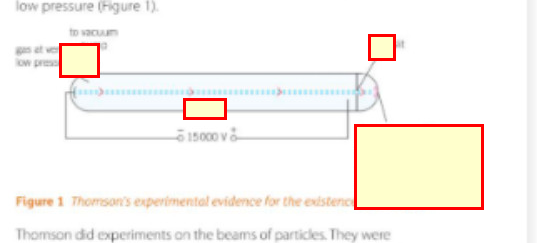
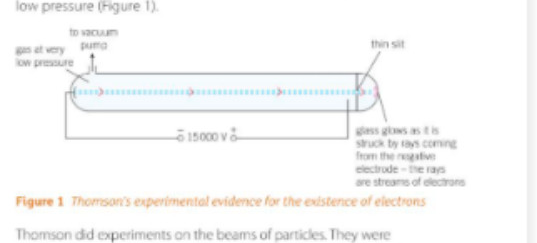
What are the characteristics of the electron discovered by J.J. Thomson?
How did Thomson conclude that the particles in his cathode ray tube experiments were negatively charged?
J.J. Thomson proposed that the tiny, negatively charged _______ were embedded in a cloud of _______.
What did Thomson's plum pudding model suggest about the overall charge of an atom?
Atoms have an overall negative charge.
Atoms fluctuate between positive and negative charges.
The charges must balance out, so atoms carry no overall charge.
Atoms have an overall positive charge.
What defines an ion?
How does an atom become a negative ion?
How do you calculate the number of neutrons in an atom?
In a neutral atom, the number of _______ equals the number of _______.
What does the atomic number of an element represent?
Which of the following describes the approximate size of an atom?
A tenth of a billionth of a metre
A billionth of a kilometre
A millionth of a centimetre
A thousandth of a millimetre
The oxygen ion \(O^{2-}\) has _______ protons, _______ neutrons, and _______ electrons.
What is the maximum number of electrons that the first energy level, closest to the nucleus, can hold?
The second energy level of an atom can hold up to _______ electrons.
What is meant by the term electronic structure in an atom?
What is the electronic structure of a sodium atom?
Silicon, which has 14 electrons, has an electronic structure of _______.
In an atom, which energy level do electrons preferentially occupy?
Any random energy level.
The third energy level regardless of others.
The highest available energy level, furthest from the nucleus.
The lowest available energy level, closest to the nucleus.
How many electrons does a sodium atom have if its atomic number is 11?
このデッキ内のフラッシュカード (38 枚)
-
1
What is the smallest part of an element that can exist?
An atom
-
2
Substances made of only one type of atom are called elements.
-
3
What are elements that have both metallic and non-metallic properties called?
metalloids
atoms
compounds
groups
-
4
What are substances formed by different types of atoms bonded together?
Compounds
-
5
The chemical formula for water is \(H_2O\), which indicates a ratio of 2 hydrogen atoms for every 1 oxygen atom.
-
6
What holds atoms together in a compound?
Chemical bonds
-
7
An atom is composed of a tiny central nucleus with electrons orbiting around it.
-
8
What are the columns of elements in the periodic table called?
Groups
-
9
What are the substances you start with in a chemical reaction called?
Reactants
-
10
What is the term for the new substances created in a chemical reaction?
Products
-
11
The Law of conservation of mass states that the total mass of the products formed in a reaction is equal to the total mass of the reactants.
-
12
When is a chemical equation considered to be balanced?
When there is the same number of each type of atom on both sides of the equation.
-
13
What does the state symbol (aq) stand for in a chemical equation?
A substance dissolved in water, known as an aqueous solution.
-
14
Which state symbol represents a gas?
(l)
(g)
(s)
(aq)
-
15
What is the balanced symbol equation for the decomposition of calcium carbonate, including state symbols?
\(CaCO_3(s) \rightarrow CaO(s) + CO_2(g)\)

-
16
What did John Dalton suggest about the nature of atoms?
He suggested they were like tiny, hard spheres that could not be divided or split and were the fundamental building blocks of nature.
-
17
How did Dalton explain the role of atoms in chemical reactions?
He suggested that atoms re-arranged themselves and combined with other atoms in new ways.
-
18
What are the characteristics of the electron discovered by J.J. Thomson?
It is a tiny, negatively charged particle with a mass about 2000 times smaller than the lightest atom.
-
19
How did Thomson conclude that the particles in his cathode ray tube experiments were negatively charged?
The beams of particles were attracted to a positive charge.
-
20
J.J. Thomson proposed that the tiny, negatively charged electrons were embedded in a cloud of positive charge.
-
21
What did Thomson's plum pudding model suggest about the overall charge of an atom?
Atoms have an overall negative charge.
Atoms fluctuate between positive and negative charges.
The charges must balance out, so atoms carry no overall charge.
Atoms have an overall positive charge.
-
22
-
23
-
24
What defines an ion?
An ion is an atom or a group of atoms that has an electrical charge.
-
25
How does an atom become a negative ion?
An atom becomes a negative ion when it gains one or more electrons, resulting in more electrons than protons.
-
26
How do you calculate the number of neutrons in an atom?
Subtract the atomic number from the mass number.
-
27
In a neutral atom, the number of protons equals the number of electrons.
-
28
What does the atomic number of an element represent?
The number of protons in an atom.
-
29
Which of the following describes the approximate size of an atom?
A tenth of a billionth of a metre
A billionth of a kilometre
A millionth of a centimetre
A thousandth of a millimetre
-
30
The oxygen ion \(O^{2-}\) has eight protons, eight neutrons, and ten electrons.
-
31
What is the maximum number of electrons that the first energy level, closest to the nucleus, can hold?
Two electrons.
-
32
The second energy level of an atom can hold up to eight electrons.
-
33
What is meant by the term electronic structure in an atom?
It is the record of the number of electrons present in each successive energy level, starting from the innermost shell.
-
34
What is the electronic structure of a sodium atom?
2,8,1
-
35
Silicon, which has 14 electrons, has an electronic structure of 2,8,4.
-
36
In an atom, which energy level do electrons preferentially occupy?
Any random energy level.
The third energy level regardless of others.
The highest available energy level, furthest from the nucleus.
The lowest available energy level, closest to the nucleus.
-
37
How many electrons does a sodium atom have if its atomic number is 11?
11 electrons.
-
38