Sla je deck op voordat het weg is
Deze flashcards zijn nog niet opgeslagen — ze verdwijnen zodra je weggaat. Maak een gratis account aan om ze te bewaren en krijg toegang tot alles hieronder.
- Save this deck to your account
- Study with spaced repetition
- Export to Anki (.apkg) or PDF
- Process documents up to 100 pages
- Images extracted from your PDFs
- Sharper text extraction & a more advanced AI model
What is the resting membrane potential (RMP) and its typical range?
What is an action potential?
Name the three key factors that contribute to the resting membrane potential.
List the main steps of synaptic transmission from presynaptic action potential to postsynaptic change.
What is the stoichiometry of the sodium-potassium pump (Na+/K+-ATPase) and its effect on charge?
What is the typical value of the resting membrane potential (RMP) in most neurons?
Define equilibrium potential (Eion) for an ion.
Name three main factors that establish and maintain the resting membrane potential.
State the Nernst equation for calculating an ion's equilibrium potential.
What is an Excitatory Postsynaptic Potential (EPSP)?
According to the text, what sign is the equilibrium potential predicted to have for K+ and for Na+?
What is an Inhibitory Postsynaptic Potential (IPSP)?
Why is the actual membrane potential usually less negative than EK in real cells?
What are the main phases of an action potential?
What permeability values are given for an example cell in the text (P for K+, Na+, Cl-)?
Why does Na+ move into the cell when Na+ channels open?
What are the main gating types of ion channels listed in the text?
Define depolarizing and hyperpolarizing in terms of membrane potential.
What is the driving force that makes Na+ move into a cell when Na+ channels open?
How does the Na+/K+-ATPase pump move ions across the membrane?
Define depolarisation and hyperpolarisation of the membrane potential.
Illustration: What concept does this image demonstrate about membrane potential changes?
Illustrate depolarising vs hyperpolarising changes (image as illustration).
Illustration: What does this image show about measuring membrane potential?
What experimental method is described for measuring membrane potential?
What is the 'absolute refractory period' during an action potential?
Summarise the core concept linking ionic gradients, permeability and action potentials from the study notes.
What defines the 'relative refractory period'?
What is an action potential?
What is 'propagation of an action potential'?
Which ion channel event causes the depolarization phase of an action potential?
What is 'continuous conduction'?
What causes the repolarization phase of an action potential?
What is 'saltatory conduction' and one key advantage?
Why does membrane potential briefly become more negative than resting potential (hyperpolarization)?
What is 'synaptic integration' in a postsynaptic neuron?
What primarily generates the resting membrane potential (RMP)?
What is 'temporal summation' of postsynaptic potentials?
What determines an ion's equilibrium potential?
What is 'spatial summation' of postsynaptic potentials?
Why is the resting membrane potential usually less negative than the K+ equilibrium potential (E_K)?
What are the main classes of neurotransmitters listed?
What factors can change the membrane potential?
What is the difference between depolarizing and hyperpolarizing changes in membrane potential? (see image)
How is 'depolarising' vs 'hyperpolarising' described for membrane potential?
How is membrane potential measured with electrodes? (image illustration)
Flashcards in this deck (46)
-
What is the resting membrane potential (RMP) and its typical range?
- The electrical potential difference across the plasma membrane when a cell is not stimulated
- Typical range: -40 mV to -90 mV
membrane rmp -
What is an action potential?
A rapid, all-or-none electrical signal generated by ion flow across the neuronal membrane responsible for transmitting information along the axon.
neuron actionpotential -
Name the three key factors that contribute to the resting membrane potential.
- Unequal ion distributions (e.g., high K+ inside, high Na+ outside)
- Selective membrane permeability (more permeable to K+ at rest)
- Sodium-potassium pump (Na+/K+-ATPase) maintaining gradients
rmp factors -
List the main steps of synaptic transmission from presynaptic action potential to postsynaptic change.
- Action potential arrives at axon terminal
- Voltage-gated Ca2+ channels open and Ca2+ enters
- Synaptic vesicles fuse and release neurotransmitters
- Neurotransmitters bind postsynaptic receptors causing membrane potential change
synapse transmission -
What is the stoichiometry of the sodium-potassium pump (Na+/K+-ATPase) and its effect on charge?
- Pumps 3 Na+ out and 2 K+ in per ATP hydrolysed, contributing to a net negative charge inside the cell
pump nak -
What is the typical value of the resting membrane potential (RMP) in most neurons?
About -70 mV
membrane rmp -
Define equilibrium potential (Eion) for an ion.
- The membrane potential that exactly balances the electrochemical gradient so there is no net movement of that ion
equilibrium nernst -
Name three main factors that establish and maintain the resting membrane potential.
- Unequal ion distributions (e.g., [Na+]out > [Na+]in, [K+]in > [K+]out)
- Selective membrane permeability via ion channels
- Na+/K+-ATPase pump activity (3 Na+ out, 2 K+ in)
rmp ionchannels -
State the Nernst equation for calculating an ion's equilibrium potential.
- Eion = (RT / zF) * ln([ion]out / [ion]in)
nernst equation -
What is an Excitatory Postsynaptic Potential (EPSP)?
A depolarization of the postsynaptic membrane that makes the neuron more likely to fire an action potential, often caused by Na+ influx.
epsp synapse -
According to the text, what sign is the equilibrium potential predicted to have for K+ and for Na+?
- K+: negative (because K+ is high inside)
- Na+: positive (because Na+ is high outside)
nernst ions -
What is an Inhibitory Postsynaptic Potential (IPSP)?
A hyperpolarization of the postsynaptic membrane that makes the neuron less likely to fire an action potential, often caused by Cl- influx or K+ efflux.
ipsp synapse -
Why is the actual membrane potential usually less negative than EK in real cells?
- Because the membrane is not completely impermeable to Na+ (Na+ moves in) and there is K+ leakage; combined Na+ and K+ movements depolarise the membrane
goldman permeability -
What are the main phases of an action potential?
- Depolarization: rapid Na+ influx (rising phase)
- Repolarization: Na+ inactivation and K+ efflux (falling phase)
- Hyperpolarization (undershoot): membrane becomes more negative
- Return to resting potential
actionpotential phases -
What permeability values are given for an example cell in the text (P for K+, Na+, Cl-)?
- P(K+) = 1, P(Na+) ≈ 0.05, P(Cl-) ≈ 0.45
permeability goldman -
Why does Na+ move into the cell when Na+ channels open?
Because the driving force is inward: concentration gradient (higher extracellular Na+) plus an electrical gradient attracting positive ions into the negatively charged cell.
ionmovement na -
What are the main gating types of ion channels listed in the text?
- Voltage-gated channels
- Ligand-gated channels
- Mechanically-gated channels
- Temperature-gated channels
ionchannels gating -
Define depolarizing and hyperpolarizing in terms of membrane potential.
- Depolarizing: making the membrane potential less negative (more positive)
- Hyperpolarizing: making the membrane potential more negative
membrane polarization -
What is the driving force that makes Na+ move into a cell when Na+ channels open?
- The driving force is the sum of the inward concentration gradient and the inward electrical gradient for Na+
drivingforce sodium -
How does the Na+/K+-ATPase pump move ions across the membrane?
It moves 3 Na+ out of the cell and 2 K+ in per cycle.
pump nak -
Define depolarisation and hyperpolarisation of the membrane potential.
- Depolarisation: membrane potential becomes less negative (more positive)
- Hyperpolarisation: membrane potential becomes more negative
depolarisation hyperpolarisation -
Illustration: What concept does this image demonstrate about membrane potential changes?
The image demonstrates depolarising (membrane becomes less negative) and hyperpolarising (membrane becomes more negative) relative to a resting potential of -70 mV.
 image polarization
 -
Illustrate depolarising vs hyperpolarising changes (image as illustration).
- Shows: resting potential ≈ -70 mV; making membrane potential more positive = depolarising; more negative = hyperpolarisingillustration polarisation -
Illustration: What does this image show about measuring membrane potential?
It shows measurement using a microelectrode and reference electrode with an amplifier, displaying the potential difference and a resting potential at -70 mV.
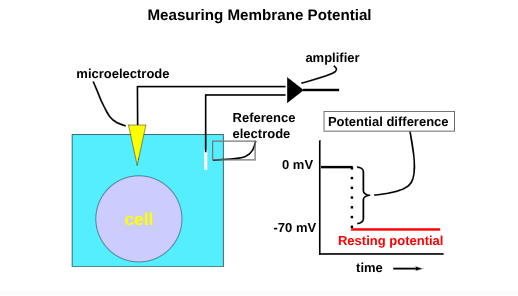 image measurement
 -
What experimental method is described for measuring membrane potential?
- Use a microelectrode inside the cell and a reference electrode outside; measure potential difference with an amplifier (resting ≈ -70 mV)
measurement technique -
What is the 'absolute refractory period' during an action potential?
No stimulus, however strong, can elicit another action potential because voltage-gated Na+ channels are inactivated; occurs during depolarization and most of repolarization.
neurophysiology refractory -
Summarise the core concept linking ionic gradients, permeability and action potentials from the study notes.
- Membrane potential arises from ionic gradients plus selective permeabilities; gated ion channels convert these gradients into action potentials
summary core -
What defines the 'relative refractory period'?
A stronger-than-usual stimulus is required to reach threshold because voltage-gated Na+ channels are returning to resting state while voltage-gated K+ channels are still open; occurs during hyperpolarization.
neurophysiology refractory -
What is an action potential?
A rapid, transient, all-or-none electrical signal that travels along the membrane of excitable cells and is initiated when membrane potential reaches a threshold.
neurophysiology action_potential -
What is 'propagation of an action potential'?
The movement of an action potential along the axon.
neurophysiology propagation -
Which ion channel event causes the depolarization phase of an action potential?
Opening of voltage-gated Na+ channels causes rapid increase in membrane potential (depolarization).
action_potential depolarization -
What is 'continuous conduction'?
Action potential propagates step-by-step along the axon membrane and occurs in unmyelinated axons.
propagation axon -
What causes the repolarization phase of an action potential?
Inactivation of voltage-gated Na+ channels and opening of voltage-gated K+ channels causes repolarization.
action_potential repolarization -
What is 'saltatory conduction' and one key advantage?
Action potentials 'jump' between nodes of Ranvier in myelinated axons; it is faster and more energy-efficient than continuous conduction.
propagation myelination -
Why does membrane potential briefly become more negative than resting potential (hyperpolarization)?
Because voltage-gated K+ channels close slowly, allowing extra K+ efflux that makes the membrane potential more negative.
action_potential hyperpolarization -
What is 'synaptic integration' in a postsynaptic neuron?
The process by which a postsynaptic neuron integrates multiple synaptic inputs to determine whether to fire an action potential.
synapse integration -
What primarily generates the resting membrane potential (RMP)?
Selective membrane permeability to K+ (via leak channels) and outward K+ movement down its concentration gradient, plus the Na+/K+ pump.
resting_potential membrane_potential -
What is 'temporal summation' of postsynaptic potentials?
Multiple postsynaptic potentials (EPSPs or IPSPs) arrive at the same synapse in rapid succession from a single presynaptic neuron.
summation synaptic -
What determines an ion's equilibrium potential?
The ion's concentration gradient across the membrane and its charge (valence), as described by the Nernst equation.
equilibrium_potential nernst -
What is 'spatial summation' of postsynaptic potentials?
Multiple postsynaptic potentials (EPSPs or IPSPs) arrive at the same postsynaptic neuron simultaneously from different presynaptic neurons.
summation synaptic -
Why is the resting membrane potential usually less negative than the K+ equilibrium potential (E_K)?
Because the membrane is slightly permeable to Na+ at rest, allowing Na+ entry that depolarizes the membrane relative to E_K.
resting_potential permeability -
What are the main classes of neurotransmitters listed?
- Amino Acids: e.g., GABA (inhibitory), Glutamate (excitatory)
- Amines: e.g., Dopamine, Serotonin, Norepinephrine
- Peptides: e.g., Endorphins, Substance P
- Other: e.g., Acetylcholine (ACh)
neurotransmitters classification -
What factors can change the membrane potential?
Changes in ion concentrations, changes in membrane permeability to specific ions (opening/closing channels), and activity of ion pumps.
membrane_potential factors -
What is the difference between depolarizing and hyperpolarizing changes in membrane potential? (see image)
Depolarizing: membrane potential becomes less negative (more positive). Hyperpolarizing: membrane potential becomes more negative.
membrane potentials -
How is 'depolarising' vs 'hyperpolarising' described for membrane potential?
- Depolarising: membrane potential becomes less negative (more positive).
- Hyperpolarising: membrane potential becomes more negative.
membrane_potential polarisation -
How is membrane potential measured with electrodes? (image illustration)
A microelectrode inside the cell and a reference electrode outside measure the potential difference, amplified and displayed with resting potential around -70 mV.
technique measurement
Chapter 4 — The Neuron: Key Study Notes
Overview
- Neuronal signalling uses electrical changes across the membrane (membrane potentials) and chemical transmission at synapses to transmit information.
Synaptic transmission (how neurons connect)
- Steps:
- Action potential arrives at the presynaptic terminal.
- Voltage-gated Ca\(^{2+}\) channels open; Ca\(^{2+}\) influx triggers vesicle fusion.
- Neurotransmitters are released into the synaptic cleft and bind postsynaptic receptors.
- Receptor binding changes postsynaptic ion permeability and membrane potential.
- Vesicle cycle: storage → Ca\(^{2+}\)-triggered fusion → diffusion → receptor action → removal (reuptake/degradation).
Membrane potentials
- Resting membrane potential (RMP): typical neuronal value ≈ -70 mV; results from ion concentration gradients and selective membrane permeability.
- Main contributors: high intracellular K\(^+\), high extracellular Na\(^+\) and Cl\(^-\), ion channels, and the Na\(^+\)/K\(^+\)-ATPase which maintains gradients (\(3\ \mathrm{Na}^+\) out, \(2\ \mathrm{K}^+\) in).
Alt text: Depolarising and hyperpolarising membrane potential diagram.
Factors that determine RMP
- Ionic concentration gradients across the membrane (e.g., \([\mathrm{K}^+]_{\text{in}}\gg[\mathrm{K}^+]_{\text{out}}\)).
- Membrane permeability to specific ions (open channels).
- Electrogenic pumps (Na\(^+\)/K\(^+\)-ATPase) that consume metabolic energy.
Nernst equation (equilibrium potential for one ion)
- General form for ion with valence \(z\): \(\(E_{\text{ion}} = \frac{RT}{zF}\ln\frac{[\text{ion}]_{\text{outside}}}{[\text{ion}]_{\text{inside}}}\)\)
- Gives the membrane potential where net flux of that ion is zero (balance of concentration and electrical forces).
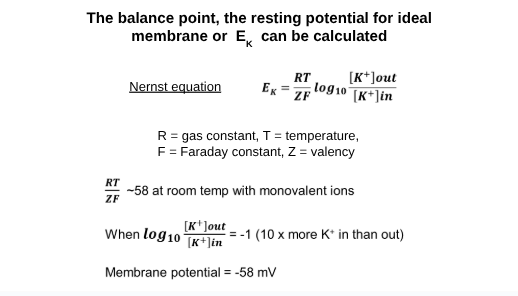 Alt text: Nernst equation and example for monovalent ions.
Goldman–Hodgkin–Katz (GHK) equation
- For multiple permeant ions, membrane potential depends on permeabilities \(P\) and concentrations: \(\(E_m = \frac{RT}{F}\ln\frac{P_K[\mathrm{K}^+]_o + P_{Na}[\mathrm{Na}^+]_o + P_{Cl}[\mathrm{Cl}^-]_i}{P_K[\mathrm{K}^+]_i + P_{Na}[\mathrm{Na}^+]_i + P_{Cl}[\mathrm{Cl}^-]_o}\)\)
- Explains why real Em is usually less negative than \(E_K\) alone (small Na\(^+\) permeability shifts Em toward less negative values).
Postsynaptic potentials (PSPs)
- PSPs are graded (size depends on neurotransmitter amount and receptor response) and can summate.
- Excitatory postsynaptic potential (EPSP): depolarizing, often due to Na\(^+\) influx; moves membrane closer to threshold.
- Inhibitory postsynaptic potential (IPSP): hyperpolarizing, often due to Cl\(^-\) influx or K\(^+\) efflux; moves membrane away from threshold.
Synaptic integration and summation
- Temporal summation: PSPS from the same synapse arrive in rapid succession and add.
- Spatial summation: PSPS from different synapses at the same time combine.
- The neuron fires an action potential if integrated PSPs bring the axon hillock to threshold.
Action potential (AP)
- AP is a rapid, all-or-none depolarization that propagates along the axon to transmit information.
- Phases and ionic basis:
- Resting: Em ≈ -70 mV.
- Depolarization (rising phase): voltage-gated Na\(^+\) channels open → rapid Na\(^+\) influx → Em becomes positive.
- Repolarization (falling phase): Na\(^+\) channels inactivate; voltage-gated K\(^+\) channels open → K\(^+\) efflux → Em returns toward rest.
- Hyperpolarization (undershoot): K\(^+\) channels close slowly, Em becomes more negative than RMP temporarily.
- Driving force on an ion can be expressed as: \(\(\text{Driving force} = V_m - E_{\text{ion}}\)\) where \(V_m\) is membrane potential and \(E_{\text{ion}}\) is that ion's equilibrium potential.
Refractory periods
- Absolute refractory period: during depolarization and most repolarization Na\(^+\) channels are inactivated; no stimulus can elicit another AP.
- Relative refractory period: during hyperpolarization a stronger-than-normal stimulus can trigger an AP because some Na\(^+\) channels have recovered.
Propagation of action potentials
- Continuous conduction: unmyelinated axons; AP is regenerated along each patch of membrane (slow).
- Saltatory conduction: myelinated axons; APs jump between nodes of Ranvier, increasing speed and efficiency.
- Myelin reduces membrane capacitance and increases membrane resistance, speeding conduction.
Neurotransmitters — main classes and examples
- Amino acids: GABA (inhibitory), Glutamate (excitatory).
- Amines: Dopamine, Serotonin, Norepinephrine.
- Peptides: Endorphins, Substance P.
- Other small molecules: Acetylcholine (ACh).
Quick practical points for study
- Remember RMP ≈ -70 mV and Na\(^+\)/K\(^+\) pump stoichiometry (\(3\ \mathrm{Na}^+\) out, \(2\ \mathrm{K}^+\) in).
- Use Nernst for single-ion equilibrium potentials and GHK for realistic Em with multiple ions.
- Distinguish graded PSPs (local, summating) from all-or-none APs (propagating).
Key terms (flashcard-style)
- Resting membrane potential (RMP)
- Nernst equation and equilibrium potential
- Goldman–Hodgkin–Katz equation
- EPSP / IPSP
- Absolute vs relative refractory period
- Saltatory vs continuous conduction