Cadastre-se para desbloquear mais recursos
- Salve este baralho na sua conta
- Estude flashcards com repetição espaçada
- Exportar para Anki (.apkg) ou PDF
- Processar documentos de até 100 páginas
- Imagens extraídas de PDFs e documentos
- Extração de texto melhorada em seus PDFs e documentos
- Flashcards melhores com nosso modelo de IA mais avançado
What are the mounting and location requirements for a fire alarm system Document Cabinet?
What labeling and access requirements must a fire alarm Document Cabinet meet?
What types of documentation media may a Document Cabinet provide storage for?
What marking information appears on a listed control unit or transponder regarding installation environment?
When does the marking include a rated prevailing ambient temperature for a control unit or transponder?
What are the typical test conditions for a control unit/transponder marked 'indoor dry'?
What are the typical test conditions for a control unit/transponder marked 'indoor damp and wet'?
What are the typical test conditions for a control unit/transponder marked 'outdoor damp and wet'?
Where may annunciators or display and control centres be installed for emergency response?
How should annunciators or display and control centres be installed?
Example: Where can you find a visual of recommended document storage for fire alarm systems?
Example: Where can you find a visual of environmental testing conditions for control units/transponders?
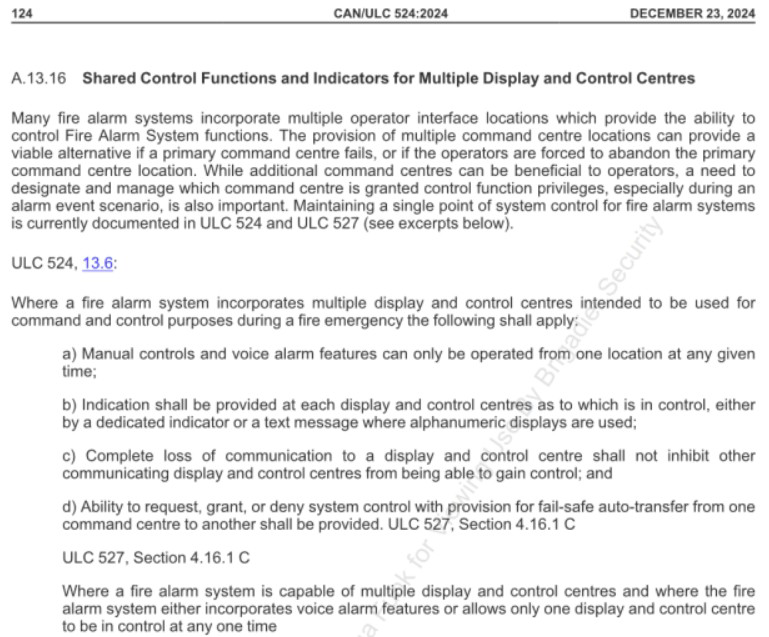
When a fire alarm system has multiple display and control centres, how many locations may operate manual controls and voice alarm features at one time?
What indication requirement must be provided at each display and control centre about control status?
How must loss of communication to one display and control centre affect other communicating centres?
What control-transfer capability must be provided between command centres?
Does the requirement to designate which centre is in control apply to parts of a command centre or the entire command centre location?
Give an example configuration of multiple Central Alarm and Control Facilities (CACFs) in a large building.
In an emergency, what restriction is specified about simultaneous control from different locations?
Illustration: Where might multiple CACFs be located in a building (see image)?
Why must a fire alarm system provide the ability to relocate operators to an alternative command centre?
What controls is each Control Location required to have for transferring command privileges?
What should happen at a requesting Control Location when it requests access to Control Functions?
How is 'Grant Access' performed when a Control Location requests control functions?
What occurs when the current Control Location denies a transfer request?
What does 'Access Status' display at each Control Location?
Give an example of a supplementary illustration available for the control-transfer workflow.
Flashcards neste baralho (27)
-
What are the mounting and location requirements for a fire alarm system Document Cabinet?
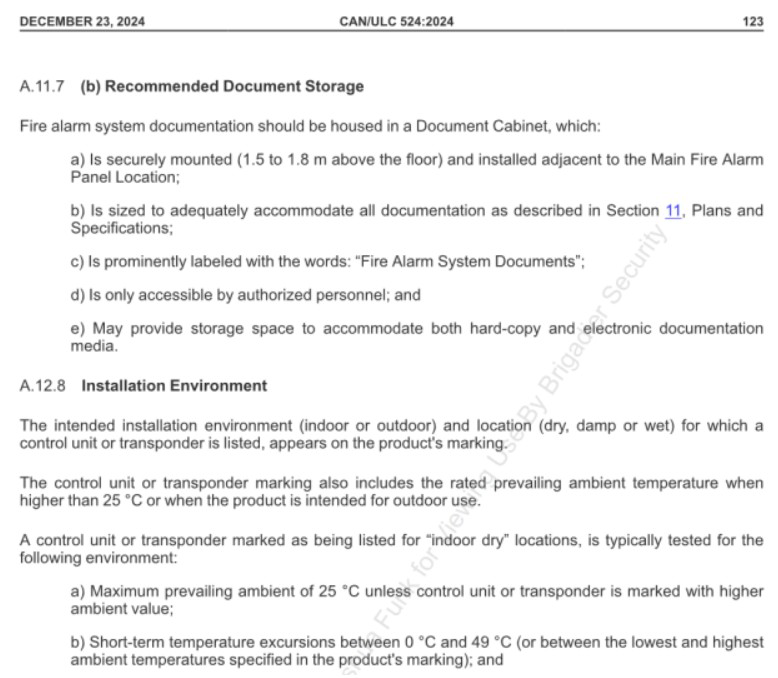
- Be securely mounted 1.5 to 1.8 m above the floor
- Installed adjacent to the Main Fire Alarm Panel Location
documents storage -
What labeling and access requirements must a fire alarm Document Cabinet meet?
- Prominently labeled 'Fire Alarm System Documents'
- Only accessible by authorized personnel
documents security -
What types of documentation media may a Document Cabinet provide storage for?
May provide storage space to accommodate both hard-copy and electronic documentation media
documents media -
What marking information appears on a listed control unit or transponder regarding installation environment?
The intended installation environment (indoor or outdoor) and location (dry, damp or wet) appears on the product's marking
marking environment -
When does the marking include a rated prevailing ambient temperature for a control unit or transponder?
When the rated prevailing ambient temperature is higher than 25 °C or when the product is intended for outdoor use
marking temperature -
What are the typical test conditions for a control unit/transponder marked 'indoor dry'?
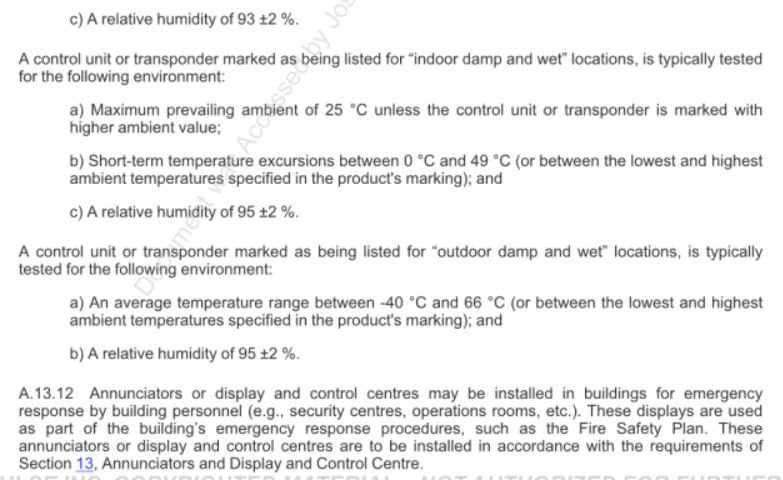
- Maximum prevailing ambient of 25 °C unless marked higher
- Short-term excursions between 0 °C and 49 °C
- Relative humidity of 93 ±2%
environment indoor -
What are the typical test conditions for a control unit/transponder marked 'indoor damp and wet'?
- Maximum prevailing ambient of 25 °C unless marked higher
- Short-term excursions between 0 °C and 49 °C
- Relative humidity of 95 ±2%
environment indoor -
What are the typical test conditions for a control unit/transponder marked 'outdoor damp and wet'?
- Average temperature range between -40 °C and 66 °C
- Relative humidity of 95 ±2%
environment outdoor -
Where may annunciators or display and control centres be installed for emergency response?
In buildings for emergency response by building personnel (e.g., security centres, operations rooms)
annunciator installation -
How should annunciators or display and control centres be installed?
They are to be installed in accordance with the requirements of Section 13, Annunciators and Display and Control Centre
annunciator standards -
Example: Where can you find a visual of recommended document storage for fire alarm systems?
See illustration:
 documents image
 -
Example: Where can you find a visual of environmental testing conditions for control units/transponders?
See illustration:
 environment image
 -
When a fire alarm system has multiple display and control centres, how many locations may operate manual controls and voice alarm features at one time?
Only one location may operate manual controls and voice alarm features at any given time.
control firealarm ulc524 -
What indication requirement must be provided at each display and control centre about control status?
Each centre must continuously display which centre is in control, either by a dedicated indicator or a text message on alphanumeric displays.
indication display ulc524 -
How must loss of communication to one display and control centre affect other communicating centres?
Complete loss of communication to one centre shall not inhibit other communicating centres from gaining control.
redundancy communication ulc524 -
What control-transfer capability must be provided between command centres?
Ability to request, grant, or deny system control and a fail-safe auto-transfer from one command centre to another must be provided.
transfer fail-safe ulc524 -
Does the requirement to designate which centre is in control apply to parts of a command centre or the entire command centre location?
The requirement applies to the entire command centre location, not only to specific functions or pieces of equipment within it.
scope commandcentre ulc524 -
Give an example configuration of multiple Central Alarm and Control Facilities (CACFs) in a large building.
- Front entrance CACF for Fire Department use
- Operations centre CACF for building operations staff
- Third reduced-capability CACF located elsewhere in the building
example cacf ulc524 -
In an emergency, what restriction is specified about simultaneous control from different locations?
In an emergency, control operations should be from only one location at any given time; simultaneous activation from multiple locations is generally not acceptable.
emergency control ulc524 -
Illustration: Where might multiple CACFs be located in a building (see image)?
Possible CACF locations include the building front entrance, the operations centre, and a third reduced-control centre elsewhere.
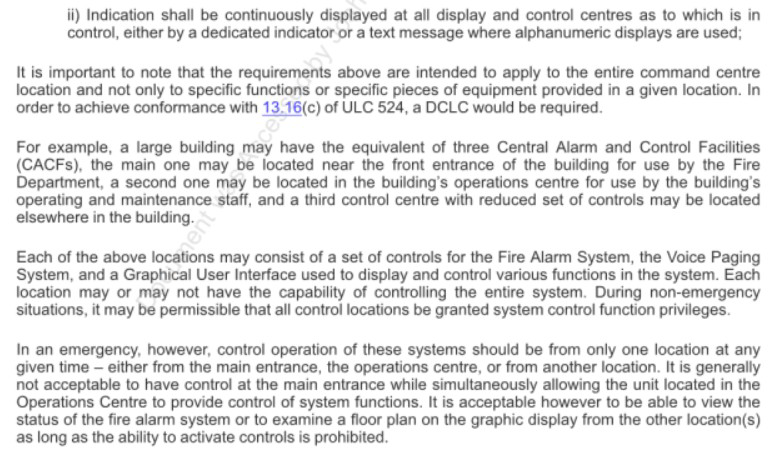 image cacf example
 -
Why must a fire alarm system provide the ability to relocate operators to an alternative command centre?
Because situations may require that command centre control privileges be moved from one location to another.
control relocation -
What controls is each Control Location required to have for transferring command privileges?
- Request
- Grant
- Deny
- And a means to indicate which Control Location is currently "in control".
controls requirements -
What should happen at a requesting Control Location when it requests access to Control Functions?
An indicator should activate for the requesting location to show the request for access to Control Functions.
request indicator -
How is 'Grant Access' performed when a Control Location requests control functions?
The Control Location presently in control should manually transfer Control Function Privileges to the requesting Control Location.
grant procedure -
What occurs when the current Control Location denies a transfer request?
The current Control Location manually denies the transfer and an indication at the requesting location activates to signify access has been denied.
deny indicator -
What does 'Access Status' display at each Control Location?
The current status and the location of Control Function Privileges (which Control Location is in control).
status access -
Give an example of a supplementary illustration available for the control-transfer workflow.
See this illustrative diagram of control-location request/grant/deny controls:
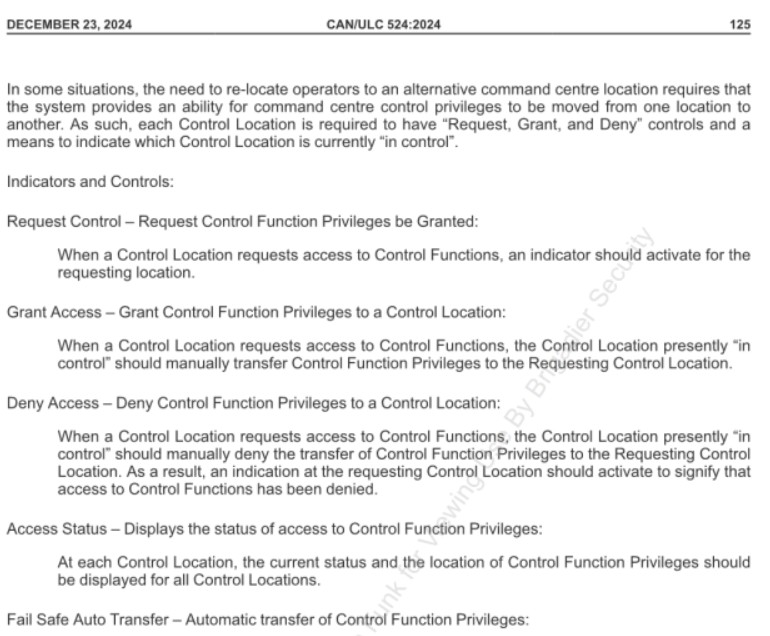 illustration diagram
Document storage (A.11.7(b))
- Document Cabinet: required location for all fire alarm system documentation.
- Mounting & location: securely mounted about 1.5–1.8 m above the floor and installed adjacent to the Main Fire Alarm Panel.
- Sizing & content: sized to hold all documents required by Section 11 (plans, specifications) and able to store both hard-copy and electronic media.
- Labeling & access: prominently labeled Fire Alarm System Documents and accessible only to authorized personnel.
Installation environment & product marking (A.12.8)
- Marking requirements: control units/transponders must be marked with intended installation environment (indoor/outdoor; dry/damp/wet) and the rated prevailing ambient if > 25 °C or intended for outdoor use.
- Marking defines the environmental conditions used during product testing and acceptance.
Typical test environments by listing
- Indoor — dry:
- Prevailing ambient: 25 °C max unless a higher value is marked.
- Short-term temperature excursions: 0 °C to 49 °C (or range shown on marking).
-
Relative humidity: 93 ±2%.
-
Indoor — damp and wet:
- Prevailing ambient: 25 °C max unless higher marked.
- Short-term excursions: 0 °C to 49 °C (or marking range).
-
Relative humidity: 95 ±2%.
-
Outdoor — damp and wet:
- Average temperature range: −40 °C to 66 °C (or marking range).
- Relative humidity: 95 ±2%.
Notes: - Always follow the product's marked temperature/humidity ranges when different from these typical values.
Annunciators / display and control centres (A.13.12)
- Annunciators and display/control centres may be installed for building personnel (security, operations) to support emergency response and the Fire Safety Plan.
- Installation must conform to Section 13 (Annunciators and Display and Control Centre) requirements.
Shared control functions for multiple display & control centres (A.13.16 / ULC 524 & 527)
- Many systems have multiple operator locations (display & control centres) to provide redundancy or distributed operation.
- Key design goals: provide one active control location at a time, clear indication of which location is in control, and the ability to relocate control if needed.
Core requirements (summary of ULC 524, 13.6 and ULC 527 4.16.1 C): - Single-control operation: manual controls and voice alarm features may be operated from only one location at any time. - Control indication: every centre must display which location is currently in control (dedicated LED or text message). - Robustness: loss of communication to one centre must not prevent other centres from gaining control. - Fail-safe transfer: ability to request, grant, or deny control and to auto-transfer control in a fail-safe manner.
Controls & indicators — practical behavior
- Request Control: a control location requests the right to control; an indicator should show the pending request at the requesting location.
- Grant Access: the current "in-control" location manually grants control to the requesting location; the granted location becomes active.
- Deny Access: the current location can deny the request; the requesting location receives a denial indication.
- Access Status: every control location displays current access status and which location holds control.
Implementation notes: - Each control location must have Request, Grant, Deny controls and a persistent indicator of current control. - The indication applies to the entire command centre location (not just some functions or devices). - Systems should support fail-safe auto-transfer to another centre if the current centre becomes unavailable.
Operational example (typical large building)
- Possible command centres (CACFs):
- Main entrance CACF for Fire Department use.
- Operations centre CACF for building staff (full controls).
- A third CACF with a reduced control set elsewhere.
- During normal conditions, only one location has control at a time.
- During an emergency, control remains from a single location (main entrance, operations, or alternate) — simultaneous active controls are not acceptable.
- Other centres may view status or floor plans but must be prevented from activating controls unless granted control.
Design & reliability considerations
- Provide redundant communications and robust fault-tolerance so loss of one centre does not block control transfer.
- Implement logging and visible indicators for all Request/Grant/Deny events for accountability.
- Use a Display and Control Centre (DCLC) design where required to meet single-control and transfer provisions (ULC 524, 13.16(c)).
- Consider circuit integrity or fault isolators when designing interconnections to reduce risk of zone loss.
Quick checklist for compliance
- Document Cabinet installed adjacent to main panel at 1.5–1.8 m.
- Cabinet sized, labeled, and access restricted.
- Control units/transponders marked with environment and prevailing ambient if > 25 °C.
- Verify product test ranges match expected site conditions (temp & RH).
- All control centres display which is in control and support Request/Grant/Deny.
- Ensure fail-safe auto-transfer and redundancy for communications.
- Prevent non-controlled centres from activating manual/voice controls.
Key references
- CAN/ULC 524:2024 — Sections: A.11.7(b), A.12.8, A.13.12, A.13.16
- ULC 524, Clause 13.6 and ULC 527, Clause 4.16.1 C