Salve seu deck antes que desapareça
Esses flashcards ainda não foram salvos — eles desaparecerão quando você sair. Crie uma conta gratuita para mantê‑los e desbloquear tudo abaixo.
- Save this deck to your account
- Study with spaced repetition
- Export to Anki (.apkg) or PDF
- Process documents up to 100 pages
- Images extracted from your PDFs
- Sharper text extraction & a more advanced AI model
Flashcards in this deck (13)
-
What is the Drude formula for electrical conductivity?
\(\sigma = \dfrac{ne^{2}\tau}{m}\)
drude conductivity -
How do you calculate the relaxation time \(\tau\) from a measured electrical conductivity \(\sigma\)?
\(\tau = \dfrac{m\sigma}{ne^{2}}\)
relaxation conductivity -
What is the mean free path \(\ell\) in the Drude model?
\(\ell = \nu\tau\)
meanfreepath drude -
In the classical Drude model, what velocity v is used in the mean free path formula ℓ = vτ?
v = \(v_{\mathrm{rms}} = \sqrt{\dfrac{3k_B T}{m}}\)
drude velocity -
In the Sommerfeld model, which velocity v is used in the relation \(\ell = v\tau\)?
- v = VF
sommerfeld velocity -
Why is a large mean free path surprising in metals?
Because electrons travel several lattice constants before scattering, so a perfect periodic lattice does not scatter electrons.
meanfreepath lattice -
What physical mechanisms determine the relaxation time τ?
- Phonon scattering
- Impurities
- Defects
- Grain boundaries
scattering relaxation -
Which scattering mechanism dominates the relaxation time τ at high temperature?
- Phonon scattering
scattering temperature -
State the Wiedemann–Franz law relating thermal and electrical conductivities.
\(K = L\,T\,\sigma\)
wiedemannfranz thermal -
What is the experimental value of the Lorenz number?
L ≈ 2.44 × 10⁻⁸ WQK-2
lorenz wiedemannfranz -
Why does the Wiedemann–Franz law fail at intermediate temperatures?
- Scattering becomes energy-dependent, causing electrical and thermal transport to be affected differently
wiedemannfranz scattering transport -
How do the following transport properties in metals change as temperature T increases?
- τ (relaxation time) decreases
- σ (electrical conductivity) decreases
- ℓ (mean free path) decreases
- p (resistivity or scattering rate) increases
temperature transport metals -
Why does a perfect periodic lattice not cause electrical resistance?
Because electrons form Bloch waves; only deviations from periodicity cause scattering.
bloch resistance
Overview
- Concise summary of charge and heat transport in metals using the Drude and Sommerfeld pictures.
- Key relations: conductivity, relaxation time, mean free path, Wiedemann–Franz law.
Drude model — electrical conductivity
- Drude formula for DC electrical conductivity:
\(\(\sigma = \frac{n e^2 \tau}{m}\)\)
where n = carrier density, e = electron charge, \tau = relaxation time, m = electron mass. - Interpretation: conductivity grows with more carriers, longer scattering time, and lower effective mass.
Relaxation time (\tau)
- Solve Drude formula for \tau:
\(\(\tau = \frac{m\,\sigma}{n e^2}\)\) - Physical meaning: average time between momentum-relaxing scattering events. - Typical scattering mechanisms: phonons (dominant at high T), impurities, defects, grain boundaries.
Mean free path (\ell)
- Definition in transport theory:
\(\(\ell = v\tau\)\)
where v is the characteristic electron speed used for transport.
Which velocity to use
- Classical Drude (thermal classical gas): use root-mean-square speed
\(\(v_{\mathrm{rms}} = \sqrt{\frac{3 k_B T}{m}}\)\)
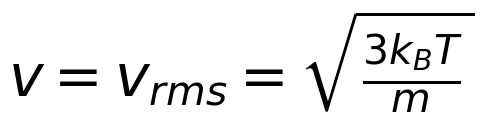
- Sommerfeld (quantum, low T) model: use the Fermi velocity
\(\(v = v_F\)\)
where \(v_F\) is set by the Fermi energy; thermal excitations occur near the Fermi surface.
Why a large mean free path is surprising
- In many metals measured \ell spans several lattice constants, implying electrons travel many unit cells before scattering.
- A perfect periodic lattice would not scatter Bloch states; observed resistance requires deviations from periodicity.
Scattering mechanisms that set \tau
- Phonon scattering: increases with temperature; dominant at higher T.
- Impurities and defects: temperature-independent (residual scattering at low T).
- Grain boundaries and microstructure: can shorten \ell independent of intrinsic scattering.
Wiedemann–Franz law (electrical ↔ thermal transport)
- Relates electronic thermal conductivity \(\kappa\) to electrical conductivity \(\sigma\):
\(\(\kappa = L\,T\,\sigma\)\)
where \(L\) is the Lorenz number. - Experimental Lorenz number (metals, low T limit):
\(\(L \approx 2.44\times 10^{-8}\ \mathrm{W\,\Omega\,K^{-2}}\)\)
When the law fails
- At intermediate temperatures scattering becomes energy-dependent, so heat and charge currents weigh electron energies differently.
- Electron–phonon scattering and inelastic processes break the simple proportionality between \(\kappa\) and \(\sigma\).
Temperature dependence of transport (qualitative)
- As temperature increases:
- \tau decreases (more phonon scattering).
- \sigma decreases (lower electrical conductivity).
- \ell decreases (shorter mean free path).
- Resistivity (\rho) generally increases.
Perfect lattice and Bloch waves
- In a perfectly periodic potential electrons form Bloch waves which do not decay; an ideal lattice gives no resistance.
- Only deviations from periodicity (phonons, impurities, defects) produce momentum-relaxing scattering and finite resistivity.
Quick practical notes
- To estimate \ell from measurements: measure \(\sigma\), compute \(\tau\) from \(\tau=\tfrac{m\sigma}{ne^2}\), then use appropriate \(v\) to get \(\ell=v\tau\).
- Use \(v_{\mathrm{rms}}\) at high T or when treating electrons classically; use \(v_F\) for low-temperature, quantum-degenerate electrons.
Common tags / topics to review
- Drude model, Sommerfeld model, relaxation time, mean free path, Wiedemann–Franz law, Lorenz number, scattering mechanisms