A patient with non-Hodgkin lymphoma receiving chemotherapy should receive annual vaccination for _______.
A patient with non-Hodgkin lymphoma receiving chemotherapy should receive annual vaccination for influenza.
Influenza can be complicated by lower respiratory tract infections such as _______ and bacterial superinfection.
Influenza can be complicated by lower respiratory tract infections such as pneumonia and bacterial superinfection.
Patients who are _______ are at higher risk for severe illness from influenza.
Patients who are immunocompromised are at higher risk for severe illness from influenza.
The CDC recommends annual influenza vaccination for all individuals over _______.
The CDC recommends annual influenza vaccination for all individuals over 6 months.
The influenza vaccine can be administered as a _______ or _______ intramuscular injection or as a nasal spray.
The influenza vaccine can be administered as a trivalent or quadrivalent intramuscular injection or as a nasal spray.
The inactivated influenza vaccine is safe for _______ patients.
The inactivated influenza vaccine is safe for immunocompromised patients.
The symptoms of influenza include _______, _______, _______, _______, _______, _______, _______, and _______.
The symptoms of influenza include fever, chills, myalgias, malaise, headaches, cough, nausea, and vomiting.
The measles-mumps-rubella vaccine is a _______ vaccine and is contraindicated in severely _______ patients.
The measles-mumps-rubella vaccine is a live attenuated vaccine and is contraindicated in severely immunocompromised patients.
The meningococcal vaccine is indicated for all children and is a _______ vaccine.
The meningococcal vaccine is indicated for all children and is a conjugate vaccine.
Boosters for the meningococcal vaccine are not routinely necessary in _______ patients.
Boosters for the meningococcal vaccine are not routinely necessary in immunocompromised patients.
The pneumococcal vaccine is indicated for adults over age _______ and in high-risk conditions.
The pneumococcal vaccine is indicated for adults over age 65 and in high-risk conditions.
The influenza vaccine is crucial for patients with high-risk conditions to prevent _______.
The influenza vaccine is crucial for patients with high-risk conditions to prevent influenza-related complications.
The recommended age for annual influenza virus vaccination is greater than _______.
The recommended age for annual influenza virus vaccination is greater than 6 months.
Influenza can be complicated by lower respiratory tract infection (pneumonia) and bacterial _______.
Influenza can be complicated by lower respiratory tract infection (pneumonia) and bacterial superinfection.
Symptoms of influenza include _______, _______, _______, _______, _______, _______, _______, and _______.
Symptoms of influenza include fever, chills, myalgias, malaise, headaches, cough, nausea, and vomiting.
The influenza vaccine can be administered in two forms: _______ or _______ intramuscular injection of inactivated virus, or as a _______ of live attenuated virus.
The influenza vaccine can be administered in two forms: trivalent or quadrivalent intramuscular injection of inactivated virus, or as a nasal spray of live attenuated virus.
Inactivated influenza vaccine is safe for immunocompromised patients via _______.
Inactivated influenza vaccine is safe for immunocompromised patients via intramuscular injection.
Patients who are immunocompromised may be at higher risk for severe illness from influenza if they do not receive _______.
Patients who are immunocompromised may be at higher risk for severe illness from influenza if they do not receive vaccination.
The correct answer in the context is the _______.
The correct answer in the context is the influenza vaccine.
The _______ is a live attenuated vaccine and is contraindicated in severely immunocompromised patients due to the risk of viral reactivation.
The measles-mumps-rubella vaccine is a live attenuated vaccine and is contraindicated in severely immunocompromised patients due to the risk of viral reactivation.
The meningococcal vaccine is a _______ recommended for all children, with an additional serogroup B vaccine for those at increased risk.
The meningococcal vaccine is a conjugate vaccine recommended for all children, with an additional serogroup B vaccine for those at increased risk.
While meningococcal vaccine can safely be given to immunocompromised patients, _______ are not routinely necessary.
While meningococcal vaccine can safely be given to immunocompromised patients, boosters are not routinely necessary.
The pneumococcal vaccine is indicated for all adults over _______ and those with high-risk conditions like chronic heart, renal, or liver disease.
The pneumococcal vaccine is indicated for all adults over 65 years and those with high-risk conditions like chronic heart, renal, or liver disease.
A patient who received the pneumococcal vaccine _______ does not need a booster dose.
A patient who received the pneumococcal vaccine 1 year ago does not need a booster dose.
Varicella vaccine is a live attenuated vaccine usually given in _______ during childhood.
Varicella vaccine is a live attenuated vaccine usually given in two doses during childhood.
Zoster vaccine for shingles is recommended for adults greater than _______ and is also a live attenuated vaccine.
Zoster vaccine for shingles is recommended for adults greater than 60 years and is also a live attenuated vaccine.
The varicella vaccine is contraindicated in patients who are _______.
The varicella vaccine is contraindicated in patients who are immunocompromised.
The educational objective emphasizes that the influenza vaccine is crucial for patients who may be at higher risk for severe illness and complications from _______.
The educational objective emphasizes that the influenza vaccine is crucial for patients who may be at higher risk for severe illness and complications from influenza.
The most appropriate next step in diagnosis for a patient with recurrent episodes of vaginal candidiasis and genital herpes is _______.
The most appropriate next step in diagnosis for a patient with recurrent episodes of vaginal candidiasis and genital herpes is HIV testing.
HIV testing is recommended for sexually active individuals over the age of 13, especially for those with _______.
HIV testing is recommended for sexually active individuals over the age of 13, especially for those with high-risk sexual behavior.
Frequent HIV testing is indicated for those who have numerous sexual partners and _______.
Frequent HIV testing is indicated for those who have numerous sexual partners and rarely use barrier protection.
A patient with a history of recurrent genital herpes and vaginal candidiasis is suggested to have underlying _______.
A patient with a history of recurrent genital herpes and vaginal candidiasis is suggested to have underlying immunodeficiency.
If the fourth-generation HIV test is positive, further testing to differentiate between _______ and _______ is indicated.
If the fourth-generation HIV test is positive, further testing to differentiate between HIV-1 and HIV-2 is indicated.
If the fourth-generation test is positive but antibody testing is negative, measuring the _______ should be performed.
If the fourth-generation test is positive but antibody testing is negative, measuring the HIV viral load should be performed.
For a positive HIV test, initiating _______ is critical.
For a positive HIV test, initiating highly active antiretroviral therapy (HAART) is critical.
Fungal culture is unnecessary because vaginal candidiasis can be diagnosed by _______ of vaginal secretion.
Fungal culture is unnecessary because vaginal candidiasis can be diagnosed by microscopy of vaginal secretion.
Genital herpes can be diagnosed clinically but requires laboratory confirmation during the _______.
Genital herpes can be diagnosed clinically but requires laboratory confirmation during the first episode.
The gold standard for diagnosing herpes infection is _______, although PCR-based tests are preferred.
The gold standard for diagnosing herpes infection is viral culture, although PCR-based tests are preferred.
Vaginal candidiasis is characterized by a discharge with a _______.
Vaginal candidiasis is characterized by a discharge with a cottage-cheese consistency.
The patient has a history of three episodes of _______ and _______.
The patient has a history of three episodes of candidal vaginitis and genital herpes.
The most appropriate next step in diagnosis for this patient with high-risk sexual behavior and recurrent episodes of vaginal candidiasis is _______.
The most appropriate next step in diagnosis for this patient with high-risk sexual behavior and recurrent episodes of vaginal candidiasis is HIV testing.
Routine screening for HIV is recommended for sexually active individuals over the age of _______ years.
Routine screening for HIV is recommended for sexually active individuals over the age of 13 years.
Populations that require more frequent HIV screening include those with numerous sexual partners and _______.
Populations that require more frequent HIV screening include those with numerous sexual partners and injection drug users.
The patient's history of recurrent vaginal candidiasis and genital herpes strongly suggests underlying _______.
The patient's history of recurrent vaginal candidiasis and genital herpes strongly suggests underlying immunodeficiency.
Testing for HIV typically involves a _______ combined HIV 1/2 antigen and antibody test.
Testing for HIV typically involves a fourth-generation combined HIV 1/2 antigen and antibody test.
If the fourth-generation HIV test is positive, further testing is needed to differentiate between infection with _______ or _______.
If the fourth-generation HIV test is positive, further testing is needed to differentiate between infection with HIV-1 or HIV-2.
If antibody testing following a positive fourth-generation test is negative or indeterminate, the next step is to measure the _______.
If antibody testing following a positive fourth-generation test is negative or indeterminate, the next step is to measure the HIV viral load.
A positive HIV test should prompt immediate initiation of _______.
A positive HIV test should prompt immediate initiation of highly active antiretroviral therapy (HAART).
Fungal culture is unnecessary for diagnosing vaginal candidiasis because yeast forms are readily appreciated on _______.
Fungal culture is unnecessary for diagnosing vaginal candidiasis because yeast forms are readily appreciated on microscopy.
Genital herpes infection can be diagnosed clinically in the presence of characteristic _______, but laboratory confirmation is necessary for the first episode.
Genital herpes infection can be diagnosed clinically in the presence of characteristic lesions, but laboratory confirmation is necessary for the first episode.
The preferred method of screening for HPV infection is cervical cytology alone or together with a _______.
The preferred method of screening for HPV infection is cervical cytology alone or together with a PCR-based assay.
Colposcopy is indicated only if the pap smear shows _______ such as cervical dysplasia.
Colposcopy is indicated only if the pap smear shows abnormal findings such as cervical dysplasia.
Recurrent infections suggest a state of _______ that is characteristic of HIV infection.
Recurrent infections suggest a state of immunodeficiency that is characteristic of HIV infection.
Testing for HIV is prudent for patients exhibiting symptoms such as recurrent vaginal infections, indicating possible _______.
Testing for HIV is prudent for patients exhibiting symptoms such as recurrent vaginal infections, indicating possible HIV infection.
The educational objective emphasizes the need for HIV testing using a _______.
The educational objective emphasizes the need for HIV testing using a fourth-generation antigen/antibody test.
The patient is a _______ African American man with _______ who has _______ of ferrous sulfate for 6 months.
The patient is a 32-year-old African American man with iron deficiency anemia who has adhered to his medication regimen of ferrous sulfate for 6 months.
Laboratory studies showed that the patient's hemoglobin increased from _______ to _______ over 6 months.
Laboratory studies showed that the patient's hemoglobin increased from 10.7 g/dL to 10.9 g/dL over 6 months.
The patient's red cell distribution width (RDW) is _______ despite the anemia, suggesting hemostatic function may not be impaired.
The patient's red cell distribution width (RDW) is normal despite the anemia, suggesting hemostatic function may not be impaired.
The blood smear findings of microcytosis and target cells in this patient are indicative of _______.
The blood smear findings of microcytosis and target cells in this patient are indicative of thalassemia.
In this male patient, the absence of _______, _______, or _______ suggests that occult gastrointestinal bleeding is less likely.
In this male patient, the absence of bloody vomiting, blood in stool, or blood in urine suggests that occult gastrointestinal bleeding is less likely.
The patient's serum iron levels revealed that he had a level of _______ with a transferrin saturation of _______ six months ago and a level of _______ with a transferrin saturation of _______ today.
The patient's serum iron levels revealed that he had a level of 60 µg/dL with a transferrin saturation of 25% six months ago and a level of 75 µg/dL with a transferrin saturation of 35% today.
Thalassemia is the most likely diagnosis for this patient because he has mild microcytic anemia with a normal _______ (RDW) and normal _______.
Thalassemia is the most likely diagnosis for this patient because he has mild microcytic anemia with a normal red cell distribution width (RDW) and normal iron studies.
Celiac disease often presents with _______ and changes in gut lining rather than solely with anemia, making it less likely in this case.
Celiac disease often presents with malabsorption and changes in gut lining rather than solely with anemia, making it less likely in this case.
Myelodysplastic syndrome typically involves _______ and a high RDW, which is not seen in this patient.
Myelodysplastic syndrome typically involves abnormal blood counts and a high RDW, which is not seen in this patient.
Pure red blood cell aplasia would show marked reductions in reticulocyte count and red cells, which are not present here, confirming it's less likely.
Occult gastrointestinal bleeding would most likely present with positive stool guaiac tests or significant changes in iron studies, which are absent in this case.
Normal iron studies indicate the absence of _______ as a cause of the patient's anemia, leading to the diagnosis of thalassemia.
Normal iron studies indicate the absence of iron deficiency as a cause of the patient's anemia, leading to the diagnosis of thalassemia.
The management of thalassemia in this patient would focus on monitoring and treating complications rather than immediate iron supplementation due to normal iron levels.
In diagnosing microcytic anemia, a key consideration is the patient's _______, including serum iron and ferritin levels.
In diagnosing microcytic anemia, a key consideration is the patient's iron studies, including serum iron and ferritin levels.
Patients with thalassemia often maintain normal iron levels despite chronic anemia, as seen in this patient who presented with a _______.
Patients with thalassemia often maintain normal iron levels despite chronic anemia, as seen in this patient who presented with a normal RDW.
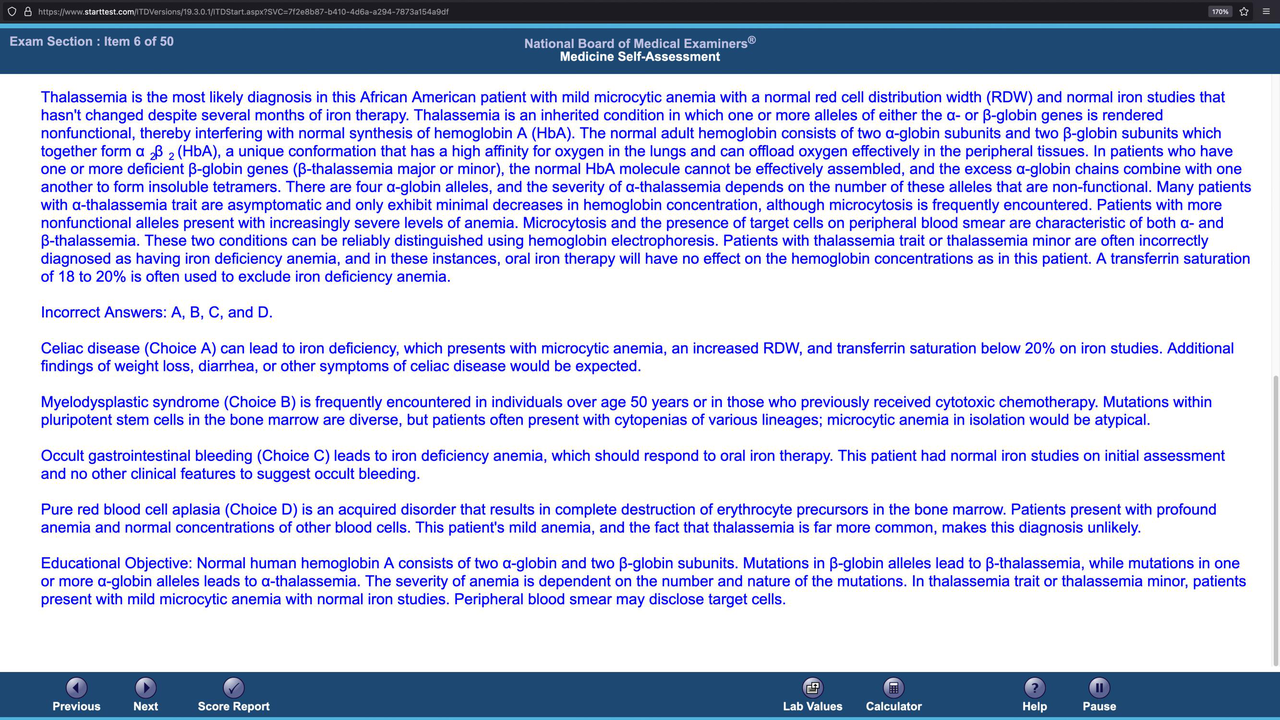
Thalassemia is characterized by one or more alleles of the _______ being rendered nonfunctional.
Thalassemia is characterized by one or more alleles of the a- or β-globin genes being rendered nonfunctional.
The normal adult hemoglobin (HbA) consists of two _______ subunits and two _______ subunits.
The normal adult hemoglobin (HbA) consists of two a-globin subunits and two β-globin subunits.
In patients with β-thalassemia, the normal HbA cannot be effectively assembled, leading to the formation of _______ from excess a-globin chains.
In patients with β-thalassemia, the normal HbA cannot be effectively assembled, leading to the formation of insoluble tetramers from excess a-globin chains.
Patients with a-thalassemia trait often exhibit minimal decreases in hemoglobin and may be _______.
Patients with a-thalassemia trait often exhibit minimal decreases in hemoglobin and may be asymptomatic.
Microcytosis and the presence of _______ on a peripheral blood smear are characteristic of both a- and β-thalassemia.
Microcytosis and the presence of target cells on a peripheral blood smear are characteristic of both a- and β-thalassemia.
Patients with thalassemia trait may be incorrectly diagnosed as having _______.
Patients with thalassemia trait may be incorrectly diagnosed as having iron deficiency anemia.
Celiac disease can lead to iron deficiency anemia, typically presenting with _______.
Celiac disease can lead to iron deficiency anemia, typically presenting with increased RDW.
Occult gastrointestinal bleeding is associated with iron deficiency anemia that should respond to _______.
Occult gastrointestinal bleeding is associated with iron deficiency anemia that should respond to oral iron therapy.
Microcytic anemia associated with myelodysplastic syndrome is typically not isolated, as it presents with _______ of various lineages.
Microcytic anemia associated with myelodysplastic syndrome is typically not isolated, as it presents with cytopenias of various lineages.
A transferrin saturation level of _______ is often used to exclude iron deficiency anemia.
A transferrin saturation level of 18 to 20% is often used to exclude iron deficiency anemia.
Iron studies in a patient with thalassemia should return _______.
Iron studies in a patient with thalassemia should return normal.
Thalassemia is most likely diagnosed in patients with _______ and normal _______.
Thalassemia is most likely diagnosed in patients with mild microcytic anemia and normal red cell distribution width (RDW).
In thalassemia, one or more alleles of either the _______ or _______ genes is rendered nonfunctional.
In thalassemia, one or more alleles of either the α- or β-globin genes is rendered nonfunctional.
Normal adult hemoglobin consists of two _______ subunits and two _______ subunits, forming a unique conformation called _______.
Normal adult hemoglobin consists of two α-globin subunits and two β-globin subunits, forming a unique conformation called hemoglobin A (HbA).
Patients with _______ have difficulty assembling the normal _______ molecule, leading to the formation of excess _______.
Patients with β-thalassemia have difficulty assembling the normal HbA molecule, leading to the formation of excess α-globin chains.
The severity of _______ depends on the number of non-functional _______.
The severity of α-thalassemia depends on the number of non-functional α-globin alleles.
Microcytosis and the presence of _______ on peripheral blood smear are characteristic of both _______ and _______.
Microcytosis and the presence of target cells on peripheral blood smear are characteristic of both α- and β-thalassemia.
Patients with thalassemia trait may be incorrectly diagnosed with _______ because oral iron therapy will have no effect on their hemoglobin concentrations.
Patients with thalassemia trait may be incorrectly diagnosed with iron deficiency anemia because oral iron therapy will have no effect on their hemoglobin concentrations.
A transferrin saturation of _______ is often used to exclude _______.
A transferrin saturation of 18% to 20% is often used to exclude iron deficiency anemia.
Celiac disease typically presents with microcytic anemia, an increased _______, and transferrin saturation below _______.
Celiac disease typically presents with microcytic anemia, an increased RDW, and transferrin saturation below 20%.
Myelodysplastic syndrome often presents with cytopenias but microcytic anemia in isolation is _______.
Myelodysplastic syndrome often presents with cytopenias but microcytic anemia in isolation is atypical.
Occult gastrointestinal bleeding should respond to oral iron therapy, unlike in patients with _______.
Occult gastrointestinal bleeding should respond to oral iron therapy, unlike in patients with thalassemia.
Pure red blood cell aplasia results in complete destruction of erythrocyte precursors and presents with _______.
Pure red blood cell aplasia results in complete destruction of erythrocyte precursors and presents with profound anemia.
Normal human hemoglobin A consists of two _______ and two _______ subunits; mutations in these lead to _______.
Normal human hemoglobin A consists of two α-globin and two β-globin subunits; mutations in these lead to thalassemia.
In thalassemia trait or thalassemia minor, patients present with mild _______ and normal _______.
In thalassemia trait or thalassemia minor, patients present with mild microcytic anemia and normal iron studies.
Peripheral blood smear in thalassemia may reveal _______.
Peripheral blood smear in thalassemia may reveal target cells.
A 23-year-old man with _______ presents with low back pain and nausea. He rates the pain as _______ on a 10-point scale.
A 23-year-old man with sickle cell disease presents with low back pain and nausea. He rates the pain as 8 on a 10-point scale.
His vital signs are within normal limits, but he has _______ and a hemoglobin concentration of _______.
His vital signs are within normal limits, but he has pale conjunctivae and a hemoglobin concentration of 7.2 g/dL.
The patient's _______ concentration is _______ and serum creatinine is _______.
The patient's serum urea nitrogen concentration is 32 mg/dL and serum creatinine is 2.6 mg/dL.
In addition to administration of oxygen and _______, the most appropriate next step in pharmacotherapy is _______.
In addition to administration of oxygen and 0.9% saline, the most appropriate next step in pharmacotherapy is intravenous morphine.
Patients with sickle cell disease commonly experience acute painful episodes due to _______.
Patients with sickle cell disease commonly experience acute painful episodes due to vaso-occlusive phenomena.
In children with sickle cell disease, pain is often concentrated in the _______ or _______.
In children with sickle cell disease, pain is often concentrated in the hands or feet.
Pain in sickle cell disease can also develop in the _______, _______, _______, and _______.
Pain in sickle cell disease can also develop in the abdomen, back, chest, and long bones.
Rapid assessment is critical to determine concomitant disorders, including acute chest syndrome, myocardial infarction, and _______.
Rapid assessment is critical to determine concomitant disorders, including acute chest syndrome, myocardial infarction, and venous thromboembolism.
The rapid administration of analgesia, often with _______, is crucial in managing acute pain in sickle cell disease.
The rapid administration of analgesia, often with opiate medication, is crucial in managing acute pain in sickle cell disease.
Patients with sickle cell disease may require _______ of opiate medications due to chronic exposure.
Patients with sickle cell disease may require higher doses of opiate medications due to chronic exposure.
Reversal of _______, _______, and _______ should be prioritized in managing pain crises.
Reversal of hypoxia, hypovolemia, and acid/base disturbances should be prioritized in managing pain crises.
Oral medications like _______ and _______ may not provide sufficient analgesia for acute pain in sickle cell disease.
Oral medications like celecoxib and oxycodone may not provide sufficient analgesia for acute pain in sickle cell disease.
Given the patient's low oral intake, a _______ of administration is preferred for analgesia.
Given the patient's low oral intake, a parenteral route of administration is preferred for analgesia.
Incorrect answers to the question included oral celecoxib, oral oxycodone, intramuscular ketorolac, and _______.
Incorrect answers to the question included oral celecoxib, oral oxycodone, intramuscular ketorolac, and intravenous meperidine.
The most appropriate medication to administer to a patient experiencing an acute painful episode in sickle cell disease is _______.
The most appropriate medication to administer to a patient experiencing an acute painful episode in sickle cell disease is intravenous morphine.
Vaso-occlusive phenomena are common in patients with _______.
Vaso-occlusive phenomena are common in patients with sickle cell disease.
Acute painful episodes, sometimes referred to as _______, are a manifestation of vaso-occlusive phenomena in sickle cell disease.
Acute painful episodes, sometimes referred to as pain crises, are a manifestation of vaso-occlusive phenomena in sickle cell disease.
In children, pain during a sickle cell crisis is often concentrated in the _______ or _______.
In children, pain during a sickle cell crisis is often concentrated in the hands or feet.
Pain can also develop in the _______, _______, _______, and _______ during a crisis.
Pain can also develop in the abdomen, back, chest, and long bones during a crisis.
Rapid assessment of the patient is critical to determine if there are concomitant disorders such as _______, _______, _______, or _______.
Rapid assessment of the patient is critical to determine if there are concomitant disorders such as acute chest syndrome, myocardial infarction, venous thromboembolism, or infection.
The rapid administration of _______ is crucial for treating acute painful episodes in sickle cell disease.
The rapid administration of analgesia is crucial for treating acute painful episodes in sickle cell disease.
Patients with sickle cell disease require substantially higher doses of opiate medications due to chronic exposure, compared to _______.
Patients with sickle cell disease require substantially higher doses of opiate medications due to chronic exposure, compared to opiate-naive patients.
Reversal of inciting features such as _______, _______, and _______ should be prioritized in the management of sickle cell pain.
Reversal of inciting features such as hypoxia, hypovolemia, and infection should be prioritized in the management of sickle cell pain.
Oral medications such as _______ and _______ may be appropriate for chronic pain but are not sufficient for _______ in sickle cell patients.
Oral medications such as oral celecoxib and oral oxycodone may be appropriate for chronic pain but are not sufficient for acute painful crises in sickle cell patients.
Intramuscular ketorolac is not preferred for acute painful episodes in sickle cell disease because it is unlikely to produce the required level of _______.
Intramuscular ketorolac is not preferred for acute painful episodes in sickle cell disease because it is unlikely to produce the required level of analgesia.
Intravenous meperidine is rarely used for acute pain due to its challenging _______ and _______.
Intravenous meperidine is rarely used for acute pain due to its challenging pharmacodynamics and kinetics.
The best-next-step in managing an acute painful episode in a patient with sickle cell disease is to promptly administer _______.
The best-next-step in managing an acute painful episode in a patient with sickle cell disease is to promptly administer intravenous opiates.
For effective management of pain crises, some centers use an individualized and predefined _______ for treatment.
For effective management of pain crises, some centers use an individualized and predefined pain pathway for treatment.
Missing key features such as _______ at assessment can lead to inadequate treatment of pain in sickle cell disease.
Missing key features such as acute chest syndrome at assessment can lead to inadequate treatment of pain in sickle cell disease.
The educational objective emphasizes the need for rapid assessment to identify concomitant disorders, which should coincide with administration of _______.
The educational objective emphasizes the need for rapid assessment to identify concomitant disorders, which should coincide with administration of intravenous opiates.
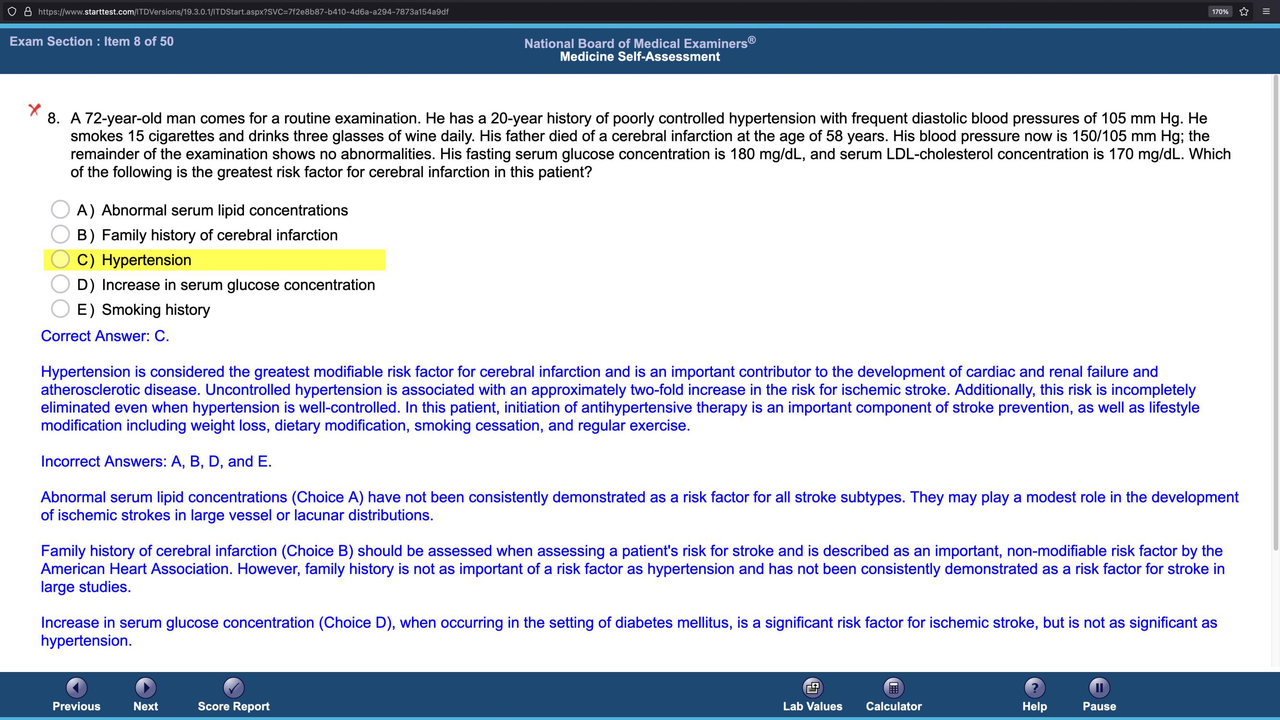
The greatest risk factor for cerebral infarction in this patient is _______.
The greatest risk factor for cerebral infarction in this patient is hypertension.
Uncontrolled hypertension is associated with an approximately _______ increase in the risk for ischemic stroke.
Uncontrolled hypertension is associated with an approximately two-fold increase in the risk for ischemic stroke.
Initiation of _______ is an important component of stroke prevention.
Initiation of antihypertensive therapy is an important component of stroke prevention.
Lifestyle modifications for stroke prevention include _______, _______, _______, and _______.
Lifestyle modifications for stroke prevention include weight loss, dietary modification, smoking cessation, and regular exercise.
Abnormal serum lipid concentrations have not been consistently demonstrated as a risk factor for _______.
Abnormal serum lipid concentrations have not been consistently demonstrated as a risk factor for all stroke subtypes.
Family history of cerebral infarction is described as an important, _______ risk factor.
Family history of cerebral infarction is described as an important, non-modifiable risk factor.
Increases in serum glucose concentration are significant for ischemic stroke in the context of _______.
Increases in serum glucose concentration are significant for ischemic stroke in the context of diabetes mellitus.
While abnormal serum lipid concentrations may play a modest role, _______ is considered more significant in the development of ischemic strokes.
While abnormal serum lipid concentrations may play a modest role, hypertension is considered more significant in the development of ischemic strokes.
The patient's fasting serum glucose concentration is _______.
The patient's fasting serum glucose concentration is 180 mg/dL.
The patient's serum LDL-cholesterol concentration is _______.
The patient's serum LDL-cholesterol concentration is 170 mg/dL.
Family history of cerebral infarction is not as important as _______ in assessing stroke risk.
Family history of cerebral infarction is not as important as hypertension in assessing stroke risk.
Lifestyle modification is crucial for preventing stroke, especially for those with _______.
Lifestyle modification is crucial for preventing stroke, especially for those with hypertension.
Hypertension is the greatest _______ for cerebral infarction and contributes to _______ and _______.
Hypertension is the greatest modifiable risk factor for cerebral infarction and contributes to cardiac and renal failure.
Uncontrolled hypertension is associated with an approximately _______ in the risk for _______.
Uncontrolled hypertension is associated with an approximately two-fold increase in the risk for ischemic stroke.
Even with well-controlled hypertension, the risk for ischemic stroke is _______.
Even with well-controlled hypertension, the risk for ischemic stroke is incompletely eliminated.
Initiation of _______ is important for stroke prevention, along with _______.
Initiation of antihypertensive therapy is important for stroke prevention, along with lifestyle modifications.
Lifestyle modifications for stroke prevention include _______, _______, and _______.
Lifestyle modifications for stroke prevention include weight loss, dietary modification, and smoking cessation.
Abnormal serum lipid concentrations have not been consistently shown to be a significant risk factor for _______.
Abnormal serum lipid concentrations have not been consistently shown to be a significant risk factor for all stroke subtypes.
Family history of cerebral infarction is an important _______ risk factor but not as significant as _______.
Family history of cerebral infarction is an important non-modifiable risk factor but not as significant as hypertension.
An increase in serum glucose concentration is a significant risk factor for ischemic stroke when associated with _______.
An increase in serum glucose concentration is a significant risk factor for ischemic stroke when associated with diabetes mellitus.
Smoking history is an important modifiable risk factor for ischemic stroke, but the relative risk is _______ than that of hypertension.
Smoking history is an important modifiable risk factor for ischemic stroke, but the relative risk is less than that of hypertension.
The American Heart Association states that family history is not as important as hypertension and has not been consistently demonstrated as a risk factor in _______.
The American Heart Association states that family history is not as important as hypertension and has not been consistently demonstrated as a risk factor in large studies.
Risk factors for cerebral infarction include: _______, _______, _______, and _______.
Risk factors for cerebral infarction include: hypertension, abnormal serum lipids, family history, and smoking.
Aspirin is an antiplatelet agent that irreversibly inactivates _______.
Aspirin is an antiplatelet agent that irreversibly inactivates cyclooxygenase.
The conversion of arachidonic acid to _______ is prevented by aspirin, reducing platelet activation.
The conversion of arachidonic acid to thromboxane A2 is prevented by aspirin, reducing platelet activation.
In large doses, salicylate poisoning causes a _______ due to hyperventilation.
In large doses, salicylate poisoning causes a respiratory alkalosis due to hyperventilation.
Salicylate poisoning leads to a delayed _______ due to effects on the electron transport chain.
Salicylate poisoning leads to a delayed anion-gap metabolic acidosis due to effects on the electron transport chain.
The production of _______ and _______ contributes to metabolic acidosis in salicylate toxicity.
The production of lactate and ketoacids contributes to metabolic acidosis in salicylate toxicity.
Symptoms of acute salicylate toxicity include _______, gastrointestinal upset, and _______.
Symptoms of acute salicylate toxicity include hyperventilation, gastrointestinal upset, and tinnitus.
Chronic salicylate ingestion may present with mild symptoms such as _______ and _______.
Chronic salicylate ingestion may present with mild symptoms such as tinnitus and nausea.
Management of salicylate toxicity involves _______ with sodium bicarbonate infusion.
Management of salicylate toxicity involves systemic alkalinization with sodium bicarbonate infusion.
Patients with severe altered mental status may require _______ as part of salicylate toxicity management.
Patients with severe altered mental status may require dialysis as part of salicylate toxicity management.
Hyponatremia is unlikely in salicylate poisoning, which helps differentiate between causes of metabolic acidosis and patient _______.
Hyponatremia is unlikely in salicylate poisoning, which helps differentiate between causes of metabolic acidosis and patient diagnosis.
Salicylate toxicity is characterized by an increased _______ and compensated metabolic acidosis.
Salicylate toxicity is characterized by an increased anion gap and compensated metabolic acidosis.
Choice A indicates _______, which is unlikely in salicylate poisoning.
Choice A indicates hyponatremia, which is unlikely in salicylate poisoning.
Choice B indicates _______, an unlikely finding in salicylate toxicity.
Choice B indicates hypokalemia, an unlikely finding in salicylate toxicity.
Choice D indicates _______, typically associated with renal insufficiency, not salicylate toxicity.
Choice D indicates hyperkalemia, typically associated with renal insufficiency, not salicylate toxicity.
Choice F indicates _______, which is not typical for salicylate toxicity.
Choice F indicates hyperkalemia, which is not typical for salicylate toxicity.
Aspirin prevents the conversion of arachidonic acid to _______.
Aspirin prevents the conversion of arachidonic acid to thromboxane A2.
Thromboxane A2 is involved in _______.
Thromboxane A2 is involved in platelet activation.
Decreased synthesis of thromboxane A2 reduces _______.
Decreased synthesis of thromboxane A2 reduces platelet activation.
Salicylate poisoning can cause _______ due to stimulation of respiratory centers.
Salicylate poisoning can cause respiratory alkalosis due to stimulation of respiratory centers.
Acute salicylate toxicity leads to a delayed _______.
Acute salicylate toxicity leads to a delayed anion-gap metabolic acidosis.
Salicylate's decoupling effects on the electron transport chain result in increased _______.
Salicylate's decoupling effects on the electron transport chain result in increased anaerobic metabolism.
In salicylate toxicity, increased anaerobic metabolism produces _______ and _______.
In salicylate toxicity, increased anaerobic metabolism produces lactate and ketoacids.
Patients with acute salicylate toxicity may present with _______ and _______.
Patients with acute salicylate toxicity may present with hyperventilation and gastrointestinal upset.
Chronic salicylate ingestion may lead to mild symptoms such as _______ and _______.
Chronic salicylate ingestion may lead to mild symptoms such as tinnitus and nausea.
Mild salicylate toxicity may present with an increased _______ and _______.
Mild salicylate toxicity may present with an increased anion gap and compensated metabolic acidosis.
Management for salicylate toxicity involves _______ using sodium bicarbonate infusion.
Management for salicylate toxicity involves systemic alkalinization using sodium bicarbonate infusion.
Patients may need _______ in severe cases of salicylate toxicity with altered mental status.
Patients may need dialysis in severe cases of salicylate toxicity with altered mental status.
Salicylate poisoning is unlikely to cause _______ (Choice A), as it does not typically impact sodium levels.
Salicylate poisoning is unlikely to cause hyponatremia (Choice A), as it does not typically impact sodium levels.
Hypokalemia is unlikely in salicylate toxicity (Choice B); it generally does not affect potassium serum concentrations.
Salicylate toxicity would not result in hyperkalemia (Choices D and F); hyperkalemia is seen in conditions like renal insufficiency.
In salicylate toxicity, the bicarbonate concentration would not be normal or increased (Choices D, E, F).
Early stages of salicylate poisoning show _______ but not mild metabolic alkalosis (Choice E).
Early stages of salicylate poisoning show respiratory alkalosis but not mild metabolic alkalosis (Choice E).
Symptoms of salicylate toxicity include _______, _______, and _______.
Symptoms of salicylate toxicity include hyperventilation, hyperthermia, and tinnitus.
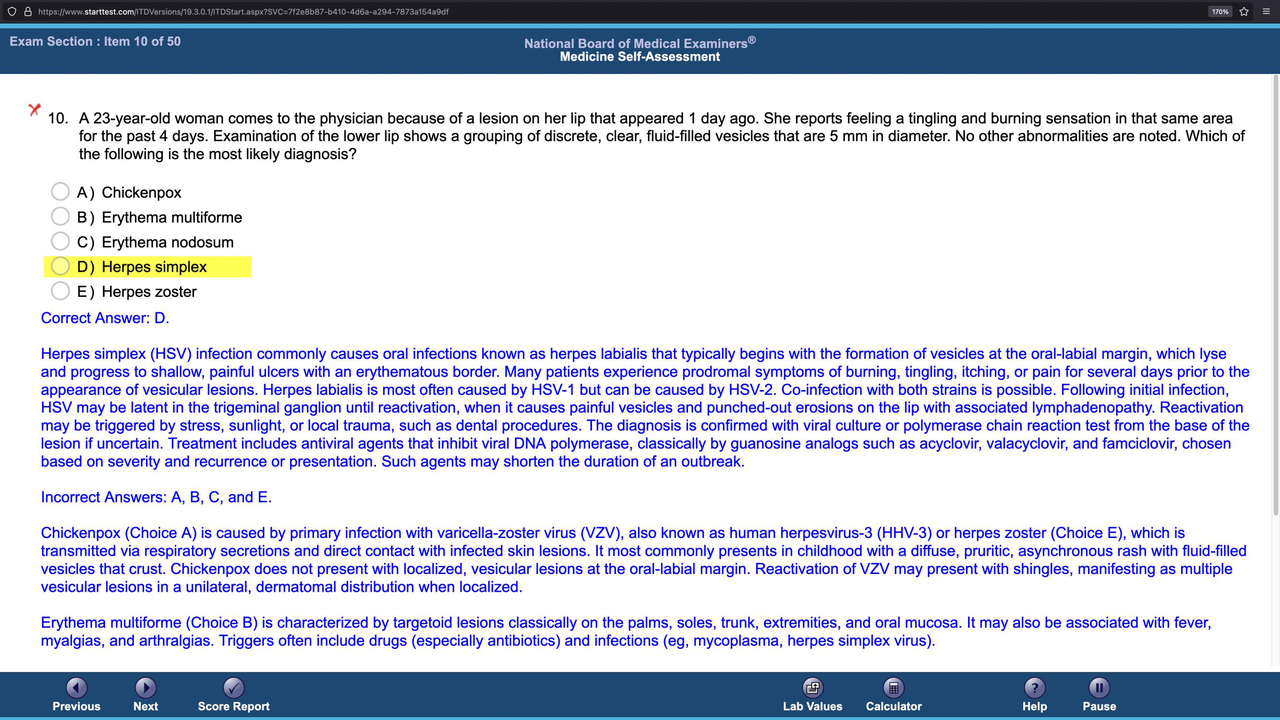
A 23-year-old woman presents with a lesion on her lip characterized by a grouping of _______ that are 5 mm in diameter, indicative of _______.
A 23-year-old woman presents with a lesion on her lip characterized by a grouping of discrete, clear, fluid-filled vesicles that are 5 mm in diameter, indicative of herpes simplex.
The prodromal symptoms of herpes labialis may include _______, _______, and _______ before the appearance of vesicular lesions.
The prodromal symptoms of herpes labialis may include burning, tingling, and itching before the appearance of vesicular lesions.
Herpes simplex virus (HSV) commonly affects the oral-labial margin, often leading to painful _______ with an _______.
Herpes simplex virus (HSV) commonly affects the oral-labial margin, often leading to painful ulcers with an erythematous border.
The diagnosis of herpes labialis is confirmed with _______ or _______ from the base of the lesion.
The diagnosis of herpes labialis is confirmed with viral culture or polymerase chain reaction testing from the base of the lesion.
Reactivation of HSV may occur from latency in the _______, producing painful vesicles with associated _______.
Reactivation of HSV may occur from latency in the trigeminal ganglion, producing painful vesicles with associated lymphadenopathy.
Treatment of herpes labialis includes antiviral agents that inhibit viral _______, such as _______, _______, and _______.
Treatment of herpes labialis includes antiviral agents that inhibit viral DNA polymerase, such as acyclovir, valacyclovir, and famciclovir.
Chickenpox is caused by the varicella-zoster virus (VZV), presenting with a diffuse rash of fluid-filled vesicles, unlike the localized lesions seen in _______.
Chickenpox is caused by the varicella-zoster virus (VZV), presenting with a diffuse rash of fluid-filled vesicles, unlike the localized lesions seen in herpes simplex.
Unlike herpes simplex, erythema multiforme presents with _______ on palms and soles and is often triggered by _______ and certain _______.
Unlike herpes simplex, erythema multiforme presents with targetoid lesions on palms and soles and is often triggered by drugs and certain infections.
Herpes zoster (shingles) manifests with multiple vesicular lesions in a unilateral, _______.
Herpes zoster (shingles) manifests with multiple vesicular lesions in a unilateral, dermatomal distribution.
The correct diagnosis for a patient presenting with tingling, burning sensation in the lip followed by vesicles is _______.
The correct diagnosis for a patient presenting with tingling, burning sensation in the lip followed by vesicles is herpes simplex.
For herpes simplex treatment, antiviral choices may vary based on severity and include agents such as _______ and _______.
For herpes simplex treatment, antiviral choices may vary based on severity and include agents such as acyclovir and valacyclovir.
Herpes labialis typically begins with the formation of vesicles at the _______, which lyse and progress to shallow, painful ulcers with an _______.
Herpes labialis typically begins with the formation of vesicles at the oral-labial margin, which lyse and progress to shallow, painful ulcers with an erythematous border.
Many patients with herpes labialis experience prodromal symptoms such as _______, _______, _______, or _______ for several days prior to vesicular lesions.
Many patients with herpes labialis experience prodromal symptoms such as burning, tingling, itching, or pain for several days prior to vesicular lesions.
Herpes labialis is most often caused by _______, but can also be caused by _______.
Herpes labialis is most often caused by HSV-1, but can also be caused by HSV-2.
Following initial infection, HSV may be latent in the _______ until reactivation occurs.
Following initial infection, HSV may be latent in the trigeminal ganglion until reactivation occurs.
Reactivation of HSV causes painful vesicles and _______ on the lip with associated _______.
Reactivation of HSV causes painful vesicles and punched-out erosions on the lip with associated lymphadenopathy.
Reactivation of HSV can be triggered by _______, _______, or _______ such as dental procedures.
Reactivation of HSV can be triggered by stress, sunlight, or local trauma such as dental procedures.
The diagnosis of herpes labialis is confirmed with a _______ or _______ from the base of the lesion if uncertain.
The diagnosis of herpes labialis is confirmed with a viral culture or polymerase chain reaction test from the base of the lesion if uncertain.
Treatment for herpes labialis includes antiviral agents that inhibit _______, such as acyclovir, valacyclovir, and famciclovir.
Treatment for herpes labialis includes antiviral agents that inhibit viral DNA polymerase, such as acyclovir, valacyclovir, and famciclovir.
These antiviral agents are chosen based on _______ and _______ of herpes labialis.
These antiviral agents are chosen based on severity and recurrence of herpes labialis.
Chickenpox is caused by primary infection with _______ (VZV) and does not present with localized vesicular lesions at the _______.
Chickenpox is caused by primary infection with varicella-zoster virus (VZV) and does not present with localized vesicular lesions at the oral-labial margin.
Erythema multiforme is characterized by _______ and may be associated with fever and myalgias.
Erythema multiforme is characterized by targetoid lesions and may be associated with fever and myalgias.
Erythema nodosum presents as _______, _______, immobile _______ on the shins.
Erythema nodosum presents as erythematous, painful, immobile nodules on the shins.
Erythema nodosum lesions are typically bilateral and between _______ and _______ centimeters in diameter.
Erythema nodosum lesions are typically bilateral and between 2 and 5 centimeters in diameter.
Erythema nodosum may be associated with conditions such as _______, _______, and _______.
Erythema nodosum may be associated with conditions such as inflammatory bowel disease, sarcoidosis, and bacterial or viral infections.
Many patients with mild symptoms from herpes labialis may not require _______.
Many patients with mild symptoms from herpes labialis may not require oral antiviral therapy.
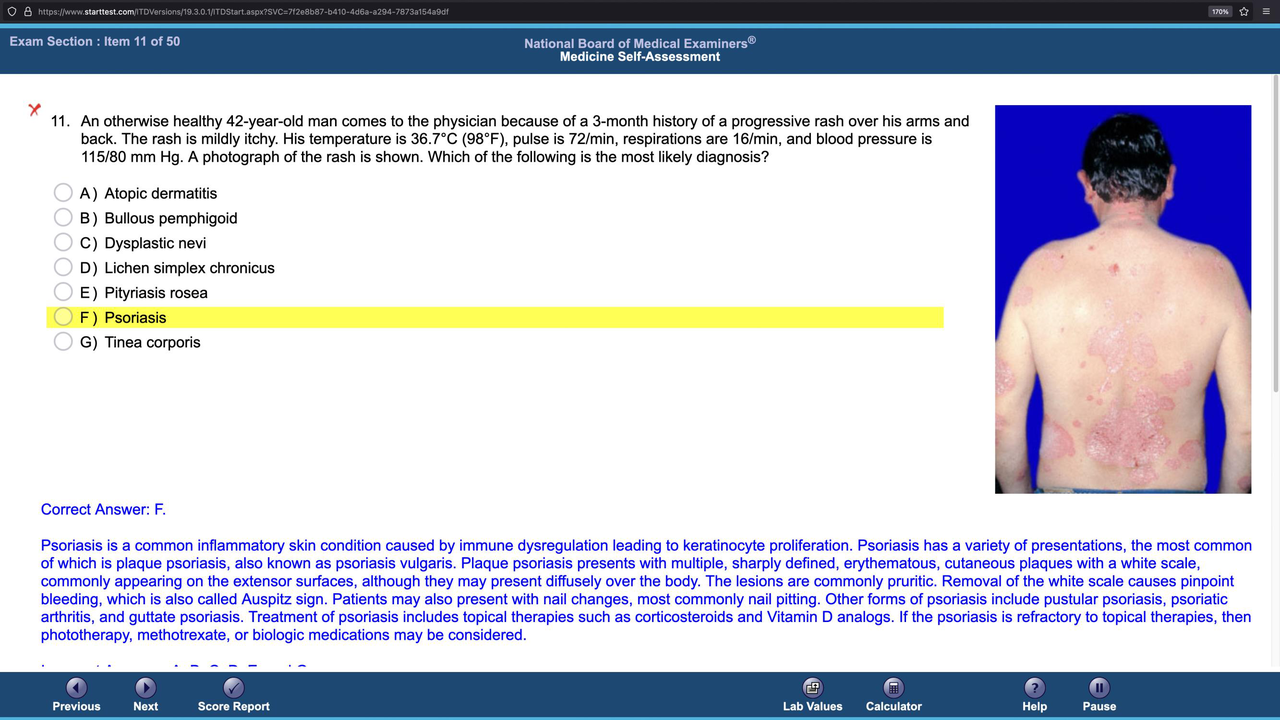
An otherwise healthy 42-year-old man presents with a progressive rash over his arms and back. The rash is likely to be _______.
An otherwise healthy 42-year-old man presents with a progressive rash over his arms and back. The rash is likely to be psoriasis.
Psoriasis is primarily caused by _______ leading to _______.
Psoriasis is primarily caused by immune dysregulation leading to keratinocyte proliferation.
The most common form of psoriasis is _______, also known as _______.
The most common form of psoriasis is plaque psoriasis, also known as psoriasis vulgaris.
Plaque psoriasis typically presents with sharply defined, _______ plaques with _______.
Plaque psoriasis typically presents with sharply defined, erythematous plaques with white scale.
In psoriasis, removal of the white scale causes _______, which is characterized by _______.
In psoriasis, removal of the white scale causes Auspitz sign, which is characterized by pinpoint bleeding.
Common nail changes in psoriasis include _______.
Common nail changes in psoriasis include nail pitting.
If psoriasis is refractory to topical therapies, potential management options include _______, _______, and _______.
If psoriasis is refractory to topical therapies, potential management options include phototherapy, methotrexate, and biologic medications.
The correct answer for a rash that is mildly itchy and has a characteristic appearance is _______.
The correct answer for a rash that is mildly itchy and has a characteristic appearance is F) Psoriasis.
Why is atopic dermatitis incorrect for this presentation? It typically presents with _______ rather than _______.
Why is atopic dermatitis incorrect for this presentation? It typically presents with pruritic eczema rather than plaque-like lesions.
Bullous pemphigoid is not the diagnosis here because it present with _______ instead of _______.
Bullous pemphigoid is not the diagnosis here because it present with blisters instead of well-defined plaques.
Dysplastic nevi are characterized by _______ and not _______.
Dysplastic nevi are characterized by atypical moles and not scaly patches.
Tinea corporis, or ringworm, would present with _______ rather than _______ seen in psoriasis.
Tinea corporis, or ringworm, would present with a scaling ring rather than patches seen in psoriasis.
What distinguishes the rash of psoriasis from pityriasis rosea? Psoriasis has _______ compared to _______ in pityriasis rosea.
What distinguishes the rash of psoriasis from pityriasis rosea? Psoriasis has sharply defined edges compared to less clear borders in pityriasis rosea.
Psoriasis is a common inflammatory skin condition caused by _______ leading to _______.
Psoriasis is a common inflammatory skin condition caused by immune dysregulation leading to keratinocyte proliferation.
The most common presentation of psoriasis is _______ or _______.
The most common presentation of psoriasis is plaque psoriasis or psoriasis vulgaris.
Plaque psoriasis presents with multiple, sharply defined, erythematous cutaneous plaques with a _______.
Plaque psoriasis presents with multiple, sharply defined, erythematous cutaneous plaques with a white scale.
The lesions in plaque psoriasis are commonly _______ and removal of the white scale causes _______ (Auspitz sign).
The lesions in plaque psoriasis are commonly pruritic and removal of the white scale causes pinpoint bleeding (Auspitz sign).
Nail changes in psoriasis are most commonly _______.
Nail changes in psoriasis are most commonly nail pitting.
Other forms of psoriasis include _______, _______, and _______.
Other forms of psoriasis include pustular psoriasis, psoriatic arthritis, and guttate psoriasis.
Treatment of psoriasis includes topical therapies such as _______ and _______.
Treatment of psoriasis includes topical therapies such as corticosteroids and Vitamin D analogs.
If psoriasis is refractory to topical therapies, then _______, _______, or _______ may be considered.
If psoriasis is refractory to topical therapies, then phototherapy, methotrexate, or biologic medications may be considered.
Atopic dermatitis is also known as _______.
Atopic dermatitis is also known as eczema.
Atopic dermatitis lesions may be found in _______ or on _______.
Atopic dermatitis lesions may be found in flexural creases or on extensor surfaces.
Bullous pemphigoid is characterized by antibodies against _______ and presents with _______.
Bullous pemphigoid is characterized by antibodies against hemidesmosome and presents with tense bullae.
Dysplastic nevi are benign melanocytic lesions that may rarely transform into _______.
Dysplastic nevi are benign melanocytic lesions that may rarely transform into cutaneous melanoma.
Lichen simplex chronicus results from repetitive _______ or _______ of the skin.
Lichen simplex chronicus results from repetitive rubbing or itching of the skin.
Pityriasis rosea often follows a _______ and is characterized by the acute onset of a pruritic _______.
Pityriasis rosea often follows a viral infection and is characterized by the acute onset of a pruritic patch.
In pityriasis rosea, the patches commonly involve the _______ and proximal _______.
In pityriasis rosea, the patches commonly involve the trunk and proximal extremities.
The image shows widespread erythematous, scaly rash, consistent with _______.
The image shows widespread erythematous, scaly rash, consistent with plaque psoriasis.
A patient with non-Hodgkin lymphoma receiving chemotherapy should receive annual vaccination for influenza.
Influenza can be complicated by lower respiratory tract infections such as pneumonia and bacterial superinfection.
The influenza vaccine can be administered as a trivalent or quadrivalent intramuscular injection or as a nasal spray.
The symptoms of influenza include fever, chills, myalgias, malaise, headaches, cough, nausea, and vomiting.
The measles-mumps-rubella vaccine is a live attenuated vaccine and is contraindicated in severely immunocompromised patients.
The influenza vaccine is crucial for patients with high-risk conditions to prevent influenza-related complications.
Influenza can be complicated by lower respiratory tract infection (pneumonia) and bacterial superinfection.
Symptoms of influenza include fever, chills, myalgias, malaise, headaches, cough, nausea, and vomiting.
The influenza vaccine can be administered in two forms: trivalent or quadrivalent intramuscular injection of inactivated virus, or as a nasal spray of live attenuated virus.
Patients who are immunocompromised may be at higher risk for severe illness from influenza if they do not receive vaccination.
The measles-mumps-rubella vaccine is a live attenuated vaccine and is contraindicated in severely immunocompromised patients due to the risk of viral reactivation.
The meningococcal vaccine is a conjugate vaccine recommended for all children, with an additional serogroup B vaccine for those at increased risk.
While meningococcal vaccine can safely be given to immunocompromised patients, boosters are not routinely necessary.
The pneumococcal vaccine is indicated for all adults over 65 years and those with high-risk conditions like chronic heart, renal, or liver disease.
Zoster vaccine for shingles is recommended for adults greater than 60 years and is also a live attenuated vaccine.
The educational objective emphasizes that the influenza vaccine is crucial for patients who may be at higher risk for severe illness and complications from influenza.
The most appropriate next step in diagnosis for a patient with recurrent episodes of vaginal candidiasis and genital herpes is HIV testing.
HIV testing is recommended for sexually active individuals over the age of 13, especially for those with high-risk sexual behavior.
Frequent HIV testing is indicated for those who have numerous sexual partners and rarely use barrier protection.
A patient with a history of recurrent genital herpes and vaginal candidiasis is suggested to have underlying immunodeficiency.
If the fourth-generation HIV test is positive, further testing to differentiate between HIV-1 and HIV-2 is indicated.
If the fourth-generation test is positive but antibody testing is negative, measuring the HIV viral load should be performed.
Fungal culture is unnecessary because vaginal candidiasis can be diagnosed by microscopy of vaginal secretion.
Genital herpes can be diagnosed clinically but requires laboratory confirmation during the first episode.
The gold standard for diagnosing herpes infection is viral culture, although PCR-based tests are preferred.
The most appropriate next step in diagnosis for this patient with high-risk sexual behavior and recurrent episodes of vaginal candidiasis is HIV testing.
Populations that require more frequent HIV screening include those with numerous sexual partners and injection drug users.
The patient's history of recurrent vaginal candidiasis and genital herpes strongly suggests underlying immunodeficiency.
If the fourth-generation HIV test is positive, further testing is needed to differentiate between infection with HIV-1 or HIV-2.
If antibody testing following a positive fourth-generation test is negative or indeterminate, the next step is to measure the HIV viral load.
A positive HIV test should prompt immediate initiation of highly active antiretroviral therapy (HAART).
Fungal culture is unnecessary for diagnosing vaginal candidiasis because yeast forms are readily appreciated on microscopy.
Genital herpes infection can be diagnosed clinically in the presence of characteristic lesions, but laboratory confirmation is necessary for the first episode.
The preferred method of screening for HPV infection is cervical cytology alone or together with a PCR-based assay.
Testing for HIV is prudent for patients exhibiting symptoms such as recurrent vaginal infections, indicating possible HIV infection.
The educational objective emphasizes the need for HIV testing using a fourth-generation antigen/antibody test.
The patient is a 32-year-old African American man with iron deficiency anemia who has adhered to his medication regimen of ferrous sulfate for 6 months.
Laboratory studies showed that the patient's hemoglobin increased from 10.7 g/dL to 10.9 g/dL over 6 months.
The patient's red cell distribution width (RDW) is normal despite the anemia, suggesting hemostatic function may not be impaired.
The blood smear findings of microcytosis and target cells in this patient are indicative of thalassemia.
In this male patient, the absence of bloody vomiting, blood in stool, or blood in urine suggests that occult gastrointestinal bleeding is less likely.
The patient's serum iron levels revealed that he had a level of 60 µg/dL with a transferrin saturation of 25% six months ago and a level of 75 µg/dL with a transferrin saturation of 35% today.
Thalassemia is the most likely diagnosis for this patient because he has mild microcytic anemia with a normal red cell distribution width (RDW) and normal iron studies.
Celiac disease often presents with malabsorption and changes in gut lining rather than solely with anemia, making it less likely in this case.
Myelodysplastic syndrome typically involves abnormal blood counts and a high RDW, which is not seen in this patient.
Pure red blood cell aplasia would show marked reductions in reticulocyte count and red cells, which are not present here, confirming it's less likely.
Occult gastrointestinal bleeding would most likely present with positive stool guaiac tests or significant changes in iron studies, which are absent in this case.
Normal iron studies indicate the absence of iron deficiency as a cause of the patient's anemia, leading to the diagnosis of thalassemia.
The management of thalassemia in this patient would focus on monitoring and treating complications rather than immediate iron supplementation due to normal iron levels.
In diagnosing microcytic anemia, a key consideration is the patient's iron studies, including serum iron and ferritin levels.
Patients with thalassemia often maintain normal iron levels despite chronic anemia, as seen in this patient who presented with a normal RDW.
Thalassemia is characterized by one or more alleles of the a- or β-globin genes being rendered nonfunctional.
In patients with β-thalassemia, the normal HbA cannot be effectively assembled, leading to the formation of insoluble tetramers from excess a-globin chains.
Patients with a-thalassemia trait often exhibit minimal decreases in hemoglobin and may be asymptomatic.
Microcytosis and the presence of target cells on a peripheral blood smear are characteristic of both a- and β-thalassemia.
Occult gastrointestinal bleeding is associated with iron deficiency anemia that should respond to oral iron therapy.
Microcytic anemia associated with myelodysplastic syndrome is typically not isolated, as it presents with cytopenias of various lineages.
Thalassemia is most likely diagnosed in patients with mild microcytic anemia and normal red cell distribution width (RDW).
Normal adult hemoglobin consists of two α-globin subunits and two β-globin subunits, forming a unique conformation called hemoglobin A (HbA).
Patients with β-thalassemia have difficulty assembling the normal HbA molecule, leading to the formation of excess α-globin chains.
Microcytosis and the presence of target cells on peripheral blood smear are characteristic of both α- and β-thalassemia.
Patients with thalassemia trait may be incorrectly diagnosed with iron deficiency anemia because oral iron therapy will have no effect on their hemoglobin concentrations.
Celiac disease typically presents with microcytic anemia, an increased RDW, and transferrin saturation below 20%.
Myelodysplastic syndrome often presents with cytopenias but microcytic anemia in isolation is atypical.
Occult gastrointestinal bleeding should respond to oral iron therapy, unlike in patients with thalassemia.
Pure red blood cell aplasia results in complete destruction of erythrocyte precursors and presents with profound anemia.
Normal human hemoglobin A consists of two α-globin and two β-globin subunits; mutations in these lead to thalassemia.
In thalassemia trait or thalassemia minor, patients present with mild microcytic anemia and normal iron studies.
A 23-year-old man with sickle cell disease presents with low back pain and nausea. He rates the pain as 8 on a 10-point scale.
His vital signs are within normal limits, but he has pale conjunctivae and a hemoglobin concentration of 7.2 g/dL.
In addition to administration of oxygen and 0.9% saline, the most appropriate next step in pharmacotherapy is intravenous morphine.
Patients with sickle cell disease commonly experience acute painful episodes due to vaso-occlusive phenomena.
Rapid assessment is critical to determine concomitant disorders, including acute chest syndrome, myocardial infarction, and venous thromboembolism.
The rapid administration of analgesia, often with opiate medication, is crucial in managing acute pain in sickle cell disease.
Patients with sickle cell disease may require higher doses of opiate medications due to chronic exposure.
Reversal of hypoxia, hypovolemia, and acid/base disturbances should be prioritized in managing pain crises.
Oral medications like celecoxib and oxycodone may not provide sufficient analgesia for acute pain in sickle cell disease.
Given the patient's low oral intake, a parenteral route of administration is preferred for analgesia.
Incorrect answers to the question included oral celecoxib, oral oxycodone, intramuscular ketorolac, and intravenous meperidine.
The most appropriate medication to administer to a patient experiencing an acute painful episode in sickle cell disease is intravenous morphine.
Acute painful episodes, sometimes referred to as pain crises, are a manifestation of vaso-occlusive phenomena in sickle cell disease.
Rapid assessment of the patient is critical to determine if there are concomitant disorders such as acute chest syndrome, myocardial infarction, venous thromboembolism, or infection.
The rapid administration of analgesia is crucial for treating acute painful episodes in sickle cell disease.
Patients with sickle cell disease require substantially higher doses of opiate medications due to chronic exposure, compared to opiate-naive patients.
Reversal of inciting features such as hypoxia, hypovolemia, and infection should be prioritized in the management of sickle cell pain.
Oral medications such as oral celecoxib and oral oxycodone may be appropriate for chronic pain but are not sufficient for acute painful crises in sickle cell patients.
Intramuscular ketorolac is not preferred for acute painful episodes in sickle cell disease because it is unlikely to produce the required level of analgesia.
Intravenous meperidine is rarely used for acute pain due to its challenging pharmacodynamics and kinetics.
The best-next-step in managing an acute painful episode in a patient with sickle cell disease is to promptly administer intravenous opiates.
For effective management of pain crises, some centers use an individualized and predefined pain pathway for treatment.
Missing key features such as acute chest syndrome at assessment can lead to inadequate treatment of pain in sickle cell disease.
The educational objective emphasizes the need for rapid assessment to identify concomitant disorders, which should coincide with administration of intravenous opiates.
Uncontrolled hypertension is associated with an approximately two-fold increase in the risk for ischemic stroke.
Lifestyle modifications for stroke prevention include weight loss, dietary modification, smoking cessation, and regular exercise.
Abnormal serum lipid concentrations have not been consistently demonstrated as a risk factor for all stroke subtypes.
Increases in serum glucose concentration are significant for ischemic stroke in the context of diabetes mellitus.
While abnormal serum lipid concentrations may play a modest role, hypertension is considered more significant in the development of ischemic strokes.
Hypertension is the greatest modifiable risk factor for cerebral infarction and contributes to cardiac and renal failure.
Uncontrolled hypertension is associated with an approximately two-fold increase in the risk for ischemic stroke.
Initiation of antihypertensive therapy is important for stroke prevention, along with lifestyle modifications.
Lifestyle modifications for stroke prevention include weight loss, dietary modification, and smoking cessation.
Abnormal serum lipid concentrations have not been consistently shown to be a significant risk factor for all stroke subtypes.
Family history of cerebral infarction is an important non-modifiable risk factor but not as significant as hypertension.
An increase in serum glucose concentration is a significant risk factor for ischemic stroke when associated with diabetes mellitus.
Smoking history is an important modifiable risk factor for ischemic stroke, but the relative risk is less than that of hypertension.
The American Heart Association states that family history is not as important as hypertension and has not been consistently demonstrated as a risk factor in large studies.
Risk factors for cerebral infarction include: hypertension, abnormal serum lipids, family history, and smoking.
The conversion of arachidonic acid to thromboxane A2 is prevented by aspirin, reducing platelet activation.
Salicylate poisoning leads to a delayed anion-gap metabolic acidosis due to effects on the electron transport chain.
Symptoms of acute salicylate toxicity include hyperventilation, gastrointestinal upset, and tinnitus.
Management of salicylate toxicity involves systemic alkalinization with sodium bicarbonate infusion.
Patients with severe altered mental status may require dialysis as part of salicylate toxicity management.
Hyponatremia is unlikely in salicylate poisoning, which helps differentiate between causes of metabolic acidosis and patient diagnosis.
Choice D indicates hyperkalemia, typically associated with renal insufficiency, not salicylate toxicity.
Salicylate's decoupling effects on the electron transport chain result in increased anaerobic metabolism.
Patients with acute salicylate toxicity may present with hyperventilation and gastrointestinal upset.
Mild salicylate toxicity may present with an increased anion gap and compensated metabolic acidosis.
Management for salicylate toxicity involves systemic alkalinization using sodium bicarbonate infusion.
Salicylate poisoning is unlikely to cause hyponatremia (Choice A), as it does not typically impact sodium levels.
Hypokalemia is unlikely in salicylate toxicity (Choice B); it generally does not affect potassium serum concentrations.
Salicylate toxicity would not result in hyperkalemia (Choices D and F); hyperkalemia is seen in conditions like renal insufficiency.
In salicylate toxicity, the bicarbonate concentration would not be normal or increased (Choices D, E, F).
Early stages of salicylate poisoning show respiratory alkalosis but not mild metabolic alkalosis (Choice E).
A 23-year-old woman presents with a lesion on her lip characterized by a grouping of discrete, clear, fluid-filled vesicles that are 5 mm in diameter, indicative of herpes simplex.
The prodromal symptoms of herpes labialis may include burning, tingling, and itching before the appearance of vesicular lesions.
Herpes simplex virus (HSV) commonly affects the oral-labial margin, often leading to painful ulcers with an erythematous border.
The diagnosis of herpes labialis is confirmed with viral culture or polymerase chain reaction testing from the base of the lesion.
Reactivation of HSV may occur from latency in the trigeminal ganglion, producing painful vesicles with associated lymphadenopathy.
Treatment of herpes labialis includes antiviral agents that inhibit viral DNA polymerase, such as acyclovir, valacyclovir, and famciclovir.
Chickenpox is caused by the varicella-zoster virus (VZV), presenting with a diffuse rash of fluid-filled vesicles, unlike the localized lesions seen in herpes simplex.
Unlike herpes simplex, erythema multiforme presents with targetoid lesions on palms and soles and is often triggered by drugs and certain infections.
Herpes zoster (shingles) manifests with multiple vesicular lesions in a unilateral, dermatomal distribution.
The correct diagnosis for a patient presenting with tingling, burning sensation in the lip followed by vesicles is herpes simplex.
For herpes simplex treatment, antiviral choices may vary based on severity and include agents such as acyclovir and valacyclovir.
Herpes labialis typically begins with the formation of vesicles at the oral-labial margin, which lyse and progress to shallow, painful ulcers with an erythematous border.
Many patients with herpes labialis experience prodromal symptoms such as burning, tingling, itching, or pain for several days prior to vesicular lesions.
Following initial infection, HSV may be latent in the trigeminal ganglion until reactivation occurs.
Reactivation of HSV causes painful vesicles and punched-out erosions on the lip with associated lymphadenopathy.
Reactivation of HSV can be triggered by stress, sunlight, or local trauma such as dental procedures.
The diagnosis of herpes labialis is confirmed with a viral culture or polymerase chain reaction test from the base of the lesion if uncertain.
Treatment for herpes labialis includes antiviral agents that inhibit viral DNA polymerase, such as acyclovir, valacyclovir, and famciclovir.
Chickenpox is caused by primary infection with varicella-zoster virus (VZV) and does not present with localized vesicular lesions at the oral-labial margin.
Erythema multiforme is characterized by targetoid lesions and may be associated with fever and myalgias.
Erythema nodosum may be associated with conditions such as inflammatory bowel disease, sarcoidosis, and bacterial or viral infections.
An otherwise healthy 42-year-old man presents with a progressive rash over his arms and back. The rash is likely to be psoriasis.
In psoriasis, removal of the white scale causes Auspitz sign, which is characterized by pinpoint bleeding.
If psoriasis is refractory to topical therapies, potential management options include phototherapy, methotrexate, and biologic medications.
The correct answer for a rash that is mildly itchy and has a characteristic appearance is F) Psoriasis.
Why is atopic dermatitis incorrect for this presentation? It typically presents with pruritic eczema rather than plaque-like lesions.
Bullous pemphigoid is not the diagnosis here because it present with blisters instead of well-defined plaques.
Tinea corporis, or ringworm, would present with a scaling ring rather than patches seen in psoriasis.
What distinguishes the rash of psoriasis from pityriasis rosea? Psoriasis has sharply defined edges compared to less clear borders in pityriasis rosea.
Psoriasis is a common inflammatory skin condition caused by immune dysregulation leading to keratinocyte proliferation.
Plaque psoriasis presents with multiple, sharply defined, erythematous cutaneous plaques with a white scale.
The lesions in plaque psoriasis are commonly pruritic and removal of the white scale causes pinpoint bleeding (Auspitz sign).
If psoriasis is refractory to topical therapies, then phototherapy, methotrexate, or biologic medications may be considered.
Bullous pemphigoid is characterized by antibodies against hemidesmosome and presents with tense bullae.
Pityriasis rosea often follows a viral infection and is characterized by the acute onset of a pruritic patch.

What is most likely to be present? - A) Na+: 112 - B) Na+: 132 - C) Na+: 140 - D) Na+: 154 - E) Na+: 154


Are you sure you want to delete 0 flashcard(s)? This cannot be undone.
Select tags to remove from 0 selected flashcard(s):
Loading tags...