Save your deck before it's gone
These flashcards aren't stored yet — they'll disappear when you leave. Create a free account to keep them, and unlock everything below.
- Save this deck to your account
- Study with spaced repetition
- Export to Anki (.apkg) or PDF
- Process documents up to 100 pages
- Images extracted from your PDFs
- Sharper text extraction & a more advanced AI model
What does NAG SAG refer to in solubility rules?
What does PMS stand for in solubility rules?
What ions are included in Castro Bear?
What is the solubility status of carbonates, phosphates, chromates, and sulfides?
Which hydroxides are soluble?
Which sulfides are soluble?
What is the solubility of cyanide?
What happens when PMS reacts with sulfate or group 17?
What happens when Castro Bear reacts with sulfates?
What are the exceptions to the solubility rules for sulfates?
What are the requirements for a successful chemical reaction?
What is the reaction formula for the given example?
What happens when there is not enough activation energy?
What happens when there is sufficient activation energy?
How does the activation energy for exothermic reactions compare to endothermic reactions?
What is the rate of reaction?
What are the factors influencing the rate of reaction?
What does the diagram show about potential energy vs reaction progress?
How does surface area affect the rate of reaction?
What happens to the rate of reaction when concentration increases?
How does temperature affect the rate of reaction?
What happens to the rate of reaction when temperature increases?
How does pressure affect the rate of reaction for gases?
What happens to volume when pressure increases?
What is the role of a catalyst in a chemical reaction?
What is shown in the image with two test tubes?
What is illustrated in the image with two beakers?
Flashcards in this deck (27)
-
What does NAG SAG refer to in solubility rules?
NAG SAG is always soluble: - Nitrates (NO3) - Acetates (C₂H₃O₂) - Group 1 (Li, Na, etc.) - Sulfates (SO4) - Ammonium (NH4) - Group 17 (F, Cl, Br, etc.)
chemistry solubility -
What does PMS stand for in solubility rules?
PMS (Purple Mushrooms Stink): - P → Lead (Pb) - M → Mercury (Hg) - S → Silver (Ag)
chemistry solubility -
What ions are included in Castro Bear?
Castro Bear: - Ca²⁺ - Sr²⁺ - Ba²⁺
chemistry solubility -
What is the solubility status of carbonates, phosphates, chromates, and sulfides?
All are insoluble except for: - Group 1 - Ammonium (NH4+)
chemistry solubility -
Which hydroxides are soluble?
Hydroxides are insoluble except for: - Group 1 - Strontium (Sr²⁺) - Barium (Ba²⁺) - Ammonium (NH4+)
chemistry solubility -
Which sulfides are soluble?
Sulfides are insoluble except for: - Group 1 - Group 2 - Ammonium (NH4+)
chemistry solubility -
What is the solubility of cyanide?
Cyanide is only soluble with: - Group 1 - Calcium (Ca²⁺)
chemistry solubility -
What happens when PMS reacts with sulfate or group 17?
When PMS reacts with sulfate or group 17, it becomes insoluble.
chemistry solubility -
What happens when Castro Bear reacts with sulfates?
When Castro Bear reacts with sulfates, it becomes insoluble.
chemistry solubility -
What are the exceptions to the solubility rules for sulfates?
Sulfates are generally soluble except when reacting with: - PMS - Castro Bear
chemistry solubility -
What are the requirements for a successful chemical reaction?
- Molecules must collide
- Correct orientation of collision
- Sufficient activation energy
chemistry reactions -
What is the reaction formula for the given example?
AB + CD → AD + CB
chemistry reactions -
What happens when there is not enough activation energy?
Bonds do not break: 00 + 00 → 0000
chemistry activation_energy -
What happens when there is sufficient activation energy?
Bonds break: 00 + 00 → 800
chemistry activation_energy -
How does the activation energy for exothermic reactions compare to endothermic reactions?
Activation energy for exothermic is less than for endothermic.
chemistry energy -
What is the rate of reaction?
Rate at which reactants decrease or products increase.
chemistry kinetics -
What are the factors influencing the rate of reaction?
- Surface area
- Concentration
- Temperature
- Pressure (if gases)
chemistry factors -
What does the diagram show about potential energy vs reaction progress?
It illustrates exothermic and endothermic reactions with activation energy, reactants, products, and energy changes.
chemistry diagrams -
How does surface area affect the rate of reaction?
Increasing surface area leads to more collisions, increasing the rate of reaction.
chemistry reaction_rate -
What happens to the rate of reaction when concentration increases?
The rate of reaction increases with higher concentration.
chemistry reaction_rate -
How does temperature affect the rate of reaction?
Increasing temperature increases the rate of reaction.
chemistry reaction_rate -
What happens to the rate of reaction when temperature increases?
The rate of reaction increases due to more kinetic energy, leading to more collisions among molecules.
chemistry temperature -
How does pressure affect the rate of reaction for gases?
When pressure increases, the rate of reaction increases.
chemistry pressure -
What happens to volume when pressure increases?
When pressure increases, the volume decreases.
chemistry pressure -
What is the role of a catalyst in a chemical reaction?
A catalyst increases the rate of reaction by decreasing the activation energy.
chemistry catalyst -
What is shown in the image with two test tubes?
The first test tube shows no reaction; the second shows a reaction with bubbles and is labeled 'heat'.
 chemistry reaction
 -
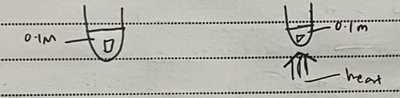
What is illustrated in the image with two beakers?
One beaker is heated, which increases the reaction rate.
 chemistry reaction