Sign up to unlock more features
- Save this deck to your account
- Study flashcards with spaced repetition
- Export to Anki (.apkg) or PDF
- Process documents up to 100 pages
- Images extracted from PDFs and documents
- Better text extraction from your PDFs and documents
- Better flashcards with our more advanced AI model
The main functions of the immune system include protecting from _______ and playing a role in many aspects of _______.
The two major arms of the immune response are _______ and _______.
The innate immune system responds rapidly using _______ that recognize broad classes of _______.
The adaptive immune system responds more slowly but with higher _______ and has memory capabilities.
The major cell types of innate immunity include _______, _______, and _______.
The major cell types of adaptive immunity include _______ and _______.
Cellular immunity primarily removes _______ while humoral immunity targets _______.
Cluster of differentiation (CD) markers are used to identify specific _______ in the immune system, such as _______ for T helper cells and _______ for cytotoxic T cells.
The immune system distinguishes _______ from _______ using innate and adaptive immune responses.
The primary role of the immune system is to protect from _______ and also to defend against _______.
Inappropriate immune responses can lead to conditions such as _______ and allergies.
The immune system plays a role in tissue _______ and _______.
A successful immune response includes features such as _______, _______, and _______.
The immune response to a pathogen involves the following steps: 1) _______ of a pathogen; 2) Determining the _______ of pathogen; 3) _______ of the pathogen; 4) Development of _______; and 5) Avoiding damage to _______.
The immune system must defend the body from infection while maintaining tolerance to _______ and to _______.
The immune system is organized into two major arms: the _______ and the _______.
Key cell types of the _______ include _______, _______, and others such as _______ and _______.
The adaptive immune response is characterized by _______ and _______.
B lymphocytes produce _______ that block infection and eliminate _______.
T lymphocytes are responsible for eradicating _______.
Innate immunity includes immediate defense mechanisms such as _______, _______, and _______.
The innate immune system recognizes broad categories of pathogens through germline-encoded innate immune _______.
Adaptive immunity generates _______ immunity through specialized antigen receptors on _______.
The specialized antigen receptors of B lymphocytes can be secreted as _______.
The diagram illustrates the principal components of innate and adaptive immunity over time after infection, showing that innate immunity acts within _______ while adaptive immunity develops over _______. 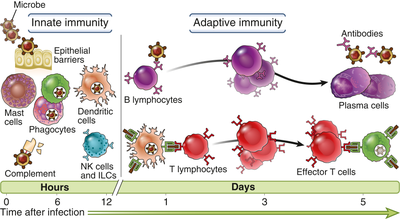
The innate immune response includes cells such as _______ and _______.
Mechanical barriers in innate immunity include _______ and _______.
Chemical barriers in innate immunity include enzymes like _______ and antimicrobial proteins such as _______.
The process of recognizing a pathogen in the immune response is known as _______.
The elimination of a pathogen involves determining the _______.
The development of immune memory leads to a _______ and more _______ upon re-exposure to the same pathogen.
The receptor of T lymphocytes is the _______.
Humoral immunity involves _______ that secrete _______ to eliminate extracellular microbes.
Cell-mediated immunity involves _______ that can kill infected cells and eliminate reservoirs of infection.
The adaptive immune response has a noticeable _______ to initiation, beginning _______ after pathogen exposure.
Adaptive immune responses are highly _______ and have _______ for quicker defense upon re-exposure to the same pathogen.
Innate immune cells do not have the same _______ as adaptive immune cells.
In humoral immunity, B lymphocytes secrete _______ that eliminate _______.
In cell-mediated immunity, some T lymphocytes secrete _______ that recruit and activate _______.
Cytotoxic T lymphocytes (CTLs) kill _______ and eliminate reservoirs of _______.
Phagocytes can ingest and destroy pathogens such as _______ and _______.
Humoral immunity refers to soluble substances found in _______ and other body _______.
Antibodies secreted by B lymphocytes bind to microbes, preventing further _______ and enhancing microbial uptake by _______.
The immune system uses both _______ and _______ to defend the body.
Cellular immunity refers to _______, while humoral immunity refers to soluble immune factors like _______.
The immune mechanisms that effectively clear _______ may not be the same as those effective against _______.
Phagocytes can ingest and destroy pathogens they encounter in _______.
The comparison of humoral and cell-mediated immunity shows that humoral immunity involves _______ and secreted _______, while cell-mediated immunity involves _______ and _______.
The principal function of _______ is to engulf pathogens and present digested pieces to alert and recruit other immune cells. Examples of APCs include _______, _______, and _______.
_______ include B and T cells, which mediate specific recognition of pathogens. Upon encountering their specific antigen, they undergo _______ and differentiate into specialized subtypes such as _______ and _______.
Effector cells carry out the functions of the immune response and include _______, _______, and _______. These cells can mediate the removal of pathogens without further differentiation.
B lymphocytes are mediators of _______, while T lymphocytes are mediators of _______.
Dendritic cells initiate _______, while macrophages are involved in the _______ of cell-mediated immunity.
_______ include neutrophils, basophils, and eosinophils, which phagocytose pathogens and mediate inflammation.
Mast cells regulate blood vessel dilation and mediate _______.
_______ destroy virally infected or tumorigenic cells as part of the innate immune response.
B lymphocytes produce _______ (immunoglobulins) that are specialized for each pathogen and found in the blood as soluble proteins.
T lymphocytes recognize infected or transformed cells and are responsible for their _______ and elimination from the body.
The table detailing cell types and their principal functions in the immune system includes lymphocytes (B and T cells), antigen-presenting cells (dendritic cells, macrophages), and effector cells (T lymphocytes, macrophages, granulocytes). See image: 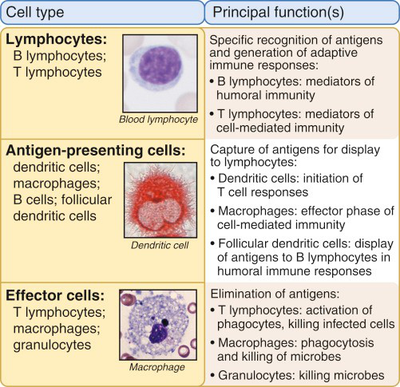
Immune cells can be identified by their cell surface molecules called _______. These are receptors or proteins found on the _______.
All B lymphocytes express the cell surface receptors _______ and _______.
All T cells express _______.
CD3+ T cells can be divided into two subsets: _______ and _______.
CD4 helper T cells provide help signals to activate other immune subsets, while CD8 cytotoxic T cells _______.
Clinical diagnostics use the CD marker system to identify a patient's type of _______ or _______ cell.
Major identifying cell surface markers for immune cells include CD34 and c-kit for _______.
B cells express the surface markers _______ and _______.
T cells express the surface marker _______.
NK cells express the surface markers _______ and _______.
Antigens are defined as an organism, molecule, or part of a molecule that is recognized by the _______.
Antigens can be simple or complex, protein or _______.
The immune system can recognize _______, which refers to changes in the body's cells after infection or malignant transformation.
Altered self antigens may be _______ or normal proteins expressed at higher levels due to aberrant regulation.
Microorganisms bear repeating patterns of molecular structure on their surface, known as _______ or _______.
PAMPs are specific targets of the immune system and include structures like the cell walls of _______ and _______ bacteria.
Bacterial flagella are made up of _______.
Many viruses express _______ as part of their life cycle.
Innate immune cells use receptors that are _______ to recognize pathogen-associated antigens.
B and T cells express receptors generated through _______.
The process of DNA rearrangement can generate up to _______} unique receptors.
Each B or T cell expresses only one type of receptor, which is always on the cell surface, although B cells can secrete their receptors in the form of _______.
Illustration shows an _______ with antibodies bound to its surface. 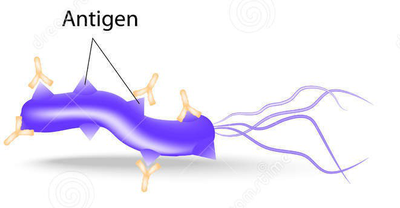
Table listing major identifying cell surface markers includes Hematopoietic stem cell, B cell, T cell, and NK cell with their corresponding _______. 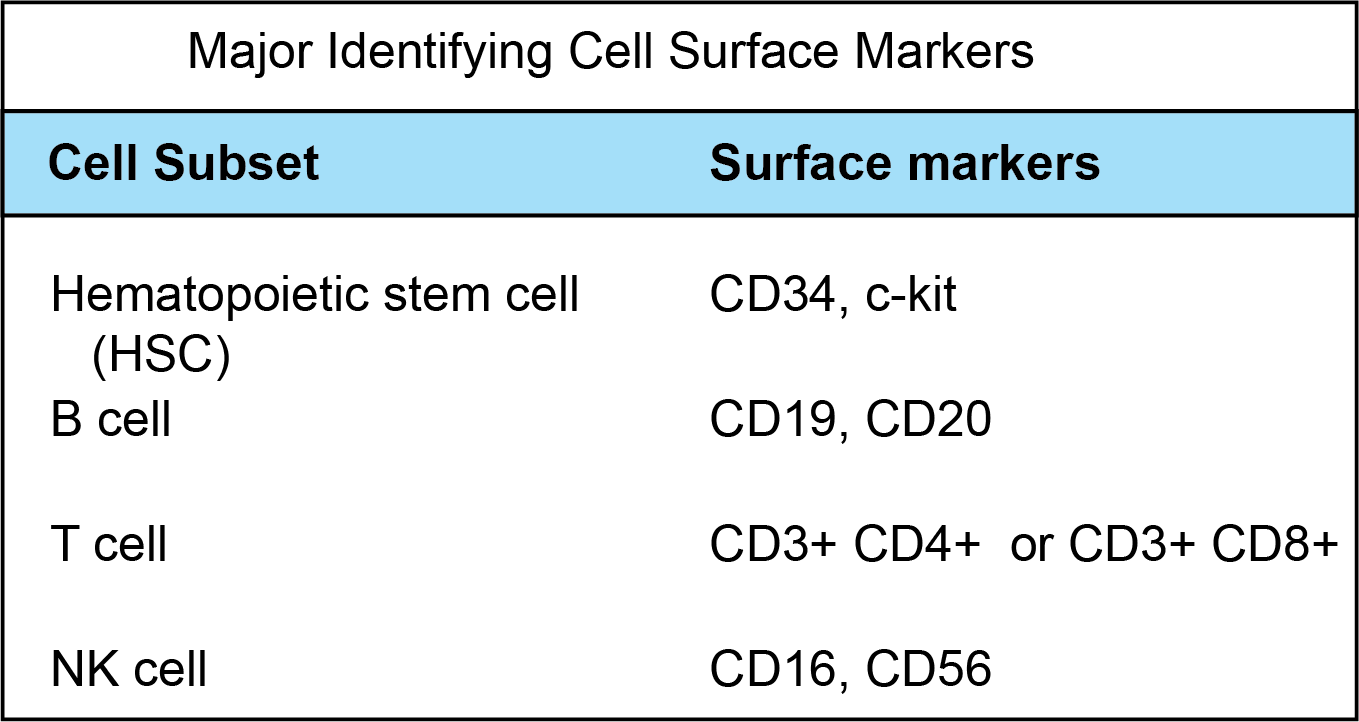
The two main types of immunity are _______ and _______.
Innate immunity recognizes structures shared by classes of microbes known as _______.
Adaptive immunity recognizes specific structural details of microbial molecules called _______.
The receptors used in innate immunity are located in the _______, _______, and _______.
The receptors in adaptive immunity are located only in the _______.
Innate immunity has about _______ different types of invariant receptors, while adaptive immunity has only _______ types of receptors (Ig and TCR).
The number of unique antigens recognized by the adaptive immune system is estimated to be greater than _______.
In the immune response, clonal expansion can lead to about _______ microbe-specific T cells.
The contraction phase of the immune response results in about _______ T cells remaining after the response.
The early innate defense relies on invariant, germline-encoded receptors recognizing common features of _______.
Adaptive immunity provides enhanced protection against reinfection by recognizing a particular _______.
The classic cadence of the immune response shows the number of microbe-specific T cells over time, indicating phases of _______ and _______.
The graph depicting the classic cadence of the immune response shows the number of CD8+ T cells and CD4+ T cells over _______.
The innate immune system is crucially important but has limitations as it can be overcome by many _______.
Adaptive immunity is characterized by the formation of _______ after an initial response to a pathogen.
The discrimination of self and nonself in innate immunity is based on the recognition of healthy host cells that do not express certain _______.
In adaptive immunity, self-reactive lymphocytes are eliminated or inactivated to avoid _______.
The genes encoding receptors in innate immunity are _______ and present in all cells.
In adaptive immunity, receptors are formed by _______ of gene segments only in B and T cells.
The table comparing innate and adaptive immunity features highlights differences in specificity, microbial molecules recognized, receptors, distribution, genes, and self-non-self discrimination. See the comparison table for details: 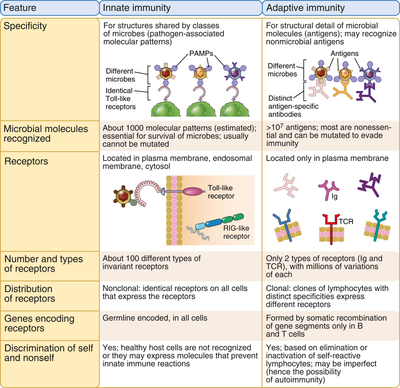
The innate immune response fails to eliminate a new infection, leading to activated _______ being delivered to the _______.
When a recirculating lymphocyte encounters its corresponding _______, it is induced to proliferate and differentiate into _______.
A subset of proliferating lymphocytes differentiates into _______, which are ready to respond rapidly to the same pathogen if encountered again.
After infection clears, antigen-specific lymphocytes gradually decrease from its peak in a phase called _______.
Following resolution, antigen-specific lymphocytes are sustained at a level that is slightly _______ than prior to infection, contributing to _______.
The immune system defends the body against infection, with the innate immune system acting quickly but lacking the ability to recognize certain _______.
Adaptive immunity is based on _______ from a repertoire of lymphocytes bearing highly diverse _______.
Host defense requires different recognition systems and a wide variety of _______ to seek out and destroy diverse pathogens.
The innate immune system provides _______ protective immunity, while adaptive immunity provides _______ protective immunity that prevents reinfection.
Flashcards in this deck (112)
-
The main functions of the immune system include protecting from infection and playing a role in many aspects of health and disease.
immune_system functions -
immune_system innate adaptive
-
The innate immune system responds rapidly using germline encoded immune receptors that recognize broad classes of pathogens.
innate_immunity immune_receptors -
The adaptive immune system responds more slowly but with higher specificity and has memory capabilities.
adaptive_immunity specificity -
innate_immunity cell_types
-
adaptive_immunity cell_types
-
Cellular immunity primarily removes intracellular pathogens while humoral immunity targets extracellular pathogens.
cellular_immunity humoral_immunity -
Cluster of differentiation (CD) markers are used to identify specific cell types in the immune system, such as CD4 for T helper cells and CD8 for cytotoxic T cells.
cd_markers immune_system cell_types -
self_vs_non-self immune_system
-
The primary role of the immune system is to protect from infection and also to defend against tumors.
immune_system infection tumors -
immune_response autoimmunity allergies
-
immune_system tissue_regeneration scarring
-
A successful immune response includes features such as recognition of pathogens, activation of immune cells, and elimination of pathogens.
immune_response features -
The immune response to a pathogen involves the following steps: 1) Recognition of a pathogen; 2) Determining the type of pathogen; 3) Elimination of the pathogen; 4) Development of immune memory; and 5) Avoiding damage to self-tissues.
immunology immune_response -
The immune system must defend the body from infection while maintaining tolerance to self and to commensal organisms.
immunology tolerance -
The immune system is organized into two major arms: the innate immune response and the adaptive immune response.
immunology immune_system -
Key cell types of the innate immune response include myeloid cells, natural killer cells, and others such as macrophages and neutrophils.
immunology innate_immunity -
immunology adaptive_immunity
-
immunology b_lymphocytes
-
immunology t_lymphocytes
-
Innate immunity includes immediate defense mechanisms such as mechanical barriers, chemical barriers, and biological barriers.
immunology innate_immunity -
The innate immune system recognizes broad categories of pathogens through germline-encoded innate immune receptors.
immunology innate_immunity -
Adaptive immunity generates pathogen-specific immunity through specialized antigen receptors on lymphocytes.
immunology adaptive_immunity -
immunology b_lymphocytes
-
The diagram illustrates the principal components of innate and adaptive immunity over time after infection, showing that innate immunity acts within hours while adaptive immunity develops over days.
immunology immune_response diagram -
immunology innate_immunity
-
immunology innate_immunity
-
Chemical barriers in innate immunity include enzymes like lysozyme and antimicrobial proteins such as beta-defensins.
immunology innate_immunity -
immunology pathogen_recognition
-
immunology pathogen_elimination
-
The development of immune memory leads to a faster and more robust response upon re-exposure to the same pathogen.
immunology immune_memory -
immunology t_lymphocytes
-
Humoral immunity involves B lymphocytes that secrete antibodies to eliminate extracellular microbes.
immunology humoral_immunity -
Cell-mediated immunity involves T lymphocytes that can kill infected cells and eliminate reservoirs of infection.
immunology cell-mediated_immunity -
The adaptive immune response has a noticeable lag phase to initiation, beginning four to seven days after pathogen exposure.
immunology adaptive_immune_response -
Adaptive immune responses are highly antigen-specific and have memory capabilities for quicker defense upon re-exposure to the same pathogen.
immunology adaptive_immune_response -
immunology innate_immunity
-
immunology humoral_immunity
-
In cell-mediated immunity, some T lymphocytes secrete cytokines that recruit and activate phagocytes.
immunology cell-mediated_immunity -
immunology cytotoxic_t_lymphocytes
-
immunology pathogens
-
immunology humoral_immunity
-
Antibodies secreted by B lymphocytes bind to microbes, preventing further dissemination and enhancing microbial uptake by phagocytes.
immunology antibodies -
immunology immune_system
-
Cellular immunity refers to cells, while humoral immunity refers to soluble immune factors like antibodies.
immunology cellular_immunity -
The immune mechanisms that effectively clear Borrelia burgdorferi may not be the same as those effective against Salmonella typhi.
immunology pathogens -
immunology phagocytes
-
The comparison of humoral and cell-mediated immunity shows that humoral immunity involves B lymphocytes and secreted antibodies, while cell-mediated immunity involves T lymphocytes and macrophages.
immunology comparison humoral_immunity cell-mediated_immunity -
The principal function of antigen presenting cells (APCs) is to engulf pathogens and present digested pieces to alert and recruit other immune cells. Examples of APCs include macrophages, B cells, and dendritic cells.
immune_system apcs -
Antigen-specific lymphocytes include B and T cells, which mediate specific recognition of pathogens. Upon encountering their specific antigen, they undergo clonal proliferation and differentiate into specialized subtypes such as effector cells and memory cells.
immune_system lymphocytes -
Effector cells carry out the functions of the immune response and include macrophages, granulocytes, and T cells. These cells can mediate the removal of pathogens without further differentiation.
immune_system effector_cells -
B lymphocytes are mediators of humoral immunity, while T lymphocytes are mediators of cell-mediated immunity.
immune_system lymphocytes -
Dendritic cells initiate T cell responses, while macrophages are involved in the effector phase of cell-mediated immunity.
immune_system apcs -
Granulocytes include neutrophils, basophils, and eosinophils, which phagocytose pathogens and mediate inflammation.
immune_system granulocytes -
immune_system mast_cells
-
Natural Killer (NK) cells destroy virally infected or tumorigenic cells as part of the innate immune response.
immune_system nk_cells -
B lymphocytes produce antibodies (immunoglobulins) that are specialized for each pathogen and found in the blood as soluble proteins.
immune_system b_lymphocytes -
T lymphocytes recognize infected or transformed cells and are responsible for their destruction and elimination from the body.
immune_system t_lymphocytes -
The table detailing cell types and their principal functions in the immune system includes lymphocytes (B and T cells), antigen-presenting cells (dendritic cells, macrophages), and effector cells (T lymphocytes, macrophages, granulocytes). See image:
immune_system cell_types -
Immune cells can be identified by their cell surface molecules called CD Markers. These are receptors or proteins found on the plasma membrane.
immunology cells -
immunology b_cells
-
immunology t_cells
-
immunology t_cells
-
CD4 helper T cells provide help signals to activate other immune subsets, while CD8 cytotoxic T cells kill infected or cancerous cells.
immunology t_cells -
Clinical diagnostics use the CD marker system to identify a patient's type of leukemia or lymphoma cell.
immunology diagnostics -
Major identifying cell surface markers for immune cells include CD34 and c-kit for Hematopoietic stem cells (HSC).
immunology cell_markers -
immunology b_cells
-
immunology t_cells
-
immunology nk_cells
-
Antigens are defined as an organism, molecule, or part of a molecule that is recognized by the immune system.
immunology antigens -
immunology antigens
-
The immune system can recognize altered self, which refers to changes in the body's cells after infection or malignant transformation.
immunology self_recognition -
Altered self antigens may be mutated gene products or normal proteins expressed at higher levels due to aberrant regulation.
immunology altered_self -
Microorganisms bear repeating patterns of molecular structure on their surface, known as PAMPs or DAMPs.
immunology patterns -
PAMPs are specific targets of the immune system and include structures like the cell walls of Gram-positive and Gram-negative bacteria.
immunology bacteria -
immunology bacteria
-
immunology viruses
-
Innate immune cells use receptors that are germline encoded to recognize pathogen-associated antigens.
immunology innate_immunity -
immunology adaptive_immunity
-
immunology receptors
-
Each B or T cell expresses only one type of receptor, which is always on the cell surface, although B cells can secrete their receptors in the form of antibodies.
immunology b_cells -
immunology antigens
-
Table listing major identifying cell surface markers includes Hematopoietic stem cell, B cell, T cell, and NK cell with their corresponding CD markers.
immunology cell_markers -
immunology immune_system
-
immunology innate_immunity
-
immunology adaptive_immunity
-
The receptors used in innate immunity are located in the plasma membrane, endosomal membrane, and cytosol.
immunology receptors -
immunology adaptive_immunity
-
Innate immunity has about 100 different types of invariant receptors, while adaptive immunity has only 2 types of receptors (Ig and TCR).
immunology receptors -
The number of unique antigens recognized by the adaptive immune system is estimated to be greater than 10^7.
immunology adaptive_immunity -
immunology immune_response
-
The contraction phase of the immune response results in about 10^4 T cells remaining after the response.
immunology immune_response -
The early innate defense relies on invariant, germline-encoded receptors recognizing common features of pathogens.
immunology innate_immunity -
Adaptive immunity provides enhanced protection against reinfection by recognizing a particular pathogen.
immunology adaptive_immunity -
The classic cadence of the immune response shows the number of microbe-specific T cells over time, indicating phases of clonal expansion and contraction.
immunology immune_response -
The graph depicting the classic cadence of the immune response shows the number of CD8+ T cells and CD4+ T cells over days after infection.
immunology immune_response -
The innate immune system is crucially important but has limitations as it can be overcome by many pathogens.
immunology innate_immunity -
Adaptive immunity is characterized by the formation of memory cells after an initial response to a pathogen.
immunology adaptive_immunity -
The discrimination of self and nonself in innate immunity is based on the recognition of healthy host cells that do not express certain molecules.
immunology self_nonself_discrimination -
In adaptive immunity, self-reactive lymphocytes are eliminated or inactivated to avoid autoimmunity.
immunology adaptive_immunity -
immunology receptors
-
In adaptive immunity, receptors are formed by somatic recombination of gene segments only in B and T cells.
immunology receptors -
The table comparing innate and adaptive immunity features highlights differences in specificity, microbial molecules recognized, receptors, distribution, genes, and self-non-self discrimination. See the comparison table for details:
immunology innate_vs_adaptive_immunity -
The innate immune response fails to eliminate a new infection, leading to activated antigen presenting cells being delivered to the draining lymph nodes.
immune_system innate_immunity -
When a recirculating lymphocyte encounters its corresponding antigen, it is induced to proliferate and differentiate into effector B or T lymphocytes.
immune_system adaptive_immunity -
A subset of proliferating lymphocytes differentiates into memory cells, which are ready to respond rapidly to the same pathogen if encountered again.
immune_system memory_cells -
After infection clears, antigen-specific lymphocytes gradually decrease from its peak in a phase called resolution phase.
immune_system resolution_phase -
Following resolution, antigen-specific lymphocytes are sustained at a level that is slightly higher than prior to infection, contributing to immunological memory.
immune_system immunological_memory -
The immune system defends the body against infection, with the innate immune system acting quickly but lacking the ability to recognize certain pathogens.
immune_system innate_immunity -
Adaptive immunity is based on clonal selection from a repertoire of lymphocytes bearing highly diverse antigen-specific receptors.
immune_system adaptive_immunity -
Host defense requires different recognition systems and a wide variety of effector mechanisms to seek out and destroy diverse pathogens.
immune_system host_defense -
The innate immune system provides non-specific protective immunity, while adaptive immunity provides specific protective immunity that prevents reinfection.
immune_system immunity_types