Sign up to unlock more features
- Save this deck to your account
- Study flashcards with spaced repetition
- Export to Anki (.apkg) or PDF
- Process documents up to 100 pages
- Images extracted from PDFs and documents
- Better text extraction from your PDFs and documents
- Better flashcards with our more advanced AI model
The vapor pressure of Sevoflurane at 20 degrees C is _______.
Desflurane has a vapor pressure approximately at _______ at 20 degrees C.
Under the Law of Laplace, tension on the wall of a cylinder is proportional to the _______.
According to Dalton's Law, the total pressure in a mixture of gases equals the _______ of the individual pressures.
In Poiseuille's Law, flow rate (Q) increases by the fourth power of the _______.
LAMINAR FLOW is determined by _______ when all other factors are constant.
Turbulent flow is primarily affected by the _______ of the fluid when other factors are constant.
The formula for flow rate, according to Poiseuille's Law, is given by \(\(Q = \frac{\pi P r^4}{8\eta L}\)\).
According to _______, the partial pressure of an anesthetic agent in the blood is proportional to the partial pressure of the volatile in the alveoli.
The amount of dissolved O2 in blood can be calculated as _______.
According to Charles Law, at constant pressure, volume and temperature are _______.
In Gay-Lussac's Law, pressure and temperature are directly proportional at constant _______.
Boyle's Gas Law describes that pressure and volume are _______ at constant temperature.
Fick's Law of Diffusion states that the rate of diffusion is directly proportional to _______, membrane area, and solubility of gas.
According to Fick's Law, diffusion is indirectly proportional to membrane thickness and the _______.
_______ occurs due to high inspired % of nitrous oxide leading to hypoventilation and displacement of O2.
In the mnemonic 'Could These Girls Possibly Be Virgins', each letter represents a different gas law including Charles Law and _______.
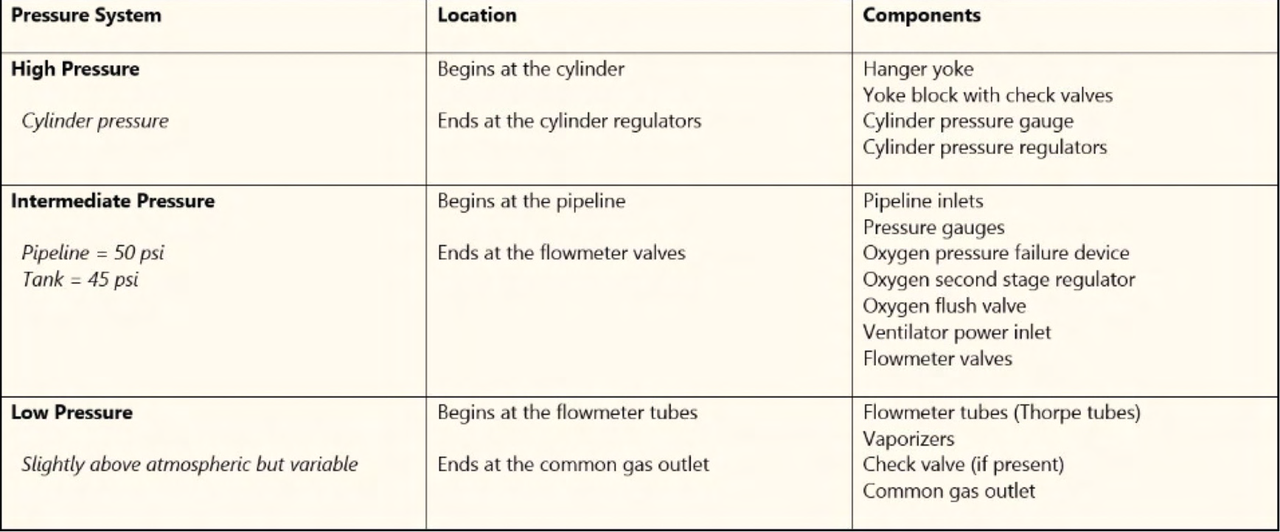
The components of the _______ system in an anesthesia machine include: - _______ - _______ - _______ - _______.
The _______ system in an anesthesia machine starts at the pipeline and ends at the _______.
Components of the _______ system include: - _______ - _______ - _______ - _______ - _______ - _______ - _______.
The _______ system begins at the flowmeter tubes and ends at the _______.
Components of the _______ system include: - _______ - _______ - _______ - _______.
The components of the anesthesia machine are divided into three pressure systems: _______, _______, and _______.
This table provides an overview of the anesthesia machine's pressure systems.
Flashcards in this deck (24)
-
physics vaporization
-
physics vaporization
-
physics law_of_laplace
-
According to Dalton's Law, the total pressure in a mixture of gases equals the sum of the individual pressures.
physics dalton's_law -
physics poiseuille's_law
-
physics fluid_dynamics
-
physics fluid_dynamics
-
The formula for flow rate, according to Poiseuille's Law, is given by \(\(Q = \frac{\pi P r^4}{8\eta L}\)\).
physics poiseuille's_law -
According to Henry's law, the partial pressure of an anesthetic agent in the blood is proportional to the partial pressure of the volatile in the alveoli.
gas_laws henry's_law -
gas_laws o2
-
gas_laws charles_law
-
gas_laws gay-lussac's_law
-
Boyle's Gas Law describes that pressure and volume are inversely proportional at constant temperature.
gas_laws boyle's_law -
Fick's Law of Diffusion states that the rate of diffusion is directly proportional to partial pressure gradient, membrane area, and solubility of gas.
diffusion fick's_law -
According to Fick's Law, diffusion is indirectly proportional to membrane thickness and the square root of molecular weight.
diffusion fick's_law -
Diffusion hypoxia occurs due to high inspired % of nitrous oxide leading to hypoventilation and displacement of O2.
diffusion gas_laws -
In the mnemonic 'Could These Girls Possibly Be Virgins', each letter represents a different gas law including Charles Law and Boyle's law.
mnemonic gas_laws -
The components of the High Pressure system in an anesthesia machine include: - Hanger yoke - Yoke block with check valves - Cylinder pressure gauge - Cylinder pressure regulators.
anesthesia machine pressure -
The Intermediate Pressure system in an anesthesia machine starts at the pipeline and ends at the flowmeter valves.
anesthesia machine pressure -
Components of the Intermediate Pressure system include: - Pipeline inlets - Pressure gauges - Oxygen pressure failure device - Oxygen second stage regulator - Oxygen flush valve - Ventilator power inlet - Flowmeter valves.
anesthesia machine pressure -
anesthesia machine pressure
-
Components of the Low Pressure system include: - Flowmeter tubes (Thorpe tubes) - Vaporizers - Check valve (if present) - Common gas outlet.
anesthesia machine pressure -
The components of the anesthesia machine are divided into three pressure systems: High Pressure, Intermediate Pressure, and Low Pressure.
anesthesia machine pressure -
anesthesia machine overview
MODULE 1: PHYSICS / EQUIP & MONITORING / NMJ & MUSCLE RELAXANTS
PHYSICS
I. Vaporization
Vapor Pressures at 20°C
| Anesthetic Agent | Vapor Pressure (mmHg) |
|---|---|
| Sevoflurane | 170 |
| Isoflurane | 240 |
| Enflurane | 172 |
| Halothane | 244 |
| Desflurane | 669 |
- Vapor Pressure (VP): Increases with temperature; Desflurane vaporizer operates at ~2 atm (approx. 1500 mmHg).
- High-Low Relationships:
- H-L-H: Higher VP agent in lower VP vaporizer results in higher delivered concentration.
- L-H-L: Lower VP agent in higher VP vaporizer results in lower delivered concentration.
- Latent Heat of Vaporization: Energy lost during vaporization without temperature change.
II. Pressure & Tension
- Pressure Conversions:
- 1 mmHg = 1.36 cmH2O, 1 atm = 760 mmHg = 101 kPa
- Law of Laplace: Tension (\(T\)) on wall of a cylinder is proportional to its radius (\(r\)): \(\(T = P imes r\)\).
- Dalton's Law: Total pressure is the sum of individual gas pressures.
III. Fluid Dynamics
Poiseuille's Law
-
Describes how flow rate (\(Q\)) is influenced by radius (\(r\)), pressure (\(P\)), viscosity ($ ext{η}\(), and length (\)L$). \(\(Q = rac{ ext{π}Pr^4}{8 ext{η}L}\)\).
-
Laminar Flow: Flow determined by viscosity; to increase flow:
- Decrease needle gauge
- Shorten needle
- Raise IV pole.
- Turbulent Flow: Flow determined by density; helium used with O2 to decrease turbulence during upper airway obstruction.
IV. Solubility of Gases
- Henry's Law: Partial pressure of an anesthetic agent in blood is proportional to its alveolar pressure. Calculation example for dissolved gases in blood:
- Dissolved O2: 0.003 mL/100mL/mmHg
- Dissolved CO2: 0.067 mL/100mL/mmHg.
V. Gas Laws
- Charles's Law: \(V_1/T_1 = V_2/T_2\); volume and temperature are directly proportional at constant pressure.
- Gay-Lussac's Law: \(P/T = K\); pressure and temperature are directly proportional at constant volume.
- Boyle's Law: \(PV = K\); pressure and volume are inversely proportional at constant temperature.
- Fick's Law of Diffusion: Rate of diffusion is directly proportional to partial pressure gradient, membrane area, and gas solubility; inversely proportional to thickness and square root of molecular weight.
VI. Equipment & Monitoring
Anesthesia Machine Overview
- High, Intermediate, and Low Pressure systems:
| Pressure System | Location | Components |
|---|---|---|
| High Pressure | Begins at the cylinder | Cylinder gauges, regulators |
| Intermediate | Pipeline to flowmeter | Pressure gauges, flowmeter valves |
| Low Pressure | Flowmeter to gas outlet | Vaporizers, common gas outlet |
Additional Visuals
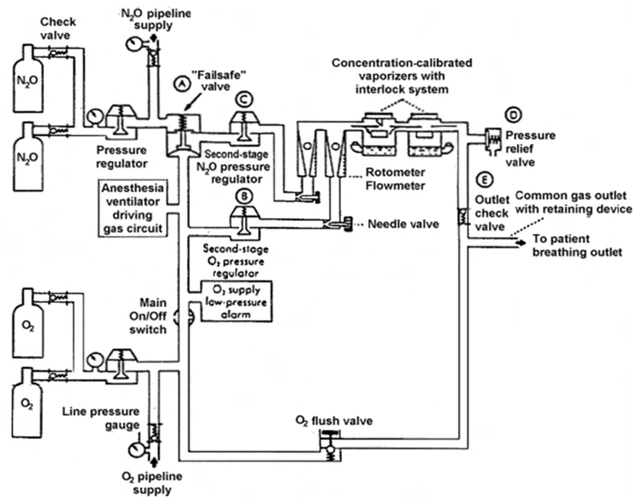 - Provides component overview of an anesthesia machine.
- - Describes different pressure systems in anesthesia machines.
Memory Tasks
- Essential readings from key sources.
- Key formulas and their applications in clinical practice.
- Understanding anesthesia machine components and functionalities.