Sign up to unlock more features
- Save this deck to your account
- Study flashcards with spaced repetition
- Export to Anki (.apkg) or PDF
- Process documents up to 100 pages
- Images extracted from PDFs and documents
- Better text extraction from your PDFs and documents
- Better flashcards with our more advanced AI model
What is the difference between packet sniffing and packet spoofing?
What is the primary difference between packet sniffing and packet spoofing?
How does a NIC decide to copy a received Ethernet frame into a buffer for dispatch to user-space? 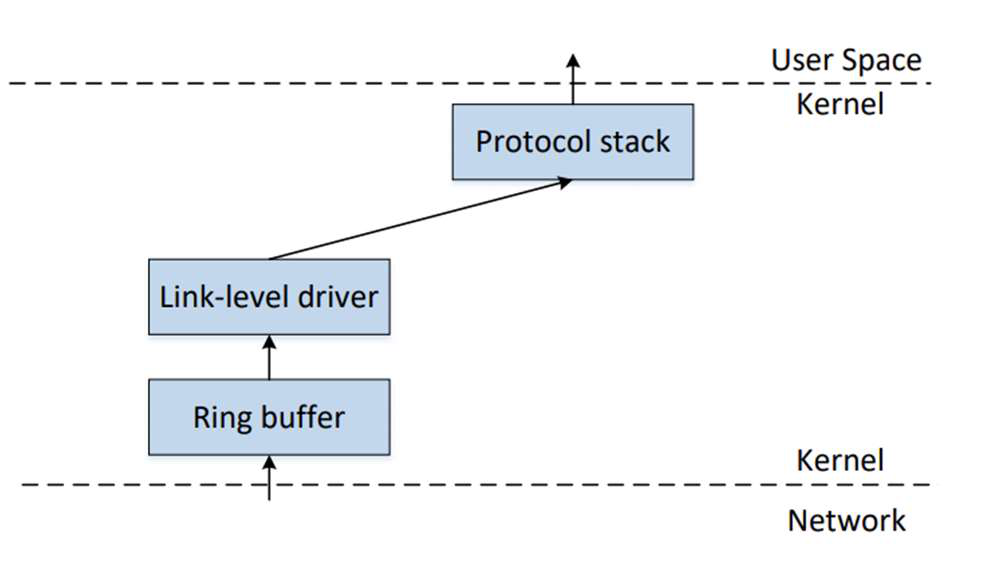
What is promiscuous mode on a network interface card (NIC)?
How does Wi‑Fi monitor mode affect what 802.11 frames a card can capture?
Why should packet sniffers filter unwanted packets as early as possible?
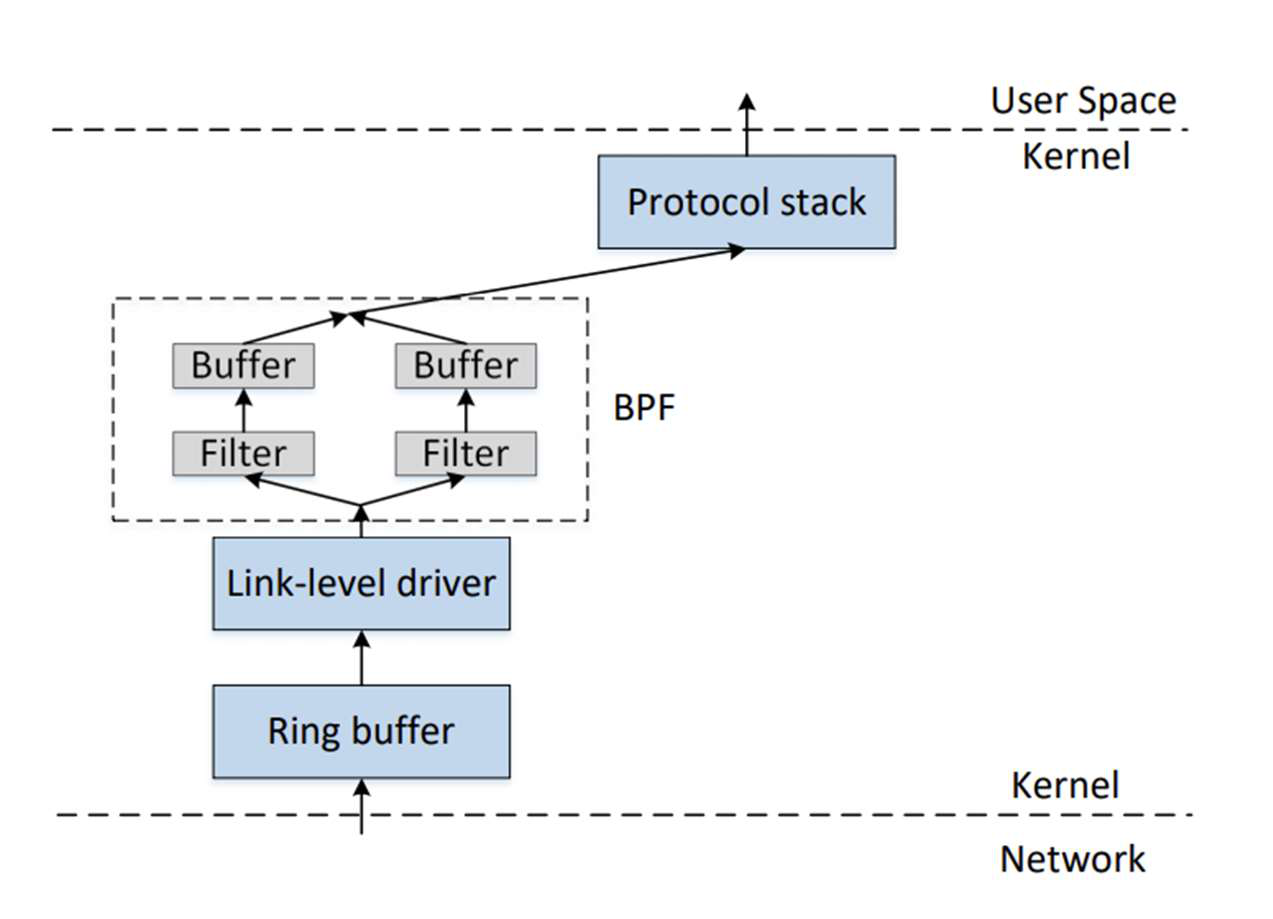
What does the BSD Packet Filter (BPF) allow a user program to do with a socket?
What is packet sniffing and what are the tools that perform it called?
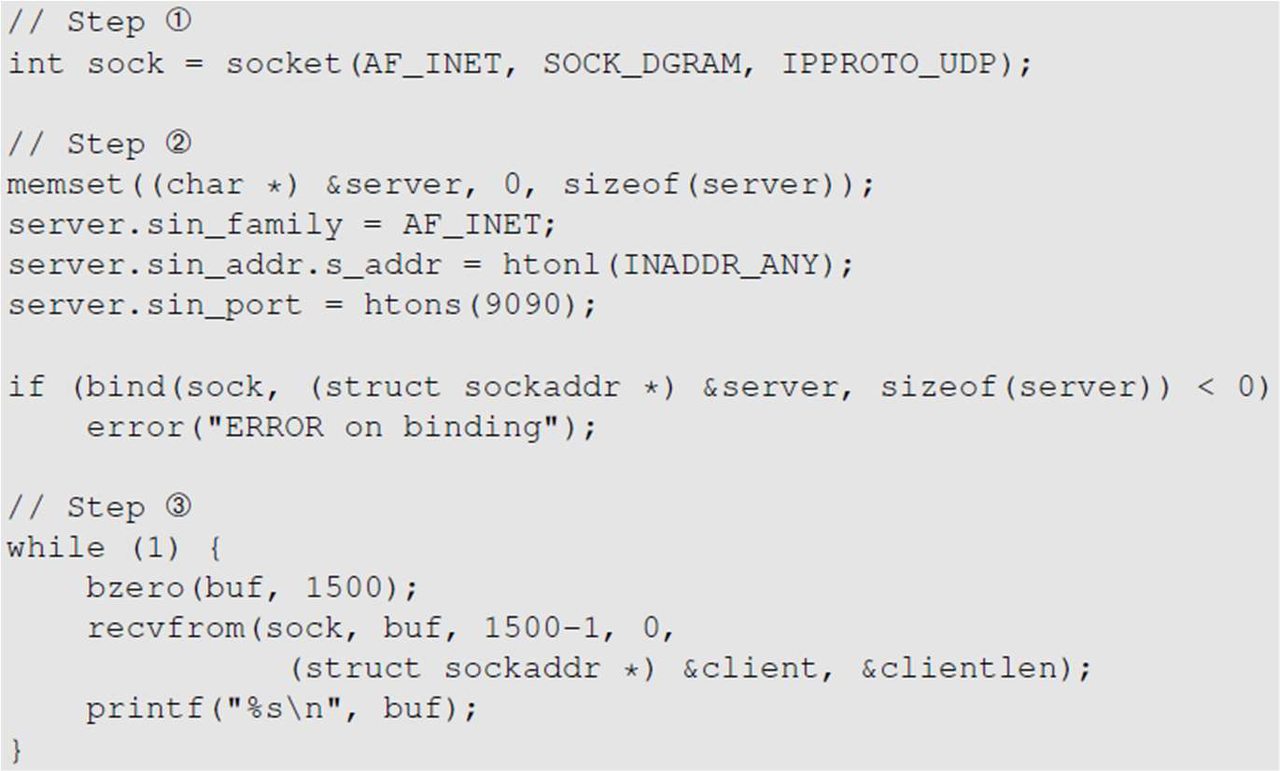
What are the main high-level steps to receive UDP packets using a socket?
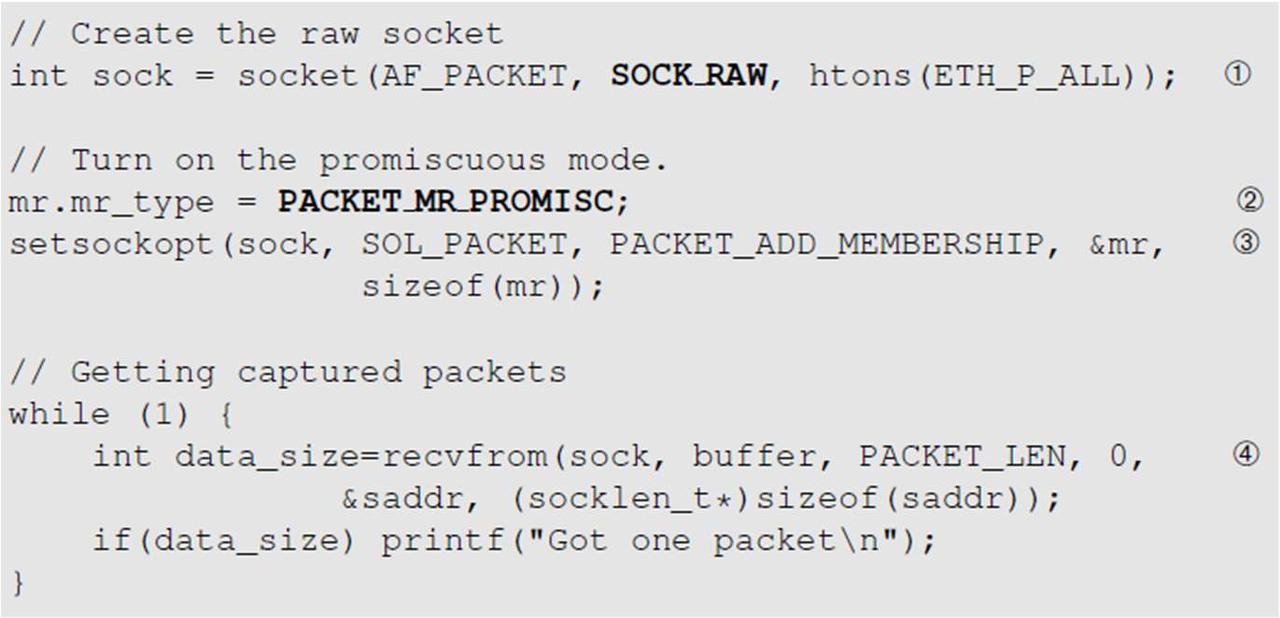
What are the high-level steps to capture packets using a raw socket for a sniffer?
What key advantages does the PCAP library provide over using raw sockets for packet capture?
What are the main steps in pcap-based packet sniffing using the pcap API?
What are the main steps of the pcap packet capture workflow demonstrated by sniff.c?
What is packet spoofing?
What are the main steps shown to send a UDP packet without spoofing in the example code?
Why use a raw socket when spoofing packets?
What are the key steps shown to construct an ICMP echo request (spoofed packet) in the example code?
In the example code for constructing a spoofed IP packet, name three IP header fields that were explicitly set.
When constructing spoofed UDP packets, what key element must be included that differs from spoofed IP or ICMP packets?
What are the high-level steps of a sniff-and-spoof workflow for UDP packets?
In the C function shown for spoofing UDP packets, after confirming the packet's destination port is 9999, what are the two main steps performed to create the spoofed reply?
Which UDP header fields are set when constructing the spoofed UDP packet in the code snippet?
In the Scapy script shown, which packet fields are printed for each captured ICMP packet?
In the ICMP example using Scapy, which protocol layers are combined to create the spoofed packet?
In a Scapy "sniff-then-spoof" workflow for ICMP shown in the snippet, what high-level packet modifications convert an ICMP echo request into a spoofed echo reply?
What are the high-level trade-offs between using Scapy (Python) and C raw sockets for packet spoofing, and what does a hybrid approach combine?
What is endianness and how do Little Endian and Big Endian differ in byte order?
What is 'network byte order' and which macros perform host↔network conversions?
Name three methods/tools mentioned for packet sniffing and spoofing.
Flashcards in this deck (29)
-
What is the difference between packet sniffing and packet spoofing?
- Packet sniffing: captures network traffic using tools/techniques like pcap, raw sockets, or BPF
- Packet spoofing: forges packet headers (e.g., IP, ICMP, UDP) by constructing raw packets or using Scapy
network security -
What is the primary difference between packet sniffing and packet spoofing?
- Packet sniffing: captures network traffic (pcap/raw sockets/BPF)
- Packet spoofing: forges packet headers (IP/ICMP/UDP) using raw packets or Scapy
networking security sniffing spoofing -
How does a NIC decide to copy a received Ethernet frame into a buffer for dispatch to user-space?
If the destination address in the frame header matches the NIC (or filter), the frame is copied into a ring buffer and dispatched to user-space programs.
network nic packet-reception -
What is promiscuous mode on a network interface card (NIC)?
- The NIC passes every received frame to the kernel
- A registered sniffer can see all packets
- Enabling usually requires elevated privilege (root)
networking promiscuous -
How does Wi‑Fi monitor mode affect what 802.11 frames a card can capture?
- Monitor mode captures 802.11 frames only on the channel the card is listening to; due to channels and interference, the card may miss frames on other channels.
networking wifi sniffing -
Why should packet sniffers filter unwanted packets as early as possible?
- It prevents the system from handing all captured packets to the sniffer program, which would then discard most unwanted packets and be inefficient.
networking sniffing -
What does the BSD Packet Filter (BPF) allow a user program to do with a socket?
- Attach a filter to the socket that tells the kernel to discard unwanted packets
 bpf kernel filtering networking
 -
What is packet sniffing and what are the tools that perform it called?
- Packet sniffing captures live data as they flow across a network.
- Tools that perform packet sniffing are called packet sniffers.
networking security -
What are the main high-level steps to receive UDP packets using a socket?
- Create a UDP socket (AF_INET, SOCK_DGRAM, IPPROTO_UDP)
- Configure server address and port then bind (INADDR_ANY, port 9090)
- Receive packets in a loop using recvfrom and process the buffer
networking udp sockets -
What are the high-level steps to capture packets using a raw socket for a sniffer?
- Create a raw socket: socket(AF_PACKET, SOCK_RAW, htons(ETH_P_ALL))
- Enable promiscuous mode: use PACKET_MR_PROMISC with PACKET_ADD_MEMBERSHIP via setsockopt
- Receive packets: loop calling recvfrom() to read captured packets
 networking sniffing rawsocket
 -
What key advantages does the PCAP library provide over using raw sockets for packet capture?
- Cross-platform standard API
- Hides OS-specific details
- Allows human-readable Boolean filtering rules
pcap networking -
What are the main steps in pcap-based packet sniffing using the pcap API?
- Open a live pcap session (e.g., pcap_open_live)
- Compile and set a BPF filter (pcap_compile, pcap_setfilter)
- Capture packets and handle them in a callback (pcap_loop and got_packet)
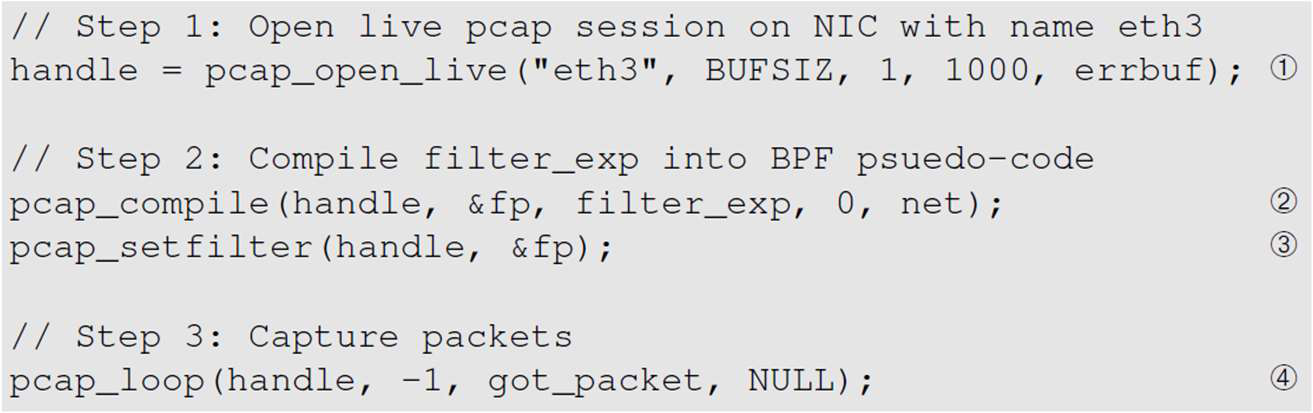 pcap sniffing bpf
 -
What are the main steps of the pcap packet capture workflow demonstrated by sniff.c?
- Open a live pcap session on a NIC
- Compile a filter expression into BPF
- Set the compiled filter on the handle
- Capture packets (pcap_loop) with a callback
- Close the pcap handle
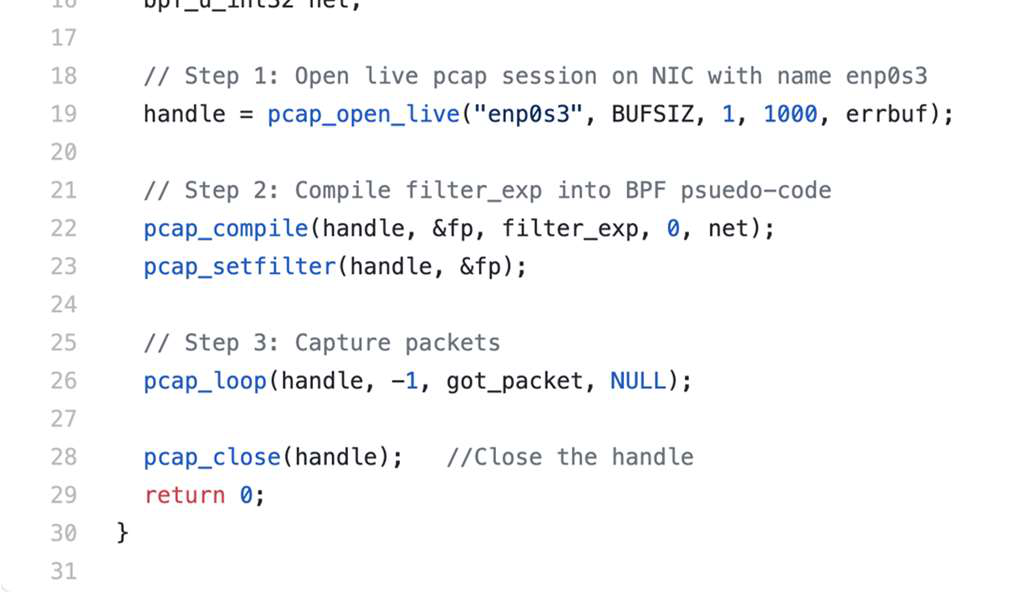 pcap sniffing bpf
 -
networking security
-
What are the main steps shown to send a UDP packet without spoofing in the example code?
- Create a UDP socket
- Provide destination information (IP and port)
- Call sendto() with the payload and destination, then close the socket
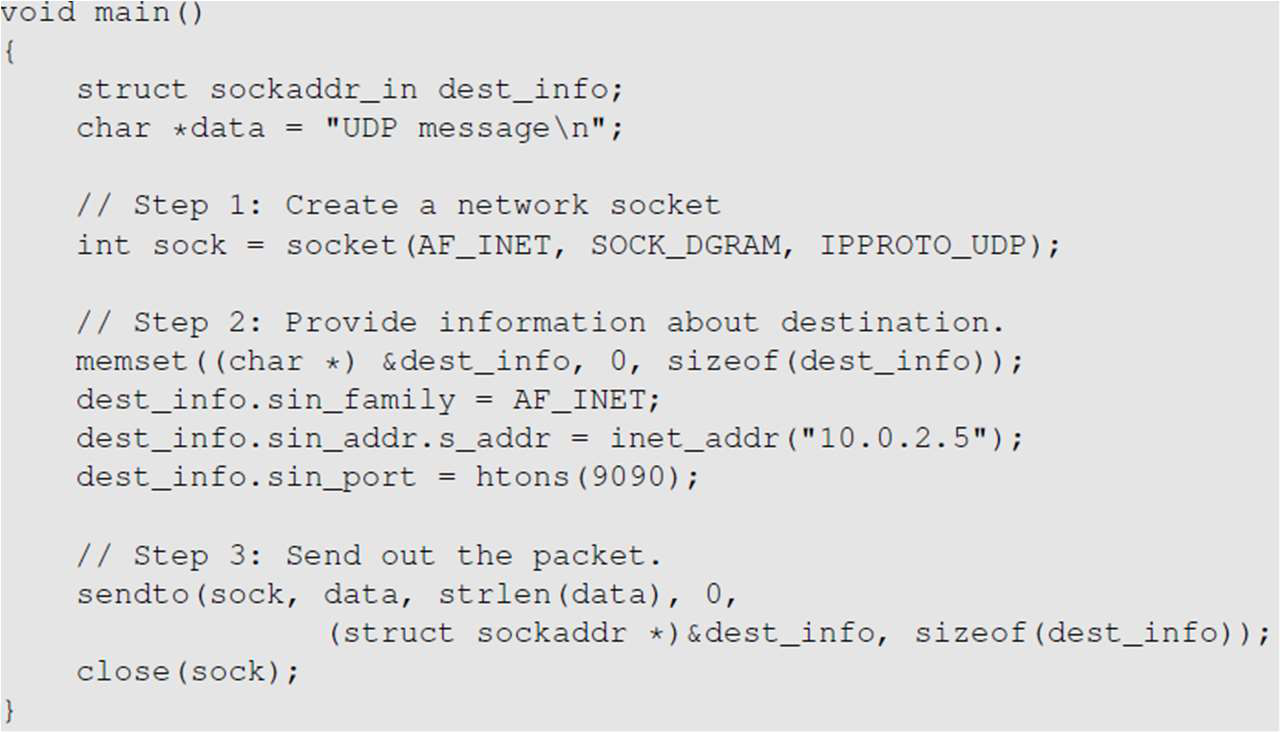 networking udp sockets
 -
Why use a raw socket when spoofing packets?
Because a raw socket lets you construct the entire packet in a buffer including the IP header; typical sockets have header fields (e.g., source IP, packet length) set by the OS.
networking spoofing rawsocket -
What are the key steps shown to construct an ICMP echo request (spoofed packet) in the example code?
- Find the ICMP header start and typecast to struct icmpheader
- Fill ICMP fields (set icmp_type to 8 for request)
- Set icmp_chksum = 0
- Compute and store checksum using in_cksum
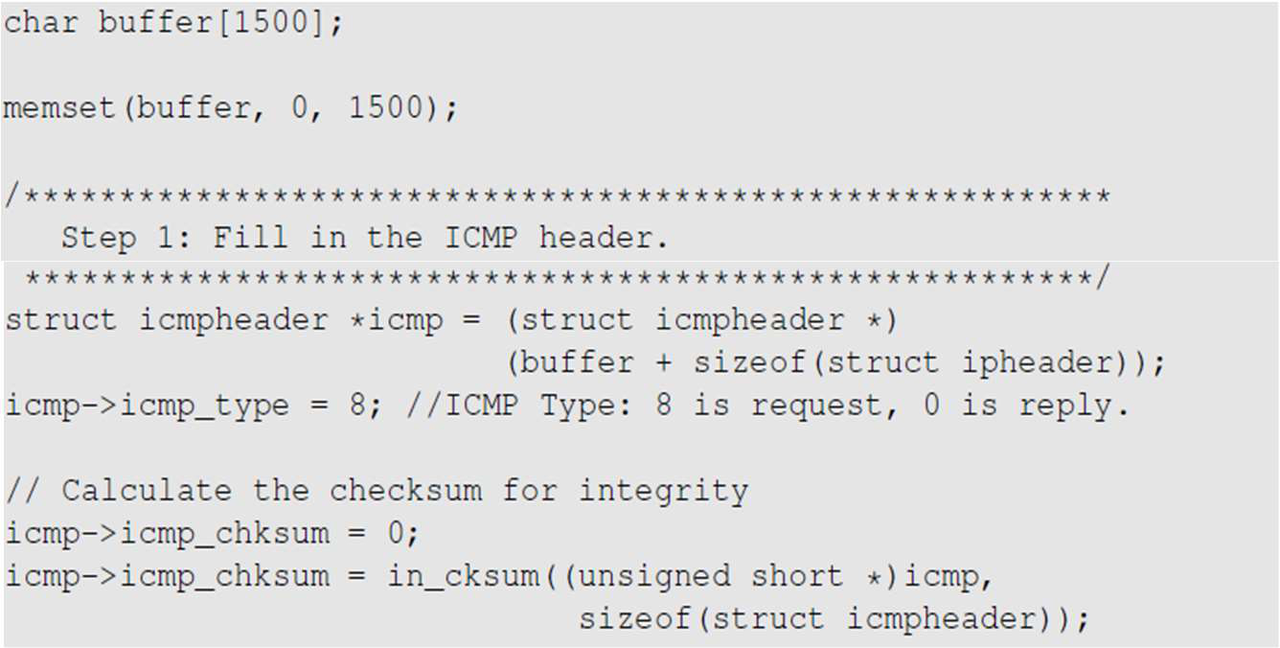 icmp spoofing networking checksum
 -
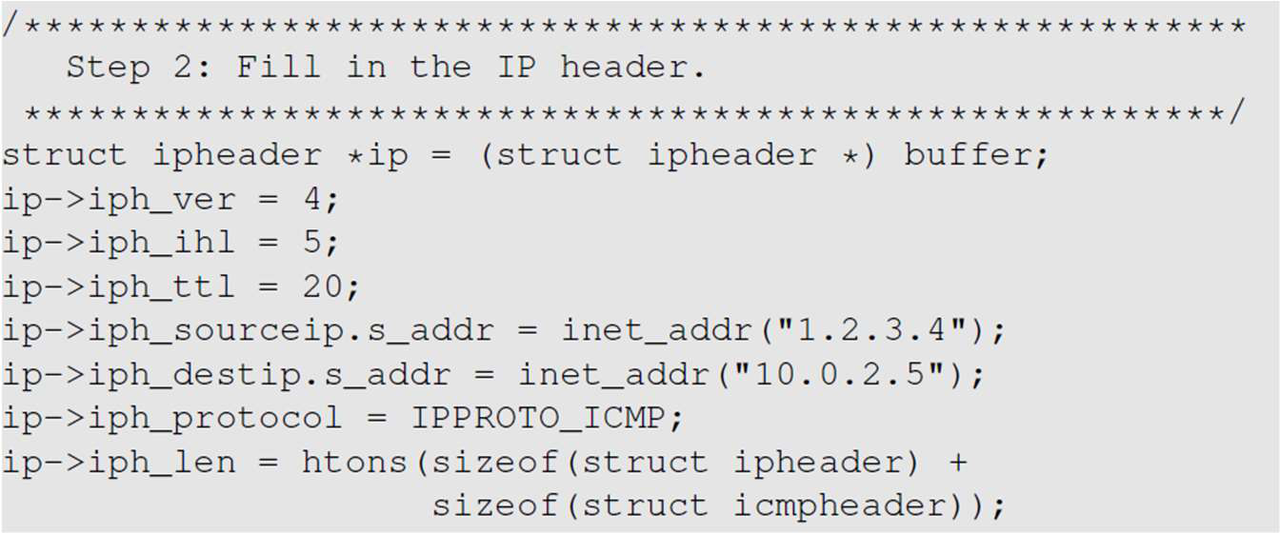
In the example code for constructing a spoofed IP packet, name three IP header fields that were explicitly set.
- IP version: 4
- Source and destination IPs: 1.2.3.4 and 10.0.2.5
- Protocol: IPPROTO_ICMP
 networking spoofing ip
 -
When constructing spoofed UDP packets, what key element must be included that differs from spoofed IP or ICMP packets?
- Payload data
networking spoofing udp -
What are the high-level steps of a sniff-and-spoof workflow for UDP packets?
- Capture UDP packets using a PCAP API
- Copy the captured packet
- Replace the UDP data field and swap source and destination fields
- Send the spoofed reply
- (Alternative): use Scapy in Python instead of C
networking security -
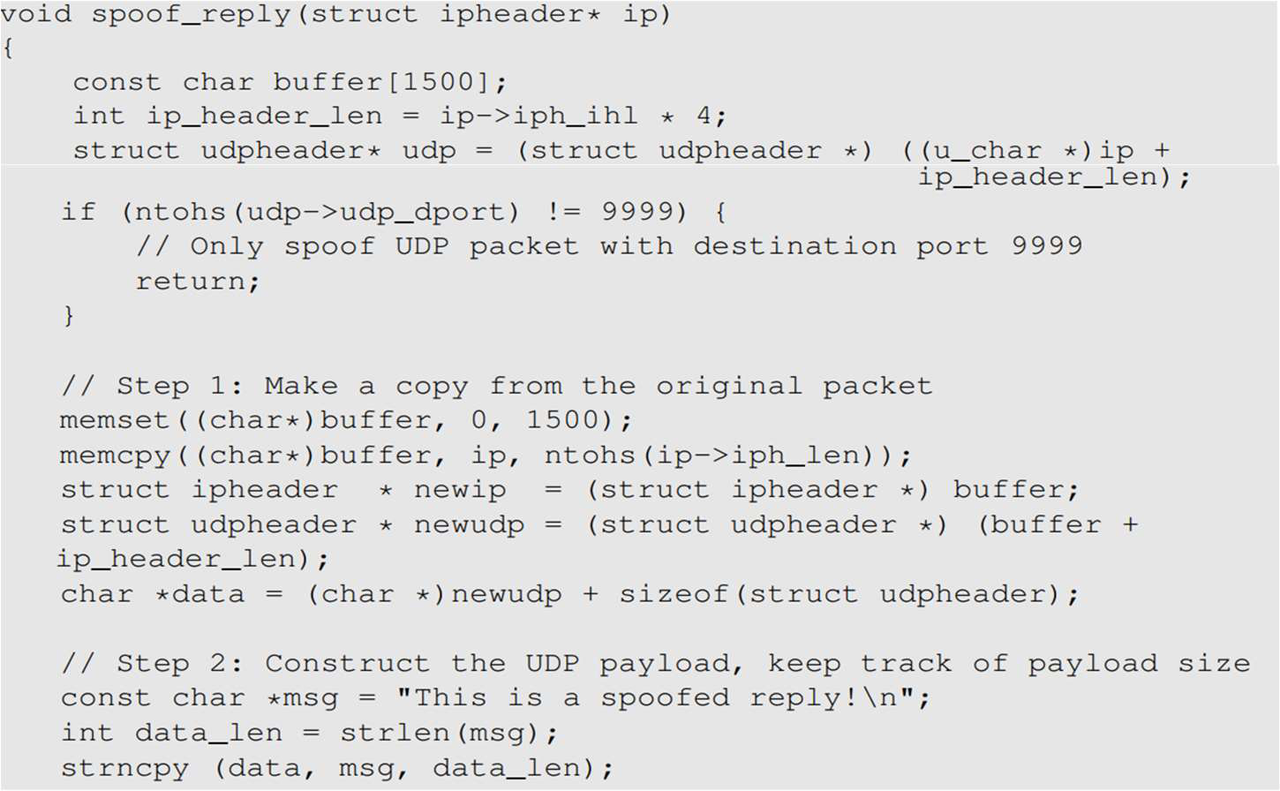
In the C function shown for spoofing UDP packets, after confirming the packet's destination port is 9999, what are the two main steps performed to create the spoofed reply?
- Make a zeroed copy of the original packet into a local buffer and set newip/newudp pointers
- Construct the UDP payload by copying the spoofed message into the packet data area
 networking spoofing udp c
 -
Which UDP header fields are set when constructing the spoofed UDP packet in the code snippet?
- udp_sport set to the original packet's destination port
- udp_dport set to the original packet's source port
- udp_ulen set to htons(sizeof(struct udpheader) + data_len)
- udp_sum set to 0
networking spoofing udp -
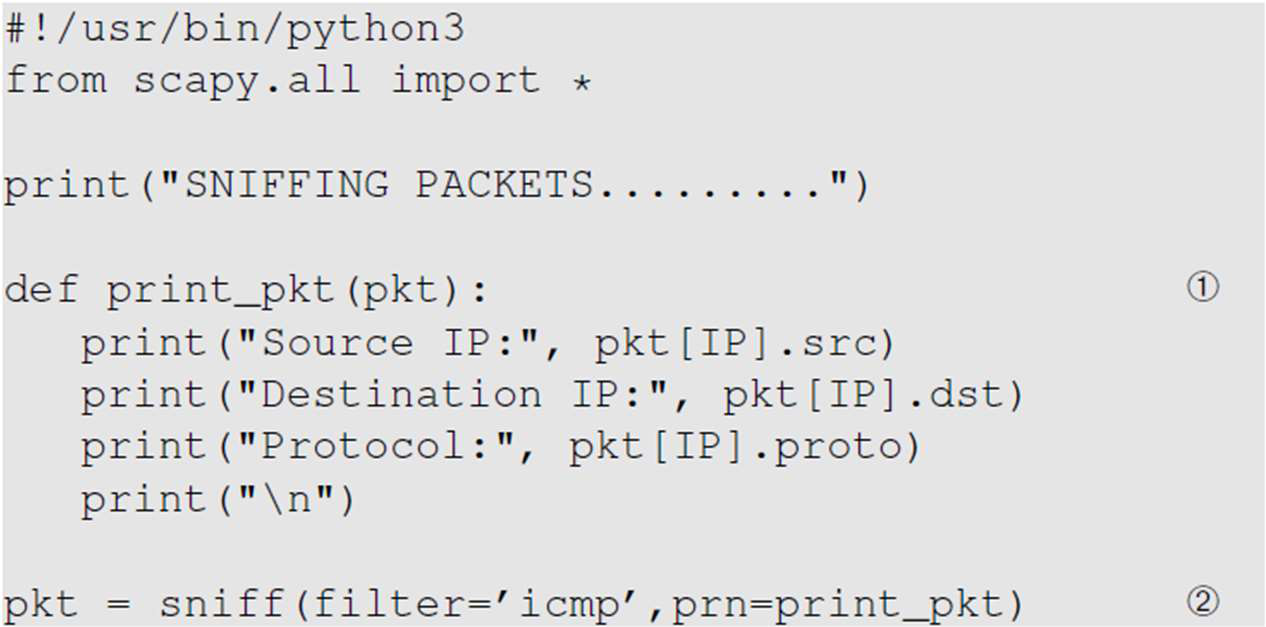
In the Scapy script shown, which packet fields are printed for each captured ICMP packet?
- Source IP
- Destination IP
- Protocol
 scapy sniffing icmp
 -
In the ICMP example using Scapy, which protocol layers are combined to create the spoofed packet?
- IP layer (with spoofed src and dst addresses)
- ICMP layer
networking scapy spoofing -
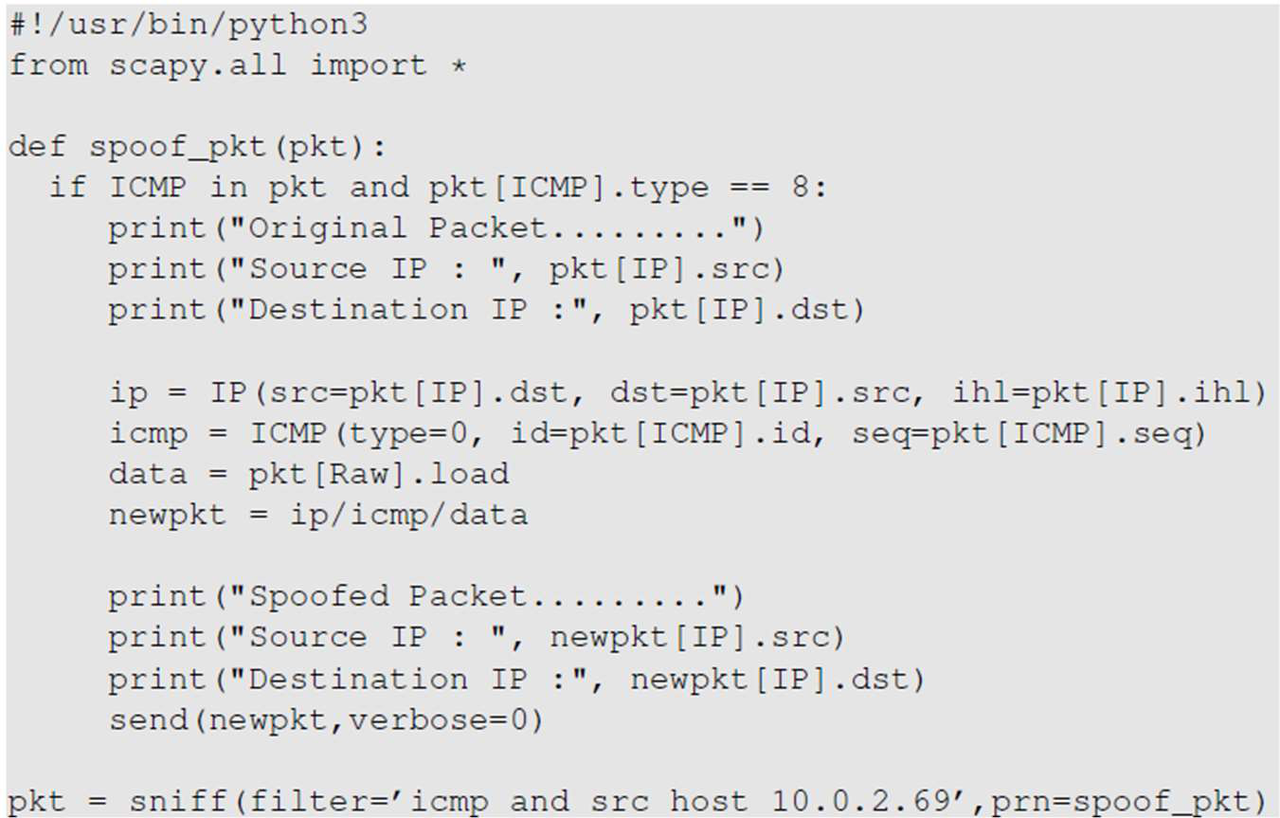
In a Scapy "sniff-then-spoof" workflow for ICMP shown in the snippet, what high-level packet modifications convert an ICMP echo request into a spoofed echo reply?
- Swap the IP source and destination
- Set ICMP type to 0 (reply)
- Preserve ICMP id and seq
- Reuse the original Raw payload
- Send the newly constructed packet
 scapy icmp spoofing sniffing
 -
What are the high-level trade-offs between using Scapy (Python) and C raw sockets for packet spoofing, and what does a hybrid approach combine?
- Scapy (Python): constructing packets is very simple; much slower than C
- C raw sockets: much faster; constructing packets is complicated
- Hybrid: use Scapy to construct packets and C to modify/send them
networking spoofing scapy c hybrid -
What is endianness and how do Little Endian and Big Endian differ in byte order?
- Endianness is the order in which a multi-byte data item is stored in memory.
- Little Endian stores the least significant byte at the lowest memory address (small end first).
- Big Endian stores the most significant byte at the lowest memory address (big end first).
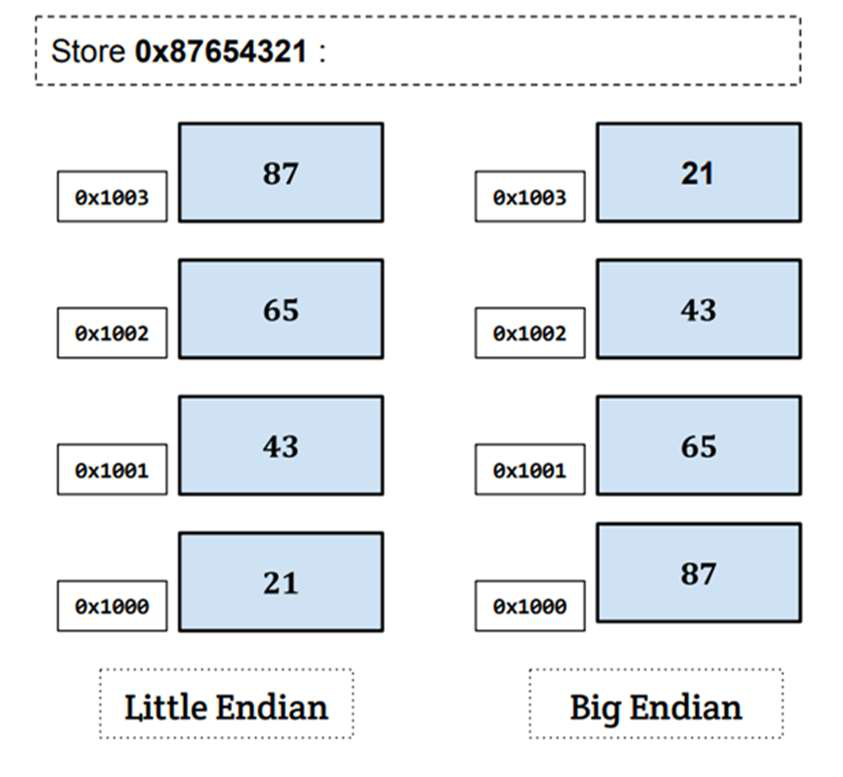 endianness networking
 -
What is 'network byte order' and which macros perform host↔network conversions?
- 'Network byte order' = big-endian
- 'htons()' and 'htonl()': convert host → network
- 'ntohs()' and 'ntohl()': convert network → host
 endianness networking
 -
Name three methods/tools mentioned for packet sniffing and spoofing.
- Raw sockets
- PCAP APIs
- Scapy (or a C/Scapy hybrid)
networking sniffing spoofing
Overview
- Topic: packet sniffing (capturing) and packet spoofing (forging) on IP networks.
- Focus: how packets are received, capture techniques (raw sockets, BPF/pcap), constructing spoofed packets (ICMP/UDP), and practical tools (Scapy, C raw sockets).
How packets are received (conceptual)
- Network Interface Card (NIC) receives frames from the physical medium and uses a MAC address to determine intended destination.
- Normally the NIC discards frames not addressed to its MAC; in promiscuous mode the NIC forwards every frame to the kernel.
- The kernel places received frames into a ring buffer and passes them up the protocol stack into sockets or user-space programs.
Alt: Diagram of link-level driver, ring buffer, kernel and user space.
Promiscuous / Monitor modes
- Promiscuous mode (wired): NIC forwards all frames to kernel regardless of destination MAC, enabling full-wire capture.
- Monitor mode (wireless): Wi‑Fi cards can capture 802.11 frames on a single channel; you may miss traffic on other channels.
- Enabling these modes typically requires elevated privileges (root).
Capturing efficiently: BPF and pcap
- Giving every packet to a sniffer is expensive; better to filter early in kernel.
- BSD Packet Filter (BPF) attaches a filter to the socket so kernel discards unwanted packets (e.g., allow only port 22).
Alt: BPF flow: buffers, filters, kernel, user space.
- pcap library (libpcap/WinPcap) provides a portable API for packet capture and filter compilation into BPF bytecode.
- Typical pcap flow: open live device, compile filter expression (e.g.,
"ip proto icmp"), set filter, then loop to receive packets.
Alt: pcap_open_live, pcap_compile, pcap_loop example.
Low-level capture: raw sockets
- A raw socket receives entire link/IP packets and can be used to implement sniffers and custom senders.
- Example steps: create raw socket (e.g.,
socket(AF_PACKET, SOCK_RAW, htons(ETH_P_ALL))), enable promiscuous membership,recvfrom()loop. - Limitations: non-portable across OSes and less convenient than pcap for filters and portability.
Alt: Raw socket creation and enabling promiscuous mode.
Basic sniffing examples
- UDP server style: use a normal UDP socket and
recvfrom()to see traffic directed to your host. - Raw sniffer style: use raw sockets or pcap to capture arbitrary traffic (requires root).
- Common tools built on pcap: tcpdump, Wireshark, and custom C programs.
Packet spoofing (concept)
- Packet spoofing: forging critical header fields (source IP, ports, TTL, etc.) to create crafted packets that the receiver treats as legitimate.
- Two main approaches:
- Use regular sockets to send packets (OS sets header fields — limited control).
- Use raw sockets or packet libraries to build full packets (you set IP/ICMP/UDP headers and payload).
- Root privileges are required to send forged packets.
Building spoofed packets in C (raw sockets) — key steps
- Allocate a buffer large enough for IP header + transport header + payload.
- Fill in transport header (e.g., ICMP: set type, code, compute checksum).
- Fill in IP header fields explicitly (version, IHL, TTL, protocol, source/dest addresses, total length).
- Compute any required checksums (ICMP/UDP pseudo-header checksums if needed).
-
Send using a raw IP send function or raw socket.
-
Example highlights: set
ip->iph_sourceip.s_addr = inet_addr("1.2.3.4")to spoof the source IP; seticmp->icmp_type = 8for echo request. - Constructing UDP spoofed packets is similar but includes a payload and UDP checksum handling.
Alt: C code filling ICMP header and checksum.
Alt: C code filling IP header fields (version, ttl, src/dst, protocol).
Sniff-then-spoof workflow
- Common attack/automation pattern:
- Capture an incoming packet of interest using pcap or Scapy.
- Copy relevant headers and payload metadata.
- Swap source/destination fields and replace or modify payload.
- Recompute checksums and send the forged reply.
- You can implement this in C (fast) or Python+Scapy (easy to write). A hybrid approach uses Scapy to craft and C to send at high speed.
C (example) — main points
- Copy the original IP packet into a local buffer, locate the UDP header via
ip->iph_ihl * 4, replace data and swap ports, update lengths, then send via raw send function.
Scapy (Python) — main points
- Scapy builds and sends packets with minimal code:
ip = IP(src="1.2.3.4", dst="dst");pkt = ip/UDP(sport=8888,dport=9090)/"data";send(pkt). - Scapy can also sniff (
sniff(filter='icmp',prn=func)) and reply interactively by constructing new packets from captured ones.
Alt: Python/Scapy snippet for sniffing ICMP packets.
Tools comparison
- Scapy (Python): very simple packet construction and sniffing; slower at high rates.
- C + raw sockets: high performance and fine-grained control; code is more complex and error-prone.
- Hybrid: use Scapy to prototype packet format, then implement high-speed sender in C.
Endianness and network byte order
- Endianness: order of bytes in multi-byte values — little-endian (LSB first) vs big-endian (MSB first).
- Network byte order: agreed convention for network communication = big-endian.
- Convert between host and network order using macros:
htons()/htonl()— host to network (short / long)ntohs()/ntohl()— network to host
Alt: Little Endian vs Big Endian byte ordering diagram.
Practical notes and defenses
- Root required: capturing all traffic or forging packets typically requires root privileges; be careful and legal.
- Use of filters: always compile and set BPF filters to limit capture volume (improves performance).
- Defenses against spoofing/abuse: ingress/egress filtering, reverse path forwarding (RPF), strong authentication at the application layer (TLS), and firewalls that check packet semantics.
- Wireless caveat: monitor mode captures only one channel at a time; you may miss cross-channel traffic.
Quick checklist for implementing a sniffer/spoofer
- Choose capture method: pcap (portable) or raw socket (low-level).
- Enable promiscuous/monitor mode if needed (requires root).
- Apply BPF filters early to reduce load.
- For spoofing, build full packet (IP + transport + payload) and recompute checksums.
- Test in an isolated lab; ensure legal authorization.
One-line summary
- Packet sniffing captures network traffic (pcap/BPF/raw sockets); spoofing forges packet headers (ICMP/UDP) by building raw packets or using Scapy.