Sign up to unlock more features
- Save this deck to your account
- Study flashcards with spaced repetition
- Export to Anki (.apkg) or PDF
- Process documents up to 100 pages
- Images extracted from PDFs and documents
- Better text extraction from your PDFs and documents
- Better flashcards with our more advanced AI model
What is the purpose of Election Algorithms in distributed systems?
How does the Bully Algorithm work?
What is a key assumption used by the Bully Algorithm?
The Bully Algorithm consists of these steps: 1. Process P notices the coordinator is dead. 2. P sends an ELECTION message to processes with IDs higher than _______. 3. If no one responds, P wins and sends a _______ message. 4. If a higher process responds, it takes over the election and P _______.
The Ring Algorithm is another election method where processes are arranged in a _______ and messages are passed around to elect a coordinator.
Compare the Bully Algorithm and the Ring Algorithm.
What is the concept of the Ring Algorithm?
What initiates the election in the Ring Algorithm?
How does each process contribute in the ring algorithm?
What happens when the election message returns to the initiator?
What is the topology of the Ring Algorithm?
Tree
Logical Ring
Star
Fully Connected
How does the traffic of the Ring Algorithm compare to the Bully Algorithm?
Exponential (O(2^N) messages)
Linear (O(N) messages)
Constant (O(1) messages)
High (O(N^2) messages)
Which algorithm has faster convergence?
Both
Neither
Bully Algorithm
Ring Algorithm
What is one drawback of the Ring Algorithm?
Explain clock synchronization in distributed systems.
What are Lamport's Logical Clocks used for?
What is the Berkeley Algorithm in the context of clock synchronization?
The Ring Algorithm processes are arranged in a logical _______. Election messages are passed around the _______.
In the Ring Algorithm, the process with the highest ID becomes the _______.
The traffic in the Ring Algorithm is _______ compared to the Bully Algorithm's high traffic.
The Berkeley Algorithm helps to average time from clocks to synchronize systematically through clock synchronization.
Lamport's Logical Clocks provide a way to order events in distributed systems without relying on _______.
In the Bully Algorithm, election messages can lead to high traffic of O(N^2), while the Ring algorithm has linear traffic of O(N).
What is the primary need for synchronization in a distributed system?
What does Lamport's Logical Clocks algorithm prioritize over absolute time?
What is maintained by each process in Lamport's Logical Clocks?
What happens when a process sends a message in Lamport's Logical Clocks?
How does the receiver update its clock in Lamport's Logical Clocks?
What type of algorithm is the Berkeley Algorithm?
What is the first step in the Berkeley Algorithm?
How does the Master calculate the new time in the Berkeley Algorithm?
What does the Master tell slaves to adjust in the Berkeley Algorithm?
What does the Master never do in the Berkeley Algorithm?
In a distributed system, synchronization is essential for ordering events like _______.
Lamport's Logical Clocks focus on the _______ rather than absolute time.
Each process in Lamport's Logical Clocks maintains a counter C and increments it _______ every event.
In Lamport's Logical Clocks, a process attaches its counter C to messages when _______ them.
The receiver updates its clock to _______ in Lamport's Logical Clocks.
The Berkeley Algorithm is an _______ algorithm for syncing physical clocks.
The first step of the Berkeley Algorithm is that the Master polls all _______ for their time.
The Master calculates the average time by ignoring _______ in the Berkeley Algorithm.
The Master directs slaves to adjust their clocks to _______ or _______ in the Berkeley Algorithm.
What does RPC stand for?
What is the role of the Client Stub in RPC?
What does the Server Stub do in RPC?
Describe the first step in the RPC process.
What happens during marshalling in RPC?
What is the final step in the RPC sequence?
RPC allows a program to call a procedure on a _______ machine as if it were a _______ function call.
The sequence in RPC starts with the client calling the _______, which later leads to _______ handling the request.
Which of the following is NOT a responsibility of the Client Stub?
Packing parameters into a message
Receiving messages from the server
Calling the server procedure
Unpacking parameters
What does the Server Stub handle in the RPC process?
Packing parameters into a message
Unpacking parameters and calling the server procedure
Computing average time
Sending messages to the client
Which diagram represents the Time Daemon in a distributed system?
Flashcards in this deck (53)
-
What is the purpose of Election Algorithms in distributed systems?
To elect a new coordinator when the current one fails.
distributed_systems algorithms -
distributed_systems bully_algorithm
-
What is a key assumption used by the Bully Algorithm?
Every process knows the ID of every other process.
distributed_systems assumptions -
The Bully Algorithm consists of these steps: 1. Process P notices the coordinator is dead. 2. P sends an ELECTION message to processes with IDs higher than its own. 3. If no one responds, P wins and sends a COORDINATOR message. 4. If a higher process responds, it takes over the election and P waits.
distributed_systems bully_algorithm steps -
The Ring Algorithm is another election method where processes are arranged in a logical ring and messages are passed around to elect a coordinator.
distributed_systems ring_algorithm -
Compare the Bully Algorithm and the Ring Algorithm.
- Bully Algorithm: Highest ID wins.
- Ring Algorithm: Works in a logical ring structure.
distributed_systems comparison bully ring -
What is the concept of the Ring Algorithm?
Processes are arranged in a logical ring and election messages are passed around the ring.
distributed_systems algorithms -
What initiates the election in the Ring Algorithm?
A process detects failure, creates an ELECTION message, and sends it to its neighbor.
distributed_systems election -
How does each process contribute in the ring algorithm?
Each process adds its own ID to the message and passes it on.
distributed_systems algorithms -
What happens when the election message returns to the initiator?
The list of IDs is circulated, and the process with the highest ID becomes the coordinator.
distributed_systems election -
distributed_systems topology
-
How does the traffic of the Ring Algorithm compare to the Bully Algorithm?
Exponential (O(2^N) messages)
High (O(N^2) messages)
Linear (O(N) messages)
Constant (O(1) messages)
distributed_systems traffic -
distributed_systems convergence
-
distributed_systems complexity
-
Explain clock synchronization in distributed systems.
It ensures all processes have a consistent view of time across the network.
distributed_systems synchronization -
What are Lamport's Logical Clocks used for?
They are used to order events in a distributed system without synchronized clocks.
distributed_systems clock -
What is the Berkeley Algorithm in the context of clock synchronization?
It averages time from several clocks to synchronize processes in a distributed system.
distributed_systems clock -
The Ring Algorithm processes are arranged in a logical ring. Election messages are passed around the ring.
distributed_systems algorithms -
distributed_systems election
-
distributed_systems traffic
-
The Berkeley Algorithm helps to average time from clocks to synchronize systematically through clock synchronization.
distributed_systems synchronization -
Lamport's Logical Clocks provide a way to order events in distributed systems without relying on synchronized clocks.
distributed_systems clock -
In the Bully Algorithm, election messages can lead to high traffic of O(N^2), while the Ring algorithm has linear traffic of O(N).
distributed_systems traffic -
What is the primary need for synchronization in a distributed system?
To order events, such as banking transactions, due to the lack of a global clock.
synchronization distributed_systems -
What does Lamport's Logical Clocks algorithm prioritize over absolute time?
The order of events, specifically the happens-before relationship.
lamport logical_clocks -
What is maintained by each process in Lamport's Logical Clocks?
A counter C that is incremented before every event.
lamport clock -
What happens when a process sends a message in Lamport's Logical Clocks?
It attaches its counter C to the message.
lamport communication -
How does the receiver update its clock in Lamport's Logical Clocks?
By setting C_receiver to max(C_receiver, C_message) + 1.
lamport clock -
What type of algorithm is the Berkeley Algorithm?
An Active Time Server algorithm for physical clock synchronization.
berkeley synchronization -
What is the first step in the Berkeley Algorithm?
The Time Daemon (Master) polls all Slaves for their time.
berkeley algorithm -
How does the Master calculate the new time in the Berkeley Algorithm?
By averaging the time reported by slaves, ignoring extreme outliers.
berkeley calculation -
What does the Master tell slaves to adjust in the Berkeley Algorithm?
By how much to speed up or slow down their clocks.
berkeley adjustment -
berkeley synchronization
-
In a distributed system, synchronization is essential for ordering events like banking transactions.
synchronization distributed_systems -
lamport logical_clocks
-
Each process in Lamport's Logical Clocks maintains a counter C and increments it before every event.
lamport clock -
lamport communication
-
lamport clock
-
berkeley synchronization
-
berkeley algorithm
-
berkeley calculation
-
The Master directs slaves to adjust their clocks to speed up or slow down in the Berkeley Algorithm.
berkeley adjustment -
communication rpc
-
communication rpc
-
What does the Server Stub do in RPC?
It unpacks parameters from the message and calls the actual server procedure.
communication rpc -
communication rpc
-
communication rpc
-
communication rpc
-
communication rpc
-
The sequence in RPC starts with the client calling the Client Stub, which later leads to Server Stub handling the request.
communication rpc -
Which of the following is NOT a responsibility of the Client Stub?
Calling the server procedure
Unpacking parameters
Receiving messages from the server
Packing parameters into a message
communication rpc -
What does the Server Stub handle in the RPC process?
Unpacking parameters and calling the server procedure
Sending messages to the client
Packing parameters into a message
Computing average time
communication rpc -
communication middleware
Comprehensive Distributed Systems Exam Preparation Guide
Distributed Systems (Elective-III)
Exam Strategy
- Focus on algorithms (step-by-step), architecture diagrams, comparisons, and bullet points.
SECTION 1: ALGORITHMS & SYNCHRONIZATION
Election Algorithms
Election algorithms are necessary for selecting a coordinator in distributed systems when the current one fails.
Bully Algorithm
- Concept: The highest ID process bullies others to become the coordinator.
- Assumptions: All processes know each other's IDs.
- Steps:
- A process detects a dead coordinator and sends an ELECTION message to higher ID processes.
- If there are no responses, it becomes the coordinator.
- If a higher process responds, it takes over the election.
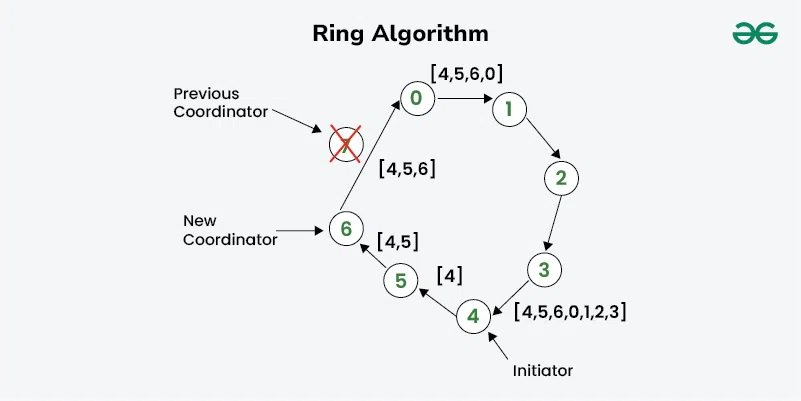
Ring Algorithm
- Concept: Processes are organized in a logical ring, passing election messages around.
- Steps:
- A process creates an ELECTION message and sends it to its neighbor.
- Each process adds its ID to the message and forwards it.
- The original sender updates its clock upon receiving the message back, determining the coordinator from the highest ID.
Comparison: Bully vs. Ring
| Feature | Bully Algorithm | Ring Algorithm |
|---|---|---|
| Topology | Fully Connected (assumed) | Logical Ring |
| Traffic | High (O(N²) worst case) | Linear (O(N)) |
| Speed | Faster convergence | Slower (sequential) |
| Complexity | Simple logic | Requires maintenance |
SECTION 2: COMMUNICATION & MIDDLEWARE
Clock Synchronization
Need for Synchronization
Distributed systems lack a global clock, requiring synchronization to order events like transactions.
Lamport's Logical Clocks
- Concept: Agreement on the order of events is essential.
- Algorithm:
- Each process maintains a counter, C.
- Increment C before events; attach C when sending messages.
- On receiving a message, update C as: \(C_{receiver} = max(C_{receiver}, C_{message}) + 1\).
Berkeley Algorithm
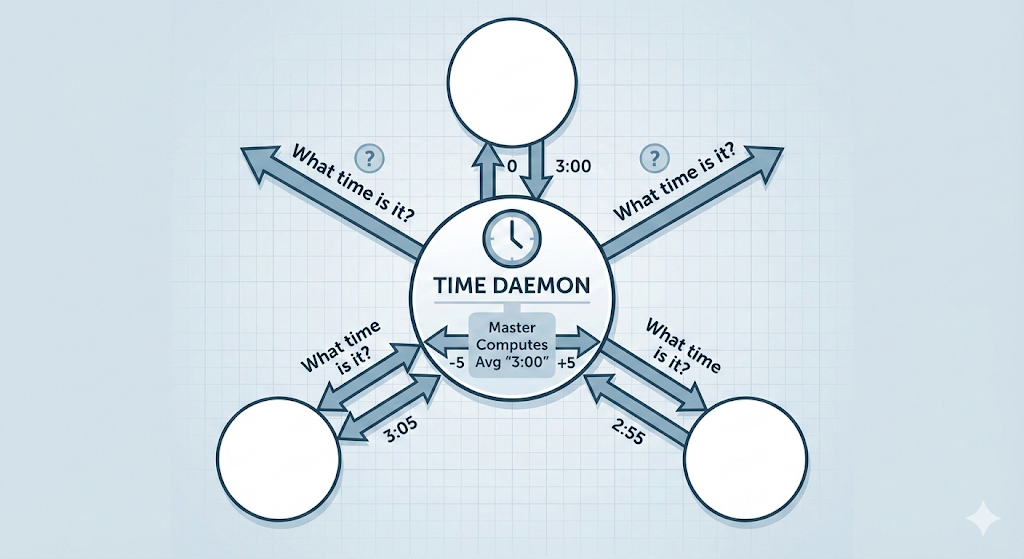
- Type: Active Time Server algorithm.
- Steps:
- The Time Daemon polls slave machines for their time.
- Slaves send their time or differences to the Master.
- The Master computes average time (ignoring outliers) and adjusts clocks of slaves.
Remote Procedure Call (RPC)
- Definition: Allows a procedure on a remote machine to be called as if local, simplifying network communication.
- Components:
- Client Stub: Packs parameters into a message to send.
- Server Stub: Unpacks the message and invokes the server procedure.
- Sequence of Events:
- Client calls Client Stub.
- Client Stub marshals parameters.
- OS sends the message to the server.
- Server Stub receives and unpacks the message.