Sign up to unlock more features
- Save this deck to your account
- Study flashcards with spaced repetition
- Export to Anki (.apkg) or PDF
- Process documents up to 100 pages
- Images extracted from PDFs and documents
- Better text extraction from your PDFs and documents
- Better flashcards with our more advanced AI model
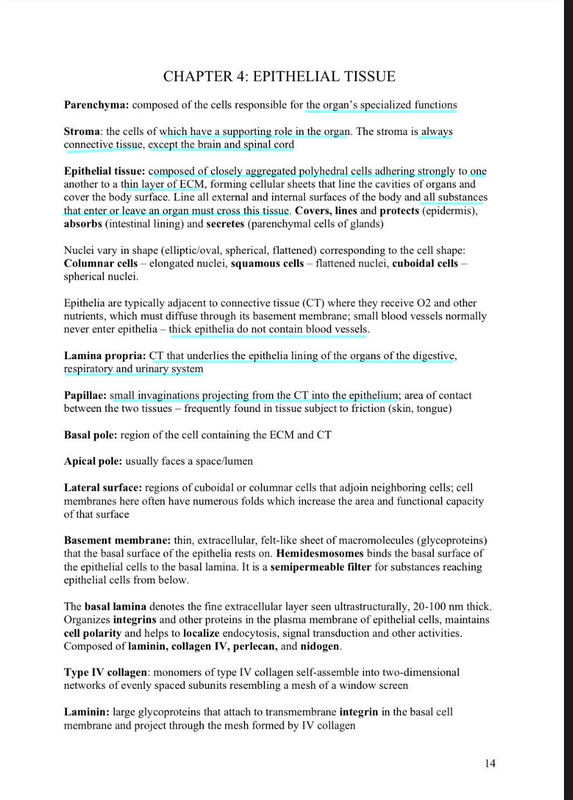 Which tissue is the focus of this chapter page image?
Epithelial tissue
Connective tissue
Muscle tissue
Nervous tissue
What is 'parenchyma'?
What is 'stroma'?
Define 'epithelial tissue' in brief.
What are main functions of epithelial tissue?
What is the nucleus shape in columnar cells?
What is the nucleus shape in squamous cells?
What is the nucleus shape in cuboidal cells?
How do epithelia receive O2 and nutrients?
What is the 'lamina propria'?
What are 'papillae' in epithelial tissues?
What is the 'basal pole' of an epithelial cell?
What is the 'apical pole' of an epithelial cell?
What is the 'lateral surface' of cuboidal/columnar epithelial cells?
What is the 'basement membrane'?
What is the role of hemidesmosomes?
What is the 'basal lamina' and its ultrastructural thickness?
List key functions of the basal lamina.
What are the main molecular components of the basal lamina?
How does type IV collagen assemble in the basal lamina?
What is laminin's role in the basal lamina?
What is the function of nidogen and perlecan in the basal lamina?
What does the reticular lamina contain and how is it bound to the basal lamina?
What is the primary function of tight (occluding) junctions?
Which transmembrane proteins and cytoskeletal component are associated with tight junctions?
What is the role of adherent (anchoring) junctions (zonulae adherens)?
Which proteins and cytoskeleton link adherens junctions?
What are gap junctions and what are they made of?
What are desmosomes (macula adherens) attached to inside the cell?
What do hemidesmosomes do and which proteins/cytoskeleton do they use?
How do focal adhesions differ from hemidesmosomes?
Describe the structure and function of microvilli.
What are stereocilia and how do they differ from microvilli?
What are cilia and how long are they?
What is a primary cilium and its function?
Where are motile cilia found and what is their role?
What is the typical microtubule arrangement in a motile cilium axoneme?
9+2 (nine peripheral doublets + two central microtubules)
9+0
6+2
3+0
What structural components maintain axoneme integrity?
How are covering/lining epithelia classified by layers?
What is keratinization in stratified squamous epithelium?
Where is stratified squamous keratinized epithelium found and its function?
What are squames?
Where is stratified squamous non-keratinized epithelium found and how do surface cells differ?
What is the role of simple squamous epithelium?
Flashcards in this deck (44)
-
Which tissue is the focus of this chapter page image?
Connective tissue
Nervous tissue
Epithelial tissue
Muscle tissue
epithelium overview -
parenchyma histology
-
stroma histology
-
Define 'epithelial tissue' in brief.
- Closely aggregated polyhedral cells forming cellular sheets that line cavities and cover body surfaces
epithelium definition -
What are main functions of epithelial tissue?
- Cover/protect (epidermis)
- Absorb (intestinal lining)
- Secrete (gland parenchymal cells)
epithelium functions -
cellshape nucleus
-
cellshape nucleus
-
cellshape nucleus
-
How do epithelia receive O2 and nutrients?
- By diffusion from adjacent connective tissue across the basement membrane; epithelia are avascular
vascularity epithelium -
What is the 'lamina propria'?
- Connective tissue underlying epithelia of digestive, respiratory and urinary organs
laminapropria connective -
What are 'papillae' in epithelial tissues?
- Small invaginations of CT projecting into epithelium; increase contact area, common where friction occurs
papillae epithelium -
What is the 'basal pole' of an epithelial cell?
- The region of the cell adjacent to the ECM and connective tissue
polarity basal -
What is the 'apical pole' of an epithelial cell?
- The region of the cell that usually faces a space or lumen
polarity apical -
What is the 'lateral surface' of cuboidal/columnar epithelial cells?
- Surfaces adjoining neighboring cells; often folded to increase area and function
lateral epithelium -
What is the 'basement membrane'?
- A thin extracellular felt-like sheet on which the basal surface of epithelia rests; acts as a semipermeable filter
basementmembrane ecm -
hemidesmosome adhesion
-
What is the 'basal lamina' and its ultrastructural thickness?
- Fine extracellular layer seen ultrastructurally; 20–100 nm thick
basallamina ultrastructure -
List key functions of the basal lamina.
- Organizes integrins and membrane proteins
- Maintains cell polarity
- Helps localize endocytosis and signal transduction
basallamina functions -
components basallamina
-
How does type IV collagen assemble in the basal lamina?
- Monomers self-assemble into two-dimensional networks of evenly spaced subunits resembling a mesh
collagen typeiv -
What is laminin's role in the basal lamina?
- Large glycoproteins that attach to transmembrane integrins and project through the type IV collagen mesh
laminin ecm -
What is the function of nidogen and perlecan in the basal lamina?
- Cross-link laminins to type IV collagen networks
- Provide the 3-D structure of the basal lamina
extracellularmatrix basal-lamina -
What does the reticular lamina contain and how is it bound to the basal lamina?
- Contains type III collagen
- Bound to the basal lamina by type VII collagen anchoring fibrils
- Both produced by fibroblasts
extracellularmatrix reticular-lamina -
What is the primary function of tight (occluding) junctions?
- Form a seal at the apical end preventing paracellular flow
- Force molecules crossing an epithelium to use the transcellular path
celljunctions tightjunctions -
Which transmembrane proteins and cytoskeletal component are associated with tight junctions?
- Transmembrane: occludins, claudins, ZO proteins
- Cytoskeleton: actin filaments
celljunctions tightjunctions -
What is the role of adherent (anchoring) junctions (zonulae adherens)?
- Provide strong cell adhesion
- Stabilize and strengthen occluding bands and help hold cells together
celljunctions adherens -
Which proteins and cytoskeleton link adherens junctions?
- Transmembrane: E-cadherin and catenin complexes
- Cytoskeleton: actin filaments
celljunctions adherens -
What are gap junctions and what are they made of?
- Patches of channels for intercellular communication
- Made of connexons (hexamers of connexins)
- Provide little mechanical strength; no cytoskeletal attachment
celljunctions gapjunctions -
What are desmosomes (macula adherens) attached to inside the cell?
- Bound to intermediate filaments (keratins) forming very strong spot attachments
- Transmembrane proteins: desmogleins and desmocollin (cadherin family)
celljunctions desmosomes -
What do hemidesmosomes do and which proteins/cytoskeleton do they use?
- Bind epithelial cells to the underlying basal lamina
- Transmembrane: integrins
- Cytoskeleton: intermediate filaments
celljunctions hemidesmosomes -
How do focal adhesions differ from hemidesmosomes?
- Found in migrating/reorganizing cells; smaller and more numerous
- Integrins link directly to bundled actin filaments (not intermediate filaments)
celljunctions focaladhesion -
Describe the structure and function of microvilli.
- Actin-supported apical projections specialized for absorption
- ~1 μm long, ~0.1 μm wide; can increase surface area 20–30×
- Intestinal brush border: dense microvilli with a thick glycocalyx of enzymes
microvilli epithelium -
What are stereocilia and how do they differ from microvilli?
- Long, less motile apical processes on absorptive epithelia (male reproductive tract) and inner ear sensory cells
- Much longer, may branch distally, and are less motile than microvilli
stereocilia epithelium -
What are cilia and how long are they?
- Long apical projections (5-10 μm)
- Highly motile, larger than microvilli
- Contain microtubules, not microfilaments
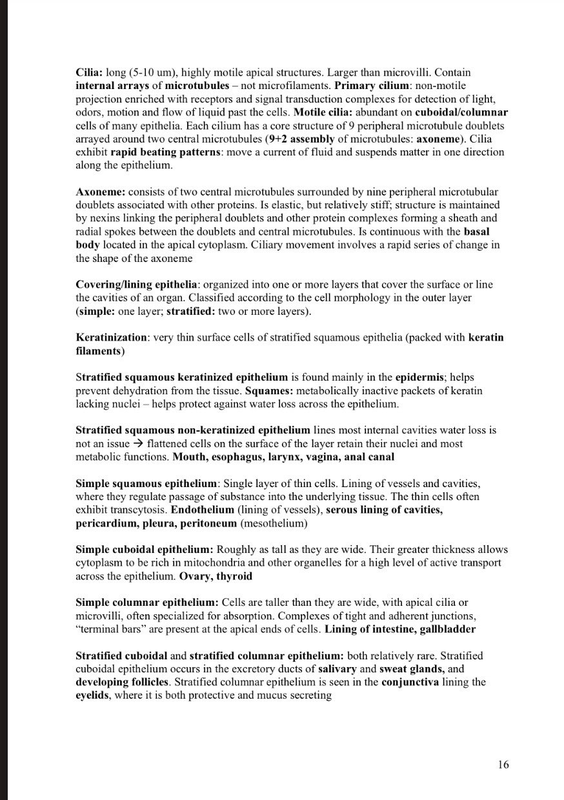 cilia cellbiology
 -
What is a primary cilium and its function?
- Non-motile apical projection
- Enriched with receptors and signal transduction complexes
- Detects light, odors, motion and fluid flow past the cell
cilia sensory -
Where are motile cilia found and what is their role?
- Abundant on cuboidal/columnar epithelial cells
- Beat rapidly to move a current of fluid and suspend matter along the epithelium
cilia epithelium -
What is the typical microtubule arrangement in a motile cilium axoneme?
6+2
9+0
3+0
9+2 (nine peripheral doublets + two central microtubules)
axoneme microtubules -
What structural components maintain axoneme integrity?
- Nexins linking peripheral doublets
- Radial spokes and sheath protein complexes
- Axoneme continuous with basal body in apical cytoplasm
axoneme structure -
How are covering/lining epithelia classified by layers?
- Simple: one cell layer
- Stratified: two or more layers
epithelium classification -
What is keratinization in stratified squamous epithelium?
- Surface cells packed with keratin filaments
- Very thin surface cells that form a protective, often anucleate layer
keratinization epithelium -
Where is stratified squamous keratinized epithelium found and its function?
- Mainly in the epidermis
- Helps prevent dehydration of underlying tissue
epidermis protection -
What are squames?
- Metabolically inactive packets of keratin lacking nuclei
- Contribute to barrier against water loss across the epithelium
squames keratin -
Where is stratified squamous non-keratinized epithelium found and how do surface cells differ?
- Lines mouth, esophagus, larynx, vagina, anal canal
- Surface cells retain nuclei and most metabolic functions
nonkeratinized epithelium -
What is the role of simple squamous epithelium?
- Single layer of thin cells lining vessels and cavities
- Regulates passage of substances into underlying tissue; often exhibits transcytosis (endothelium)
simple endothelium