Sign up to unlock more features
- Save this deck to your account
- Study flashcards with spaced repetition
- Export to Anki (.apkg) or PDF
- Process documents up to 100 pages
- Images extracted from PDFs and documents
- Better text extraction from your PDFs and documents
- Better flashcards with our more advanced AI model
 This section is labeled the _______ difficulty level, described as a great place to begin for building confidence and spotting patterns.
A single asterisk () next to a word indicates _______; a double asterisk (*) indicates _______.
An _______ is defined in the text as _______.
The word _______ is described as "sunk to or existing in _______."
The entry for _______ states it means _______.
_______ is defined in the text as _______.
The adjective _______ is described as "marked by a _______."
The adjective _______ is defined as "of _______."
The term _______ is given the brief definition _______.
The word 'celestial' means _______
To 'commandeer' is _______
A 'cliché' is _______
'Contrite' means _______
'Composite' is _______
'Drivel' means _______
The word "elusive" is defined as _______
The verb "enervate" is defined as _______
Each year over _______ students join the spelling bee.
If you reach the Scripps National Spelling Bee's National Competition, you'll be one of the top _______ of spellers — _______.
Beginner One Bee word list (part 1): - _______ - _______ - _______ - _______ - _______
Beginner One Bee word list (part 2): - _______ - _______ - _______ - _______ - _______
Beginner One Bee word list (part 3): - _______ - _______ - _______ - _______ - _______
The adverb _______ means _______
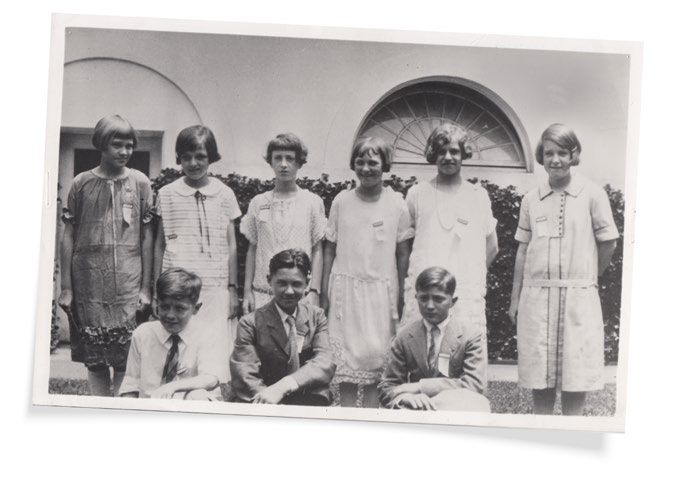
Answer-side image (contest group photo):
Flashcards in this deck (23)
-
This section is labeled the "one bee" difficulty level, described as a great place to begin for building confidence and spotting patterns.difficulty
-
A single asterisk () next to a word indicates a primarily British spelling; a double asterisk (*) indicates the spelling that is more widely used.
spelling notation -
vocabulary accolade
-
vocabulary abject
-
vocabulary adjacent
-
vocabulary atrophy
-
vocabulary baleful
-
The adjective august is defined as "of majestic dignity or grandeur: marked by stateliness or magnificence."
vocabulary august -
vocabulary cadence
-
vocabulary celestial definitions
-
vocabulary commandeer definitions
-
vocabulary cliché definitions
-
vocabulary contrite definitions
-
vocabulary composite definitions
-
vocabulary drivel definitions
-
vocabulary elusive
-
vocabulary enervate
-
statistics spellingbee
-
If you reach the Scripps National Spelling Bee's National Competition, you'll be one of the top \(0.00002\%\) of spellers — like being one in a million.
statistics spellingbee -
spelling onebee vocab
-
spelling onebee vocab
-
spelling onebee vocab
-
The adverb fervently means in a manner marked by often deep intensity of feeling or expression.
Answer-side image (contest group photo):
vocab definition onebee
Overview
This document is a beginner-level ("One Bee") spelling list from the Scripps National Spelling Bee study book, arranged alphabetically and intended to build confidence with common spelling patterns.
How the list is organized
- Difficulty level: "One Bee" (beginner).
- Alphabetical order: words arranged A–Z across parts.
- Spelling flags: single asterisk () = primarily British spelling; double asterisk (*) = more widely used form.
- Notes & stories: some words link to short etymology or story pages (e.g., pages 56, 85, 86).
Quick-study strategy (how to use this list)
- Learn in small groups (10–20 words) and quiz aloud to practice pronunciation and spelling recall.
- Focus on patterns (prefixes, suffixes, roots) rather than memorizing single words.
- Study variants: memorize the preferred form for contests but recognize British/American alternatives.
- Use active recall: cover the word, spell it aloud, then check; repeat after 24–48 hours.
- Use the book's story pages (where indicated) to create mnemonic hooks for tricky words.
Key spelling patterns & sample words
- Prefixes & roots: ab-, ad-, ac-, an-, anti-, con-, de-, en-, trans- (examples: abashed, adjacent, accolade, anthropology, antiseptic, conserve).
- Common suffixes: -tion, -able/-ible, -ence/-ance, -ive (examples: acceptance, applicable, applause, apprehensive).
- Double letters & consonant clusters: accommodate-style doubles; committee‑style patterns (watch for repeated letters).
- Silent letters & tricky phonemes: watch for silent letters or unexpected letters in pronunciation (examples: cliché, broccoli? (watch endings), cavalry?).
- Variant spellings to watch: criticized / criticised and other -ize/-ise or -or/-our differences.
Note: the list contains many short, common words ideal for building pattern recognition (e.g., amass, amiably, attempt, attendee, cascade/caesar-type).
Selected word meanings and quick notes (from text)
- abject — sunk to or existing in a low state or condition.
- accolade — praise or honor for something one did.
- adjacent — having a common border.
- atrophy — a wasting away or progressive decline.
- brigand — a bandit; one who lives by plunder.
- august (adj.) — of majestic dignity or grandeur.
- blingy — flashy jewelry worn to indicate wealth or status.
- cadence — vocal rhythm.
- commandeer — to seize possession of (often used in law/military contexts).
- cliché — a trite or stereotyped phrase or expression.
- contrite — repentant; apologetic.
(Use these short definitions as mnemonic anchors when studying each word.)
Common pitfalls & exam tips
- Pay attention to homophones and words with similar sounds but different spellings.
- Watch for regional variants marked by * or **; confirm which form the judge expects.
- When unsure, break words into prefix + root + suffix and spell each part.
- Listen for silent letters and unexpected consonant clusters when speaker pronounces the word.
- If given a definition or sentence, use it to infer prefix/root meaning.
Contest context & motivation
- The Scripps National Spelling Bee is international: contestants come from U.S. territories and many countries.
- Over 11 million students participate in preliminary programs each year.
- Reaching the national competition places a speller among the top 0.00002% of participants.
Practical study plan (2-week example)
- Days 1–3: learn 20 new words (focus on pronunciation, part of speech, and a short definition).
- Days 4–7: review those 20 with dictation tests and flashcards; add 10 more words.
- Week 2: mixed review, practice rounds (oral spelling), and use story/mnemonic pages for hard words.
References & notes from the book
- New words list: see book page 56.
- Word histories / stories: referenced on pages 85 and 86 for selected entries.
- Use the book’s example sentences and story notes to strengthen memory for difficult words.
Quick reminders
- Prioritize pattern mastery (roots, prefixes, suffixes) over rote memorization.
- Use the starred notation to learn variant forms but know the contest-preferred spelling.
- Practice spelling aloud under timed conditions to simulate the Bee.