Sign up to unlock more features
- Save this deck to your account
- Study flashcards with spaced repetition
- Export to Anki (.apkg) or PDF
- Process documents up to 100 pages
- Images extracted from PDFs and documents
- Better text extraction from your PDFs and documents
- Better flashcards with our more advanced AI model
Who belongs to the 'working age population'?
How is an individual defined as 'employed'?
How is an individual defined as 'unemployed'?
What constitutes the 'labour force'?
What conditions must be met to be counted among the unemployed?
How is the 'activity rate' (participation rate) calculated?
What is the relation between inactivity rate and activity rate?
Which UK rate 'has continued to fall since the pandemic', and what seems to explain it?
What describes a 'dynamic labour market' in the notes?
What typical length is given for the typical unemployment spell?
What does the notes state about most job seekers?
What does the manufacturing example say about jobs despite sector shrinkage?
Refer to the chart: which three UK labour rates are shown in the stacked area chart? 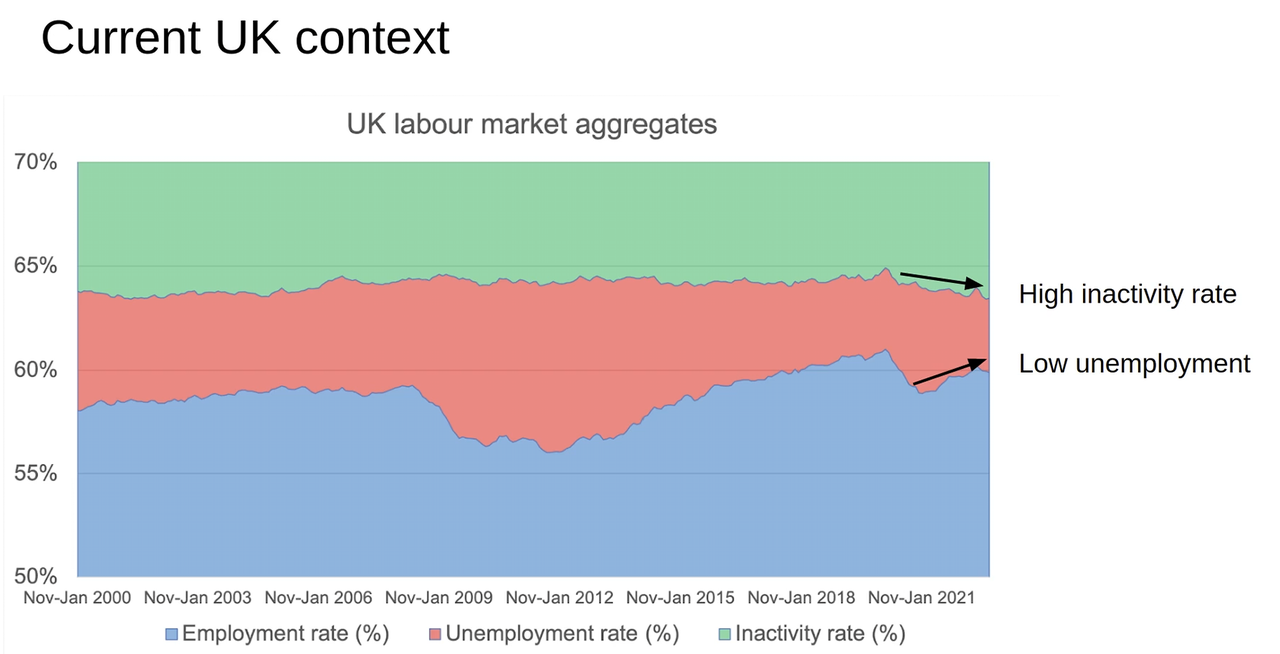
Who are considered 'long-term unemployed' in the UK labour-market context?
How do unemployment spell lengths change during deep recessions?
Name two reasons it becomes harder for the long-term unemployed to find work.
What does the text say about people not in the labour force and employment transitions?
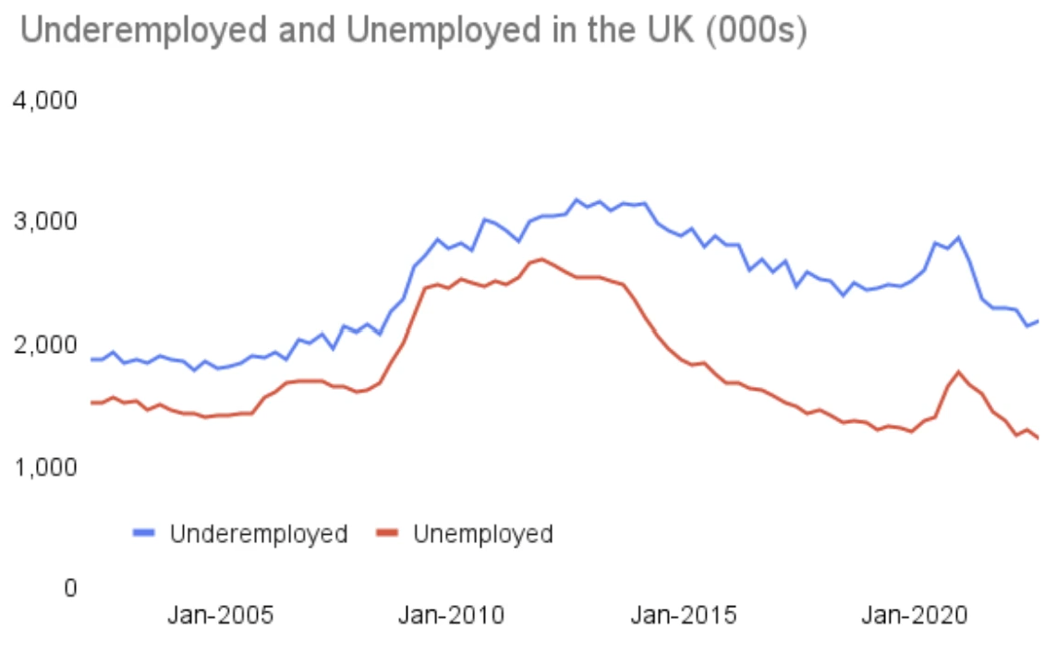
How is 'underemployment' described in the UK context?
What trend between unemployment and underemployment is noted for recent years?
According to the recap, what makes it easier to find a new job?
What two facts about most job seekers and most unemployment spells are stated in the recap?
What is 'frictional unemployment'?
Name two causes of frictional unemployment mentioned in the text.
What is 'structural unemployment' as defined in the text?
Why does structural unemployment arise when wages are 'stuck'?
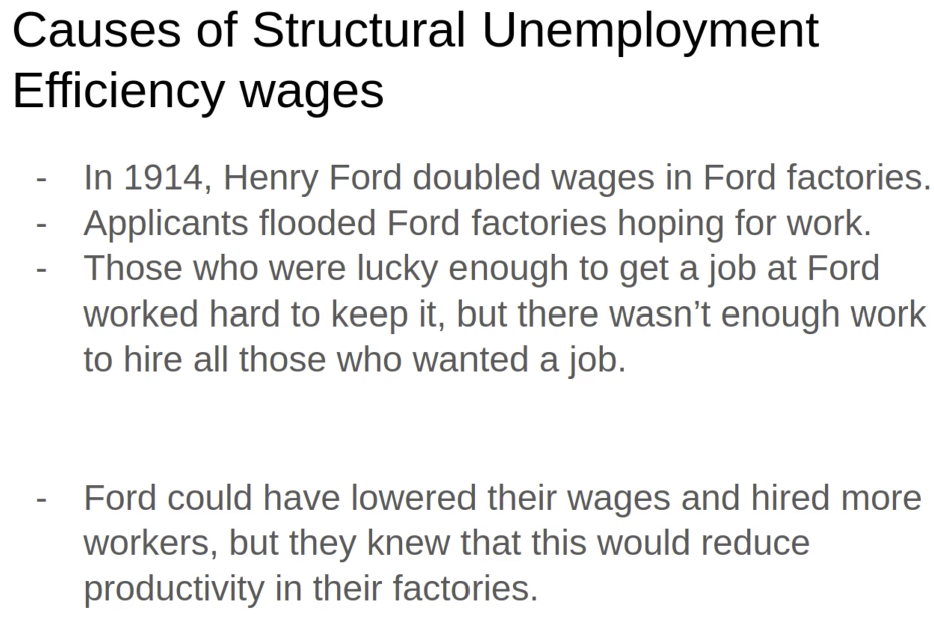
What is an 'efficiency wage' and how can it cause unemployment (example given)?
Give one institutional cause of structural unemployment mentioned in the text.
What labor-market issues do unemployment rates alone fail to capture?
Which image illustrates structural unemployment with labor supply and demand curves?
How do job protection regulations affect firms' ability to fire workers?
Why might firms choose not to grow beyond certain workforce sizes?
What is cyclical unemployment?
How do frictional and structural unemployment relate to economic growth?
Flashcards in this deck (33)
-
Who belongs to the 'working age population'?
- People aged 16 or older who are not in the military or institutionalized
definitions population -
definitions employment
-
How is an individual defined as 'unemployed'?
- A working age person without a job who is trying to get a job
definitions unemployment -
definitions labourforce
-
What conditions must be met to be counted among the unemployed?
- Part of working age population
- Not currently working
- Actively searching for a job
- Able to accept a job if offered
unemployment criteria -
How is the 'activity rate' (participation rate) calculated?
- (Employed + Unemployed) / Working age population
rates participation -
rates inactivity
-
Which UK rate 'has continued to fall since the pandemic', and what seems to explain it?
- The inactivity rate has continued to fall, seemingly due to long-term illness
uk inactivity -
What describes a 'dynamic labour market' in the notes?
- High turnover that makes it easier for people to find new jobs
dynamics turnover -
duration unemployment
-
jobseekers employment
-
What does the manufacturing example say about jobs despite sector shrinkage?
- Manufacturing still creates a lot of new jobs even though the sector has shrunk over the last 15 years
manufacturing jobs -
Refer to the chart: which three UK labour rates are shown in the stacked area chart?
- Employment rate
- Unemployment rate
- Inactivity rate
uk chart -
Who are considered 'long-term unemployed' in the UK labour-market context?
People who have been unemployed for six consecutive months or longer.
unemployment duration -
How do unemployment spell lengths change during deep recessions?
Unemployment spells lengthen during deep recessions.
cyclical recessions -
Name two reasons it becomes harder for the long-term unemployed to find work.
- Discrimination by employers
- Skill and connection loss the longer someone is out of work
longterm barriers -
What does the text say about people not in the labour force and employment transitions?
There is a similar number of people who move from inactivity to employment as those who move from unemployment to employment.
participation flows -
How is 'underemployment' described in the UK context?
Workers who prefer more hours or a new job with more hours; many UK workers are underemployed.
underemployment hours -
What trend between unemployment and underemployment is noted for recent years?
The gap between unemployment and underemployment has increased in recent years.
trend underemployment -
According to the recap, what makes it easier to find a new job?
A dynamic labour market makes it easier to find a new job.
dynamics jobsearch -
What two facts about most job seekers and most unemployment spells are stated in the recap?
- Most job seekers are employed
- Most unemployment spells are short
recap core -
What is 'frictional unemployment'?
Unemployment due to the time it takes for employers to search for workers and workers to search for jobs.
unemployment frictional -
Name two causes of frictional unemployment mentioned in the text.
- The efficiency of matching firms with workers (workers must network, travel have interview and firms must employ costly recruitment agencies, job postings et)
- skills mismatch (changing tech and market means mismatch between workers skills and those needed by the firm)
- universal credit. increase OC of work
frictional causes -
What is 'structural unemployment' as defined in the text?
Unemployment that occurs because wages don't fall to bring labour demand and supply into equilibrium.
unemployment structural -
Why does structural unemployment arise when wages are 'stuck'?
When the bargained wage stays above the market-clearing wage, a persistent gap between labour supply and demand causes structural unemployment.
structural wages -
What is an 'efficiency wage' and how can it cause unemployment (example given)?
An efficiency wage is a high wage set to improve productivity; example: Henry Ford doubled wages in 1914, attracting many applicants and leaving not enough jobs.
efficiency wages -
Give one institutional cause of structural unemployment mentioned in the text.
Unions can keep wages high for some workers.
Job protection regulations means its difficult to fire workers
minimum wages
institutions unions -
What labor-market issues do unemployment rates alone fail to capture?
- Some people not in the labor force would work under the right conditions
- Many employed people are underemployed
labor measurement -
Which image illustrates structural unemployment with labor supply and demand curves?
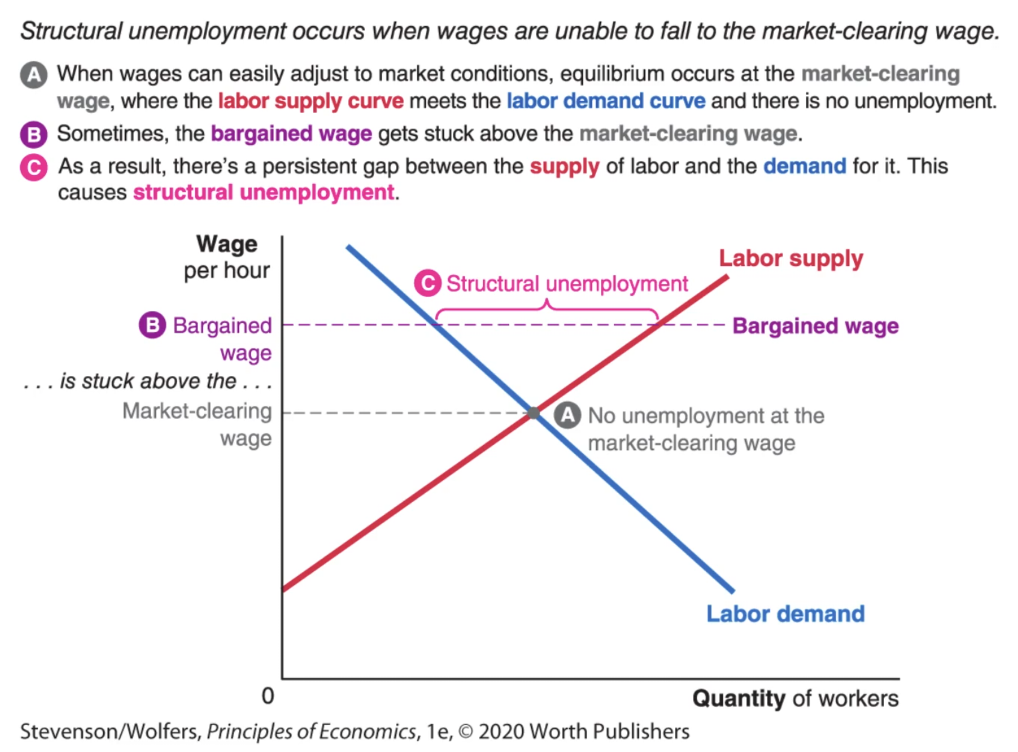 The graph shows labour supply, labour demand and a bargained wage above the market-clearing wage.diagram structural
 -
How do job protection regulations affect firms' ability to fire workers?
Job protection regulations make it difficult for firms to fire workers.
labour regulation -
Why might firms choose not to grow beyond certain workforce sizes?
Firms choose not to grow beyond thresholds because job protection regulations come into force when a firm reaches a certain workforce size.
firm-size thresholds -
What is cyclical unemployment?
Cyclical unemployment is unemployment due to a temporary downturn in the economy.
unemployment cyclical -
How do frictional and structural unemployment relate to economic growth?
Frictional and structural unemployment are present whether the economy is growing or shrinking.
unemployment frictional structural
Overview
Concise summary of core labour-market concepts: who counts as employed/unemployed, how participation is measured, labour-market dynamics, unemployment duration, underemployment, and types of unemployment.
Key definitions
- Working-age population: people aged 16+ who are not in the military or institutionalised.
- Employed: working members of the working-age population.
- Unemployed: working-age people without a job who are actively seeking work and can start if offered.
- Labour force: Employed + Unemployed.
Participation and inactivity
- Activity (participation) rate measures labour-market engagement:
- \(\text{Activity rate} = \dfrac{\text{Employed} + \text{Unemployed}}{\text{Working\text{-}age\ population}}\).
- Inactivity rate = \(1 - \text{Activity rate}\).
Current UK context (high level)
- Inactivity in the UK has fallen since the pandemic, driven in part by long-term illness.
- Employment, unemployment and inactivity trends can be visualised to spot structural shifts.
Labour-market dynamics
- Labour markets are dynamic: high turnover means many hires even in shrinking sectors.
- Example: manufacturing still creates many hires despite long-term decline in employment.
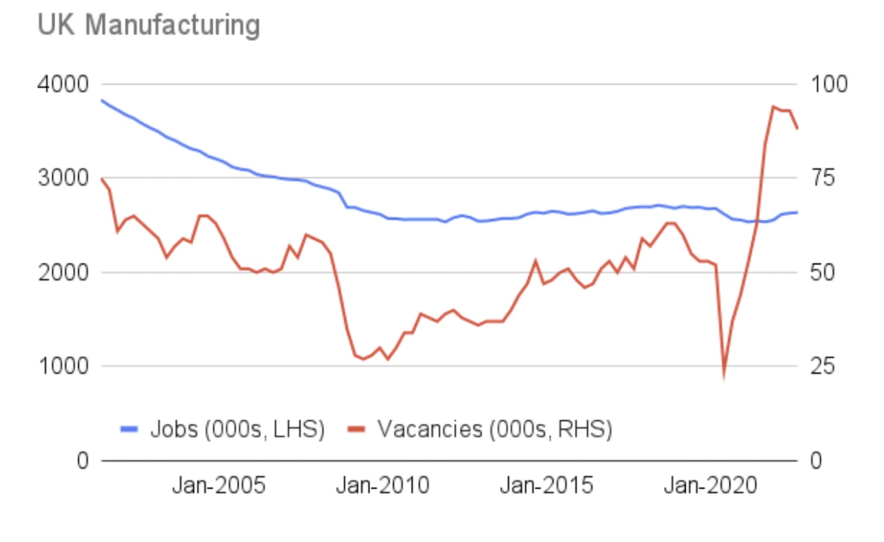
- Most job seekers are already employed; typical unemployment spells are short (around 10 weeks).
Unemployment duration and long-term unemployment
- Most unemployment spells are short (largest share in 0–6 months).
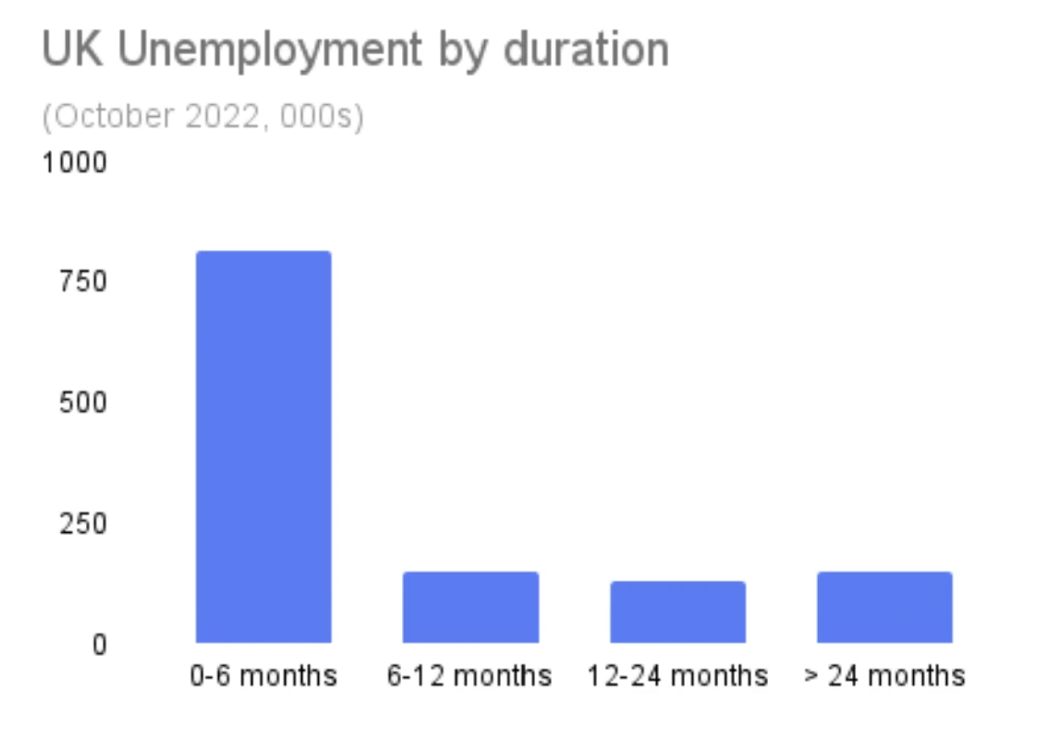
- During deep recessions, spells lengthen and the share of long-term unemployed (>6 months) rises.
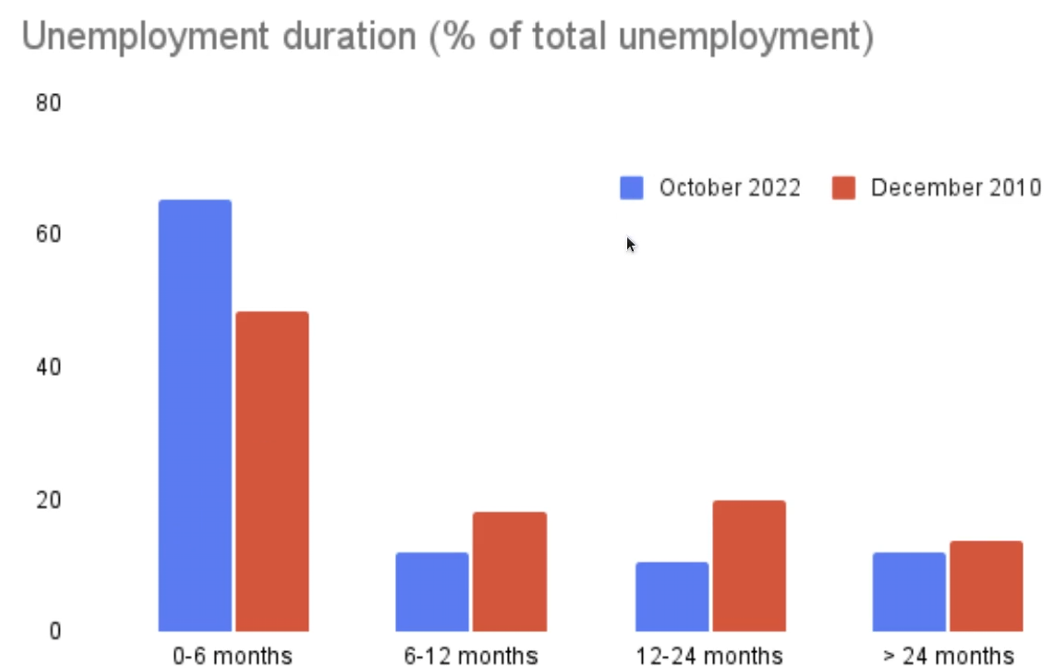
- Long-term unemployed (6+ months) face:
- Employer discrimination against resumes with long gaps.
- Loss of skills and professional networks, reducing re-employment chances.
Underemployment
- Underemployment: employed people who want more hours or a different job with more hours.
- In the UK the gap between underemployment and unemployment has increased in recent years.
Types of unemployment
Frictional unemployment
- Caused by time and costs needed for matching workers and firms (search, interviews, recruitment).
- Drivers:
- Search and hiring costs for firms and workers.
- Skill mismatch when technology or markets change required skills.
- More generous unemployment benefits can lengthen search time but may improve job matching quality.
Structural unemployment
- Occurs when wages do not fall to the market-clearing level, leaving excess labour supply.
- Graphically, a bargained or sticky wage above the market-clearing wage generates persistent unemployment.
- Causes:
- Efficiency wages: firms pay above-market wages to boost productivity and reduce turnover (historical example: Ford, 1914).
- Institutions: unions, minimum wages, and job-protection rules can keep wages or employment rigid.
- Regulatory thresholds (e.g. rules that apply only above a certain firm size) can discourage firm growth.
Cyclical unemployment
- Caused by downturns in aggregate demand; unemployment rises during recessions and falls in expansions.
- Frictional and structural unemployment exist regardless of the cycle; cyclical is the fluctuation around that baseline.
Policy relevance and implications
- Short spells: focus on rapid job matching and mobility (job information, active labour policies).
- Long-term unemployment: address discrimination, retraining and reintegration to prevent skill erosion.
- Structural problems: consider wage-setting institutions, efficiency-wage incentives, and regulation design.
- Underemployment: policies may need to address hours, job quality, and flexible working.
Recap (quick)
- Labour force = employed + unemployed; participation measures engagement.
- Labour markets are dynamic; most spells are short but recessions lengthen them.
- Underemployment and inactivity hide labour-market slack.
- Unemployment types: frictional, structural, cyclical — each has different causes and policy responses.