Sign up to unlock more features
- Save this deck to your account
- Study flashcards with spaced repetition
- Export to Anki (.apkg) or PDF
- Process documents up to 100 pages
- Images extracted from PDFs and documents
- Better text extraction from your PDFs and documents
- Better flashcards with our more advanced AI model


What are the five senses?


What is the function of taste buds?
What sense is primarily responsible for balance?
What part of the eye detects light?
What are the three types of photoreceptors in the eye?
What is the role of olfactory receptors?
Which sense is affected by the cochlea?
What is the main role of the cornea?
What are the components of the afferent division of the nervous system?
What are the components of the efferent division of the nervous system?
What is the somatic nervous system responsible for?
Why do receptors respond to specific stimuli?
How does the organization of a receptor affect its sensitivity?
What are the receptors for the general senses?
How do general sense receptors function?
What are the general senses responsible for sensing?
What are the special senses?
Where are special sensory receptors located?
What sensations do special sensory receptors provide?
What are the focus areas in this section?
What do sensory pathways consist of?
What does the somatic nervous system (SNS) control?
What are sensory pathways?
What are sensory receptors?
Where can sensory receptors be found?
What happens when a receptor is stimulated?
What does the efferent division of the nervous system include?
What do somatic motor commands control?
How do commands travel from the brain in the efferent pathway?
What happens during the depolarization of sensory receptors?
What triggers action potential generation in sensory pathways?
What do sensory neurons carry to the CNS?
Where does CNS processing occur in sensory pathways?
What does the immediate involuntary response involve?
What is the role of the voluntary response in motor pathways?
What percentage of sensations are relayed to the primary somatosensory cortex?
What diagram illustrates sensory and motor pathways?
What do sensory receptors detect?
What is receptor specificity?
What is a receptive field?
How does receptive field size affect stimulus localization?
What is transduction in sensory receptors?
What are receptive fields in the skin?
What is the function of free nerve endings?
Where are receptive fields located?
What is adaptation in sensory receptors?
What type of adaptation occurs in the PNS?
What type of adaptation occurs in the CNS?
How does the nervous system respond to constant stimuli?
What are tonic receptors?
What do pain receptors do?
What are Tonic receptors?
How do Tonic receptors respond to stimulus change?
What does the frequency of action potentials indicate in Tonic receptors?
What does increased stimulation do to Tonic receptors?
What does decreased stimulation do to Tonic receptors?
What does the term 'Normal' refer to in the context of Tonic receptors?
What visual aid represents Tonic receptors?
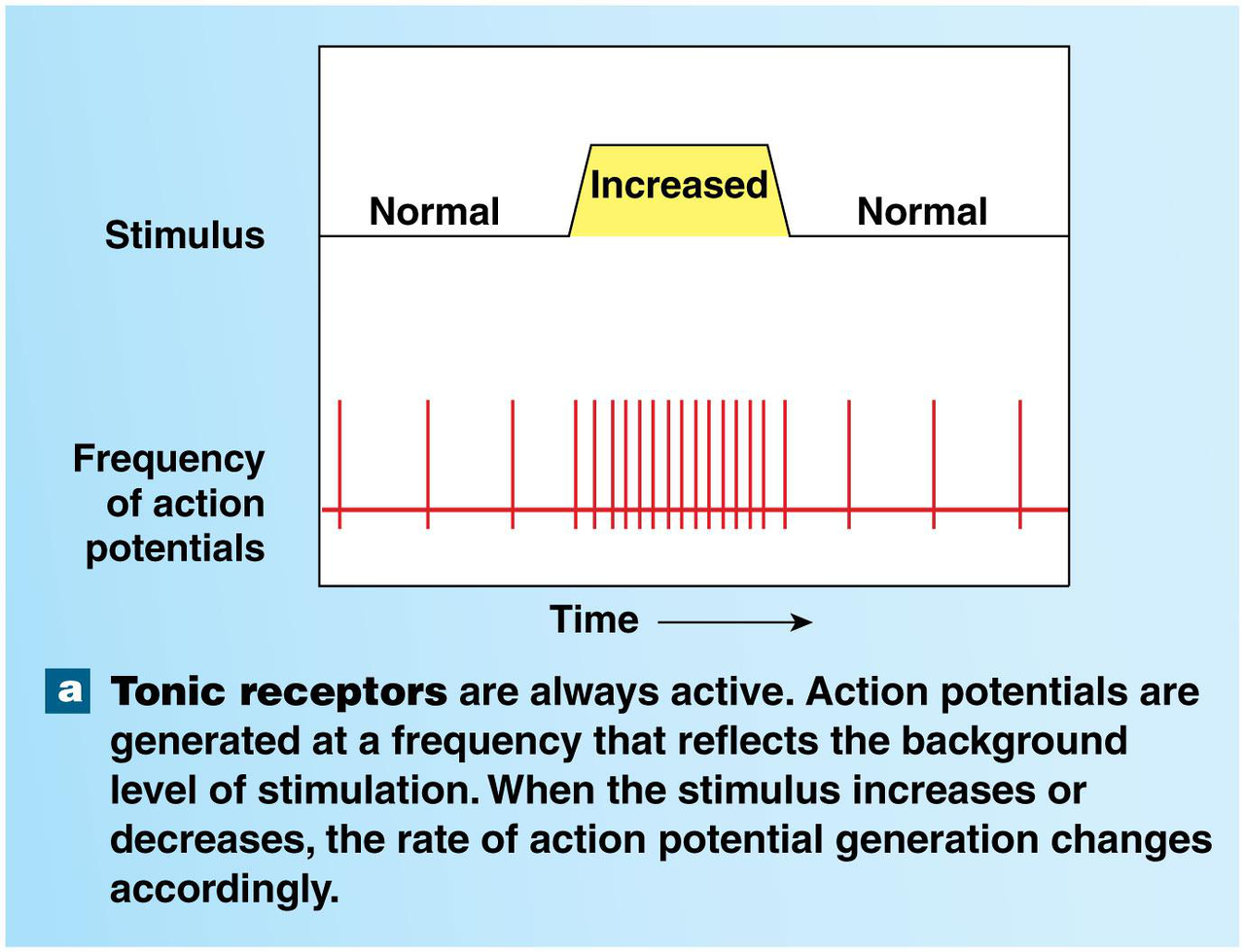
What are phasic receptors?
How do phasic receptors respond to stimuli?
What are phasic receptors known for?
What happens to phasic receptors when a stimulus is applied?
What is the representation of action potentials in phasic receptors?
What does the graph depict about phasic receptors?
What are the characteristics of action potentials in phasic receptors?
What are nociceptors?
Do nociceptors adapt?
What are thermoreceptors?
How do cold receptors compare to warm receptors?
How do thermoreceptors function when temperature changes?
What are chemoreceptors responsible for?
What types of chemicals do chemoreceptors detect?
Where are chemoreceptors important?
How does information from chemoreceptors process?
What are mechanoreceptors sensitive to?
What do mechanoreceptors contain in their membranes?
What triggers the ion channels in mechanoreceptors?
What do tactile receptors provide sensations of?
What do baroreceptors detect?
What do proprioceptors monitor?
What are free nerve endings?
What do free nerve endings respond to?
Where are free nerve endings located?
What type of receptors are free nerve endings?
Describe the structure of free nerve endings.
What are root hair plexus nerve endings responsible for?
How do root hair plexus receptors adapt?
What stimulates the root hair plexus?
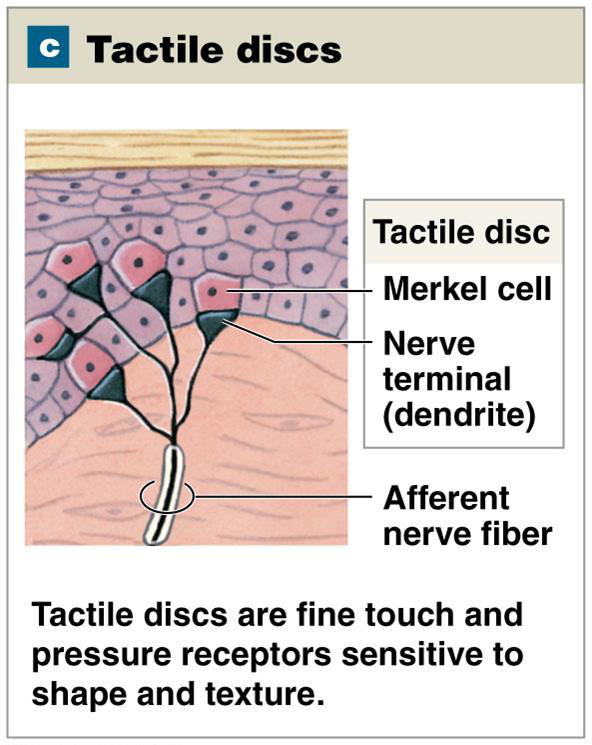
What are tactile discs?
What do tactile discs detect?
What type of receptors are tactile discs?
What are bulbous corpuscles (Ruffini corpuscles) sensitive to?
Where are bulbous corpuscles located?
What type of receptors are bulbous corpuscles?
What does the structure of a bulbous corpuscle include?
What are lamellar corpuscles also known as?
What do lamellar corpuscles respond to?
How do lamellar corpuscles adapt to stimuli?
Describe the structure of a lamellar corpuscle.
Where are lamellar corpuscles located?
What stimuli are lamellar corpuscles most sensitive to?
What does a cross-section of a lamellar corpuscle illustrate?
What sensations do tactile corpuscles (Meissner corpuscles) perceive?
How quickly do tactile corpuscles adapt to stimulation?
Where are tactile corpuscles most abundant?
What are lamellar (Pacinian) corpuscles sensitive to?
What is the structure of a lamellar corpuscle?


Flashcards in this deck (112)
-
-
biology senses
-
-
-
biology taste
-
biology balance
-
biology eyes
-
biology photoreceptors
-
biology olfaction
-
biology hearing
-
biology eyes
-
What are the components of the afferent division of the nervous system?
- Sensory neurons
- Affector neurons
nervous_system anatomy -
What are the components of the efferent division of the nervous system?
- Motor neurons
- Effector organs
nervous_system anatomy -
What is the somatic nervous system responsible for?
- Voluntary control of skeletal muscles
- Reflex actions
nervous_system somatic -
Why do receptors respond to specific stimuli?
Receptors are specialized for detecting certain types of energy (e.g., light, sound).
physiology receptors -
How does the organization of a receptor affect its sensitivity?
The structure and location determine the types of stimuli and the efficiency of response.
physiology sensitivity -
What are the receptors for the general senses?
- Mechanoreceptors
- Thermoreceptors
- Nociceptors
- Photoreceptors
senses anatomy -
How do general sense receptors function?
They convert different forms of energy into electrical signals for interpretation.
senses function -
What are the general senses responsible for sensing?
- Temperature
- Pain
- Touch
- Pressure
- Vibration
- Proprioception (body position)
biology senses -
What are the special senses?
- Olfaction (smell)
- Gustation (taste)
- Vision (sight)
- Equilibrium (balance)
- Hearing
biology special_senses -
Where are special sensory receptors located?
- In sense organs
- Such as the eye or ear
- Protected by surrounding tissues
biology senses receptors -
biology senses receptors
-
What are the focus areas in this section?
- Sensory pathways
- Motor pathways
- Somatic nervous system (SNS)
nervous_system anatomy -
nervous_system sensory
-
nervous_system motor_control
-
anatomy nervous_system
-
anatomy nervous_system
-
anatomy environment
-
What happens when a receptor is stimulated?
It generates action potentials sent along sensory pathways.
physiology nervous_system -
nervous_system efferent
-
nervous_system motor
-
nervous_system motor
-
What happens during the depolarization of sensory receptors?
A stimulus produces a graded change in the membrane potential of a receptor cell.
neuroscience sensory -
What triggers action potential generation in sensory pathways?
The membrane depolarization reaching the threshold.
neuroscience action_potential -
What do sensory neurons carry to the CNS?
Information about the type of stimulus (e.g., touch, pressure, temperature).
neuroscience sensory -
Where does CNS processing occur in sensory pathways?
At every relay synapse, distributing information to multiple nuclei and centers.
neuroscience cns -
What does the immediate involuntary response involve?
Processing centers in the spinal cord or brainstem direct a reflex response before sensations reach the cortex.
neuroscience reflex -
What is the role of the voluntary response in motor pathways?
It can moderate, enhance, or supplement involuntary reflexive responses.
neuroscience motor -
What percentage of sensations are relayed to the primary somatosensory cortex?
Only about 1 percent of arriving sensations.
neuroscience perception -
What diagram illustrates sensory and motor pathways?
See the diagram showing stimulus arrival, depolarization, action potential generation, propagation, and processing.
diagram overview -
biology sensation
-
biology sensation
-
biology sensation
-
How does receptive field size affect stimulus localization?
Larger fields make it more difficult to localize a stimulus.
biology sensation -
What is transduction in sensory receptors?
Conversion of an arriving stimulus into an action potential.
biology sensation -
biology sensation
-
biology sensation
-
biology sensation
-
What is adaptation in sensory receptors?
Reduction of receptor sensitivity in the presence of a constant stimulus
biology sensation -
biology nervous_system
-
biology nervous_system
-
How does the nervous system respond to constant stimuli?
It quickly adapts to painless, constant stimuli
biology nervous_system -
anatomy sensation
-
anatomy sensation
-
What are Tonic receptors?
Receptors that are always active and generate action potentials reflecting the background level of stimulation.
biology sensory -
How do Tonic receptors respond to stimulus change?
They change the frequency of action potentials based on stimulus increases or decreases.
biology sensory -
What does the frequency of action potentials indicate in Tonic receptors?
It indicates the background level of stimulation.
biology neuroscience -
What does increased stimulation do to Tonic receptors?
It increases the rate of action potential generation.
biology sensory -
What does decreased stimulation do to Tonic receptors?
It decreases the rate of action potential generation.
biology sensory -
What does the term 'Normal' refer to in the context of Tonic receptors?
The baseline level of stimulation at which Tonic receptors operate.
biology neuroscience -
biology visual
-
What are phasic receptors?
- Normally inactive
- Provide information about intensity and rate of change of a stimulus
- Fast-adapting receptors
biology sensory -
How do phasic receptors respond to stimuli?
- Respond strongly at first
- Activity decreases after initial response
biology sensory -
What are phasic receptors known for?
They are normally inactive and generate action potentials only for a short time during a change in conditions.
biology senses -
What happens to phasic receptors when a stimulus is applied?
Action potentials are generated in response to the change in conditions.
biology senses -
What is the representation of action potentials in phasic receptors?
The frequency of action potentials increases during stimulus change and returns to normal afterward.
biology senses -
What does the graph depict about phasic receptors?
It shows the frequency of action potentials in response to a stimulus over time.
biology senses -
What are the characteristics of action potentials in phasic receptors?
They are generated for a short time during a change in monitored conditions.
biology senses -
What are nociceptors?
- Pain receptors
- Free nerve endings in:
- Superficial skin
- Joint capsules
- Periostea of bones
- Walls of blood vessels
biology nervous_system -
biology nervous_system
-
What are thermoreceptors?
- Temperature receptors
- Free nerve endings in:
- Dermis
- Skeletal muscle
- Liver
- Hypothalamus
biology nervous_system -
biology nervous_system
-
How do thermoreceptors function when temperature changes?
- Very active during temperature changes
- Quickly adapt to stable temperature
biology nervous_system -
What are chemoreceptors responsible for?
Detecting small changes in concentrations of specific chemicals.
biology sensors -
biology chemicals
-
biology respiration
-
biology neurology
-
biology sensory
-
biology sensory
-
What triggers the ion channels in mechanoreceptors?
- Stretching
- Compression
- Twisting
- Other distortions
biology sensory -
What do tactile receptors provide sensations of?
- Touch (shape or texture)
- Pressure (mechanical distortion)
- Vibration (pulsing pressure)
biology sensory mechanoreceptors -
What do baroreceptors detect?
- Pressure changes in blood vessels
- Pressure changes in digestive tracts
- Pressure changes in respiratory tracts
- Pressure changes in urinary tracts
biology sensory mechanoreceptors -
biology sensory mechanoreceptors
-
What are free nerve endings?
- Branching tips of sensory neurons
- Respond to touch, pressure, pain, and temperature
- Sensitive receptors situated between epidermal cells
biology sensory -
biology sensory
-
anatomy skin
-
biology receptors
-
biology structure
-
What are root hair plexus nerve endings responsible for?
- Monitoring distortions
- Detecting movements
- Adapting rapidly
sensory receptors -
How do root hair plexus receptors adapt?
They adapt rapidly, best for detecting initial contact and subsequent movements.
sensory adaptation -
sensory hair
-
What are tactile discs?
Fine-touch and pressure receptors - Sensitive to shape and texture - Extremely sensitive tonic receptors - Very small receptive fields
 biology sensation receptors
 -
biology sensation receptors
-
What type of receptors are tactile discs?
Tonic receptors - Extremely sensitive - Small receptive fields
biology sensation receptors -
anatomy sensation
-
anatomy skin
-
physiology receptors
-
What does the structure of a bulbous corpuscle include?
- Collagen fibers
- Capsule
- Dendrites
- Sensory nerve fiber
anatomy structure -
anatomy receptors
-
physiology sensory
-
physiology adaptation
-
Describe the structure of a lamellar corpuscle.
- Single dendrite
- Concentric layers of collagen fibers
- Separated by fluid
anatomy structure -
anatomy location
-
physiology sensitivity
-
What does a cross-section of a lamellar corpuscle illustrate?
Dermis, dendrite, and concentric layers of collagen fibers
anatomy cross-section illustration -
What sensations do tactile corpuscles (Meissner corpuscles) perceive?
- Fine touch
- Pressure
- Low-frequency vibration
anatomy receptors -
physiology adaptation
-
anatomy sensitivity
-
anatomy receptors
-
What is the structure of a lamellar corpuscle?
- Dendrite
- Concentric layers of collagen fibers
- Separated by fluid
anatomy structure -
-