Sign up to unlock more features
- Save this deck to your account
- Study flashcards with spaced repetition
- Export to Anki (.apkg) or PDF
- Process documents up to 100 pages
- Images extracted from PDFs and documents
- Better text extraction from your PDFs and documents
- Better flashcards with our more advanced AI model
What is septic arthritis?
Pathophysiology of septic arthritis
Most common pathogen in septic arthritis
Clinical features of septic arthritis
Diagnostic step for suspected septic arthritis
Typical synovial WBC count in septic arthritis
First‑line management of septic arthritis
Why is vancomycin appropriate for suspected S aureus septic arthritis?
When is ampicillin appropriate for joint infection?
Prevention strategy for septic arthritis
Hepatitis infection suspicion: key defining features in this patient?
Diagnostic anchor: How is hepatitis infection confirmed?
Treatment for suspected hepatitis infection in this case?
Why is measurement of alpha-fetoprotein (AFP) incorrect for acute hepatitis workup?
When is CT scan of the abdomen appropriate vs serologic hepatitis testing?
Role of HIDA scan in abdominal pain evaluation?
Role of esophagogastroduodenoscopy (EGD) in this presentation?
Why is liver biopsy incorrect as initial test for suspected hepatitis B?
Imaging card: which study 'helps evaluate abdominal pain in an undifferentiated patient' but is not first for suspected hepatitis?
Gonococcal arthritis: which clinical features in this 24-year-old support the diagnosis?
Gonococcal arthritis: which synovial fluid result in this case supports an infectious cause?
Why is a negative Gram stain in this case consistent with gonococcal arthritis?
Staphylococcal septic arthritis: which feature from study notes differentiates it from this case?
Septic arthritis (general): immediate diagnostic step emphasized by study notes
Septic arthritis (general) management per study notes for suspected pathogen before culture results
Why is gonococcal arthritis the most likely diagnosis for this patient?
When would Staphylococcus aureus be the leading cause of septic arthritis instead of gonococcus?
What is the diagnosis 'Gonococcal arthritis' presentation?
Which synovial fluid leukocyte count is often seen in septic arthritis (including gonococcal)?
Why can Gram stain be negative in gonococcal arthritis despite infection?
Which definitive test confirms Neisseria gonorrhoeae in suspected gonococcal arthritis?
First-line outpatient treatment to prevent gonococcal complications after N. gonorrhoeae infection?
Initial treatment for confirmed gonococcal arthritis requiring hospitalization?
What urgent diagnostic procedure is required for any patient with suspected septic arthritis?
Key clinical exam and vital sign findings in septic arthritis
How does management of septic arthritis differ from uncomplicated gonococcal infection?
Distinguish Staphylococcus aureus vs Neisseria gonorrhoeae in septic arthritis
Image: Gonococcal arthritis supplementary visual
Flashcards in this deck (38)
-
internalmedicine step2
-
Pathophysiology of septic arthritis
- Infection in joint space → inflammatory response → pain, swelling, erythema, restricted ROM
surgery step2 -
internalmedicine step2
-
Clinical features of septic arthritis
- Acute hot swollen joint with severe pain and restricted movement; fever possible
pediatrics step2 -
internalmedicine step2
-
Typical synovial WBC count in septic arthritis
- Often very elevated: \(40{,}000\)–\(50{,}000/\text{mm}^3\)
internalmedicine step2 -
First‑line management of septic arthritis
- Urgent IV antibiotics + joint drainage/operative irrigation (source control)
surgery step2 -
Why is vancomycin appropriate for suspected S aureus septic arthritis?
- Broad coverage for gram‑positive cocci including MRSA; appropriate empiric IV therapy
internalmedicine step2 -
When is ampicillin appropriate for joint infection?
- For infections due to group B streptococci or Listeria species, not empiric S aureus coverage
internalmedicine step2 -
obgyn step2
-
Hepatitis infection suspicion: key defining features in this patient?
- Use of others' medications
- Fever
- Tender, enlarged liver
- Increased bilirubin
- Markedly increased AST/ALT; ALT > 1000 U/L
internalmedicine step2 -
internalmedicine step2
-
Treatment for suspected hepatitis infection in this case?
- Supportive care
- Severe cases: nucleotide analogue therapy can be given
internalmedicine step2 -
Why is measurement of alpha-fetoprotein (AFP) incorrect for acute hepatitis workup?
- AFP is used for hepatocellular carcinoma surveillance, typically in chronic hepatitis B
internalmedicine step2 -
When is CT scan of the abdomen appropriate vs serologic hepatitis testing?
- CT abdomen: useful for undifferentiated abdominal pain
- This patient: hepatitis likely → send serologic study first
internalmedicine step2 -
Role of HIDA scan in abdominal pain evaluation?
- HIDA assesses biliary system, especially the gallbladder; not best for hepatitis
internalmedicine step2 -
Role of esophagogastroduodenoscopy (EGD) in this presentation?
- EGD evaluates esophagus, stomach, small bowel anatomy; does not evaluate the liver
internalmedicine step2 -
Why is liver biopsy incorrect as initial test for suspected hepatitis B?
- Liver biopsy is needlessly invasive; diagnosis of hepatitis B is by serologic workup (gold standard)
internalmedicine step2 -
Imaging card: which study 'helps evaluate abdominal pain in an undifferentiated patient' but is not first for suspected hepatitis?
- CT scan of the abdomen
 internalmedicine step2
 -
Gonococcal arthritis: which clinical features in this 24-year-old support the diagnosis?
- Acute migratory arthralgia of multiple large joints
- Progressive purulent monoarthritis (right knee)
- Painless hemorrhagic macules/papules rash
- Gram stain of joint fluid negative
internalmedicine step2 -
Gonococcal arthritis: which synovial fluid result in this case supports an infectious cause?
- Synovial WBC 40,000/mm³ with neutrophil predominance
internalmedicine step2 -
Why is a negative Gram stain in this case consistent with gonococcal arthritis?
- Neisseria gonorrhoeae often yields a negative Gram stain despite infection (culture pending)
internalmedicine step2 -
Staphylococcal septic arthritis: which feature from study notes differentiates it from this case?
- Staphylococcus aureus is gram-positive cocci (Gram stain often positive); this case had Gram stain negative
internalmedicine step2 -
Septic arthritis (general): immediate diagnostic step emphasized by study notes
- Urgent arthrocentesis and synovial culture
internalmedicine step2 -
Septic arthritis (general) management per study notes for suspected pathogen before culture results
- Empiric IV antibiotics plus joint drainage
internalmedicine step2 -
Why is gonococcal arthritis the most likely diagnosis for this patient?
- Young patient with migratory large-joint arthralgias, pustular/hemorrhagic skin lesions, acute purulent monoarthritis, high synovial WBC, and negative Gram stain
internalmedicine step2 -
When would Staphylococcus aureus be the leading cause of septic arthritis instead of gonococcus?
- When Gram stain shows gram-positive cocci and presentation suggests single-joint infection without migratory arthralgias or characteristic pustular dermatitis
internalmedicine step2 -
What is the diagnosis 'Gonococcal arthritis' presentation?
- Fever, joint effusion, pain on range of motion in untreated Neisseria gonorrhoeae infection
obgyn internalmedicine step2. -
Which synovial fluid leukocyte count is often seen in septic arthritis (including gonococcal)?
- \(40{,}000\)–$50{,}000/\text{mm}^3 (variable)
internalmedicine step2. -
Why can Gram stain be negative in gonococcal arthritis despite infection?
- Gonococci often exist within neutrophils, so Gram stain is often negative
internalmedicine obgyn step2. -
Which definitive test confirms Neisseria gonorrhoeae in suspected gonococcal arthritis?
- Nucleic acid amplification testing (NAAT) for N. gonorrhoeae
obgyn internalmedicine step2. -
First-line outpatient treatment to prevent gonococcal complications after N. gonorrhoeae infection?
- Ceftriaxone (first-line for uncomplicated gonococcal infection)
obgyn internalmedicine step2. -
Initial treatment for confirmed gonococcal arthritis requiring hospitalization?
- IV ceftriaxone plus azithromycin (cover possible Chlamydia co-infection)
internalmedicine obgyn step2. -
What urgent diagnostic procedure is required for any patient with suspected septic arthritis?
- Arthrocentesis with synovial fluid bacterial culture
surgery internalmedicine step2. -
Key clinical exam and vital sign findings in septic arthritis
- Fever, tachycardia/hypotension possible; joint warm, tender, swollen, limited ROM from pain
internalmedicine pediatrics step2. -
How does management of septic arthritis differ from uncomplicated gonococcal infection?
- Septic arthritis: IV antibiotics + joint drainage; Uncomplicated gonorrhea: ceftriaxone outpatient
internalmedicine surgery step2. -
Distinguish Staphylococcus aureus vs Neisseria gonorrhoeae in septic arthritis
- S. aureus: gram-positive cocci; treat with vancomycin.
- N. gonorrhoeae: young patients, rash, often Gram stain negative; treat with ceftriaxone
internalmedicine infectiousdisease step2. -
Image: Gonococcal arthritis supplementary visual
- Supplementary image showing case words 'Gonococcal arthritis' and features (fever, joint effusion, Gram stain note):

internalmedicine obgyn step2. - Supplementary image showing case words 'Gonococcal arthritis' and features (fever, joint effusion, Gram stain note):
Septic arthritis — concise study notes
Quick overview
- Septic arthritis is an infection of a joint space causing acute inflammation, most commonly due to bacterial pathogens.
- Rapid diagnosis and treatment (IV antibiotics + joint drainage) are required to prevent joint destruction and systemic spread.
Common pathogens & epidemiology
- Staphylococcus aureus: most common cause of nongonococcal septic arthritis (including MRSA).
- Neisseria gonorrhoeae: common cause in young, sexually active patients; can present with migratory polyarthralgias and skin lesions.
- Other organisms: streptococci, gram-negative bacilli, and less commonly anaerobes.
Typical clinical presentation
- Acute, painful, swollen, warm joint with limited range of motion.
- Systemic features: fever, chills, tachycardia, hypotension in severe cases (sepsis).
- Gonococcal arthritis may have migratory polyarthralgia, tenosynovitis, and skin lesions (painless hemorrhagic macules/papules).
- Important risk factors: immunosuppression, IV drug use, recent joint surgery or prosthesis, sexually active patients.
Diagnostic approach — priorities
- Arthrocentesis (urgent): obtain synovial fluid before antibiotics when possible.
- Synovial fluid studies: Gram stain, cell count with differential, crystals, and culture.
- Blood tests: CBC (leukocytosis), inflammatory markers (CRP, ESR), blood cultures if systemic signs.
- NAAT/PCR for suspected N. gonorrhoeae from genital sites or synovial fluid when gram stain/culture are negative.
Synovial fluid interpretation
- Purulent, cloudy fluid with high neutrophil proportion suggests infection.
- Leukocyte counts: septic arthritis often shows very elevated counts; example values:
- \(40{,}000/\text{mm}^3\) (case example).
- Counts around \(50{,}000/\text{mm}^3\) are common but values overlap with inflammatory arthritides.
- Gram stain sensitivity varies: Staph often seen on Gram stain (gram-positive cocci in clusters); gonococcus may have negative Gram stain because bacteria can be intracellular or present in low numbers.
Distinguishing gonococcal vs staphylococcal septic arthritis
- Gonococcal arthritis
- Typical patient: young, sexually active.
- May present with migratory polyarthralgia, tenosynovitis, painless hemorrhagic skin lesions.
- Synovial fluid: variable WBC (often moderately elevated), Gram stain frequently negative.
- Diagnosis: NAAT/PCR or culture; treat with ceftriaxone ± azithromycin for chlamydial coverage.
- Example from vignette: young woman with fever, right-knee effusion, rash, synovial WBC \(40{,}000/\text{mm}^3\), negative Gram stain → Gonococcal.
- Staphylococcal (nongonococcal) septic arthritis
- Typical patient: older, immunosuppressed, IV drug user, prosthetic joint.
- Synovial fluid: high WBC, Gram stain more likely positive for gram-positive cocci in clusters.
- Empiric therapy often includes vancomycin to cover MRSA until cultures guide therapy.
- Example: presentation with classic septic knee and gram-positive cocci on Gram stain → treat for S. aureus (vancomycin) + surgical irrigation.
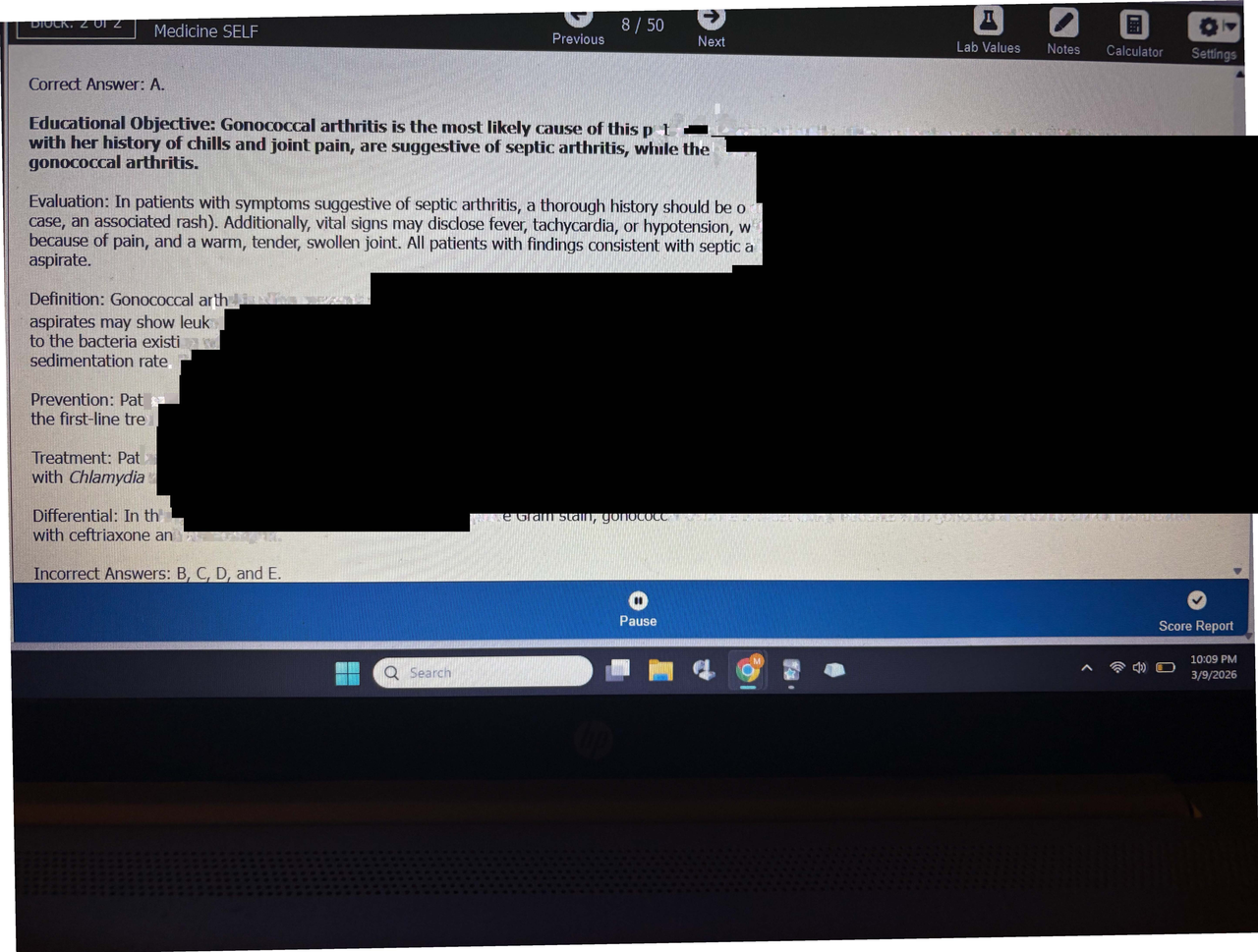 Alt text: Gonococcal arthritis slide showing key features
Treatment principles
- Begin urgent IV antibiotics after obtaining synovial fluid (do not delay sampling).
- Empiric choices depend on likely pathogens and local resistance patterns:
- If gram-positive cocci suspected or severe illness: vancomycin (covers MRSA).
- If gonococcal arthritis suspected: ceftriaxone IV; add azithromycin for possible Chlamydia coinfection per guidelines.
- Source control: joint drainage — repeated arthrocentesis or surgical irrigation/debridement for prosthetic joints or failure of needle drainage.
- Adjust antibiotics based on Gram stain, culture, and susceptibility results.
Management algorithm (practical steps)
- Recognize acute monoarthritis with systemic symptoms as possible septic arthritis.
- Obtain history focusing on sexual exposures, immunosuppression, prosthetic joints, and trauma.
- Perform urgent arthrocentesis and send synovial fluid for cell count, Gram stain, culture, crystals.
- Start empiric IV antibiotics guided by most likely organism and Gram stain.
- Arrange imaging (plain radiographs to exclude fracture; ultrasound or MRI if diagnostic uncertainty or deep infection).
- Provide joint drainage (needle aspiration vs surgical) and monitor clinical/lab response; modify therapy per cultures.
Prevention & prognosis
- No specific universal prevention; reduce modifiable risks (treat skin infections, safe sexual practices, prophylaxis for prosthetic joint procedures when indicated).
- Prognosis depends on rapidity of diagnosis and adequacy of drainage and antibiotics; delayed treatment risks irreversible joint damage.
Two brief clinical vignettes (key teaching points)
- Case A (Staphylococcal): Patient with acute knee effusion and Gram stain showing gram-positive cocci in clusters → treat promptly with vancomycin and arrange joint irrigation.
- Case B (Gonococcal): Young woman with fever, migratory arthralgias, painless hemorrhagic skin lesions, right-knee effusion, synovial WBC \(40{,}000/\text{mm}^3\), negative Gram stain → most consistent with gonococcal arthritis; treat with ceftriaxone and consider azithromycin.
High-yield summary
- Always perform arthrocentesis for suspected septic arthritis.
- Negative Gram stain does not exclude infection (notably gonococcal disease).
- Early empiric IV antibiotics and prompt source control are essential to prevent joint destruction.