Sign up to unlock more features
- Save this deck to your account
- Study flashcards with spaced repetition
- Export to Anki (.apkg) or PDF
- Process documents up to 100 pages
- Images extracted from PDFs and documents
- Better text extraction from your PDFs and documents
- Better flashcards with our more advanced AI model
Flashcards in this deck (117)
-
What are proteins primarily responsible for in cells?
Active participants in cell structure and function.
biology proteins -
genetics genes
-
molecular_biology mrna
-
genetics function
-
Why must cellular proteins be produced correctly?
In the correct cell, at the proper time, and in suitable amounts.
biology protein_synthesis -
history genetics
-
medicine metabolism
-
medicine symptoms
-
biochemistry metabolism
-
history genetics
-
What relationship did Garrod propose regarding genes?
A connection between genes and protein production
genetics protein -
genetics enzymes
-
genetics inheritance
-
What did Garrod propose about enzyme inheritance?
A relationship exists between the trait and a defective enzyme.
genetics enzyme -
metabolism genetics
-
biochemistry metabolism
-
biochemistry enzymes
-
genetics diseases
-
genetics diseases
-
genetics diseases
-
biochemistry diseases
-
What are the key components of the metabolic pathway of phenylalanine?
- Phenylalanine
- Tyrosine
- p-Hydroxyphenylpyruvic acid
- Homogentisic acid
- Maleylacetoacetic acid
biochemistry metabolism -
genetics biochemistry
-
Who conducted experiments on the relationship between genes and enzymes in the 1940s?
George Beadle and Edward Tatum
history genetics -
What was the genetic model used by Beadle and Tatum for their studies?
Neurospora crassa (bread mold)
biology experiments -
What key question did Beadle and Tatum investigate?
Is it one gene–one enzyme or one gene–many enzymes?
genetics theories -
biology nutrition
-
genetics theories
-
What was the focus of Beadle and Tatum's experiments?
Analyzed enzyme pathways for synthesis of vitamins and amino acids.
genetics experiments -
How many strains did Beadle and Tatum analyze in their research?
More than 2,000 strains that had been irradiated to produce mutations.
genetics research -
genetics theories
-
genetics history
-
genetics protein_synthesis
-
What type of media were Neurospora strains tested on?
- Minimal plates
- Plates supplemented with:
- O-acetylhomoserine
- Cystathionine
- Homocysteine
- Methionine
biology media -
What was observed on the plates showing the growth of Neurospora strains?
- No growth in some conditions
- Varying degrees of growth for wild-type and mutant strains
biology observations -
What is the key purpose of using supplemented growth media?
To assess the nutritional requirements of different Neurospora strains.
biology nutrition -
What does the term 'wild type' refer to in Neurospora?
The standard strain used for comparison with mutant strains.
genetics wild_type -
What could the absence of growth in mutant strains indicate?
A potential enzyme deficiency in the biosynthetic pathway for the given nutrients.
biology mutants -
biology nutrients
-
What is the first step in the methionine biosynthesis pathway?
Conversion of Homoserine to O-acetylhomoserine
metabolism biosynthesis -
metabolism enzymes
-
metabolism biosynthesis
-
metabolism biosynthesis
-
metabolism enzymes
-
Which strains are missing specific enzymes in the pathway?
Strains 1, 2, 3, and 4 each lack different enzymes.
genetics research -
genetics enzymes
-
genetics mutations
-
What does the one gene–one enzyme hypothesis state?
A single gene controls the synthesis of a single enzyme.
genetics hypotheses -
history genetics
-
What is a consequence of a defect in one gene?
Prevention of synthesis of a protein required for methionine production.
genetics proteins -
genetics proteins
-
definitions proteins
-
definitions proteins
-
biology enzymes
-
Can some proteins be composed of more than one polypeptide?
Yes, some proteins are composed of multiple polypeptides
biology proteins -
Which types of molecules can some genes encode apart from polypeptides?
- Functional RNA molecules
- tRNA
- rRNA
genetics molecules -
genetics splicing
-
genetics theory
-
What is the process of translation in genetics?
The interpretation of mRNA nucleotide language into amino acid language of proteins.
genetics translation -
What does the genetic code rely on?
It relies on codons, which are groups of three nucleotides in mRNA.
genetics genetic_code -
What language does mRNA get translated into during protein synthesis?
The amino acid language of proteins.
genetics protein_synthesis -
genetics genetic_code
-
genetics molecular_biology
-
genetics protein_synthesis
-
What is the significance of the one gene–one enzyme theory?
It proposes that a single gene encodes a specific enzyme.
genetics theory -
history science
-
Define the role of codons in the genetic code.
Codons are triplets of nucleotides that correspond to specific amino acids.
genetics molecular_biology -
genetics nucleotides
-
genetics start_codon
-
genetics stop_codons
-
Explain Garrod's contribution to understanding genetics.
He linked genes to enzymatic actions in metabolism.
history genetics -
What's the relationship between genes and metabolic pathways?
Genes code for enzymes that control metabolic pathways.
genetics metabolism -
Show how the genetic code table relates mRNA to amino acids.
Each mRNA codon corresponds to a specific amino acid or stop signal.
genetics molecular_biology -
What is the start codon in the genetic code?
AUG specifies methionine and defines the reading frame for all subsequent codons.
genetics codons -
genetics codons
-
What does it mean that the genetic code is degenerate?
More than one codon can specify the same amino acid, like GGU, GGC, GGA, and GGG for glycine.
genetics degeneracy -
In the genetic code, which base is often variable?
The third base in the codon is usually the variable base.
genetics codons -
How universal is the genetic code?
The genetic code is nearly universal, with only a few rare exceptions.
genetics universality -
What relationship does the one gene–one enzyme theory suggest?
Each gene encodes one enzyme responsible for a specific metabolic pathway.
genetics theories -
What contribution did Garrod make to genetics?
Garrod proposed that genes influence metabolic pathways linked to inherited diseases.
genetics history -
Who developed the one gene–one enzyme theory?
Beadle and Tatum proposed this theory based on their experiments with mold.
genetics theories -
genetics amino_acids
-
biochemistry enzymes
-
genetics codons
-
genetics codons
-
genetics protein_synthesis
-
What does mRNA need in addition to codons to incorporate selenocysteine and pyrrolysine?
Codon and downstream sequences.
genetics mrna -
genetics codons
-
genetics codons
-
genetics exceptions
-
genetics codons
-
genetics exceptions
-
genetics codons
-
In which context do AGA, AGG act as stop codons?
In ciliated protozoa and yeast and vertebrate mitochondria.
genetics exceptions -
genetics codons
-
genetics exceptions
-
genetics exceptions
-
genetics exceptions
-
gene_expression transcription
-
gene_expression translation
-
translation trna
-
What are the components that make up mRNA?
- 5'-untranslated region
- Start codon
- Codons
- Stop codon
- 3'-untranslated region
mrna gene_expression -
gene_expression phases
-
genetics theory
-
genetics hypothesis
-
genetics genetic_code
-
What is represented in the diagram related to gene expression?
Flow from DNA to mRNA to polypeptide.
gene_expression diagram -
biology synthesis
-
biology chemistry
-
biology structure
-
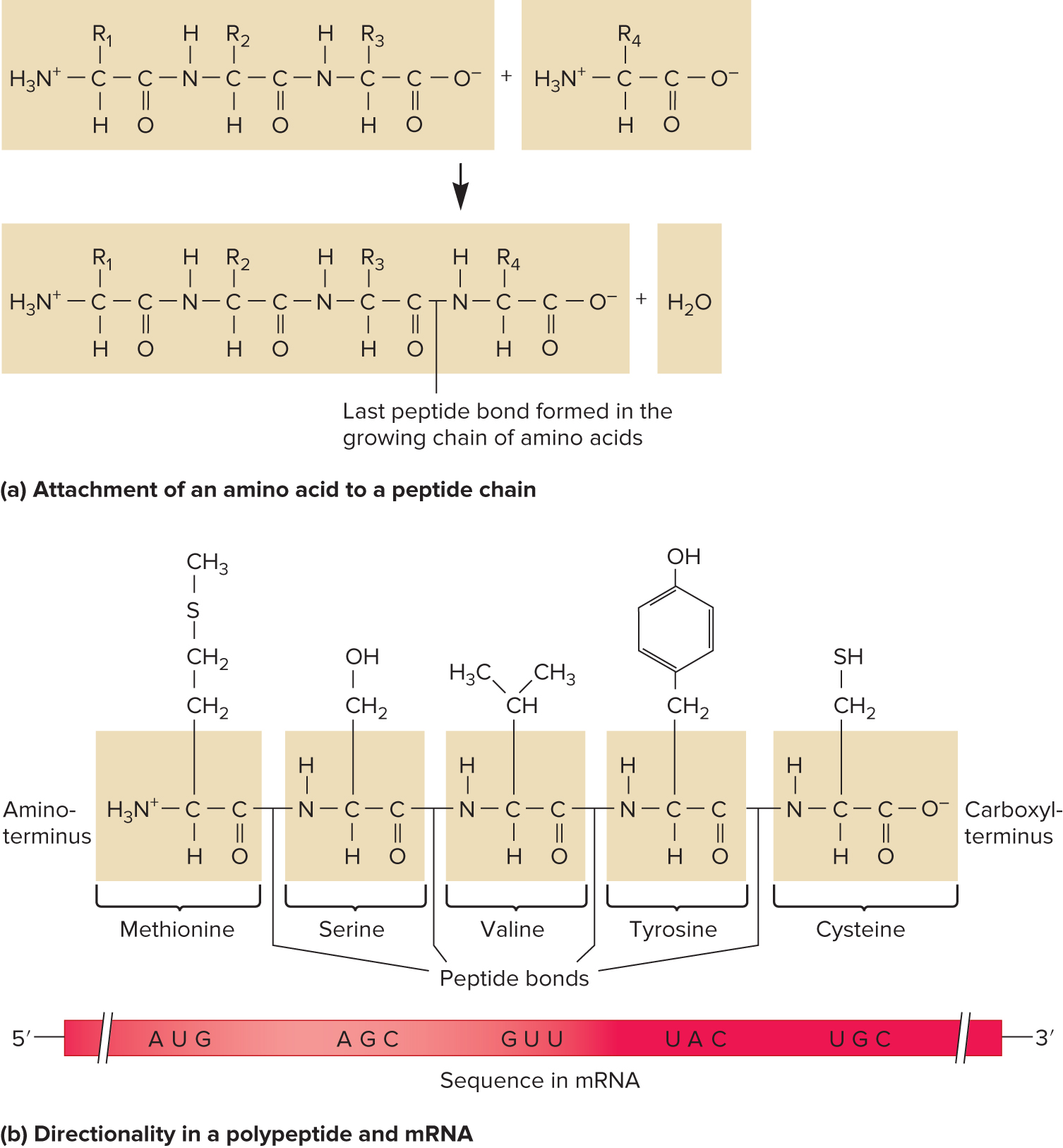
What distinguishes the last amino acid in a polypeptide chain?
It has an exposed carboxyl group, known as C-terminal.
biology structure -
biochemistry polypeptides
-
biochemistry peptide_bonds
-
biochemistry polypeptides
-
biochemistry amino_acids
-
What is the relationship between mRNA and polypeptide directionality?
They both share the same directionality.
biochemistry mrna -
biochemistry genetics
1. The Genetic Basis for Protein Synthesis
• Proteins are crucial for cell structure and function. • Genes that encode polypeptides are called protein-encoding or structural genes. • These genes are transcribed into messenger RNA (mRNA). • The genetic material's primary role is to encode the production of cellular proteins. • Proper cell, timing, and quantity are vital for protein production.
2. Archibald Garrod's Contribution
• Garrod proposed a link between genes and protein production in the early 20th century. • He studied patients with metabolic defects, notably alkaptonuria, which causes black urine and skin discoloration. • He identified a missing enzyme, homogentisic acid oxidase, as a cause of this condition and noted it follows a recessive inheritance pattern.
3. Metabolic Pathway of Phenylalanine
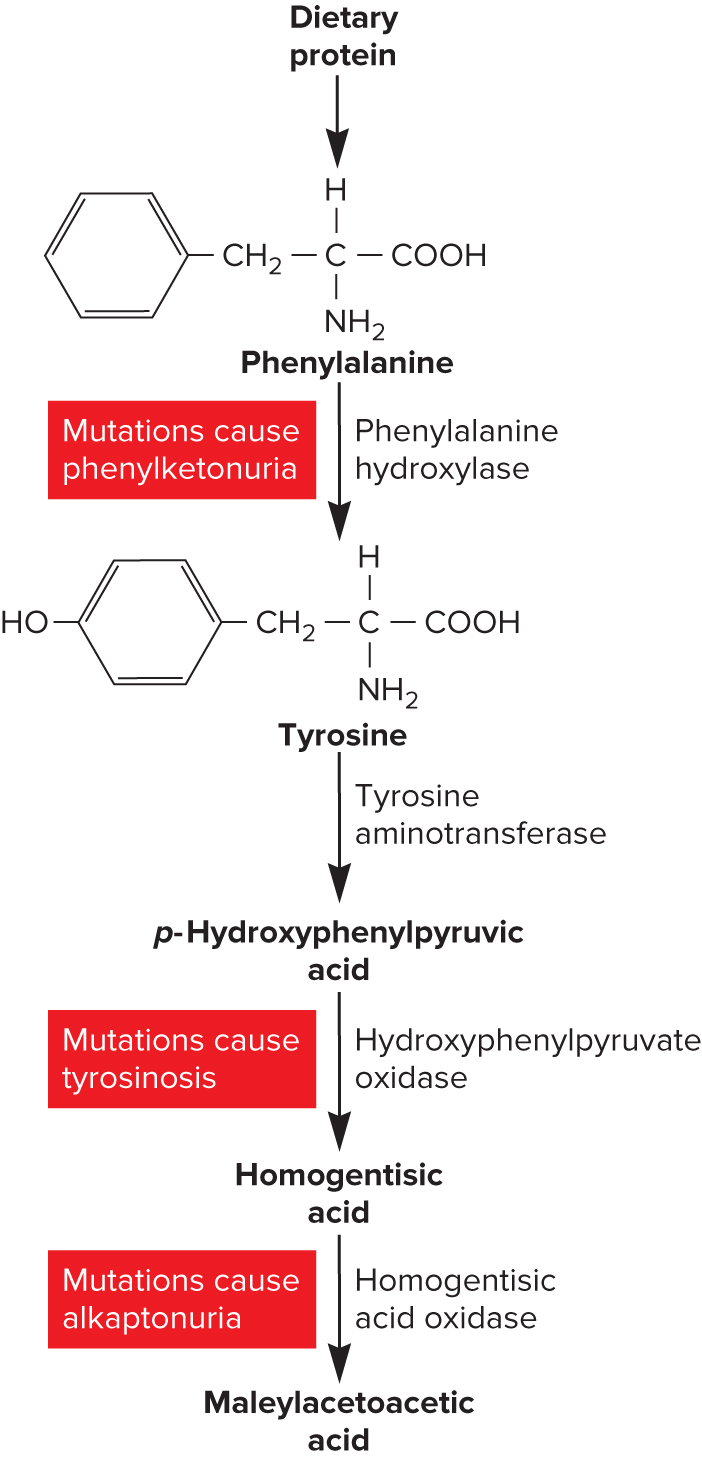
• Diseases arise from mutations leading to missing or defective enzymes.
4. Beadle and Tatum's Experiments
• George Beadle and Edward Tatum explored the link between genes, enzymes, and traits in Neurospora crassa in the 1940s. • They questioned whether one gene controls one enzyme or multiple enzymes. • They analyzed over 2,000 mutated strains for enzyme pathways required for vitamins and amino acids.
5. Growth of Neurospora Strains
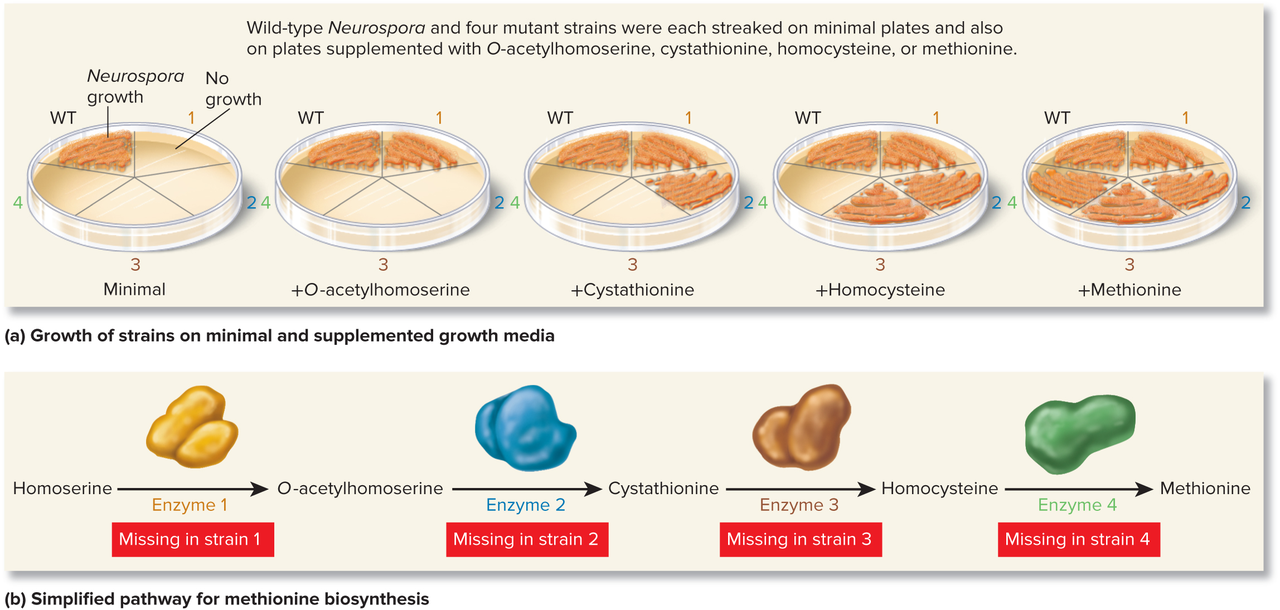
• Growth was tested on minimal and supplemented media, indicating metabolic capabilities based on mutation.
6. One Gene–One Enzyme Hypothesis
• Normal strains synthesize methionine through enzymes, whereas mutant strains have genetic defects affecting protein synthesis. • Beadle and Tatum concluded that each gene corresponds to one enzyme, establishing the one gene–one enzyme hypothesis.
7. Modifications to the One Gene-One Enzyme Theory
• Not all genes encode polypeptides; some produce functional RNA (e.g., tRNA, rRNA). • A single gene can code for multiple polypeptides through alternative splicing.
8. Translation and the Genetic Code
• Translation is the conversion of mRNA nucleotide sequences into amino acid sequences. • Codons are groups of three nucleotides coding for amino acids. • The genetic code consists of vital codons like AUG (start) and stop codons (UAA, UAG, UGA).
9. Exceptions to the Genetic Code
• Selenocysteine and pyrrolysine are often termed the 21st and 22nd amino acids. • They are incorporated by specialized tRNAs corresponding to UGA and UAG codons.
| Codon | Universal Meaning | Exception |
|---|---|---|
| UGA | Stop | Selenocysteine |
| UAG | Stop | Pyrrolysine |
10. Overview of Gene Expression
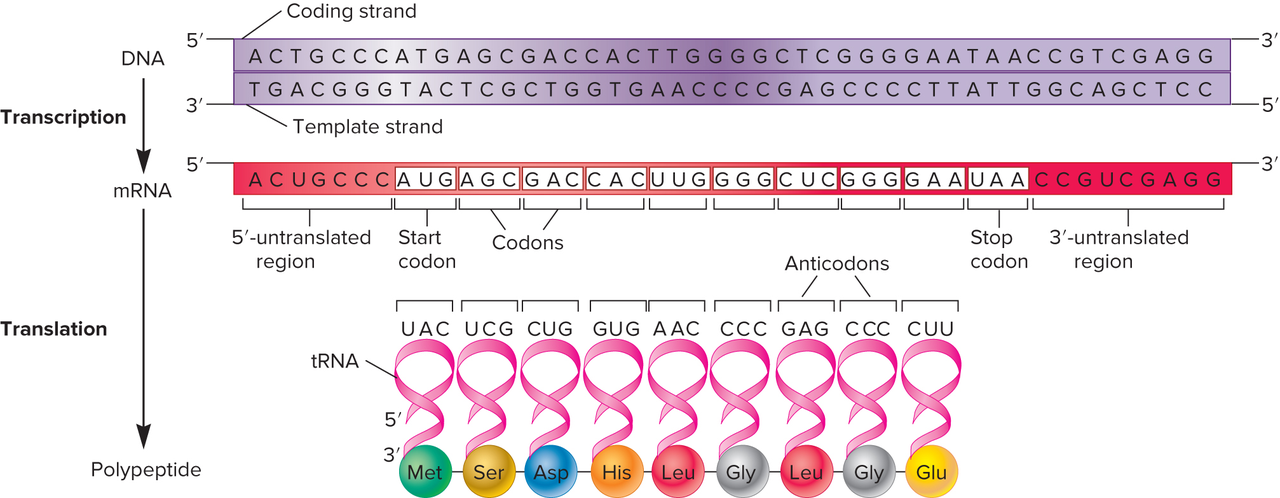
• Gene expression involves DNA transcription to mRNA and translation to polypeptides.
11. Polypeptide Chain Directionality
• Polypeptide synthesis aligns with the 5' to 3' direction of mRNA. • Amino acids link via peptide bonds, forming distinct N-terminal and C-terminal ends.