Sign up to unlock more features
- Save this deck to your account
- Study flashcards with spaced repetition
- Export to Anki (.apkg) or PDF
- Process documents up to 100 pages
- Images extracted from PDFs and documents
- Better text extraction from your PDFs and documents
- Better flashcards with our more advanced AI model
Flashcards in this deck (63)
-
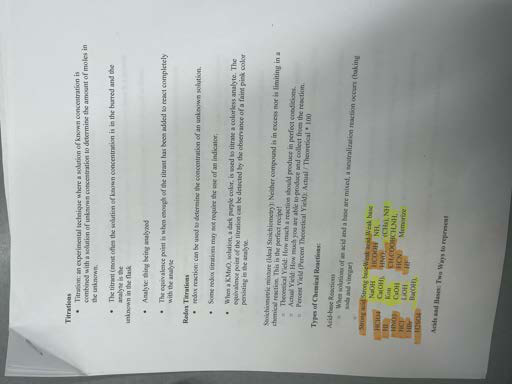
What is a titration?
An experimental technique to determine the concentration of an unknown solution by combining it with a solution of known concentration.
chemistry titration -
What is a titrant?
The solution of known concentration used in titrations, often placed in a burette.
chemistry titration -
chemistry titration
-
What is the equivalence point?
The point in titration where the titrant completely reacts with the analyte.
chemistry titration -
What is a redox titration?
A titration method that involves oxidation-reduction reactions to determine the concentration of an unknown solution.
chemistry redox -
When can redox titrations not require an indicator?
Some redox titrations use solutions like KMnO₄, where color changes indicate the equivalence point.
chemistry redox -
What indicates the equivalence point in a titration using KMnO₄?
The appearance of a faint pink color in a colorless analyte.
chemistry redox -
What is the theoretical yield?
The maximum amount of product expected from a reaction under perfect conditions.
chemistry stoichiometry -
chemistry stoichiometry
-
chemistry stoichiometry
-
In a neutralization reaction, when an acid and a base are mixed, they undergo a reaction. For example, with baking soda and vinegar.
chemistry reactions -
chemistry reactions
-
chemistry acids
-
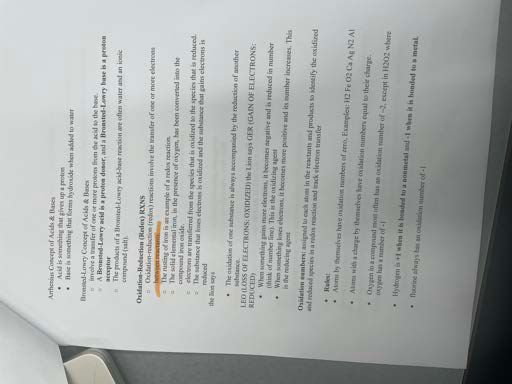
What characterizes a base in the Arrhenius concept?
A base is something that forms hydroxide when added to water.
chemistry bases -
chemistry bronsted-lowry
-
chemistry bronsted-lowry
-
chemistry bronsted-lowry
-
What are the typical products of a Bronsted-Lowry acid-base reaction?
The products are often water and an ionic compound (salt).
chemistry bronsted-lowry -
What do oxidation-reduction (redox) reactions involve?
They involve the transfer of one or more electrons.
chemistry redox -
chemistry redox
-
chemistry redox
-
chemistry redox
-
chemistry redox
-
chemistry redox
-
What are oxidation numbers used for?
They identify the oxidized and reduced species in a redox reaction.
chemistry oxidation_numbers -
What is the oxidation number of atoms by themselves?
Atoms by themselves have oxidation numbers of zero.
chemistry oxidation_numbers -
What is the common oxidation number of oxygen in compounds?
Oxygen most often has an oxidation number of -2.
chemistry oxidation_numbers -
What is the oxidation number of hydrogen when bonded to a nonmetal?
Hydrogen is +1 when bonded to a nonmetal.
chemistry oxidation_numbers -
chemistry oxidation_numbers
-
chemistry redox
-
chemistry redox
-
What is the electron-transfer process in redox reactions?
Electrons are transferred from the oxidized to the reduced species.
chemistry redox -
chemistry oxidation_numbers
-
chemistry oxidation_numbers
-
What is the oxidation number of hydrogen when bonded to a metal?
Hydrogen is -1 when bonded to a metal.
chemistry oxidation_numbers -
chemistry oxidation
-
chemistry oxidation
-
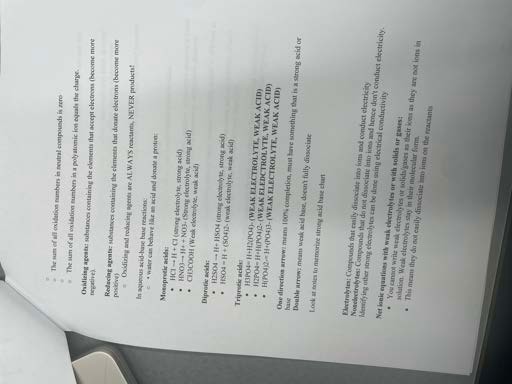
What are oxidizing agents?
Substances that contain elements that accept electrons (becoming more negative).
chemistry oxidation -
What are reducing agents?
Substances that contain elements that donate electrons (becoming more positive).
chemistry oxidation -
chemistry oxidation
-
chemistry acid-base
-
chemistry acids
-
chemistry acids
-
chemistry acids
-
What does a one-direction arrow in reactions indicate?
It indicates 100% completion and must involve a strong acid or base.
chemistry reactions -
What does a double arrow in reactions indicate?
It indicates a weak acid-base reaction that doesn't fully dissociate.
chemistry reactions -
chemistry electrolytes
-
What are nonelectrolytes?
Compounds that do not dissociate into ions and hence don't conduct electricity.
chemistry electrolytes -
Net ionic equations with weak electrolytes should not include them as they cannot be represented as ions; they stay in their molecular form.
chemistry equations -
chemistry equations
-
What can be done to measure other strong electrolytes?
Mesifying can be performed using electrical conductivity.
chemistry electrolytes -
What observable characteristic defines weak and strong acids?
Weak acids do not fully dissociate, while strong acids do.
chemistry acids -
What denotes strong acids and bases?
One-direction arrows denote strong acids or bases in reactions.
chemistry acids-bases -
chemistry acids
-
chemistry acids
-
chemistry vapor_pressure
-
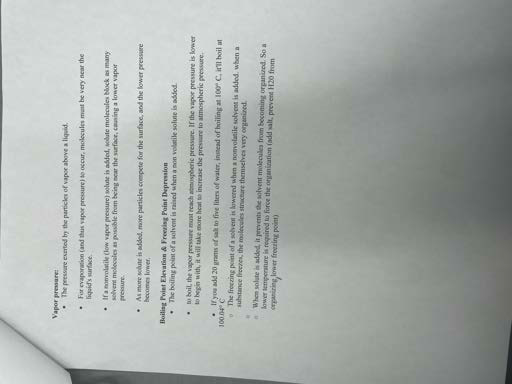
How does a nonvolatile solute affect vapor pressure?
It lowers vapor pressure by blocking solvent molecules from reaching the surface.
chemistry vapor_pressure -
What occurs to the boiling point when a nonvolatile solute is added?
The boiling point of the solvent is raised.
chemistry boiling_point -
chemistry boiling_point
-
What happens to boiling point when you add 20 grams of salt to 5 liters of water?
It will boil at 100.04° C instead of 100° C.
chemistry boiling_point -
How does a nonvolatile solute affect the freezing point?
It lowers the freezing point of the solvent.
chemistry freezing_point -
When a substance freezes, its molecules become very organized. Adding a solute prevents this organization, resulting in a lower freezing point required to force organization. Thus, the freezing point is lowered when a nonvolatile solute is added.
chemistry freezing_point -
What is the effect of adding a nonvolatile solute to a solvent?
Lowers vapor pressure
Lowers boiling point
Lowers freezing point
Raises boiling point
Raises vapor pressure
Does not affect freezing point
chemistry solutions
Titrations
- Titration: Experimental technique combining a known concentration solution (titrant) with an unknown concentration solution (analyte).
- Analyte: Substance being analyzed.
- Equivalence Point: The point at which the titrant completely reacts with the analyte.
Redox Titrations
- Redox Reaction: Utilized for determining the concentration of unknown solutions.
- Indicator: Some titrations do not require it; for example, using KMnO₄ with a colorless analyte shows a faint pink at the equivalence point.
Stoichiometric Mixture
- Theoretical Yield: Expected amount of product in perfect conditions.
- Actual Yield: Amount produced in practice.
- Percent Yield: \( ext{Percent Yield} = rac{ ext{Actual Yield}}{ ext{Theoretical Yield}} imes 100 \)
Types of Chemical Reactions
Acid-base Reactions
- Mixing an acid and a base results in a neutralization reaction.
| Strong Acid | Strong Base | Weak Acid | Weak Base |
|---|---|---|---|
| HCl | NaOH | HCOOH | NH₃ |
| HNO₃ | KOH | CH₃COOH | (CH₃)₂NH |
| H₂SO₄ | Ca(OH)₂ | HF | CH₃NH₂ |
| HClO₄ | LiOH | NH₄OH | |
| Ba(OH)₂ | Memorize |
Acid & Base Concepts
Arrhenius Concept
- Acid: Gives up a proton.
- Base: Forms hydroxide in water.
Bronsted-Lowry Concept
- Acid: Proton donor.
- Base: Proton acceptor.
Oxidation-Reduction (Redox) Reactions
- Involve electron transfer.
- Example: Rusting of iron forms iron oxide.
- LEO (Loss of Electrons: Oxidized) GER (Gain of Electrons: Reduced).
- Oxidation numbers help track electron transfers.
Oxidation Number Rules
- Atoms alone = 0.
- Charge equals oxidation number.
- Oxygen = -2 (except in H₂O₂: -1).
- Hydrogen = +1 (to nonmetals), -1 (to metals).
- Fluorine = -1.
Agents in Redox Reactions
- Oxidizing Agent: Accepts electrons (gets more negative).
- Reducing Agent: Donates electrons (gets more positive).
Acid Types
Monoprotic Acid
- Example: HCl (strong acid).
Diprotic Acids
- Example: H₂SO₄ → H⁺ + HSO₄⁻.
Triprotic Acid
- Example: H₃PO₄ → H⁺ + H₂PO₄⁻.
Electrolytes
- Electrolytes: Dissociate into ions and conduct electricity.
- Nonelectrolytes: Do not dissociate and do not conduct electricity.
Vapor Pressure
- Vapor pressure is the pressure of vapor above a liquid.
- Nonvolatile Solute: Lowers vapor pressure by blocking solvent from the surface.
Boiling Point Elevation & Freezing Point Depression
- Boiling point increases and freezing point decreases with added nonvolatile solutes due to intermolecular interactions.
Useful Visuals