Sign up to unlock more features
- Save this deck to your account
- Study flashcards with spaced repetition
- Export to Anki (.apkg) or PDF
- Process documents up to 100 pages
- Images extracted from PDFs and documents
- Better text extraction from your PDFs and documents
- Better flashcards with our more advanced AI model
What happens to the thyroid gland in Graves disease (toxic goiter)?
By how much is metabolic rate increased in hyperthyroidism as stated in the text?
Why do patients with hyperthyroidism develop heat intolerance?
What causes the warm, red, soft, wet skin in hyperthyroidism?
List the main cardiac symptoms of hyperthyroidism mentioned in the text.
What nervous system symptoms occur in hyperthyroidism?
What causes the fine tremor of the outstretched fingers in hyperthyroidism?
Why do patients with hyperthyroidism often lose weight despite increased appetite?
What explains diarrhea in hyperthyroidism?
What causes muscular weakness in hyperthyroidism?
What causes exophthalmos in Graves disease?
Does exophthalmos in Graves disease resolve with treatment according to the text?
What is hypothyroidism?
What is myxedema?
What is cretinism?
How does decreased metabolic rate present in adult hypothyroidism?
What skin and appendage changes occur in myxedema?
What causes the edematous 'myxedema' appearance in hypothyroidism?
How is the voice affected in myxedema?
What musculoskeletal symptoms occur in myxedema?
What are the cardiovascular effects of myxedema?
Why does hypoventilation occur in hypothyroidism?
What gastrointestinal symptom is common in myxedema and why does weight increase?
Show an illustrative image of myxedema manifestations.
What nervous system and mental changes occur in adult myxedema (hypothyroidism)?
What is the cause of anemia in myxedema described in the text?
How does lack of thyroid hormone lead to arteriosclerosis in myxedema?
What physical signs of primary myxedema are listed in the illustration transcript?
What causes cretinism?
What is the main characteristic of cretinism?
Why might a newborn with congenital absence of the thyroid appear normal at birth?
What changes occur a few weeks after birth in an infant with cretinism?
Name three neurological consequences of hypothyroidism in infants.
What mental problems can result from cretinism and when are they irreversible?
List key physical signs of cretinism related to growth and development.
Describe the typical body and facial appearance of a child with cretinism.
Flashcards in this deck (36)
-
What happens to the thyroid gland in Graves disease (toxic goiter)?
- Thyroid is diffusely enlarged and active
- Cell number increases
- Each cell increases its rate of secretion
endocrine graves goiter -
By how much is metabolic rate increased in hyperthyroidism as stated in the text?
60–100% above normal
metabolism hyperthyroidism -
Why do patients with hyperthyroidism develop heat intolerance?
Because of increased metabolic rate leading to increased heat production
symptoms thermoregulation -
What causes the warm, red, soft, wet skin in hyperthyroidism?
Increased sweating and cutaneous vasodilation from high metabolic end products
skin hyperthyroidism -
List the main cardiac symptoms of hyperthyroidism mentioned in the text.
- Tachycardia
- Palpitation
- Increased cardiac output
- Increased pulse pressure
cardiac hyperthyroidism -
What nervous system symptoms occur in hyperthyroidism?
- Nervousness, irritability, anxiety, restlessness
- Extreme fatigue with inability to sleep
- Fine tremors of outstretched fingers
nervous hyperthyroidism -
What causes the fine tremor of the outstretched fingers in hyperthyroidism?
Increased activity of areas that control muscle tone
tremor neuromuscular -
Why do patients with hyperthyroidism often lose weight despite increased appetite?
Because of high metabolism leading to weight loss despite increased appetite
weight metabolism -
What explains diarrhea in hyperthyroidism?
Increased movement (motility) of the gastrointestinal tract
gastrointestinal hyperthyroidism -
muscle metabolism
-
What causes exophthalmos in Graves disease?
- Edematous swelling of retro-orbital tissues
- Degenerative changes in extraocular muscles
- Autoimmune antibodies reacting with extraocular muscle protein
exophthalmos autoimmune -
Does exophthalmos in Graves disease resolve with treatment according to the text?
Yes, it disappears with treatment
treatment exophthalmos -
endocrine hypothyroidism
-
endocrine myxedema
-
endocrine cretinism
-
How does decreased metabolic rate present in adult hypothyroidism?
- Weight gain
- Decreased tolerance to cold
clinical metabolism -
What skin and appendage changes occur in myxedema?
- Dry, cold, yellowish skin (carotenaemia)
- Brittle nails
- Coarse, sparse hair
clinical skin -
What causes the edematous 'myxedema' appearance in hypothyroidism?
Increased mucopolysaccharide in interstitial space causing increased interstitial fluid and generalized edema.
pathology edema -
clinical voice
-
clinical muscles
-
What are the cardiovascular effects of myxedema?
Decreased heart rate, decreased cardiac output, and decreased blood flow.
clinical cardiology -
Why does hypoventilation occur in hypothyroidism?
Hypoventilation occurs because muscle weakness decreases respiratory effort.
clinical respiration -
What gastrointestinal symptom is common in myxedema and why does weight increase?
Constipation due to decreased colonic motility; weight increases despite loss of appetite.
clinical gastrointestinal -
Show an illustrative image of myxedema manifestations.
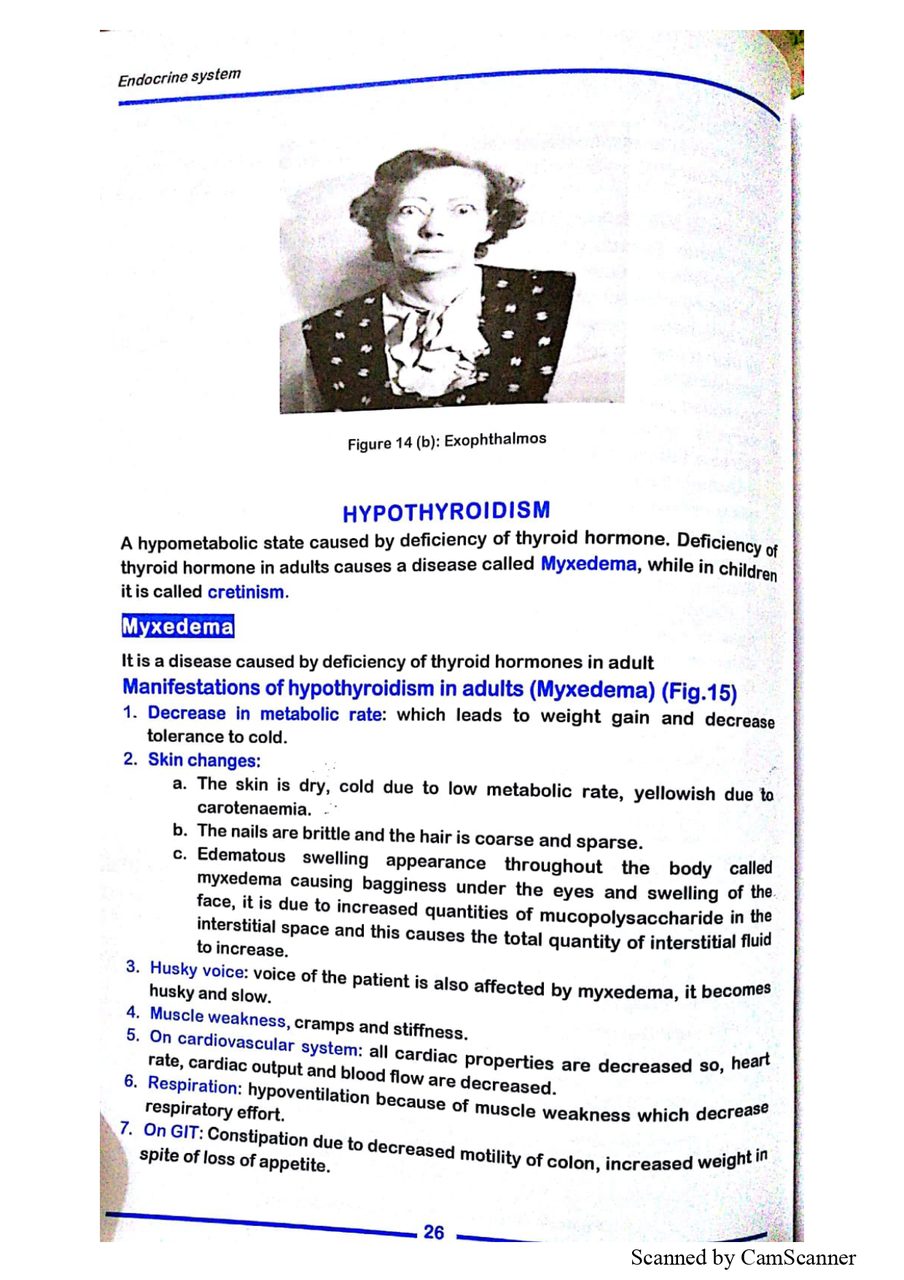 - Photograph and brief text illustrating myxedema featuresmedia myxedema
 -
What nervous system and mental changes occur in adult myxedema (hypothyroidism)?
- Slow thinking
- Poor memory
- Apathy (appears apathetic)
- Rapid fatigue
- Extreme somnolence (sleeping 14-16 hours/day)
neurology hypothyroidism -
What is the cause of anemia in myxedema described in the text?
Anemia due to decreased bone marrow activity
hematology hypothyroidism -
How does lack of thyroid hormone lead to arteriosclerosis in myxedema?
Lack of thyroid hormone increases blood lipids, especially cholesterol, leading to arteriosclerosis with peripheral vascular disease, deafness, and often extreme coronary sclerosis
cardiology hypothyroidism lipids -
What physical signs of primary myxedema are listed in the illustration transcript?
- Dry hair
- Lethargy
- Edema
- Thick tongue
- Slow speech
- Diminished perspiration
- Coarse skin
- Slow pulse
- Enlarged heart
- Menorrhagia
- Ascites
- Weakness
signs hypothyroidism -
endocrine cretinism
-
cretinism growth
-
Why might a newborn with congenital absence of the thyroid appear normal at birth?
Because the mother supplied some thyroid hormones in utero.
neonatology thyroid -
What changes occur a few weeks after birth in an infant with cretinism?
Movements become sluggish due to low metabolic rate and physical and mental growth are greatly retarded.
clinical thyroid -
Name three neurological consequences of hypothyroidism in infants.
Abnormal synapsis development, defective myelination, and mental retardation.
neurodevelopment hypothyroidism -
What mental problems can result from cretinism and when are they irreversible?
Mental retardation leading to speech defects and urinary/fecal incontinence; changes are irreversible if replacement therapy is not begun soon after birth.
therapy prognosis -
List key physical signs of cretinism related to growth and development.
- Delayed eruption of teeth
- Delayed sitting and walking
- Delayed closure of fontanels
physical development -
Describe the typical body and facial appearance of a child with cretinism.
Obese, stocky, short child; swollen eyelids, depressed nose with wide nostrils, enlarged protruding tongue between thick lips, and a bulging abdomen.
appearance signs
Thyroid disorders — Hyperthyroidism and Hypothyroidism
Overview
- The thyroid controls metabolic rate via thyroid hormones (T3/T4); disorders cause systemic metabolic and developmental effects.
- Focus: clinical features, basic mechanisms, and key differences between hyperthyroidism (Graves/toxic goiter) and hypothyroidism (myxedema, cretinism).
Hyperthyroidism (Graves disease / Toxic goiter)
Definition & pathophysiology - Excess thyroid hormone production from diffuse gland hyperactivity (Graves) or toxic nodules. - In Graves disease an autoimmune process (thyroid-stimulating immunoglobulins) increases thyroid cell number and secretion rate. - Metabolic rate typically rises by about \(60-100\%\) compared with normal, producing multisystem effects.
Major clinical manifestations and mechanisms 1. Goiter: diffuse, hyperactive thyroid due to increased cell number and secretion. 2. Heat intolerance & increased sweating: from raised metabolic heat production and vasodilation. 3. Cardiovascular: tachycardia, palpitations, increased cardiac output and widened pulse pressure from increased metabolism. 4. Weight loss with increased appetite: high basal metabolic rate causes catabolism despite hunger. 5. Nervousness & tremor: anxiety, restlessness, insomnia and fine tremor due to increased central and motor activity. 6. Gastrointestinal: diarrhea from increased gut motility. 7. Muscle weakness: protein catabolism causes weakness. 8. Exophthalmos: autoimmune-mediated edema of retro-orbital tissues and extraocular muscle changes cause protruding eyes; often improves with treatment.
Illustration
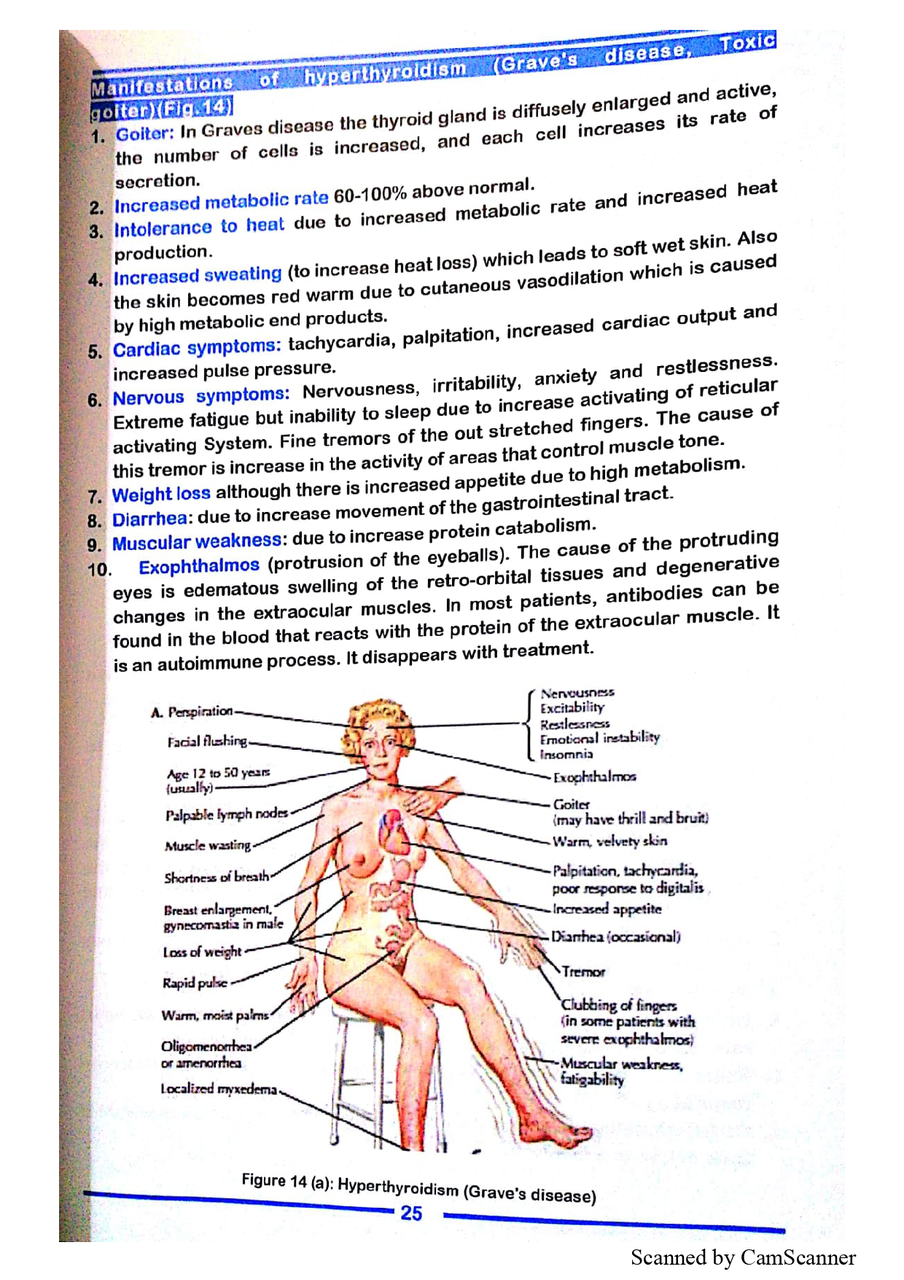 Alt: Illustration of hyperthyroidism signs (goiter, exophthalmos, tremor).
Hypothyroidism
Definition - Hypometabolic state from inadequate thyroid hormone; timing determines clinical syndrome: myxedema in adults and cretinism in infants/children.
Myxedema (adult hypothyroidism)
Pathophysiology - Reduced thyroid hormone lowers basal metabolic rate and alters protein/lipid metabolism. - Interstitial accumulation of mucopolysaccharides causes non-pitting edema (myxedema).
Major clinical features and mechanisms 1. Low metabolic rate: weight gain, cold intolerance. 2. Skin and appendages: dry, cold, yellowish skin (carotenemia), brittle nails, coarse sparse hair. 3. Edema (myxedema): generalized mucopolysaccharide deposition causes facial puffiness and periorbital bagginess. 4. Voice and neuromuscular: husky/slow voice, muscle weakness, cramps, stiffness. 5. Cardiorespiratory: bradycardia, reduced cardiac output, possible hypoventilation from weak respiratory muscles. 6. Gastrointestinal: constipation from decreased motility despite weight gain. 7. Other: anemia from reduced marrow activity; hyperlipidemia leading to arteriosclerosis and cardiovascular risk.
Illustration
Alt: Photograph showing features of myxedema (facial puffiness, dry skin).
Cretinism (congenital hypothyroidism)
Essence - Severe thyroid deficiency during fetal life/early childhood causes irreversible deficits in growth and brain development if untreated.
Key features - Mental retardation: defective synapse formation and myelination → impaired cognition, speech defects, incontinence; largely irreversible if therapy delayed. - Physical retardation: delayed tooth eruption, late motor milestones, delayed fontanel closure; short, stocky build, large tongue, coarse facial features, protuberant abdomen.
Illustration
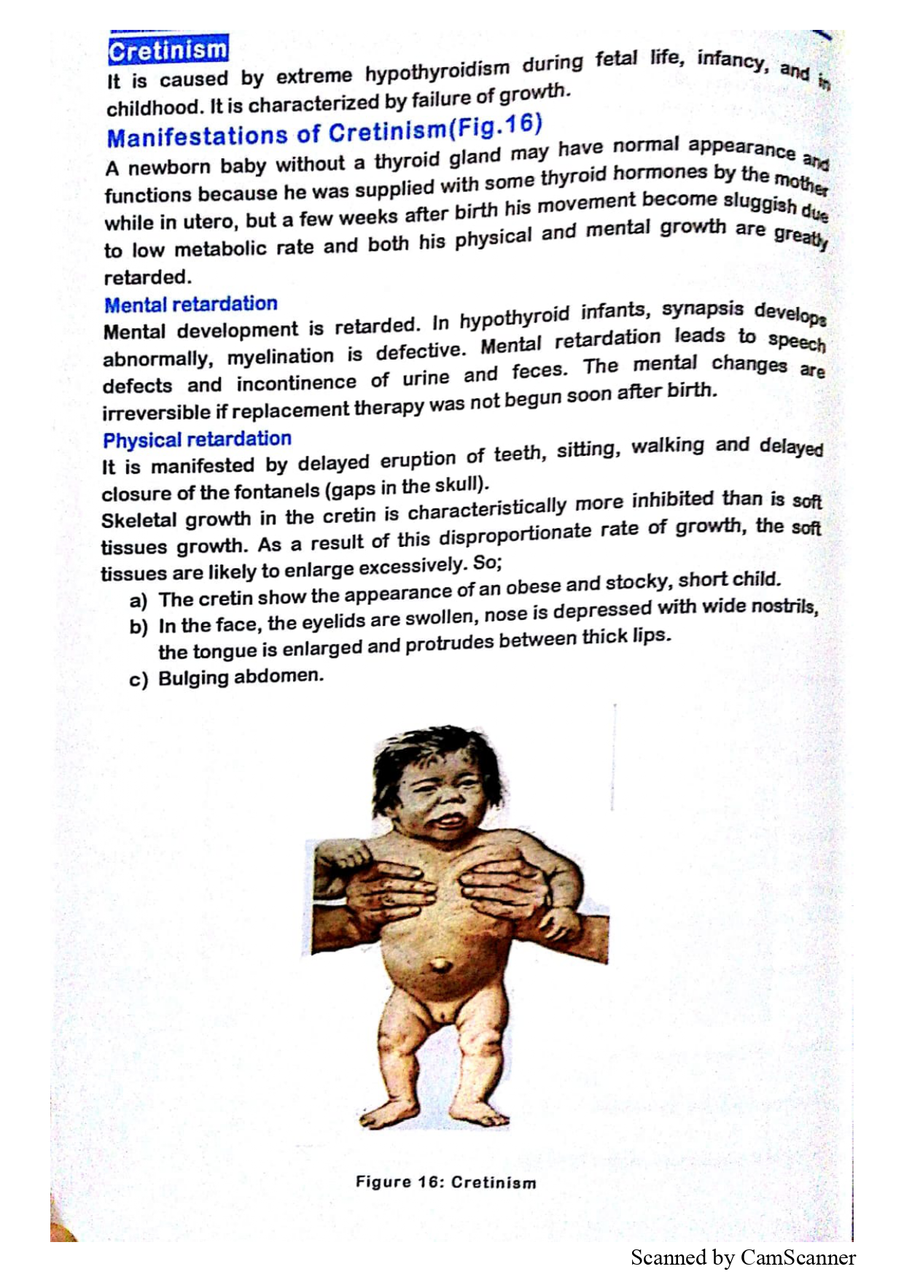 Alt: Infant with features of cretinism (large tongue, facial edema).
Quick comparison (key contrasts)
| Feature | Hyperthyroidism | Hypothyroidism (Myxedema) |
|---|---|---|
| Metabolic rate | Increased (≈ \(60-100\%\)) | Decreased |
| Weight | Loss, increased appetite | Gain, decreased appetite |
| Temperature tolerance | Heat intolerance, sweating | Cold intolerance, dry skin |
| Heart rate | Tachycardia, high output | Bradycardia, low output |
| Neurologic | Restless, tremor, insomnia | Slowed thinking, somnolence |
| Eyes | Exophthalmos (autoimmune) | No exophthalmos; facial puffiness |
Clinical relevance / Key points to remember
- Graves disease is autoimmune; exophthalmos arises from retro-orbital inflammation and edema.
- Myxedema is characterized by mucopolysaccharide deposition producing non-pitting edema.
- Cretinism requires early detection and thyroid replacement to prevent irreversible neurodevelopmental damage.
- Many systemic signs reflect changes in basal metabolic rate; treatment reverses most but timing matters for developmental outcomes.
Mnemonics & study tips
- Hyperthyroid: think "hot, sweaty, thin, tachycardic, tremor, tense".
- Hypothyroid (myxedema): think "cold, dry, fat, slow, puffy, husky voice".