Save your deck before it's gone
These flashcards aren't stored yet — they'll disappear when you leave. Create a free account to keep them, and unlock everything below.
- Save this deck to your account
- Study with spaced repetition
- Export to Anki (.apkg) or PDF
- Process documents up to 100 pages
- Images extracted from your PDFs
- Sharper text extraction & a more advanced AI model
Flashcards in this deck (36)
-
What does the autonomic nervous system regulate?
It regulates involuntary bodily functions.
nervous_system physiology -
What are the main subdivisions of the autonomic nervous system?
- Sympathetic nervous system
- Parasympathetic nervous system
- Enteric nervous system
nervous_system subdivisions -
What is the role of the Enteric Nervous System?
It operates independently to control the gastrointestinal system.
nervous_system enteric -
The autonomic nervous system consists of the following parts: - Sympathetic nervous system - Parasympathetic nervous system - Enteric nervous system.
nervous_system functions -
The autonomic nervous system is primarily responsible for the regulation of involuntary functions in the human body.
nervous_system regulation -
What distinguishes involuntary control from voluntary control in the nervous system?
Involuntary control is automatic, while voluntary control requires conscious effort.
nervous_system control -
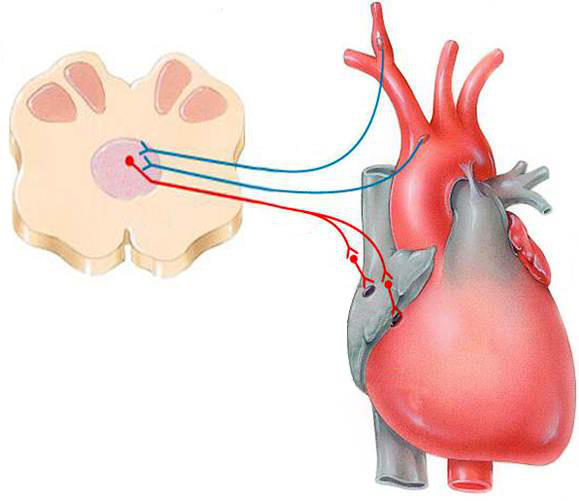
What does the diagram in Chapter 15 illustrate?
It illustrates the autonomic nervous system's control over the heart.
nervous_system diagram -
What are the 3 fundamental steps of the nervous system?
- Detection of stimuli
- Interpretation of stimuli
- Motor response to stimuli
nervous_system fundamentals -
What does the Central Nervous System (CNS) consist of?
- Brain
- Spinal cord
anatomy cns -
What are the components of the Peripheral Nervous System (PNS)?
- All nervous tissue outside the CNS
anatomy pns -
What is the Somatic Nervous System (SNS) responsible for?
- Voluntary control of skeletal muscle
- Somatic sensory receptors and neurons
sns voluntary -
What does the Autonomic Nervous System (ANS) control?
- Involuntary control
- Smooth muscle, cardiac muscle, glands
involuntary ans -
What differentiates the sympathetic and parasympathetic divisions of the ANS?
- Sympathetic: prepares body for stress
- Parasympathetic: promotes rest and digestion
divisions ans -
What functions does the Enteric Nervous System (ENS) control?
- Involuntary control of GI tract
- Smooth muscle, glands, and endocrine cells
ens gi_tract -
The Central Nervous System (CNS) comprises the: - brain - spinal cord.
anatomy cns -
The Peripheral Nervous System (PNS) includes all nervous tissue outside the CNS.
pns definition -
The Autonomic Nervous System (ANS) regulates involuntary functions such as: - Smooth muscle - Cardiac muscle - Glands
functions ans -
The Enteric Nervous System (ENS) controls the functions of the GI tract.
ens gi_tract -
How is the Enteric Nervous System (ENS) characterized?
- Independent
- Controls gastrointestinal functions
ens independence -
What are the two main types of neurons in the ANS?
- Autonomic sensory neurons
- Autonomic motor neurons
ans neurons -
What type of control does the Somatic Nervous System (SNS) involve?
- Voluntary control of skeletal muscle
sns control -
What are the two main subdivisions of the nervous system?
CNS (Central Nervous System) and PNS (Peripheral Nervous System)
nervous_system pns cns -
What does the PNS consist of?
All nervous tissue outside the CNS, including SNS, ANS, and ENS.
nervous_system pns -
What are the primary components of the CNS?
The brain and spinal cord.
nervous_system cns -
What does the Somatic Nervous System (SNS) include?
Somatic and special sensory receptors, somatic sensory neurons, and somatic motor neurons.
nervous_system sns -
What is the function of Somatic motor neurons?
They control voluntary movements of skeletal muscles.
nervous_system motor_neurons -
What does the Autonomic Nervous System (ANS) regulate?
Involuntary bodily functions through sympathetic and parasympathetic divisions.
nervous_system ans -
What muscle types does the ANS affect?
Smooth muscle, cardiac muscle, and glands.
nervous_system muscle_types -
What is the role of the Enteric Nervous System (ENS)?
It controls involuntary functions within the GI tract.
nervous_system ens -
What does the ENS include?
Enteric motor neurons, sensory receptors, and neurons in GI tract.
nervous_system enteric -
What does ENS stand for?
Enteric Nervous System
nervous_system biology -
Where is the enteric nervous system located?
Within the wall of the gastrointestinal tract
nervous_system biology anatomy -
The enteric nervous system (ENS) is an independent network forming within the wall of the gastrointestinal tract.
nervous_system biology -
Is the enteric division discussed in this chapter?
No, it will be discussed in Chapter 24.
nervous_system biology -
What is the role of the autonomic nervous system?
Regulates involuntary bodily functions.
nervous_system autonomic biology -
What are some core concepts of the autonomic nervous system?
- Central Nervous System overview
- Peripheral Nervous System structure
- Functions of the Autonomic Nervous System
- Involuntary vs. voluntary control
- Enteric Nervous System independence
nervous_system autonomic biology
Chapter 15: The Autonomic Nervous System
Overview of the Nervous System
The nervous system consists of three main parts: 1. Central Nervous System (CNS): Brain and spinal cord. 2. Peripheral Nervous System (PNS): All other nervous tissue. - Somatic Nervous System (SNS): Controls voluntary movements. - Autonomic Nervous System (ANS): Regulates involuntary actions. Contains: - Sympathetic Division: Activates fight or flight response. - Parasympathetic Division: Promotes rest and digestion. - Enteric Nervous System (ENS): Independent nerve network in the GI tract.
Functions of Nervous System
Fundamental Steps:
- Detection: Sensory function identifies stimuli.
- Interpretation: Analysis of the stimuli.
- Reaction: Motor response triggered.
Central and Peripheral Nervous Systems
Central Nervous System (CNS)
- Comprises the brain and spinal cord.
Peripheral Nervous System (PNS)
- All nervous tissue outside the CNS, divided into:
- Somatic Nervous System (SNS): Involves sensory and motor pathways for voluntary control of skeletal muscles.
- Autonomic Nervous System (ANS): Controls involuntary actions of smooth muscles, cardiac muscles, and glands.
- Enteric Nervous System (ENS): Governs the gastrointestinal functions, consisting of enteric neurons.
Introduction to the Autonomic Nervous System
The Autonomic Nervous System (ANS) is crucial for involuntary physiological functions, controlling: - Smooth muscle - Cardiac muscle - Glandular secretions
The Enteric Nervous System (ENS) operates independently within the gastrointestinal tract but is not detailed here; it will be revisited in Chapter 24.
Key Concepts and Diagrams
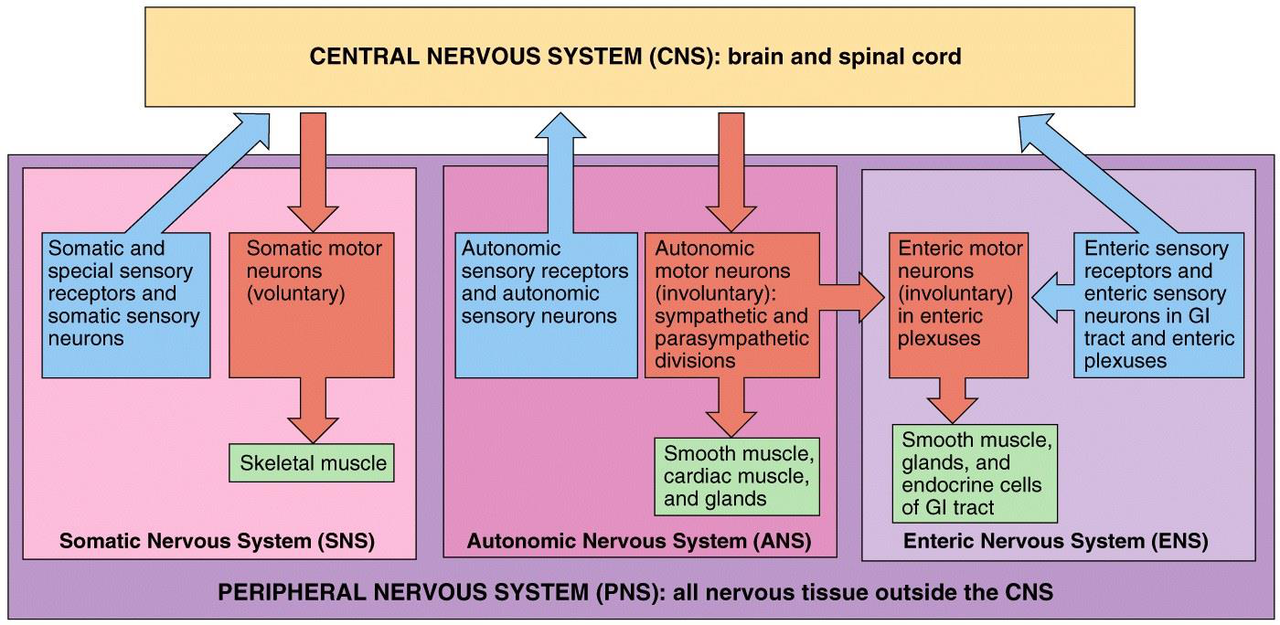
Summary of Nervous Systems:
- CNS: Brain and spinal cord.
- PNS: Divided into SNS, ANS, and ENS.
- SNS: Voluntary control.
- ANS: Involuntary control, sympathetic and parasympathetic responses.