더 많은 기능을 잠금 해제하려면 가입하세요
- 이 덱을 계정에 저장하기
- 간격 반복으로 플래시카드 공부하기
- Anki(.apkg) 또는 PDF로 내보내기
- 문서 최대 100페이지까지 처리 가능
- PDF와 문서에서 이미지 추출
- PDF와 문서에서 더 정확한 텍스트 추출
- 더 발전된 AI 모델로 더 나은 플래시카드 생성
What is motivation?
What are instincts?
What does the Instinct Theory state?
Define arousal in behavioral science.
What is the Optimal Arousal principle?
What are drives?
Differentiate primary and secondary drives.
What is the Drive Reduction Theory?
List the levels of Maslow's Hierarchy of Needs.
What is self-actualization?
What three universal needs does Self-Determination Theory emphasize?
What does the Incentive Theory explain about motivation?
What determines motivation in the Expectancy-Value Theory?
What does the Opponent-Process Theory explain about drug use?
What is the House Money Effect in decision making?
What is the Gambler's Fallacy?
What does the Prisoner's Dilemma illustrate?
Define emotion.
What are the three components of emotion?
Name the 7 universal emotions.
What does the James-Lange Theory propose about emotion?
What does the Cannon-Bard Theory propose?
What is the Schachter-Singer (Two-Factor) Theory of emotion?
Which brain system is concerned with instincts and mood?
What is stress?
What are the two stages of Stress Appraisal?
What are stressors and their possible outcomes?
What is the General Adaptation Syndrome and its stages?
Which systems are involved in the General Adaptation Syndrome and what hormone increases?
Name the three major psychological theories of emotion.
What does Maslow's pyramid visually represent?
What is self-concept?
What are identities in relation to self-concept?
How is self-esteem related to the actual, ideal, and ought selves?
Define self-efficacy.
What is learned helplessness?
Contrast internal and external locus of control.
Summarize Freud's view on personality development.
List Erikson's stage for adolescence (age ~12–20).
What does Kohlberg's theory focus on?
Define Vygotsky's Zone of Proximal Development.
What is a reference group?
Give the three levels in Freud's structural model of personality.
How do the id, ego, and superego operate with respect to consciousness?
What does Jung propose about the unconscious?
What motivation source do Adler and Horney emphasize?
State the humanistic view of personality.
Name two humanistic concepts mentioned.
What do type theories and trait theories describe?
List the Big Five personality traits (OCEAN).
What are cardinal, central, and secondary traits?
Summarize the social-cognitive (reciprocal determinism) perspective.
What does the behaviorist perspective say about personality development?
Use the Freud iceberg diagram to explain levels of consciousness (image on answer).
Use the Id/Ego/Superego illustration to summarize their roles (image on answer).
이 덱의 플래시카드 (55)
-
motivation
-
motivation instincts
-
What does the Instinct Theory state?
Instinct Theory: People perform behaviors because of their evolutionarily programmed instincts
motivation theory -
arousal
-
What is the Optimal Arousal principle?
Optimal Arousal: Optimal performance requires optimal arousal; levels too high or too low impede performance
arousal performance -
motivation drives
-
Differentiate primary and secondary drives.
- Primary drives: Related to biological processes
- Secondary drives: Stem from learning
drives -
What is the Drive Reduction Theory?
Drive Reduction Theory: Motivation arises from the desire to eliminate drives that create uncomfortable internal states
motivation theory -
List the levels of Maslow's Hierarchy of Needs.
- Physiological
- Safety and security
- Love and belonging
- Self-esteem
- Self-actualization
maslow motivation -
maslow self-actualization
-
What three universal needs does Self-Determination Theory emphasize?
- Autonomy
- Competence
- Relatedness
motivation self-determination -
What does the Incentive Theory explain about motivation?
Incentive Theory: Motivation is the desire to pursue rewards and avoid punishments
motivation incentive -
What determines motivation in the Expectancy-Value Theory?
Motivation is based on the expectation of success and the value of that success
motivation expectancy-value -
What does the Opponent-Process Theory explain about drug use?
As drug use increases, the body counteracts its effects, producing tolerance and uncomfortable withdrawal symptoms
motivation opponent-process -
What is the House Money Effect in decision making?
After a prior gain, people become more open to assuming risk because the new money is not treated as one's own
decision-making bias -
What is the Gambler's Fallacy?
Belief that if an event happens more frequently than normal, it will happen less frequently in the future, or vice versa
bias decision-making -
What does the Prisoner's Dilemma illustrate?
Two people acting in self-interest can produce worse outcomes than if they had cooperated
social game-theory -
Define emotion.
Emotion: A state of mind or feeling, subjectively experienced based on circumstances, mood, and relationships
emotion -
What are the three components of emotion?
- Cognitive: Subjective
- Physiological: Changes in autonomic nervous system
- Behavioral: Facial expressions and body language
emotion components -
emotion universal
-
What does the James-Lange Theory propose about emotion?
Behavioral and physiological actions lead to emotions (physiological response precedes emotion)
emotion james-lange -
What does the Cannon-Bard Theory propose?
Emotional and physiological responses to a stimulus occur simultaneously and arise from separate brain areas
emotion cannon-bard -
What is the Schachter-Singer (Two-Factor) Theory of emotion?
Physiological arousal plus interpretation of context (cognitive label) lead to emotion
emotion schachter-singer -
Which brain system is concerned with instincts and mood?
Limbic System: Concerned with instincts and mood
neuroscience limbic -
stress
-
What are the two stages of Stress Appraisal?
- Primary Appraisal: Classifying a potential stressor as irrelevant, benign-positive, or stressful
- Secondary Appraisal: Evaluating if the organism can cope with the stress
stress appraisal -
What are stressors and their possible outcomes?
Stressors: Anything that leads to a stress response; can lead to distress or eustress
stress stressors -
What is the General Adaptation Syndrome and its stages?
General Adaptation Syndrome: Specific stressors generate the same general physical stress response; stages: Alarm, Resistance, Exhaustion
stress gas -
Which systems are involved in the General Adaptation Syndrome and what hormone increases?
Both the sympathetic nervous system and the endocrine system are involved; release of ACTH leads to increased cortisol
stress neuroendocrine -
Name the three major psychological theories of emotion.
- James-Lange Theory
- Cannon-Bard Theory
- Schachter-Singer Two-Factor Theory
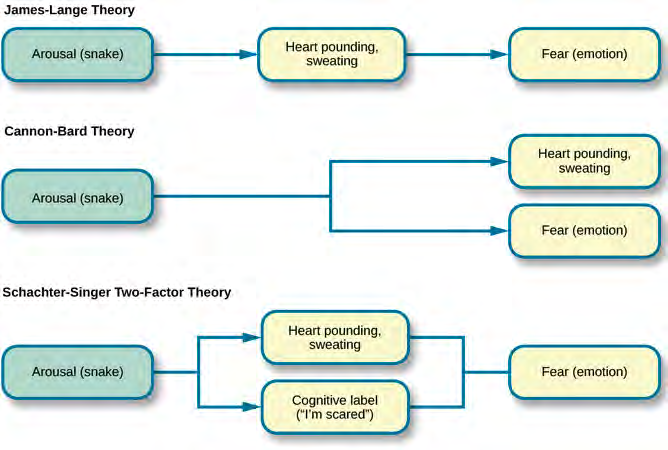 emotion theories
 -
What does Maslow's pyramid visually represent?
A hierarchy of needs with five levels from basic to highest needs, shown as a 5-bar pyramid
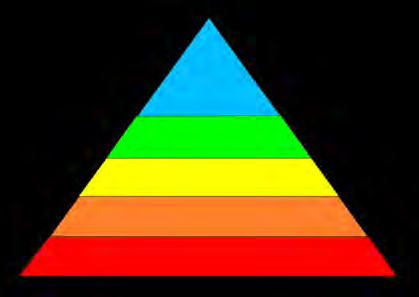 maslow visual
 -
identity self
-
What are identities in relation to self-concept?
Identities are individual components of our self-concept related to the group(s) to which we belong.
identity social -
How is self-esteem related to the actual, ideal, and ought selves?
Self-esteem increases when the actual self is closer to the ideal self and the ought self.
self esteem -
Define self-efficacy.
Self-efficacy is the degree to which we see ourselves as being capable at a given skill or situation.
self efficacy -
What is learned helplessness?
Learned helplessness is a state of hopelessness that results from being unable to avoid repeated negative stimuli.
learning motivation -
Contrast internal and external locus of control.
- Internal: We control our own success/failure
- External: Outside factors have more control
motivation locus -
Summarize Freud's view on personality development.
Personality develops through psychosexual stages based on tensions from the libido; failure at a stage leads to fixation and personality disorder.
freud development -
erikson development
-
What does Kohlberg's theory focus on?
Kohlberg's theory focuses on stages of moral development based on moral dilemmas.
kohlberg moral -
Define Vygotsky's Zone of Proximal Development.
The Zone of Proximal Development is the set of skills a child has not yet mastered and requires a more knowledgeable other to accomplish.
vygotsky development -
social comparison
-
Give the three levels in Freud's structural model of personality.
- Id: Base urges of survival and reproduction
- Ego: Mediator between id and superego and the conscious mind
- Superego: The idealist and perfectionist
freud personality -
How do the id, ego, and superego operate with respect to consciousness?
All three (id, ego, superego) operate, at least in part, in the unconscious.
freud consciousness -
What does Jung propose about the unconscious?
Jung proposed a collective unconscious that links all humans and that personality is influenced by archetypes.
jung personality -
What motivation source do Adler and Horney emphasize?
Adler and Horney emphasized that the unconscious is motivated by social urges.
adler horney -
State the humanistic view of personality.
The humanistic perspective emphasizes internal feelings of healthy individuals who strive for happiness and self-realization.
humanistic personality -
Name two humanistic concepts mentioned.
- Maslow's hierarchy of needs
- Rogers's unconditional positive regard
humanistic concepts -
What do type theories and trait theories describe?
- Type theories: Describe personality by categories (e.g., Type A/B, Myers-Briggs)
- Trait theories: Describe personality by identifiable traits that carry characteristic behaviors
trait type -
List the Big Five personality traits (OCEAN).
- Openness
- Conscientiousness
- Extraversion
- Agreeableness
- Neuroticism
bigfive traits -
What are cardinal, central, and secondary traits?
- Cardinal traits: Traits around which a person organizes their life
- Central traits: Major characteristics of personality
- Secondary traits: Personal characteristics limited in occurrence
traits personality -
Summarize the social-cognitive (reciprocal determinism) perspective.
People shape their environments according to their personality, and those environments in turn shape their thoughts, feelings, and behaviors (reciprocal determinism).
social cognitive -
What does the behaviorist perspective say about personality development?
Personality develops as a result of operant conditioning, based on reward and punishment.
behaviorist learning -
Use the Freud iceberg diagram to explain levels of consciousness (image on answer).
The iceberg illustrates Conscious, Preconscious, and Unconscious levels, with ego linked to the conscious, superego to the preconscious, and id to the unconscious.
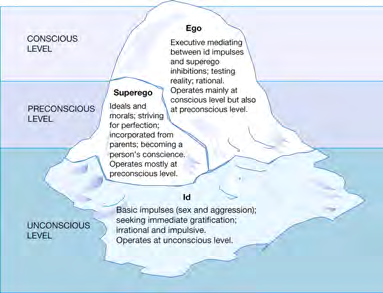 freud image
 -
Use the Id/Ego/Superego illustration to summarize their roles (image on answer).
Id urges immediate needs, ego mediates between urges and reality, and superego enforces moral standards.
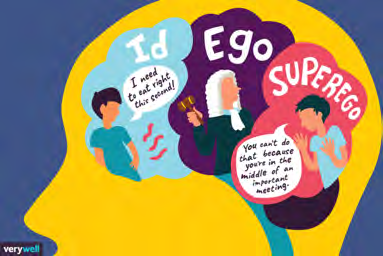 freud image
Behavioral Sciences: Motivation, Emotion, Stress, Identity & Personality
Overview
- Concise review of major theories and concepts about what drives behavior, how emotions arise, stress responses, identity formation, and personality frameworks.
Motivation
- Motivation: The driving force behind actions; can be extrinsic (external rewards) or intrinsic (internal satisfaction).
Major concepts and theories
- Instincts / Instinct Theory: Innate, fixed behavioral patterns triggered by stimuli; evolutionary basis for some behaviors.
- Arousal & Arousal Theory: Arousal = alertness/reactivity; performance follows an optimal arousal level — too high or too low impairs performance.
- Drives & Drive-Reduction Theory: Drives are internal tensions (primary: biological; secondary: learned). Drive-reduction theory proposes behavior aims to reduce these tensions.
- Maslow's Hierarchy of Needs: Needs arranged from basic to advanced: physiological → safety → love/belonging → esteem → self-actualization; higher needs motivate only after lower needs satisfied.
- Self-Determination Theory: Three universal needs: autonomy, competence, relatedness; fulfilling them supports intrinsic motivation.
- Incentive Theory: Behavior driven by anticipated rewards and punishments.
- Expectancy-Value Theory: Motivation = expectation of success × value of that success.
- Opponent-Process Theory (addiction): Repeated drug use produces opposing physiological responses, causing tolerance and withdrawal.
Decision / Bias examples
- House Money Effect: After gains, people take more risks because gains feel like "not theirs".
- Gambler's Fallacy: Belief that past independent events change future probabilities.
- Prisoner’s Dilemma: Individual rational choices can produce worse outcomes than cooperation.
Emotion
- Emotion: Subjective state shaped by circumstances, mood, and relationships; has cognitive, physiological, and behavioral components.
Components
- Cognitive: Subjective appraisal (thoughts about the situation).
- Physiological: Autonomic changes (heart rate, sweating).
- Behavioral: Facial expressions, gestures, actions.
- Seven universal emotions: Happiness, sadness, contempt, surprise, fear, disgust, anger.
Major theories of emotion
- James–Lange: Physiological response precedes and causes emotional experience ("I feel afraid because I tremble").
- Cannon–Bard: Physiological response and subjective emotion occur simultaneously and independently.
- Schachter–Singer (Two-factor): Emotion = physiological arousal + cognitive label (context determines emotion).
Brain systems
- Limbic system: Key structures (amygdala, hippocampus, hypothalamus) mediate emotion, memory, and basic drives.
Stress
- Stress: Physiological and psychological response to demands or threats.
Appraisal
- Primary appraisal: Is the stressor irrelevant, benign-positive, or stressful?
-
Secondary appraisal: Can I cope? What resources are available?
-
Stressors: Events or stimuli that trigger stress; responses can be negative (distress) or positive (eustress).
General Adaptation Syndrome (GAS)
- Three stages: Alarm (fight-or-flight activation), Resistance (adaptation), Exhaustion (resource depletion).
- Involves sympathetic nervous system and endocrine responses; ACTH release raises cortisol.
Identity & Self
- Self-concept: All self-descriptions and beliefs about who we are.
- Identity: Components of self-concept tied to group memberships (e.g., gender, ethnicity, role).
- Self-esteem: How similar the actual self is to the ideal and ought selves; greater similarity → higher self-esteem.
- Self-efficacy: Belief in one’s competence for specific tasks.
- Learned helplessness: Belief that outcomes are uncontrollable after repeated failures or unavoidable stressors.
- Locus of control: Internal (you control outcomes) vs external (outcomes due to outside forces).
Formation of Identity
Psychodynamic and developmental theories
- Freud (psychosexual stages): Childhood stages (oral, anal, phallic, latent, genital); fixations at stages can shape adult personality.
- Erikson (psychosocial stages): Lifespan conflicts (e.g., Trust vs. Mistrust; Identity vs. Role Confusion; Integrity vs. Despair) — successful resolution strengthens identity.
- Kohlberg (moral development): Three levels (Pre-conventional, Conventional, Post-conventional) across six stages; moral reasoning matures with age and perspective.
- Vygotsky: Zone of Proximal Development — learning occurs with guidance from a more knowledgeable other.
- Social learning: Children learn via imitation, role-taking, and observing reference groups.
Personality Theories
Major perspectives
- Psychoanalytic: Personality shaped by unconscious drives (Freud, Jung, Adler, Horney); includes id, ego, superego and defense mechanisms.
- Humanistic: Emphasizes personal growth, self-actualization, and subjective experience (Maslow, Rogers).
- Trait & Type theories: Describe stable characteristics (traits) or categories (types).
- Type examples: Type A/B, Myers–Briggs, somatotypes.
- Trait models: PEN (Psychoticism, Extraversion, Neuroticism); Big Five (OCEAN): Openness, Conscientiousness, Extraversion, Agreeableness, Neuroticism.
- Trait hierarchy: Cardinal (dominant), central (major), secondary (situational) traits.
- Social-cognitive: Reciprocal determinism — behavior, personal factors, and environment interact to shape personality.
- Behaviorist: Personality is learned through reinforcement and punishment (operant conditioning).
- Biological: Genetics, brain structures, and neurochemistry influence personality traits.
Quick notes on Freud’s structure
- Id: Primitive drives, seeks immediate gratification.
- Ego: Reality-oriented mediator using defense mechanisms.
- Superego: Moral conscience and ideals.
Useful Mnemonics & Quick Recall
- OCEAN = Openness, Conscientiousness, Extraversion, Agreeableness, Neuroticism.
- Maslow pyramid: Physiological → Safety → Love/Belonging → Esteem → Self-actualization.
- GAS stages: Alarm → Resistance → Exhaustion.
- Emotion theories: James–Lange (physio → emotion), Cannon–Bard (simultaneous), Schachter–Singer (physio + label).
Study Tips
- Focus on differences between similar theories (e.g., James–Lange vs Cannon–Bard vs Schachter–Singer).
- Use examples to anchor abstract stages (Erikson crises, Kohlberg dilemmas).
- Practice applying models to scenarios (stress appraisal, motivation sources, personality explanations).