Sign up to unlock more features
- Save this deck to your account
- Study flashcards with spaced repetition
- Export to Anki (.apkg) or PDF
- Process documents up to 100 pages
- Images extracted from PDFs and documents
- Better text extraction from your PDFs and documents
- Better flashcards with our more advanced AI model
What are the main parts of the cestode body plan?
What is the function of the tegument in cestodes?
What are microtriches in cestodes used for?
What notable feature describes cestode reproductive anatomy mentioned in the notes?
Name two major groups of cestodes mentioned.
List the larval types of cestodes noted.
Give three key features of Diphyllobothrium latum from the summary.
What is the general body form of organisms in Cestoda (tapeworms)?
Which two major divisions belong to parasitic flatworms?
What is 'protandry' in cestodes?
Which flatworms are exceptions to hermaphroditism?
Name the two orders of cestodes described and one distinguishing scolex feature for each.
How do cestodes obtain nutrition given they lack an alimentary tract?
What are microtriches on cestodes?
List the main parts of a cestode body plan mentioned.
What strobila segment arrangements are described for cestodes?
Define 'apolytic' and 'anapolytic' in relation to proglottids.
Where can the genital pore be located on a proglottid?
Where do the vas deferens and vagina open when they share a common genital pore?
What are the main organs for attachment on a cestode scolex?
How does a proglottid develop and function in cestodes?
Describe the arrangement of genital pores in proglottids.
What are main features of the mature uterus in cestodes?
List the structures found in a gravid segment of a cestode.
What is the function of vitellaria in cestodes?
What is the cirrus in cestodes and where is it found?
What type of excretory cell system do cestodes have?
Define heteroxenous and homoxenous life cycles for cestodes.
Where do cestodes typically inhabit in the host and what is their metabolism?
Describe cestode reproduction modes and typical lifespan detail given.
Name the two larval types classified as 'solid' in cestodes and a key feature of each.
What are the vesicular (bladder) larval forms and key characteristics?
Use the diagram to recall female reproductive organs visible in a cestode cross-section.
What are key external features of a scolex described in the notes?
Where is the genital pore located on a pseudophyllidean proglottid?
Where are uterine pores located in the described proglottids?
Give three morphological facts about adult Diphyllobothrium yonagoensis from the notes.
How is the uterus described in the midterm notes for pseudophyllideans?
What are the characteristics of ova listed for pseudophyllideans?
What is the oncosphere (onco larva) stage called and its feature?
List the main differences between Pseudophyllidean and Cyclophyllidean eggs/larvae as given.
What is the diagnostic and infective stage of Diphyllobothrium latum?
How is Diphyllobothrium latum transmitted to humans?
What clinical effect related to vitamins is associated with Diphyllobothrium latum?
Provide key facts about Diphyllobothrium latum size, longevity, and common name.
What are the described features of Diphyllobothrium latum proglottids and uterus?
List the ovum characteristics for Diphyllobothrium latum given in the notes.
Which regions are listed as endemic areas for Diphyllobothrium latum?
Show an illustrative image of Diphyllobothrium latum scolex and gravid proglottid.
Flashcards in this deck (49)
-
cestode morphology
-
cestode tegument
-
cestode microtriches
-
What notable feature describes cestode reproductive anatomy mentioned in the notes?
Answer- Protandry
cestode reproduction -
cestode classification
-
cestode larvae
-
Give three key features of Diphyllobothrium latum from the summary.
Answer- Fish-borne
- Causes anemia
- Produces operculated eggs
diphyllobothrium epidemiology -
What is the general body form of organisms in Cestoda (tapeworms)?
Answer- Flat or ribbon-like appearance
cestoda morphology -
Which two major divisions belong to parasitic flatworms?
Answer- Trematodes (flukes)
- Cestodes (tapeworms)
classification parasite -
What is 'protandry' in cestodes?
Answer- A microorganism begins life as a male and changes into a female
reproduction cestoda -
reproduction trematoda
-
Name the two orders of cestodes described and one distinguishing scolex feature for each.
Answer- Order Pseudophyllidean: scolex with 2 opposing sucking organs
- Order Cyclophyllidean: scolex with 4 suckers
cestoda orders -
How do cestodes obtain nutrition given they lack an alimentary tract?
Answer- Food is absorbed through the tegument (integument) system
physiology tegument -
What are microtriches on cestodes?
Answer- Highly specialized microvilli covering the tegument, fine hair-like filaments over the body
tegument microtriches -
List the main parts of a cestode body plan mentioned.
Answer- Scolex: organ of attachment
- Neck: region of growth and chain of developing proglottids
anatomy cestoda -
What strobila segment arrangements are described for cestodes?
Answer- Craspedote: anterior proglottids overlap next exterior one
- Acraspedote: proglottids do not overlap
strobila morphology -
Define 'apolytic' and 'anapolytic' in relation to proglottids.
Answer- Apolytic: premature detachment or release of terminal gravid proglottids
- Anapolytic: gravid proglottids are not shed; eggs released another way
reproduction strobila -
Where can the genital pore be located on a proglottid?
Answer- Same side of proglottid
- Bilateral
- Ventral surface with uterine pore
- Irregular alternate
reproduction anatomy -
Where do the vas deferens and vagina open when they share a common genital pore?
Answer- Open on the ventral surface
- Or open on the lateral margin
reproduction genital -
What are the main organs for attachment on a cestode scolex?
Answer- Bothria: two elongated grooves
- Sucking disks: cup-like
- Rostellum: chitinous hooks
morphology scolex -
How does a proglottid develop and function in cestodes?
Answer- Progressively matures and functions individually
- Originates from the posterior neck region
- Contains completely formed sexual organs
proglottid reproduction -
Describe the arrangement of genital pores in proglottids.
Answer- Common genital pores: on the same side of each proglottid
- Irregularly alternate
- Bilateral
proglottid genital -
What are main features of the mature uterus in cestodes?
Answer- Coiled
- Saccular or lobulated
- Tube: straight or branched
female uterus -
List the structures found in a gravid segment of a cestode.
Answer- Reticulate with ova in capsules
- Lateral branches
- Vagina
- Seminal receptacle
- Ovary
- Oviduct joined to spermatic duct
- Ootype: egg formation
- Vitellaria: nourishment of the eggs
gravid reproduction -
vitellaria female
-
What is the cirrus in cestodes and where is it found?
Answer- Cirrus: muscular male copulatory organ that opens to the vagina
- Found in Hymenolepis spp and Taenia spp
male cirrus -
excretory physiology
-
Define heteroxenous and homoxenous life cycles for cestodes.
Answer- Heteroxenous: one or more intermediate hosts
- Homoxenous: one intermediate host
life-cycle hosts -
Where do cestodes typically inhabit in the host and what is their metabolism?
Answer- Habitat: intestinal lumen (ileum, jejunum, colon)
- Metabolism: anaerobic; absorption by tegument; causes Vitamin B decrease/starvation
habitat metabolism -
Describe cestode reproduction modes and typical lifespan detail given.
Answer- Hermaphroditism: self and cross fertilization
- Asexual: in intermediate host
- Life span: generally short-lived; Taenia may last 20–25 years
reproduction lifespan -
Name the two larval types classified as 'solid' in cestodes and a key feature of each.
Answer- Procercoid: no scolex; with oncospiral hooks
- Plerocercoid: elongated, infective stage with developing scolex & strobila
larva solid -
What are the vesicular (bladder) larval forms and key characteristics?
Answer- Cysticercus: true bladder with enlarged central cavity
- Cysticercoid: slightly developed bladder with scolex at apex
- Variations: coenurus (multiple scolices), echinococcus/hydatid (daughter cysts, brood capsules)
larva vesicular -
Use the diagram to recall female reproductive organs visible in a cestode cross-section.
Answer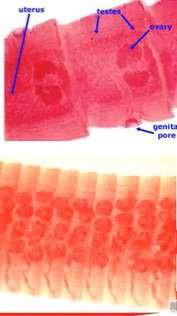 - Visible structures: uterus, testes, ovary, genital porediagram female
 -
What are key external features of a scolex described in the notes?
Answer- 2 suctorial grooves
- 4 muscular suckers (may have spines or hooks)
morphology scolex -
Where is the genital pore located on a pseudophyllidean proglottid?
Answer- Center of the proglottid (center of segment)
reproduction proglottid -
Where are uterine pores located in the described proglottids?
Answer- At the margins of the proglottid; may be absent
reproduction uterus -
Give three morphological facts about adult Diphyllobothrium yonagoensis from the notes.
Answer- Ivory white
- Length: 3–10 meters
- About 4000 proglottids
diphyllobothrium morphology -
How is the uterus described in the midterm notes for pseudophyllideans?
Answer- Coiled; sac-like branched; may contain eggs in capsule
uterus morphology -
What are the characteristics of ova listed for pseudophyllideans?
Answer- Operculated
- Immature (if found in feces)
ova pseudophyllidean -
larva coracidium
-
List the main differences between Pseudophyllidean and Cyclophyllidean eggs/larvae as given.
Answer- Pseudophyllidean: operculated; immature when laid; coracidium; ciliated
- Cyclophyllidean: non-operculated; mature when laid; hexacanth embryo; non-ciliated with 3 pairs of hooks
comparison life-cycle -
What is the diagnostic and infective stage of Diphyllobothrium latum?
Answer- Diagnostic stage: embryonated egg
- Infective stage: procercoid larva
diphyllobothrium life-cycle -
How is Diphyllobothrium latum transmitted to humans?
Answer- By ingestion of raw or undercooked freshwater fish
transmission diphyllobothrium -
What clinical effect related to vitamins is associated with Diphyllobothrium latum?
Answer- Causes anemia by interfering with intrinsic factor and vitamin B12 absorption
clinical anemia -
Provide key facts about Diphyllobothrium latum size, longevity, and common name.
Answer- Largest human tapeworm: up to 10 meters
- Can live up to 25 years
- Common name: Fish tapeworm (Broad tapeworm)
diphyllobothrium epidemiology -
What are the described features of Diphyllobothrium latum proglottids and uterus?
Answer- Proglottids broader (2–4 mm long × 10–12 mm wide)
- Male and female organs present; uterus coiled (rosette)
proglottid morphology -
List the ovum characteristics for Diphyllobothrium latum given in the notes.
Answer- Size: 30–50 μm
- Posterior part thickened; yellowish to yellow-brown
- May be immature if found in feces; ~100,000 eggs/day
ova diagnosis -
Which regions are listed as endemic areas for Diphyllobothrium latum?
Answer- Great Lakes, Scandinavia, Western Europe, Japan, South America
epidemiology diphyllobothrium -
Show an illustrative image of Diphyllobothrium latum scolex and gravid proglottid.
Answer- Image:
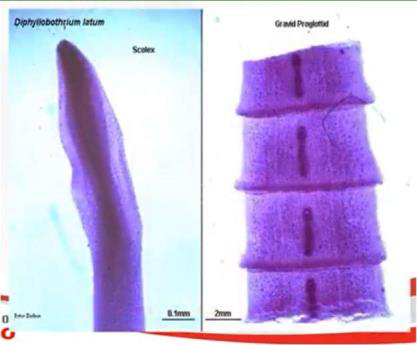
- Caption: Scolex and gravid proglottid (illustration only)
image diphyllobothrium - Image:
Clinical Parasitology — Cestodes (Tapeworms) — Study Notes
Quick facts
- Platyhelminths = flatworms; most are hermaphroditic (both sexes in one individual); exception: schistosomes (dioecious).
- Two main groups: Trematodes (flukes) and Cestodes (tapeworms).
Cestode (Tapeworm) overview
- Body: long, flattened strobila made of segments (proglottids).
- No digestive tract; nutrients are absorbed through the tegument.
- Surface specialized by microtriches (fine microvilli) to increase absorption.
- Reproductive strategy: protandry (segments mature male first, then female) and usually hermaphroditic; some species self- or cross-fertilize.
Main body regions
- Scolex: attachment organ (varies by species: bothria, suckers, rostellum with hooks).
- Neck: proliferative zone producing new proglottids.
- Proglottids: individual segments containing complete sexual organs; mature sequentially from neck outward.
Proglottid types and strobila features
- Craspedote: anterior proglottids overlap next exterior one.
- Acraspedote: proglottids do not overlap.
- Apolytic: terminal gravid proglottids detach to release eggs.
- Anapolytic: gravid proglottids remain; eggs released by other means.
Tegument and excretory systems
- Tegument: syncytial covering; site of nutrient uptake and immune interaction.
- Flame cells / protonephridia: excretory/osmoregulatory units.
Reproductive anatomy (key structures)
Female structures (ventral side of proglottid)
- Uterus: may be coiled, sac-like, lobulated or branched (forms a rosette in some species).
- Ootype: site of egg formation.
- Vitellaria: yolk glands that supply nutrients to eggs.
- Seminal receptacle, ovary, oviduct: typical components in mature proglottid.
Male structures (dorsal part of proglottid)
- Testes and small ducts (vasa efferentia) lead to vas deferens.
- Cirrus: muscular copulatory organ (present in genera such as Hymenolepis and Taenia).
Genital pore positions
- Can be unilateral (same side), bilateral, ventral central, or alternating irregularly.
- Vas deferens and vagina can share a common genital pore that opens on the ventral or lateral margin.
Life cycles & hosts
- Heteroxenous: requires one or more intermediate hosts.
- Homoxenous: requires only definitive host (rare among cestodes).
- Typical cycle: egg → larva (in intermediate host) → adult (definitive host).
- Larval forms vary by species (see next section).
Larval types / metacestodes
- Solid (no big bladder): e.g., procercoid (no scolex initially, often in copepods), plerocercoid (elongated, infective, developing scolex).
- Vesicular (bladder): e.g., cysticercus (single scolex within bladder), cysticercoid (small bladder with apex scolex), coenurus (many scolices), hydatid cyst (Echinococcus with daughter cysts).
Key differences: Pseudophyllidean vs Cyclophyllidean
- Pseudophyllidean
- Eggs operculated, often passed as immature in feces.
- Coracidium (ciliated) hatches; typically aquatic life cycle with copepod first intermediate host.
- Scolex with bothria (two longitudinal grooves).
- Cyclophyllidean
- Eggs non-operculated, mature when shed; embryo = hexacanth (six hooks), non-ciliated.
- Scolex usually with four suckers ± rostellum/hooks; vitellaria condensed near ovary.
| Feature | Pseudophyllidean | Cyclophyllidean |
|---|---|---|
| Egg shell | Operculated | Non-operculated |
| Embryo | Coracidium (ciliated) | Hexacanth (6 hooks, non-ciliated) |
| Scolex | Bothria (grooves) | 4 suckers ± hooks |
Physiology (clinical relevance)
- Habitat: adult cestodes inhabit the intestinal lumen (ileum, jejunum, colon).
- Metabolism: anaerobic; absorb nutrients across tegument; can cause vitamin deficiencies (notably vitamin B12).
- Reproduction: high egg output; some species live many years (e.g., Taenia up to \(20\text{–}25\) years).
- Pathogenicity: usually mild intestinal irritation; more serious disease from larval/cystic forms (tissue invasion), and nutrient/vitamin depletion.
Laboratory diagnosis (general)
- Stool microscopy: detection of eggs (operculated vs non-operculated), proglottids, or segments.
- Identification based on egg morphology, proglottid shape, and scolex features when available.
Diphyllobothrium latum — "Fish (broad) tapeworm" (Pseudophyllidean)
- Epidemiology: associated with ingestion of raw/undercooked freshwater fish; regions: Great Lakes, Scandinavia, W. Europe, Japan, South America.
- Size & longevity: can reach large size; humans may harbor worms up to about \(10\ \text{m}\) and survive \(\sim25\) years.
- Clinical: often asymptomatic in light infections; may cause megaloblastic (Diphyllobothrium) anemia by interfering with intrinsic factor and vitamin B\(_{12}\) absorption.
- Diagnostic stage: embryonated egg in feces.
- Infective stage: procercoid (in copepod) → plerocercoid (in fish) → adult in human.
- Proglottid: broader than long (typical proglottid size ~\(2\text{–}4\ \text{mm}\) long by \(10\text{–}12\ \text{mm}\) wide), hermaphroditic with coiled (rosette) uterus.
- Egg: \(30\text{–}50\ \mu\text{m}\), yellow-brown, operculated; heavy egg production (~\(100{,}000\) eggs/day).
Clinical & public health points to remember
- Prevent infection by cooking fish thoroughly or proper freezing where indicated.
- Consider D. latum in patients with unexplained vitamin B\(_{12}\) deficiency and history of eating raw freshwater fish.
- Identify eggs/proglottids in stool for diagnosis; imaging/serology needed for larval (tissue) forms.
High-yield summary
- Cestodes: segmented, tegumental absorption, complex life cycles.
- Distinguish Pseudophyllidean vs Cyclophyllidean by egg type, embryonic form, and scolex.
- Larval (metacestode) forms determine tissue disease; adult worms mainly cause nutrient loss and mechanical irritation.