Save your deck before it's gone
These flashcards aren't stored yet — they'll disappear when you leave. Create a free account to keep them, and unlock everything below.
- Save this deck to your account
- Study with spaced repetition
- Export to Anki (.apkg) or PDF
- Process documents up to 100 pages
- Images extracted from your PDFs
- Sharper text extraction & a more advanced AI model
Flashcards in this deck (14)
-
What is the correct use of the term 'fish' versus 'fishes'?
Fish = singular or plural for multiple individuals of the same species; Fishes = plural for individuals from different species
Fish = only singular; Fishes = only plural for same species
Fish and Fishes are interchangeable with no difference
Fish = plural for different species; Fishes = singular
terminology fish -
What does the phrase 'Form to Function' mean in morphology?
When form and function are always unrelated
When form is only for display and never for use
When function determines genetics of an organism
When a morphological structure (form) has a use (function)
morphology concepts -
What is the primary role of gill filaments/lamellae in fish?
Used for breathing (gas exchange); lamellae increase surface area to maximize gas exchange
Used to give structural support to the gill arch only
Used primarily for filtering food particles
Used to detect light and color changes in water
respiration gills -
What is the function of gill rakers?
Main site of gas exchange in the gill
Structures that connect the two gill arches
Sensory organs for detecting water temperature
Bony or cartilaginous processes that aid in suspension feeding tiny prey and protect gills from debris
feeding gills -
What is countercurrent exchange in fish gills?
Process of moving blood in the same direction as water flow for mixing
Mechanism fishes use to efficiently absorb oxygen through their gills
Method of heat exchange between body and water
A way to filter large prey items from water
respiration physiology -
What defines an anadromous fish?
Lives most adult life in freshwater and returns to sea to spawn
Lives entirely in saltwater with no spawning migrations
Lives entirely in freshwater with no migrations
Lives most adult life at sea but returns to freshwater to spawn
lifehistory migration -
What defines a catadromous fish?
Lives most adult life at sea and returns to freshwater to spawn
Lives most adult life in freshwater but returns to saltwater to spawn
Lives entirely in freshwater and spawns there without migration
Migrates vertically in the water column but not between fresh and salt water
lifehistory migration -
What is sequential hermaphroditism in animals?
Reproduction that alternates between sexual and asexual phases
A mating system where sexes are fixed for life
A reproductive strategy where individuals function first as one sex and later switch to the other
Simultaneous possession of both male and female reproductive organs
reproduction lifehistory -
What does protogynous hermaphroditism mean?
An individual has both sexes at the same time
An individual changes from female to male
An individual reproduces asexually then sexually
An individual changes from male to female
reproduction terminology -
What does protandrous hermaphroditism mean?
An individual reproduces only once and dies
An individual is simultaneously male and female
An individual changes from male to female
An individual changes from female to male
reproduction terminology -
Which group are cartilaginous fishes classified as?
Osteichthyes
Chondrichthyes
Actinopterygii
Sarcopterygii
classification fish -
Which term refers to bony fishes that include Sarcopterygii and Actinopterygii?
Cephalaspidomorphi
Chondrichthyes
Osteichthyes
Agnatha
classification fish -
Which statement about Sarcopterygii is correct?
They are exclusively freshwater invertebrates
They are lobe-finned fishes that include lungfishes and coelacanths and gave rise to tetrapods
They are cartilaginous fishes including sharks and rays
They are ray-finned fishes representing most modern fishes
classification evolution -
Which of the following is listed as a homocercal tail shape?
Diphycercal
Heterocercal
Lunate
Hagfish
morphology tails
Overview
- Concise summary of key concepts about fishes: terminology, form-function relationships, gill anatomy and gas exchange, life-history strategies, reproduction, classification, and fin/tail shapes.
Terminology
- Fish: singular or plural when referring to multiple individuals of the same species.
- Fishes: plural when referring to individuals of different species.
Form to Function (Morphology)
- Form to Function: morphological structures often reflect their ecological function (e.g., fin shape relates to swimming style).
- Focus on how external shape and internal structures enable feeding, respiration, locomotion, and reproduction.
Gill Anatomy & Feeding Structures
- Gill arch: series of bony or cartilaginous supports for gills.
- Gill filaments / lamellae: thin, fleshy plates on filaments where gas exchange occurs; lamellae increase surface area to maximize oxygen uptake.
- Gill rakers: projections from branchial arches used for suspension feeding and protecting gill filaments from debris; distinct from filaments (not used for gas exchange).
Gas Exchange: Countercurrent Exchange
- Countercurrent exchange: water flows over gill lamellae opposite to blood flow, maintaining a favorable oxygen gradient along the entire lamella and maximizing O2 uptake.
- This mechanism enables efficient extraction of oxygen even from low-O2 water.
Life-History Migration Types
- Anadromous: adults live mostly in saltwater but migrate into freshwater to spawn (example: many salmon species).
- Catadromous: adults live mostly in freshwater but migrate to saltwater to spawn (example: eels).
Reproduction: Sequential Hermaphroditism
- Sequential hermaphroditism: individuals change sex during their life.
- Protogyny: start as female, later become male.
- Protandry: start as male, later become female.
- Widespread strategy tied to social structure, mating systems, and maximizing reproductive success.
Major Taxonomic Groups
- Chondrichthyes: cartilaginous fishes (sharks, rays, skates, chimaeras).
- Osteichthyes: bony fishes; extremely diverse and split into two major clades:
- Sarcopterygii: lobe-finned fishes (lungfishes, coelacanths); ancestral to tetrapods.
- Actinopterygii: ray-finned fishes (the majority of modern fish diversity).
Fin and Tail Shapes (Function and Examples)
- Tail (homocercal) shapes affect swimming performance and ecology:
- Rounded: high maneuverability, slow sustained speed.
- Truncate: intermediate maneuverability and speed.
- Emarginate: slightly forked, balanced performance.
- Forked: good continuous swimming, moderate speed.
- Lunate: crescent-shaped, very efficient for sustained high-speed swimming (e.g., fast pelagic predators).
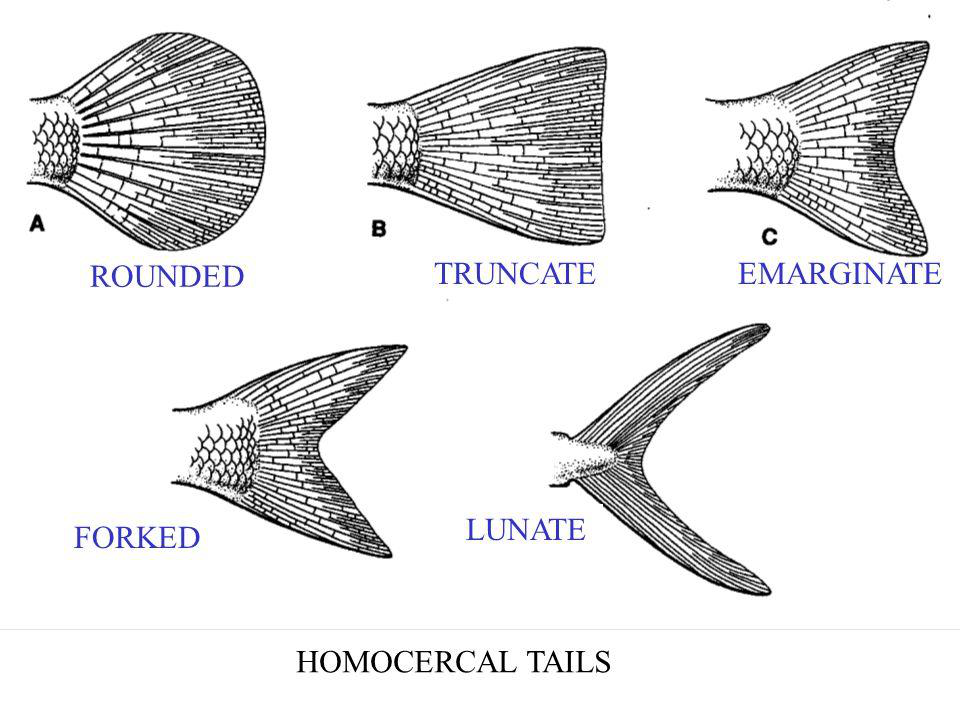
Alt text: Diagram of five homocercal tail shapes.
Study Tips & Key Points to Remember
- Distinguish gill filaments (gas exchange) from gill rakers (feeding/protection).
- Understand countercurrent exchange as the main physiological principle for gill respiration.
- Remember lifecycle labels: anadromous (sea to fresh to spawn) vs catadromous (fresh to sea to spawn).
- Know major clades and that Sarcopterygii gave rise to tetrapods.
- Relate fin/tail shape to ecological role (maneuverability vs sustained speed).
Quick Definitions (Flashcard-style)
- Gill arch: structural support for gills.
- Lamellae: sites of gas exchange on filaments.
- Gill raker: feeding/protective projection on branchial arch.
- Protandry / Protogyny: sex change directions.
- Anadromous / Catadromous: migration directions for spawning.